Pattern
Chevron Flooring
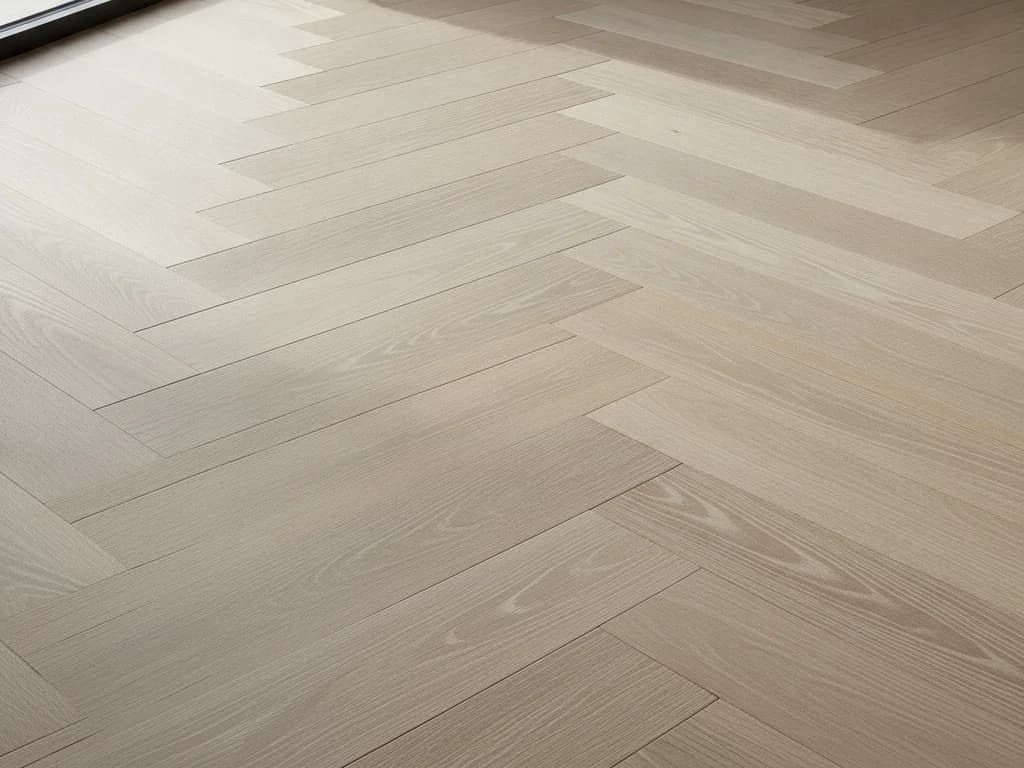
Boards cut at an angle and joined point-to-point into continuous zigzag lines — a crisp, tailored, distinctly European pattern for statement spaces.
Character
Why Chevron
Look
Planks meet at mitered angles to form unbroken V-shaped rows — sharper and more formal than herringbone, with a strong sense of direction.
Material
Most often European or French white oak, cut and finished specifically for the pattern; wire-brushed and custom-stained options are popular.
Craft
Chevron is precision work — the angled cuts and layout leave no room for error, so it's as much about installation skill as the wood.
Chevron at a Glance
- Type
- Pattern
What It Needs
Installing Chevron
The requirements that apply specifically to this product — with the standard each one comes from.
Chevron is cut, not just arranged
The visual difference from herringbone is that chevron pieces meet in a continuous point rather than a staggered right angle, and achieving it requires the board ends to be mitred to an angle rather than cut square. That is a milling difference before it is a layout difference, which is why chevron material is ordered as chevron rather than laid from standard planks, and why substituting one pattern for the other late in a project is a material decision rather than an installation one.
Product definition
The point is where tolerance shows
Because every chevron joint converges to a single line running the length of the floor, any accumulated error is displayed along the most visible axis in the room. Subfloor flatness matters for the same reason it does in herringbone — NWFA calls for 1/8 inch in 6 feet or 3/16 inch in 10 feet where glue-down or floating installation is used — and the set-out line is established before the first piece is fixed.
NWFA Installation Guidelines
Same wood, same movement
The pattern changes how a floor reads, not how the wood behaves. Each piece moves across its own width according to its species and cut: for American white oak, the Forest Products Laboratory publishes a tangential coefficient of 0.00376 against a radial coefficient of 0.00194, so a rift or quartersawn chevron moves about half as much seasonally as a plainsawn one.
USDA FPL Wood Handbook, Table 13-5
These are what the standards require, not a guarantee of outcome. The flooring manufacturer's written instructions govern wherever they are stricter.
Best For
Entryways, formal living and dining rooms, and luxury spaces wanting a bold, tailored, European statement.
How We Install It
Chevron demands exact layout and mitered cuts over a flat, prepped, moisture-tested subfloor — typically engineered oak, glue-down. Precision installation is everything.
Explore related
See it in a mountain home, explore Lake Tahoe flooring, or view all wood species.
Sources
- USDA Forest Products Laboratory - Wood Handbook (FPL-GTR-282), Ch. 13 — Dimensional change coefficients (Table 13-5) and Equation 13-3, behind the seasonal-movement figures.
- National Wood Flooring Association (NWFA) — Industry authority on wood-flooring species characteristics, grading, and installation.
Species characteristics reflect published industry and government references; individual boards vary by grade, cut, and finish. Figures are general to the species and are not a grading or performance guarantee for a specific product.
Good to Know
Frequently Asked Questions
What's the difference between chevron and herringbone?
In chevron, boards are cut at an angle and meet point-to-point to form continuous zigzag lines. In herringbone, rectangular boards meet at 90° in a staggered, broken pattern. Chevron looks sharper and more formal; herringbone reads a touch more classic and forgiving.
Is chevron flooring hard to install?
It's one of the more demanding patterns — the angled cuts and precise layout leave little margin, so it takes real skill and a dead-flat, prepped subfloor. That craftsmanship is a big part of the cost and the result.
Related
Keep Reading
Related pages: Natural Stone, Sheet Vinyl, Hardwood Flooring, and Engineered Hardwood.

Install Chevron in Your Home
Call (916) 749-0272 — we'll bring chevron samples and give you an honest estimate.