Service Area
Flooring in Elk Grove
Renaissance Floors installs and refinishes hardwood, luxury vinyl, tile, and more for homeowners throughout Elk Grove and the surrounding Sacramento County area.
CSLB #1060673
Licensed & Insured
Est. 2019
Family-Owned
15+ Years
Hands-On Experience
5.0★ Rated
22 Reviews on Thumbtack
Local, Licensed, Accountable
Flooring Contractor Serving Elk Grove
Elk Grove is part of Sacramento County, and it's one of the communities Renaissance Floors regularly works in. We're based in Roseville, CA and serve homeowners across Greater Sacramento & Northern California— from small refinishing jobs to full home installs. Every project starts with an honest look at your subfloor and your goals, followed by a clear, no-pressure estimate. There's no dispatched sales team and no guesswork: you work directly with the crew doing the installation, backed by our CSLB C-15 license and a workmanship warranty on every job.
Sacramento-area homes see hot, dry summers and mild winters, so solid wood can move seasonally if it isn't acclimated and sealed properly. We prep and acclimate every install for the local climate — and luxury vinyl plank is a popular, worry-free choice for busy valley households.
Elk Grove is a city of the year 2000 in two senses. It incorporated on July 1 of that year, and 2000 is also the median year its homes were built, according to the Census Bureau's 2020–2024 five-year estimates — against 1981 for Sacramento County and 1976 for California. About 77 percent of Elk Grove's housing units went up in 1990 or later, more than double the county's 35 percent, and the 2000s alone account for about 37 percent; only about 4 percent predate 1970. The housing is as uniform in type as in age: about 86 percent of units are detached single-family houses, and owners occupy about 74 percent of occupied homes. For roughly 179,000 residents on 42 square miles of valley floor at about 46 feet above sea level, that makes Elk Grove essentially a one-era housing market.
The town is far older than its houses. City records date Elk Grove to 1850, when a stage stop and hotel, the Elk Grove House, opened on the Upper Stockton Road — now Highway 99 — between Sacramento and Stockton. In 1868 the Central Pacific's Sacramento–Stockton line came through, the town's center shifted to its present location, and in 1876 the business district called 'Elk Grove Station' was surveyed and its first plats sold. That core is today's Old Town, where the Elk Grove Historic District was listed on the National Register of Historic Places on March 1, 1988, with a period of significance from 1876 to 1930 and more than 40 buildings by the City's count. The City says Elk Grove remained quietly independent of Sacramento's growth until the 1980s. In eastern Elk Grove, the triangle between Elk Grove-Florin Road, Sheldon Road and Grant Line Road is what the City calls Rural Elk Grove — 'the area that once typified the entire community.'
Under nearly all of it lies one soil. Area-weighted inside city limits, about 81 percent of Elk Grove's mapped soil area falls in USDA-NRCS survey map units led by the San Joaquin series, California's official State Soil since 1997. Its official series description sets a cemented hardpan — a duripan — 20 to 40 inches down, beneath an abrupt increase in clay, with very slow permeability; survey data rate the silt loam near the surface low for shrink-swell and the thin clay layer above the hardpan high. About 5 percent of the city is mapped in Galt clay, a smectitic clay rated high to very high, whose type location is in Sacramento County about five miles northwest of Galt and whose series description says its cracks 'are open from about mid-June to mid-October.' These are area shares of survey mapping: planning-scale data, not a report on any one lot.
Water divides the city along a line most residents cross without noticing. Sacramento County's 2021 hazard mitigation plan describes Elk Grove's storm drainage as a gravity system east of the Union Pacific tracks and a pumped system west of them for the Laguna West communities, where three pump stations and a perimeter levee protect against backwater from the Cosumnes and Mokelumne rivers. The same plan puts 1,266 acres, about 5 percent of the city, in FEMA's 1% annual chance flood zone, including areas along Laguna Creek. The city joined the National Flood Insurance Program in 2001, and as of March 2020 the plan reports five historical flood-loss claims and no repetitive-loss buildings.
No weather station inside Elk Grove carries NOAA's 1991–2020 normals, so the reference is Sacramento Executive Airport, about 9 miles northwest. Its normals put the July high at 92.6°F with a July rainfall normal of 0.00 inches, and about four-fifths of its roughly 18 inches a year falling from November through March. The National Weather Service's Sacramento record averages July relative humidity at 78 percent at 4 AM and 30 percent at 4 PM, on a 1971–2000 basis, and credits breezes blowing up from San Francisco Bay through the Delta for usually pleasant summer nights. Hourly readings at the same airport, brought to 70°F without added moisture, give a median of about 38 percent relative humidity through the heating season and about 55 percent in summer.
Put together, the flooring picture is specific. Homes built from 1990 to 2009, about 64 percent of the city's housing, are now roughly 17 to 36 years old, so wherever original floors are still down, the next floor is the first replacement, over a slab or subfloor that has not been exposed since construction. The City's permit policy names 'tiling, carpeting … and similar finish work' as exempt; structural repair is not. Renaissance Floors is a licensed California C-15 flooring contractor (CSLB #1060673) based in Roseville. For an Elk Grove home we start with what is under the old floor and what the house sits on, then choose the material. Free in-home estimates, straight answers about scope and permits, and a workmanship warranty.
Local Coverage
Neighborhoods We Serve in Elk Grove
From Old Town Elk Grove to Rural Elk Grove, Renaissance Floors installs and refinishes floors across Elk Grove.
Recent Work
A Sample of Our Craftsmanship
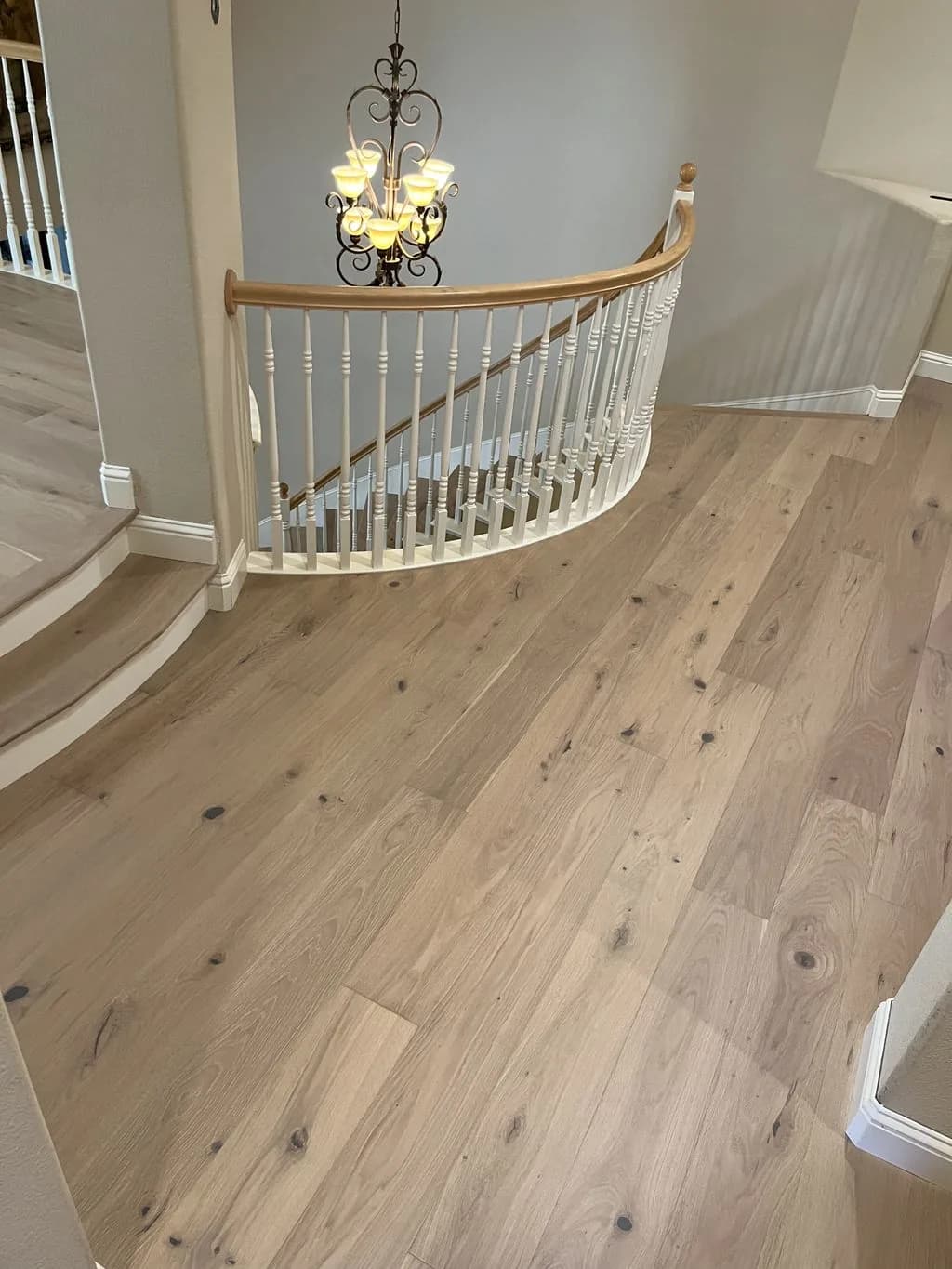
White Oak Hardwood
Great Room & Landing
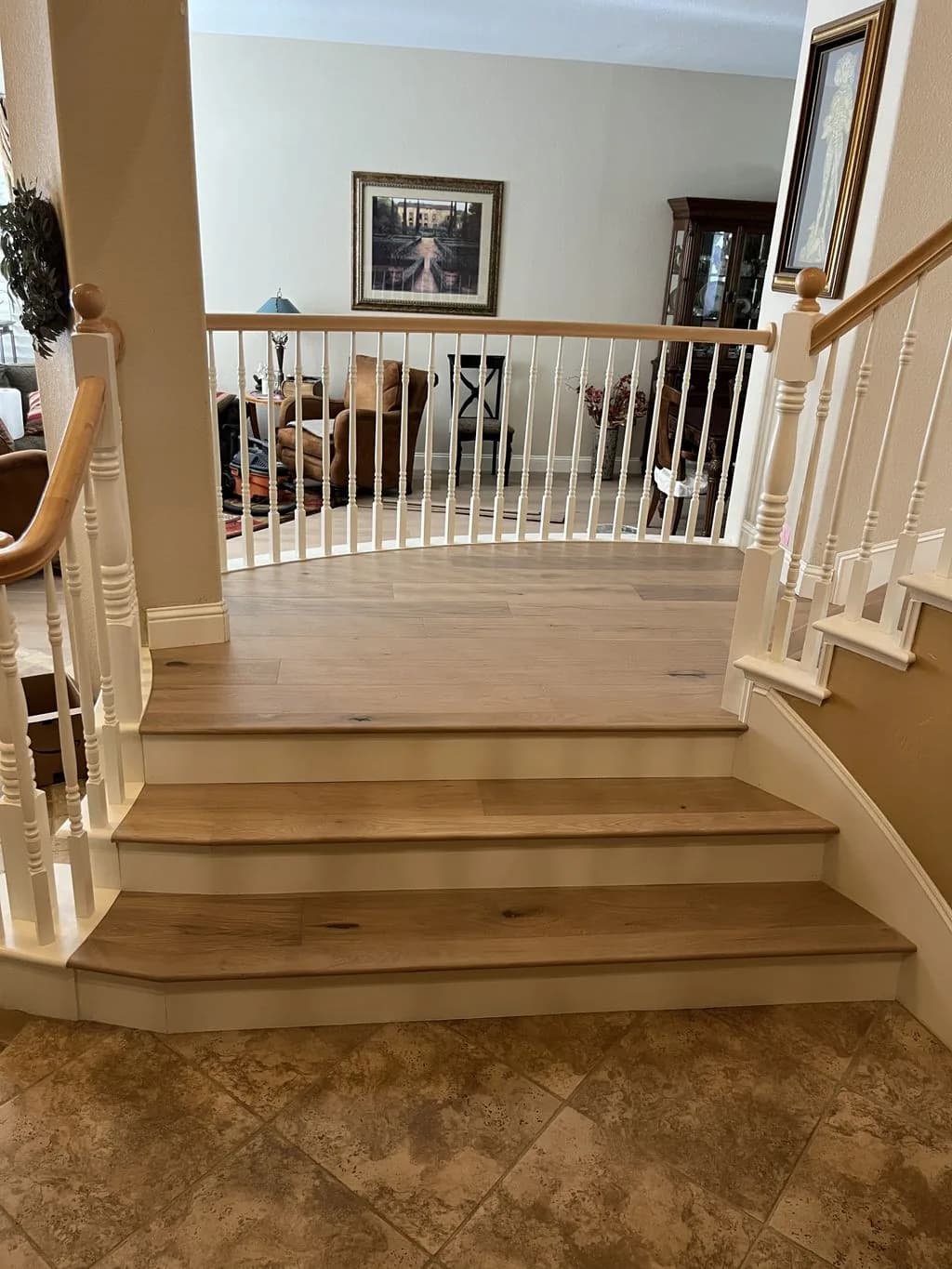
White Oak Hardwood
Staircase & Landing

White Oak Hardwood
Curved Staircase
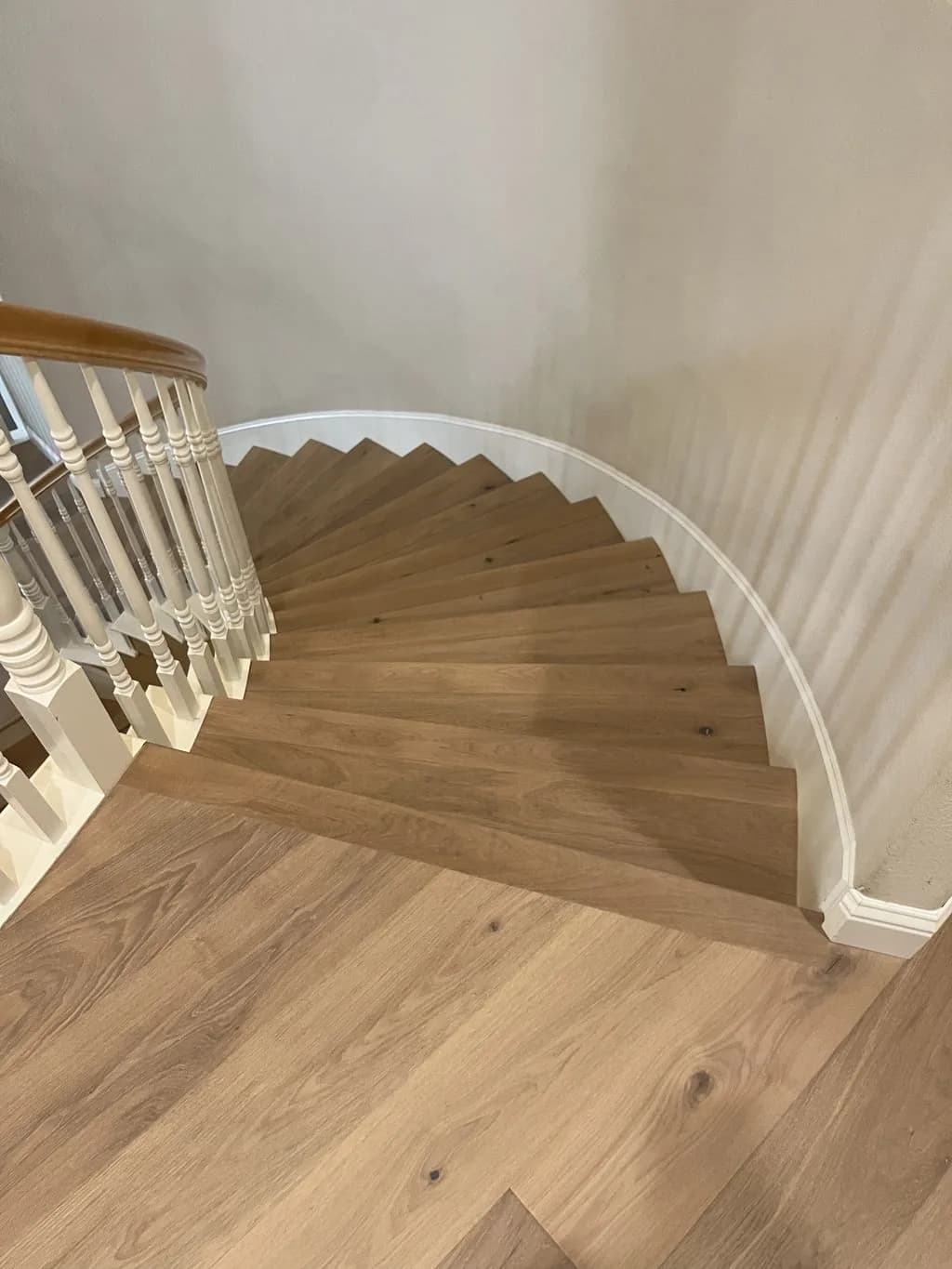
White Oak Hardwood
Stair Treads
Our Services
Flooring Services in Elk Grove
From hardwood to luxury vinyl, here's how we help Elk Grove homeowners upgrade their floors.
Hardwood Flooring
Solid oak, maple, and walkable heirloom-grade hardwood, precisely installed.
Hardwood Flooring in Elk GroveEngineered Hardwood
Real-wood wear layers built for California's climate swings.
Engineered Hardwood in Elk GroveLuxury Vinyl Plank
Waterproof, wood-look LVP for kitchens, baths, and busy households.
Luxury Vinyl Plank in Elk GroveLaminate Flooring
Durable, high-style laminate at a friendly price point.
Laminate Flooring in Elk GroveTile Flooring
Porcelain and ceramic tile set dead-level with crisp grout lines.
Tile Flooring in Elk GroveFloor Installation
Full-service installation from subfloor prep to final baseboard.
Floor Installation in Elk GroveFloor Refinishing
Sand, stain, and reseal tired hardwood back to new.
Floor Refinishing in Elk GroveFloor Repair
Board swaps, water damage, squeaks, and seamless patch-ins.
Floor Repair in Elk GroveLocal Considerations
What Elk Grove Homes Need From a Floor
Climate, home age, and foundation type all shape the right flooring choice in Elk Grove — here's what we account for.
Tile and carpet are named exempt work; structural repair is not
The City of Elk Grove's permit policy, Policy and Procedure No. B-20-35, reproduces the California Building Code's list of work exempt from permits, and item 7 reads: 'Painting, papering, tiling, carpeting, cabinets, counter tops and similar finish work.' Hardwood, laminate and vinyl plank are not named individually, so whether a particular product counts as 'similar finish work' is a question for the City's Building Division, not something to assume either way. The same page makes two further points: exempt work 'must still follow all applicable building codes and laws,' and a permit is required to construct, alter or repair a building or structure. Replacing a damaged subfloor, joists or a section of slab is structural work, outside the finish-work exemption.
Franklin and Vineyard are not the City
Elk Grove incorporated on July 1, 2000, and the City's Building Division 'issues permits and performs plan checks and inspections for Building, Plumbing, Mechanical and Electrical permits.' Not every nearby place name is inside that boundary. Census geography classifies Franklin and Vineyard as census-designated places, which are unincorporated by definition, so the City is not the permitting authority there. East Franklin is different: it is a planning area inside the city, covered by a Sacramento County specific plan adopted before incorporation and repealed by the City as of April 2019. Before any permit question, it is worth confirming which government covers the address.
One era of houses, reaching the same age together
The Census Bureau's 2020–2024 estimates place about 64 percent of Elk Grove's housing units in the years 1990 to 2009, with the 2000s alone at about 37 percent. Those homes are now roughly 17 to 36 years old, and in a subdivision built in one pass, neighboring houses reach that age at the same time. No public record establishes what flooring the builders installed or what the houses are founded on, and neither is assumed. Removing the old floor shows whether it sits on a slab or a framed subfloor; a slab is tested for in-slab relative humidity (ASTM F2170) and checked for flatness, and a framed floor is checked for fastening and deflection, before new flooring is chosen.
Hardpan under about four-fifths of the city
USDA-NRCS soil survey mapping, area-weighted inside city limits, puts about 81 percent of Elk Grove's mapped soil area in map units led by the San Joaquin series, California's official State Soil. Its official series description places a duripan, or cemented hardpan, 20 to 40 inches down, below a clay increase of 'more than 15 percent absolute,' and describes permeability as very slow. Survey data rate the silt loam near the surface low for shrink-swell and the thin clay layer above the hardpan high. The series' type location is near Lodi, not in Elk Grove. Map units are not lot boundaries, so slow drainage and a high-rated clay layer are reasons to test a slab's moisture and flatness, not conclusions about any one house.
Galt clay: a small share that cracks open every summer
About 5 percent of the city is mapped in Galt clay, a smectitic clay whose official series description places its type location in Sacramento County about five miles northwest of Galt. MLRA 17 survey data rate its layers above the duripan high to very high for shrink-swell, at a linear extensibility of 7.4 to 9.9 percent, and the description says cracks 1 to 4 centimeters wide at 20 inches 'are open from about mid-June to mid-October and remain closed the rest of the year.' USDA-NRCS guidance says that above 3 percent, shrinking and swelling 'can cause damage to buildings, roads, and other structures' and that special design commonly is needed. The map cannot say how a given house was engineered for it; a flatness check across the floor is how that question gets answered in the room.
Two drainage systems and a 5 percent floodplain
Sacramento County's 2021 hazard mitigation plan describes the city's storm drainage as a gravity flow system east of the Union Pacific tracks and a pumped system west of them for the Laguna West communities, with three pump stations and a perimeter levee against backwater from the Cosumnes and Mokelumne rivers. It puts 1,266 acres, about 5 percent of the city, in FEMA's 1% annual chance flood zone, covering 403 parcels, 269 of them improved, and notes that a structure on a mapped parcel may itself sit outside the floodplain. The 1986 and 1997 floods are documented along the Cosumnes River and Deer Creek; the plan says only that such events 'likely affected the City to some degree.' For a ground-floor room, check the address on FEMA's flood map, and in a mapped zone favor a floor that tolerates water.
Hot, dry summers, measured nine miles away
No station inside Elk Grove carries NOAA's 1991–2020 normals. The nearest that does, Sacramento Executive Airport about 9 miles northwest, averages a 92.6°F July high, a July rainfall normal of 0.00 inches and 18.14 inches a year, about four-fifths of it from November through March. The National Weather Service's Sacramento record averages July relative humidity at 78 percent at 4 AM and 30 percent at 4 PM on a 1971–2000 basis, a 48-point difference between the two averages. Hourly observations at the same airport from 2015 to 2025, brought to 70°F without added moisture, give a heating-season median of about 38 percent relative humidity, with nearly a quarter of hours below 30 percent, and a summer median of about 55 percent. Wood is acclimated to the conditioned rooms it will live in, not to a reading taken outdoors.
Local Resources & References
Helpful Elk Grove Resources
Authoritative local and industry references for permits, planning, and flooring standards.
- Do I need a building permit? (Policy and Procedure No. B-20-35) — 'tiling, carpeting … and similar finish work' on the exempt list; the live page blocks automated retrievalCity of Elk Grove
- Building Safety, Inspection and Permits (Wayback Machine snapshot, August 29, 2025) — the Building Division's permit, plan check and inspection roleCity of Elk Grove
- Local Hazard Mitigation Plan Update (September 2021), Annex B: City of Elk Grove — incorporation, drainage east and west of the Union Pacific tracks, flood zone acreage, NFIP recordSacramento County
- Old Town Elk Grove SPA Existing Conditions Analysis (December 2019) — the 1850 stage stop, 1868 railroad, 1876 'Elk Grove Station' plat and 1988 National Register listingCity of Elk Grove
- ACS 2020–2024 5-year — year built, median year built, tenure and units in structure, Elk Grove city (place 0622020)US Census
- 1991–2020 monthly normals, Sacramento Executive Airport (USW00023232) — nearest station to Elk Grove with normals, about 9 miles northwestNOAA NCEI
- Climate of Sacramento, California (rev. 2010) — relative humidity by time of day, 1971–2000 basis; Delta breezesNWS Sacramento
- Official Series Description, San Joaquin series — duripan 20 to 40 inches, very slow permeabilityUSDA Natural Resources Conservation Service
- Official Series Description, Galt series — cracks open from about mid-June to mid-OctoberUSDA Natural Resources Conservation Service
External links are provided for reference. Always confirm current requirements with the issuing agency.
Explore Flooring Services in Elk Grove
Nearby
Nearby Cities We Serve in Greater Sacramento
Good to Know
Frequently Asked Questions
Does Renaissance Floors serve Elk Grove?
Yes. We install and refinish flooring throughout Elk Grove and the surrounding Sacramento County area. Call (916) 749-0272 for a free estimate.
What flooring services do you offer in Elk Grove?
We install hardwood, engineered wood, luxury vinyl plank, laminate, tile, and more in Elk Grove, plus floor refinishing, repair, and full-service installation. See the full list below.
Are you licensed to work in Elk Grove?
Yes. We hold CSLB C-15 license #1060673 (C-15 Flooring & Floor Covering) and carry insurance. We're based in Roseville, CA and serve Elk Grove and all of Greater Sacramento & Northern California.
How do I get a free flooring estimate in Elk Grove?
Call (916) 749-0272 or request an estimate online. We'll schedule a convenient in-home visit in Elk Grove, measure your space, and give you an honest, no-pressure quote.
Do I need a permit to replace flooring in Elk Grove?
Not for tile or carpet as finish work. The City's permit policy, No. B-20-35, lists 'painting, papering, tiling, carpeting, cabinets, counter tops and similar finish work' as exempt from permits. Hardwood, laminate and vinyl plank are not named individually, so confirm those with the City's Building Division. Exempt work must still meet applicable codes, and repairing a subfloor, joists or slab is structural work outside that exemption.
Who issues building permits in Elk Grove?
The City of Elk Grove's Building Division, which issues permits and performs plan checks and inspections for building, plumbing, mechanical and electrical work. The city has governed itself since incorporating on July 1, 2000. Nearby Franklin and Vineyard are unincorporated census-designated places, so the City is not the permitting authority there; for an address in either community, check with Sacramento County.
How old are most Elk Grove homes?
Mostly from the 1990s and 2000s. The Census Bureau's 2020–2024 estimates put Elk Grove's median year built at 2000, compared with 1981 for Sacramento County and 1976 for California. About 77 percent of housing units were built in 1990 or later, about 64 percent between 1990 and 2009, and only about 4 percent before 1970. About 86 percent are detached single-family houses.
What soil are Elk Grove homes built on?
Mostly San Joaquin soils. USDA-NRCS survey mapping puts about 81 percent of the city's mapped soil area in San Joaquin map units: a silt loam over a thin, dense clay layer and a cemented hardpan (duripan) 20 to 40 inches down. About 5 percent is Galt clay, rated high to very high for shrink-swell. These are area shares from survey mapping, so they describe the city at planning scale, not any single lot.
Is my Elk Grove home in a flood zone?
Most of the city is not. Sacramento County's hazard mitigation plan puts 1,266 acres, about 5 percent of Elk Grove, in FEMA's 1% annual chance flood zone, including areas along Laguna Creek. The Laguna West communities west of the Union Pacific tracks drain through pump stations behind a perimeter levee. FEMA's flood map shows whether a specific parcel is mapped, and the plan notes a structure on a mapped parcel may sit outside the floodplain.
Are Elk Grove homes built on concrete slabs?
No public record answers that for the city. No City or County document reviewed for this page states residential foundation type, and the City's production-home permit checklist does not address it. The records do show when the homes were built, mostly 1990 to 2009, and what they sit on, mostly San Joaquin soil over hardpan. Whether a particular floor is on a slab or a framed subfloor is confirmed in the house before products or adhesives are chosen.
How hot and dry do Elk Grove summers get?
Hot, and very dry by afternoon. Sacramento Executive Airport, about 9 miles northwest and the nearest station with NOAA's 1991–2020 normals, averages a 92.6°F July high and a July rainfall normal of 0.00 inches. The National Weather Service's Sacramento record averages July humidity at 78 percent at 4 AM and 30 percent at 4 PM. Airport air brought to 70°F has a summer median near 55 percent, so wood is acclimated to conditioned rooms.
What is historic about Old Town Elk Grove?
It is the railroad-era town center. Elk Grove began in 1850 as a stage stop and hotel, the Elk Grove House, on the Upper Stockton Road, now Highway 99. After the Central Pacific's Sacramento–Stockton line arrived in 1868, the center shifted to its present location, and the 'Elk Grove Station' business district was surveyed in 1876. The Elk Grove Historic District was listed on the National Register on March 1, 1988, with a period of significance of 1876 to 1930.
Related
Keep Reading
Related pages: Greater Sacramento, Engineered Hardwood in Carmichael, Hardwood Flooring in Elk Grove, and Engineered Hardwood in Elk Grove.

Ready for Floors You'll Love?
Free, no-pressure flooring estimates throughout Elk Grove and Sacramento County.