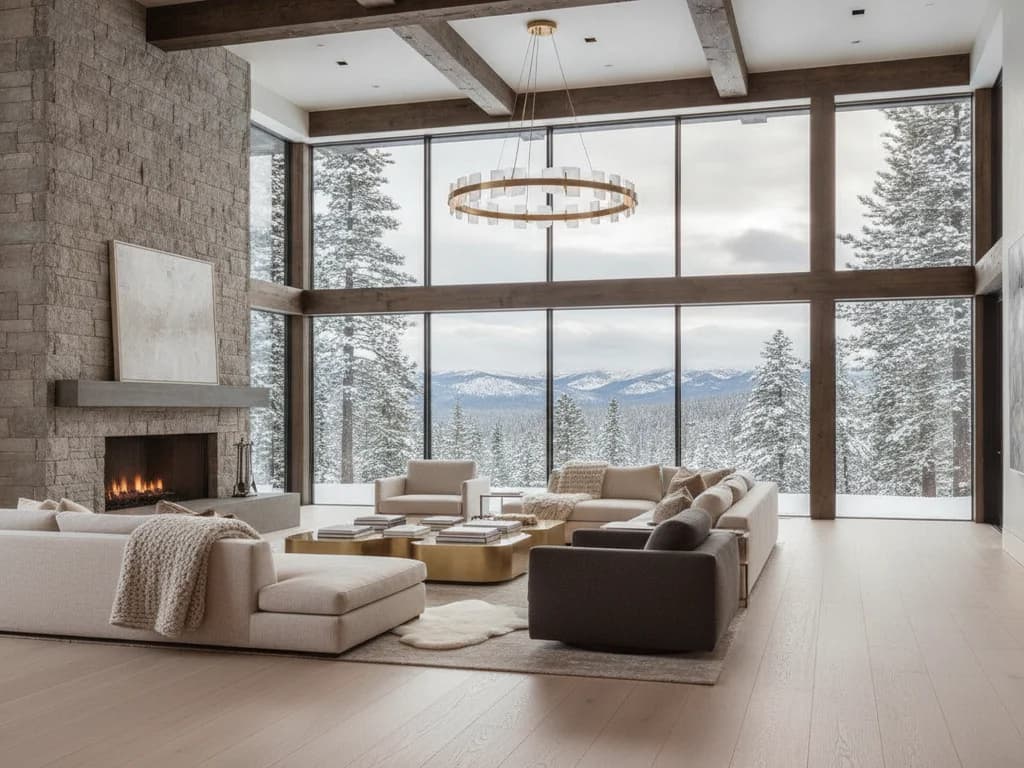
Lake Tahoe & Truckee
Lake Tahoe Luxury & Mountain Flooring
Custom hardwood, wide-plank white oak, and engineered flooring for the homes and cabins of the California Tahoe & Truckee region — built to last at altitude.
The Tahoe Flooring Specialists
Mountain-Home & Luxury Hardwood, Done Right
Lake Tahoe and Truckee homes aren't ordinary houses, and they don't need ordinary floors. From ultra-luxury estates in Martis Camp and Lahontan to ski cabins near Northstar and lakefront homes on the West Shore, these are custom homes in a demanding mountain climate — and flooring is where a beautiful project quietly succeeds or fails.
Renaissance Floors specializes in custom engineered and solid hardwood — wide-plank white oak, French oak, walnut, chevron, and herringbone — installed to perform through altitude humidity swings, freeze/thaw cycles, radiant heat, and Sierra winters. We're a licensed CSLB #1060673 contractor serving the California side of the Tahoe & Truckee region.
The Short Answer
Why a Tahoe Floor Is a Different Specification
Every flooring company says mountain homes are hard on floors. Here is how hard, in numbers anyone can check.
7,697
heating degree-days
Tahoe City's annual heating load in NOAA's 1991–2020 normals — 3.2 times Sacramento Executive's 2,436, with 33 cooling degree-days against the valley's 1,292. A Tahoe house is heated almost continuously and cooled essentially never.
~17%
indoor humidity, Nov–Apr
The median relative humidity that outside air reaches once it is warmed to 70°F indoors without humidification, computed across 95,274 hourly observations at South Lake Tahoe Airport. The NWFA specifies 30–50%.
0.056″
shrinkage per plank
What a 7½-inch plainsawn white oak board loses across its width when it drops two points of moisture content, using the Forest Products Laboratory's published coefficient. Quartersawn, the same board moves about half as much.
50%
of homes are not lived in
TRPA's figure from the 2020 Census: 50% of Tahoe Region housing is occupied by full-time residents, 44% is seasonal, 6% otherwise vacant — and parts of the West Shore reach 70–80%.
The short version: Lake Tahoe is a severe heating climate at roughly 6,225 feet, heating dries indoor air far below the range wood flooring is specified for, and wide planks turn that dryness into visible gaps. Engineered construction, a quartersawn or rift face, and a house that is actually humidified through the winter are the three levers that fix it — and the rest of this page shows the working.
Why Mountain Flooring Is Different
What Tahoe Homes Need From a Floor
Altitude & Seasonal Humidity
Tahoe homes swing from dry, wood-heated winters to humid summer afternoons. We choose stable constructions and acclimate every floor so it doesn't cup or gap.
Freeze/Thaw & Snow-Melt
Snow, boots, and grit hammer entries. We plan durable finishes and transitions while keeping the warm wood look you want inside.
Radiant-Heat Compatible
Radiant floor heating is common in mountain homes. We install flooring rated for and installed over radiant systems, with proper moisture management.
Engineered Wide-Plank
Quality engineered wide-plank white oak is usually the smart choice at altitude and over slabs — the defining look of modern Tahoe interiors.
The Climate, Measured
The Tahoe Basin Is Not One Climate — and None of It Is Sacramento
Thirty-year normals from the five NOAA stations that bracket the region we work in, plus the valley station our own shop reports to.
| NOAA station | Elevation | Mean temp | Precipitation | Snowfall | Heating DD | Cooling DD |
|---|---|---|---|---|---|---|
| Tahoe City, CAUSC00048758 | 6,230 ft | 43.9°F | 33.28″ | 179.0″ | 7,697 | 33 |
| Truckee Ranger Station, CAUSC00049043 | 5,820 ft | 44.0°F | 30.57″ | 206.6″ | 7,694 | 63 |
| Donner Memorial State Park, CAUSC00042467 | 5,940 ft | 44.0°F | 38.81″ | 182.9″ | 7,707 | 60 |
| South Lake Tahoe Airport, CAUSW00093230 | 6,310 ft | 44.2°F | 20.46″ | — | 7,599 | 29 |
| Sacramento Executive Airport, CAUSW00023232 | 15 ft | 61.8°F | 18.14″ | — | 2,436 | 1,292 |
Heating is the whole story.Tahoe City accumulates 7,697 heating degree-days a year against Sacramento Executive's 2,436, and 33 cooling degree-days against the valley's 1,292. Put plainly, a Tahoe house is being heated more than three times as hard as a Sacramento house and is almost never air-conditioned. Everything that goes wrong with wood here starts there.
Temperature is uniform; water is not. Every basin station sits within a third of a degree of a 44°F annual mean. Precipitation spreads from 38.81 inches at Donner Memorial and 33.28 at Tahoe City down to 20.46 at South Lake Tahoe Airport — a south-end rain shadow that puts the South Shore closer to Sacramento than to Truckee for annual water. Snowfall runs 206.6 inches at the Truckee Ranger Station against 179.0 at Tahoe City — and higher than either, at 6,894 feet in Soda Springs, UC Berkeley's Central Sierra Snow Laboratory maintains a snowfall and snow-depth record reaching back to 1879, which it describes as the longest in the world.
What that means for a floor. The practical differences between a Truckee project and a South Shore project are about water, snow load and site drainage — subfloor moisture, crawlspace condition, the entry sequence — rather than about heat. The heating-driven indoor humidity problem in the next section is effectively identical everywhere in the basin, because the heating load is.
The lake itself moderates nothing in this respect. It is 22 miles by 12, 1,645 feet at its deepest, with 72 miles of shoreline at a surface elevation of about 6,225 feet, and the Forest Service manages 75% of basin land through the Lake Tahoe Basin Management Unit, established in 1973.
Source: NOAA NCEI U.S. Climate Normals, 1991–2020. Degree-days are base 65°F. Mean temperature is the annual mean of the monthly normals. Station elevations are NCEI's, converted from metres — the mountain stations to the nearest 10 feet, Sacramento Executive (4.6 m) to the nearest foot.
The Real Mechanism
It Is Not the Altitude. It Is Your Furnace.
Cold air holds almost no water. Heat it to room temperature without adding any and the humidity collapses — which is what happens in every Tahoe house, every winter, for months.
Outside air at Lake Tahoe is not dry. Measured relative humidity at South Lake Tahoe Airport averages 71% in January. But relative humidity is relative to temperature, and January air at 30°F simply contains very little water. Bring it indoors, warm it to 70°F, add nothing, and the same water is now spread through air that could hold six times as much.
We ran that calculation on every hourly observation the National Weather Service recorded at South Lake Tahoe Airport from 2015–2025 — 95,274 usable readings — taking each hour's outdoor dewpoint and computing the relative humidity that air reaches at 70°F. Then we ran the identical calculation on 95,923 observations at Sacramento Executive Airport for the same eleven years.
November–April, heated to 70°F, no humidification
- South Lake Tahoe — median
- 16.9%
- South Lake Tahoe — driest tenth of hours
- 10.1%
- Sacramento — median
- 37.7%
- NWFA specified range
- 30–50%
Sacramento lands inside the range wood flooring is specified for. Tahoe lands about thirteen points below the bottom of that range — and about twenty-one points below the valley — for six months of the year. That single comparison is why a floor specification that has worked perfectly for a client in Roseville or Granite Bay can fail in their cabin at 6,200 feet.
| Month | Outdoor temp | Outdoor RH | Indoor RH at 70°F |
|---|---|---|---|
| January | 30.6°F | 71.4% | 16.6% ↓ |
| February | 31.3°F | 66% | 15.5% ↓ |
| March | 34.7°F | 65.7% | 17.4% ↓ |
| April | 41.6°F | 59.1% | 20% ↓ |
| May | 48.6°F | 58.4% | 25.2% ↓ |
| June | 58.9°F | 48.6% | 28.7% ↓ |
| July | 64.4°F | 47.7% | 32.4% |
| August | 62.6°F | 47.8% | 30.8% |
| September | 55.5°F | 49.9% | 26.4% ↓ |
| October | 45.4°F | 55.5% | 21.4% ↓ |
| November | 35.7°F | 65.1% | 18% ↓ |
| December | 31°F | 72% | 16.9% ↓ |
South Lake Tahoe Airport (KTVL), 2015–2025. Outdoor columns are measured; the indoor column is computed from the measured dewpoint. Arrows mark months that fall below the NWFA minimum — ten of the twelve. Only July and August, the two months with the highest outdoor dewpoints, reach the bottom of the band at 32.4% and 30.8%. Note what that means: the two months a floor is closest to correct are the two months the house is least likely to be heated at all.
What this is and is not. This models the humidity floor of a house whose indoor air is dominated by outdoor air: an older cabin, any home on a ventilation cycle, and above all an empty second home with nobody inside cooking or showering. Occupancy, tight construction and a working humidifier all push the real number up. It is not a measurement of your specific house — it is the reason floors gap here, expressed as a number rather than an adjective.
From Humidity to Gaps
What Dry Air Actually Does to a Plank
Wood movement is not mysterious. The Forest Products Laboratory publishes the coefficients, and the arithmetic takes one line.
Wood in a room reaches an equilibrium moisture content set by the air around it. The Wood Handbook publishes those equilibria; at 70°F they run like this:
| Relative humidity | Wood reaches | In a Tahoe house |
|---|---|---|
| 15% | 3.5% MC | A Tahoe January, unhumidified |
| 20% | 4.5% MC | |
| 25% | 5.4% MC | |
| 30% | 6.2% MC | Bottom of the NWFA band; a Tahoe July |
| 35% | 6.9% MC | |
| 40% | 7.7% MC | A Sacramento winter, unhumidified |
| 45% | 8.5% MC | |
| 50% | 9.2% MC | Top of the NWFA band |
The NWFA service range for a wood floor is 6–9% moisture content. A Tahoe winter at 15–17% indoor humidity pulls wood toward roughly 3.5–4% — below the bottom of the range, not merely at it. That is the condition, and no amount of acclimation at the time of installation changes where the air goes in February.
| Plank width | NWFA class | Plainsawn | Quartersawn |
|---|---|---|---|
| 2.25″ | Strip | 0.017″about 1/60 in | 0.009″ |
| 3.25″ | Plank | 0.024″about 1/40 in | 0.013″ |
| 5″ | Plank | 0.038″about 1/27 in | 0.019″ |
| 7.5″ | Wide plank | 0.056″about 1/18 in | 0.029″ |
| 10″ | Wide plank | 0.075″about 1/13 in | 0.039″ |
Width change of a single American white oak (Quercus alba) board losing two points of moisture content, from 8% to 6%. Measured across the boards rather than along them, 20 feet of plainsawn floor loses about 1.8 inches in total, which has to appear somewhere — as gaps at every board, as movement into the expansion space, or as stress on the fasteners.
Computed from FPL-GTR-282 Equation 13–3 with the Table 13–5 coefficients for American white oak: 0.00376 tangential, 0.00194 radial, per point of moisture content per inch of width. The 8%→6% range is deliberate — FPL states the coefficients hold between 6% and 14%, and 6% is also the bottom of the NWFA range. Tahoe winters pull a floor below 6%, so every figure here is a lower bound on what actually happens, not an upper one. FPL also notes the method slightly overestimates width change on commercial stock that is not perfectly flatsawn. European (French) oak is a different species group with no published FPL coefficient, so none is claimed for it.
Build it engineered
A cross-laminated core restrains the wear layer from shrinking freely across its width — the exact direction that fails here. It is also what makes a wood floor installable on or below grade, which matters in a region of slab great rooms and daylight basements.
Buy the cut, not just the species
Quartersawn and rift faces present the radial dimension across the plank, and radial movement is roughly half of tangential in white oak. The same wood, the same width, half the seasonal gap — for a cutting yield penalty that shows up in the price.
Spend the width budget knowingly
Anything over 5 inches is wide plank by NWFA definition, and it is what Tahoe interiors are designed around. That is a legitimate choice. It just has to be paid for with construction and cut rather than pretended away.
Humidify, or accept the gaps
The NWFA asks for 30–50% relative humidity year-round. In this climate that is a whole-house humidifier on a humidistat, not a good intention. A floor kept in range does not gap; a floor left at 15% will, whatever it cost.
More on the two details this section turns on: wide-plank installation and hardwood over radiant heat.
Species & Stability
The Sierra Inversion: the Native Softwoods Are the Steady Ones
Ranked by how much a 7½-inch plainsawn board moves across the same two-point moisture drop. Every conifer native to this basin is steadier than every oak, maple and hickory installed in it — only walnut breaks into the softwood range.
| Species | Radial coeff. | Tangential coeff. | 7½″ board moves | Notes |
|---|---|---|---|---|
| Incense-cedarNative to the basin | 0.00112 | 0.00180 | 0.027″ | The most stable wood in this table, and a tree the Forest Service names in the basin's own mixed-conifer forest. Too soft for a high-traffic floor, but it explains why cedar trim and paneling in old buildings stays tight. |
| Sugar pineNative to the basin | 0.00099 | 0.00194 | 0.029″ | The tree Sugar Pine Point is named for. Moves about half as much as white oak across the grain. |
| Jeffrey pine (as ponderosa)Native to the basin | 0.00133 | 0.00216 | 0.032″ | The basin's signature yellow pine, and with white fir, incense-cedar and sugar pine one of the four species in TRPA's adopted Yellow Pine Forest association. FPL publishes no separate coefficient for Jeffrey pine because its tech sheet treats the wood as identical to ponderosa pine in mechanical and physical properties, so the ponderosa figures are the ones that apply. |
| Douglas-fir (Interior North) | 0.00130 | 0.00241 | 0.036″ | Not a basin tree, but the softwood most often met underfoot in older western houses. Its radial coefficient is barely half its tangential one, so a vertical-grain board moves far less than a flat-sawn one. |
| White firNative to the basin | 0.00112 | 0.00245 | 0.037″ | Common through the basin's mixed-conifer forest. Soft underfoot — historically a subfloor and framing wood more than a finish floor. |
| Mountain hemlockNative to the basin | 0.00151 | 0.00248 | 0.037″ | Named by TRPA in both the basin's Red Fir Forest and Subalpine Forest associations — a high-country tree, and a steady one. |
| Western white pineNative to the basin | 0.00141 | 0.00259 | 0.039″ | Part of TRPA's Red Fir Forest association. The last of the basin natives before the first hardwood appears on this list. |
| Lodgepole pineNative to the basin | 0.00176 | 0.00263 | 0.039″ | Another of TRPA's Red Fir Forest species. Still steadier than every hardwood below it on this list. |
| Black walnut | 0.00190 | 0.00274 | 0.041″ | The most stable of the common dark hardwoods, which is part of why walnut plank survives mountain conditions better than its softness suggests. |
| California red firNative to the basin | 0.00155 | 0.00278 | 0.042″ | The tree TRPA's Red Fir Forest association is named for — the basin's higher-elevation forest, above the Yellow Pine belt. The most active of the basin natives, and still steadier than any oak. |
| Red oak (northern) | 0.00137 | 0.00304 | 0.046″ | Steadier across the grain than white oak, and more porous — the trade-off that keeps it out of most mountain-modern palettes. |
| Sugar maple | 0.00165 | 0.00353 | 0.053″ | Hard, pale and lively. A demanding choice in a house that spends five months below 20% indoor humidity. |
| White oak (American) | 0.00194 | 0.00376 | 0.056″ | The defining wood of contemporary Tahoe interiors, and one of the least stable in this table. Everything about how it is cut, built and conditioned here is compensation for that. |
| Hickory | 0.00259 | 0.00411 | 0.062″ | Very hard, and very active across the grain. Wide-plank hickory at altitude is among the highest-risk combinations on this list — only beech moves more. |
| American beech | 0.00190 | 0.00431 | 0.065″ | The largest tangential coefficient in the table. Rare in Sierra homes, and the numbers explain why. |
Incense-cedar moves 0.027 inch where white oak moves 0.056 — less than half. Sugar pine, the tree Sugar Pine Point is named for, is nearly as steady. Eight of the ten steadiest woods here are species TRPA names in its adopted plant associations for the Region. Where an old softwood floor in a basin cabin has stayed flat for a century, the coefficients are a large part of the reason: the wood available to whoever built it was, by the numbers, the most dimensionally stable material on this list — and the house it was laid in had no furnace capable of holding 70°F through a January.
None of which is an argument for flooring a modern Tahoe house in cedar. Softwood is soft: incense-cedar and sugar pine dent under ski boots and dog claws in a way white oak does not, and the mountain-modern palette that Tahoe buyers actually want is built on oak. The point is that choosing oak here is choosing the least stable material on this list, and that choice is only safe when the construction, the cut and the humidity are all doing their share of the work. Compare the species we install.
Coefficients from FPL-GTR-282 Table 13–5. Movement computed by Equation 13–3 for a 7.5-inch plainsawn board, 8% → 6% moisture content. “Native to the basin” marks species named in TRPA's adopted plant associations for the Lake Tahoe Region. Jeffrey pine has no FPL coefficient of its own; FPL's tech sheet treats its wood as identical to ponderosa pine, whose figures are used here.
A Short History of Wood at Lake Tahoe
Why Every Hardwood Floor at Tahoe Arrived on a Truck
The basin's relationship with timber runs from the Washoe, through a thirty-year clear-cut that paid for the Comstock, to a second-growth forest with no hardwood in it at all.
01
Time out of mind
Da ow ga
The Washoe have lived at the lake for at least 2,000 years by the archaeological record the Forest Service publishes, with evidence of use going back 8,000 to 10,000 years. Their name for it, Da ow ga, is believed to be the origin of the word Tahoe. The Forest Service also notes the basin's conifer forest is itself young in that frame: 10,000 years ago this was sagebrush country, and large conifer stands established around 7,000 years ago as the climate warmed and wetted.
02
1859–1890
The basin is cut down to pay for the Comstock
The Comstock silver strike at Virginia City in 1859 turned Tahoe's forest into a mining input. Between 1860 and 1890 the basin was, in the Forest Service's own words, virtually clear-cut — for square-set timbers to line the mine shafts, for cordwood to fire the steam engines, and for lumber to build Virginia City. Logs went down purpose-built water flumes to the Carson and Washoe valleys, were milled there, and rode the Virginia & Truckee railroad up to the mines. From 1870 to 1890 the cordwood cutting and flume tending was done largely by Chinese laborers; more than fifty of their camp sites have been recorded in the basin, the largest concentration at Glenbrook.
03
1897–1929
The resort era, and what was left to build with
What followed the logging camps was a summer-estate and resort economy. I. W. Hellman began assembling Sugar Pine Point in 1897 and finished the house he called Pine Lodge — the Ehrman Mansion — in 1903; Lora Josephine Knight bought the head of Emerald Bay in 1928 and completed Vikingsholm in 1929. Both are California State Parks today. What matters for a floor is the constraint those builders worked under rather than any particular room in them: the only timber within reach of the lake was conifer, because conifer is the only thing that grows here. Whatever a Tahoe building of that era is made of, it is not local hardwood, because there was none.
04
Today
A young forest and an imported floor
Ninety percent of the forest around the lake is less than a hundred years old — it is second growth on ground that was stripped in a thirty-year window. The plant associations TRPA has adopted for the Region are conifer: Yellow Pine Forest is Jeffrey pine, white fir, incense-cedar and sugar pine; Red Fir Forest adds lodgepole and western white pine, mountain hemlock and western juniper; above that is subalpine whitebark pine. The basin does have native hardwoods, but they are riparian — alder, aspen, willow, cottonwood and dogwood — and TRPA records that whole vegetation type as rare here, with a threshold standard of maintaining just four percent deciduous riparian vegetation. None of it is, or ever was, a commercial flooring hardwood. Every oak, walnut, maple and hickory floor in Tahoe arrived on a truck from somewhere with a different climate, and that is the single fact underneath everything else on this page.
The practical consequence. When you restore an original cabin floor at Tahoe you are almost always working with softwood — vertical-grain fir, pine, sometimes cedar — and it wants different fasteners, different sanding and a different finish than oak. When you put a new floor into that same cabin you are introducing a material the building has never held, dried somewhere else, into a house whose winter humidity the original builders never had to think about. Both are ordinary work. Neither is the same job as flooring a house in the valley. Our approach to historic and period floors.
The Empty-House Problem
Half of Tahoe's Housing Has Nobody in It
This is the region's defining flooring condition, and it is almost never designed for.
TRPA reports that as of the 2020 Census, 50% of Tahoe Region housing units were occupied by full-time residents. The other half is classified as seasonal use (44%, including short-term rentals) or otherwise vacant (6%). In 2010 the split was 49/44/7. And the average hides the extremes: TRPA notes some West Shore communities approach 70–80% seasonal and vacant, while some East Shore communities sit near 33%.
A floor in a house like that lives a life no manufacturer's warranty language anticipates. It sits at a deep thermostat setback through the driest months of the year, with no cooking, no showers and no humidifier adding a drop of moisture. Then eight people arrive for a holiday week, the heat goes to 70°F, wet boots and gear come through the entry, and the whole thing reverses inside a day.
The NWFA maintenance guidelines address this directly and are worth quoting: hold indoor relative humidity between 30% and 50% and temperature between 60–80°F year-round, and do not shut down the HVAC system for prolonged periods of time. For radiant systems the guidelines go further: setback or programmable thermostats that vary room temperature by more than 5°F in a day should not be used, the wood surface should never exceed 80°F unless the flooring manufacturer specifies otherwise, and ASHRAE puts the comfortable range for a heated floor at 70–80°F.
What we specify for a house that sits empty
A steady setpoint, not a deep setback
Leaving the heat at a consistent temperature costs more than dropping it to 50°F and matters more than most owners expect — especially over radiant, where the NWFA rules out swings above 5°F a day outright.
Humidification on a humidistat, not a schedule
A humidifier that runs on occupancy is off exactly when the house is driest. Tied to a humidistat, it holds the floor in range through the months nobody is there.
Construction and cut chosen for the empty months
If the house will spend February at 15% humidity regardless, the specification has to survive that: engineered build-up, quartersawn or rift face, and expansion detailing sized for the real swing rather than the occupied one.
An entry sequence built for arrival day
Short-term-rental and holiday-week traffic concentrates a season of wear into a few days. Mudroom and ski-room transitions, underlayment and finish selection get planned around that pattern, not around average use.
Permits, Seasons & Jurisdiction
What Tahoe Adds on Top of a Normal Flooring Project
One extra regulator, one construction calendar, and a state line that matters.
TRPA: interior remodeling is exempt
Section 2.3 of the TRPA Code of Ordinances lists interior remodeling among the exempt activities, and the agency's own packet states that exempt activities meeting the qualifications and criteria in it require no notice or application to TRPA. Those criteria include no change or intensification of use, and a $40,000 value cap for commercial and tourist-accommodation structures. That exemption is TRPA's alone.
The grading season runs May 1 to October 15
Anything that disturbs soil is confined to May 1–October 15 unless TRPA issues a Grading Season Exception, and sites must be winterized with BMPs in place by October 15. Interior-only flooring work is not grading — which is precisely why interior projects are often easiest to schedule in the months exterior work cannot happen.
Your building department is a county, usually
Most of the communities on this page are unincorporated: Tahoe City, Kings Beach, Olympic Valley, Homewood and the rest go through Placer County Building Services, which keeps a Tahoe office on North Lake Boulevard. The South Shore splits between El Dorado County and the City of South Lake Tahoe, and Truckee has its own town building division.
California only, and we mean it
Renaissance Floors holds CSLB #1060673, a California C-15 Flooring & Floor Covering license. We work the California side of the lake and the Truckee corridor. Incline Village, Crystal Bay, Glenbrook, Zephyr Cove and Stateline are Nevada; a project there needs a Nevada-licensed contractor, and we will say so rather than take it.
This describes what the agencies publish, not a determination about your property. Confirm your own project with TRPA and your building department before relying on any of it.
Explore by Region
Flooring Across the Tahoe & Truckee Region
Two corridors, three California regions, and the communities within them.
Hwy 80
Truckee & North Tahoe
Truckee and the North Shore along the I-80 corridor — home to the region's marquee mountain and golf communities.
Hwy 80
West Shore Tahoe
The quieter, tree-lined West Shore — Tahoe City down to the lakefront cabins and estates of Homewood and Tahoma.
Explore West Shore Tahoe →Hwy 50
South Shore Tahoe (California)
The California South Shore along Highway 50 — South Lake Tahoe, Meyers, and the Christmas Valley corridor.
Custom Hardwood
The Woods Tahoe Homes Are Built Around
Wide-plank white oak leads the mountain-modern look — but we install the full range.
The details that make a mountain floor last: radiant-heat installation, wide-plank installation, mountain-home flooring, and custom staircases.
Good to Know
Frequently Asked Questions
What is the best flooring for a Lake Tahoe home?
For most Lake Tahoe and Truckee homes the answer is engineered wide-plank white oak, in a rift-and-quartered or quartersawn cut rather than plainsawn. The reason is measurable: NOAA's 1991–2020 normals put Tahoe City at 7,697 heating degree-days a year against Sacramento's 2,436, and heating that cold outside air without humidifying it drives indoor humidity to a median of about 17% from November through April. That sits about thirteen points below the 30% floor of the 30–50% range the National Wood Flooring Association specifies. Engineered construction restrains movement across the plank's width, and a quartersawn face moves about half as much as a plainsawn one in the same conditions.
How dry does the air actually get inside a Tahoe house in winter?
Very dry — around 17% relative humidity as a November-to-April median, and about 10% in the driest tenth of hours. That figure comes from taking 95,274 hourly weather observations recorded at South Lake Tahoe Airport between 2015 and 2025 and calculating what humidity each hour's outside air reaches once it is warmed to 70°F indoors with no moisture added. Run the identical calculation on Sacramento Executive Airport for the same period and the median is about 38%, which sits comfortably inside the wood-flooring industry's specified range. The valley is fine; the basin is not.
Why do hardwood floors gap in Lake Tahoe homes?
Because the wood is losing moisture to air that is far drier than the wood was built for, and wide planks make each loss visible. The USDA Forest Products Laboratory's Wood Handbook gives American white oak a tangential dimensional change coefficient of 0.00376 per percentage point of moisture content per inch of width. A 7½-inch plainsawn plank that drops two points of moisture content therefore narrows by about 0.056 inch — roughly a 1/18-inch gap at every single board. Measured across the boards rather than along them, 20 feet of that floor loses about 1.8 inches in total, which has to go somewhere. The same wood quartersawn moves about half as much, and a 2¼-inch strip less than a third as much.
Should I install solid or engineered hardwood at Lake Tahoe?
Engineered, in the great majority of Tahoe and Truckee homes. Engineered flooring is built as a cross-laminated assembly, so the plies underneath restrain the wear layer from shrinking freely across its width — which is exactly the direction that fails at altitude. The National Wood Flooring Association also notes that engineered construction is what allows a wood floor to be installed on or below grade, which matters in a region full of slab-on-grade great rooms and daylight basements. Solid hardwood is not banned here, but it needs a narrower plank, a quartersawn or rift cut, a genuinely conditioned house, and an owner who keeps it that way through the winter.
What flooring did old Lake Tahoe cabins actually use?
Softwood, in almost every case, because softwood was the only building timber the basin had. The plant associations TRPA has adopted for the Region are conifer — Jeffrey pine, white fir, incense-cedar and sugar pine in the Yellow Pine Forest, red fir, lodgepole, western white pine and mountain hemlock above it — and the basin's only native hardwoods are riparian species TRPA classes as rare here, none of them a flooring wood. The Forest Service records that the basin was virtually clear-cut between 1860 and 1890 to supply the Comstock mines, leaving a second-growth forest where ninety percent of the trees are under a hundred years old. Those conifers are also, by the Forest Products Laboratory's own coefficients, more dimensionally stable than the oak and maple installed here today: incense-cedar moves about half as much as white oak across the same moisture change. Identifying what is actually underfoot in a specific cabin is something we do on site, before anyone decides whether to refinish it or replace it.
Does hardwood work over radiant heat in a mountain home?
Yes, and radiant is common in Tahoe construction, but the NWFA guidelines set hard limits that matter more here than anywhere else. Unless the flooring manufacturer specifies otherwise, the heat-loss calculation must restrict the system so the finished wood surface never exceeds 80°F; ASHRAE puts the comfortable range for a heated floor surface at 70–80°F, and the guidelines state plainly that setback or programmable thermostats swinging a room more than 5°F in a day should not be used over a wood floor. That last rule collides directly with how Tahoe second homes are run. Any radiant project needs an in-floor sensor, a gradual ramp, and a heat-loss calculation done against the actual floor build-up.
I only use my Tahoe house on weekends. What should I do about the floor?
Treat the empty months as the real design condition, because in this region they usually are. TRPA reports that as of the 2020 Census only about half of Tahoe Region housing units were occupied by full-time residents, with 44% classified as seasonal use and 6% otherwise vacant — and that some West Shore communities approach 70–80% seasonal and vacant. The NWFA guidelines say not to shut down the HVAC system for prolonged periods and to hold 30–50% humidity year-round. In practice that means leaving the heat on at a steady setpoint rather than deep setback, running a whole-house or portable humidifier on a humidistat, and choosing a floor built for the house you leave alone, not the house you visit.
Is the Lake Tahoe climate the same all the way around the lake?
No, and precipitation is where the difference shows up most. NOAA's 1991–2020 normals give Donner Memorial State Park 38.81 inches of annual precipitation and Tahoe City 33.28, while South Lake Tahoe Airport — in the rain shadow on the south end — records 20.46 inches, close to Sacramento's 18.14. Snowfall normals run 206.6 inches at the Truckee Ranger Station against 179.0 at Tahoe City. Temperature is remarkably uniform across the basin, with every station near a 44°F annual mean, so the practical differences between a Truckee build and a South Shore build are about water, snow load and site drainage rather than heat.
Do I need a TRPA permit to replace the floors in my Tahoe house?
Interior remodeling is listed as an exempt activity under Section 2.3 of the TRPA Code of Ordinances, and the agency's Exempt Activities packet states that exempt activities meeting the qualifications and criteria in it require no notice or application to TRPA — those criteria including no change or intensification of use and, for commercial or tourist-accommodation structures, a $40,000 value cap. That exemption covers TRPA only. County or town building permits, contractor licensing and any Best Management Practices obligations on the property are separate questions, and anything that disturbs soil falls inside TRPA's May 1 to October 15 grading season. Confirm your own project with TRPA and your building department before relying on any of this.
Do you work on the Nevada side of Lake Tahoe?
No. Renaissance Floors holds a California CSLB C-15 Flooring and Floor Covering license, number 1060673, and works only on the California side of the Lake Tahoe and Truckee region — the Highway 80 corridor through Truckee and North Tahoe, the West Shore, and the Highway 50 corridor through the South Shore and Meyers. Incline Village, Crystal Bay, Glenbrook, Zephyr Cove and Stateline are Nevada, and a Nevada project needs a Nevada-licensed contractor. We name those places on this site as geography and history, never as service area.
When is the best time of year to do a flooring project at Lake Tahoe?
For interior-only work, the shoulder seasons and winter are often the easiest to schedule, because interior remodeling is TRPA-exempt and does not depend on the grading season. Anything that disturbs soil — drainage, foundation, exterior access work feeding into an interior project — is confined to TRPA's grading season of May 1 through October 15, and sites must be winterized with BMPs in place by October 15. The other seasonal factor is the floor itself: a wood floor installed in February is being acclimated at the driest indoor humidity of the year, and one installed in August at the wettest, so the acclimation target and expansion allowances differ depending on when the work happens.
How wide can a plank be in a Tahoe house before it becomes a problem?
Width does not have a hard cutoff, it has a cost that scales linearly, and the number is knowable in advance. Using the Forest Products Laboratory's coefficient for American white oak, a two-point drop in moisture content narrows a plainsawn board by about 0.017 inch at 2¼ inches, 0.038 inch at 5 inches, 0.056 inch at 7½ inches and 0.075 inch at 10 inches. The NWFA classes anything over 5 inches as wide plank. Tahoe interiors are built around exactly that look, so the answer is not to go narrow — it is to spend the width budget on engineered construction, a quartersawn or rift face, and a house whose winter humidity is actually controlled.
Sources
Where Every Number on This Page Comes From
Federal agencies, a bi-state compact agency, a land-grant university and the trade's own standards body. Each entry says what it is used to support.
- U.S. Climate Normals, 1991–2020NOAA National Centers for Environmental Information
Temperature, precipitation, snowfall and degree-day normals for Tahoe City, Truckee, Donner Memorial, South Lake Tahoe and Sacramento.
- ASOS/AWOS hourly observation archiveIowa State University — Iowa Environmental Mesonet
The 95,274 hourly South Lake Tahoe observations and 95,923 Sacramento observations behind the indoor-humidity calculation.
- Wood Handbook FPL-GTR-190, Chapter 4: Moisture Relations and Physical Properties of WoodUSDA Forest Service — Forest Products Laboratory
Table 4–2 equilibrium moisture content values at 70°F.
- Wood Handbook FPL-GTR-282, Chapter 13: Drying and Control of Moisture Content and Dimensional ChangesUSDA Forest Service — Forest Products Laboratory
Equation 13–3 and the Table 13–5 dimensional change coefficients for every species named on this page.
- NWFA Technical Publications & Installation GuidelinesNational Wood Flooring Association
The 30–50% humidity and 60–80°F service range, 6–9% moisture content, strip/plank/wide-plank width classes, quartersawn and engineered definitions, and the radiant-heat surface-temperature and thermostat limits.
- Discover History: the Washoe, the Comstock logging era, and the basin's second-growth forestUSDA Forest Service — Lake Tahoe Basin Management Unit
Washoe occupation and the name Da ow ga, the 1859 Comstock strike, the 1860–1890 clear-cutting, the flumes and V&T railroad, the Chinese cordwood camps, and the ninety-percent-under-a-century forest figure.
- About the Area and Frequently Asked QuestionsUSDA Forest Service — Lake Tahoe Basin Management Unit
Lake dimensions, 6,225 ft surface elevation, 1,645 ft maximum depth, 72 miles of shoreline, the 75% federal share of basin land, and the 1973 establishment of the LTBMU.
- Connections 2050 Regional Transportation Plan, Appendix F — Data and ForecastingTahoe Regional Planning Agency
The 2020 and 2010 occupied / seasonal / vacant housing shares for the Tahoe Region, and the 70–80% West Shore figure.
- Exempt Activities Information Packet (Code of Ordinances Section 2.3)Tahoe Regional Planning Agency
Interior remodeling as an exempt activity, and the $40,000 commercial value cap.
- Grading Season and Grading Season ExceptionsTahoe Regional Planning Agency
The May 1 to October 15 grading season and the October 15 winterization deadline.
- 2015 Threshold Evaluation, Chapter 6 — Vegetation PreservationTahoe Regional Planning Agency
TRPA's adopted plant associations for the Region (the Yellow Pine, Red Fir and Subalpine Forest species lists), and the finding that deciduous riparian hardwood — alder, aspen, willow, cottonwood, dogwood — is rare in the Lake Tahoe Region, with a four-percent threshold standard.
- Softwoods of North America tech sheet: Jeffrey pine (Pinus jeffreyi)USDA Forest Service — Forest Products Laboratory
That FPL treats Jeffrey pine as identical to ponderosa pine in mechanical and physical properties, which is why the ponderosa coefficient stands in for the basin's yellow pine.
- Central Sierra Snow Laboratory, Soda SpringsUniversity of California, Berkeley
The Soda Springs snowfall and snow-depth record the laboratory maintains and describes as the longest in the world, reaching back to 1879.
- Hellman-Ehrman Mansion, Ed Z'berg Sugar Pine Point State ParkCalifornia State Parks
The 1897 land assembly and the 1903 completion of Pine Lodge.
- Vikingsholm, Emerald Bay State ParkCalifornia State Parks
The 1928 purchase of the head of Emerald Bay and the 1929 completion of Vikingsholm.
- Placer County Building Services (Tahoe office, North Lake Blvd, Tahoe City)Placer County
Permitting authority for unincorporated North Tahoe and West Shore communities.
- Town of Truckee — Building PermitsTown of Truckee
Permitting authority inside the Town of Truckee, which is separate from Placer and Nevada County.
- City of South Lake Tahoe — Building DivisionCity of South Lake Tahoe
Permitting authority inside the incorporated city, as distinct from unincorporated El Dorado County around it.
External links are provided for reference and were verified live on 28 August 2026. Climate normals, wood-movement coefficients and regulatory requirements all change over time — always confirm current figures with the issuing agency or association. Where a number on this page is computed rather than quoted, the calculation and its inputs are stated alongside it.
Related
Keep Reading
Related pages: Al Tahoe, Alpine Meadows, Epoxy Garage Floors, and Hardwood Flooring.
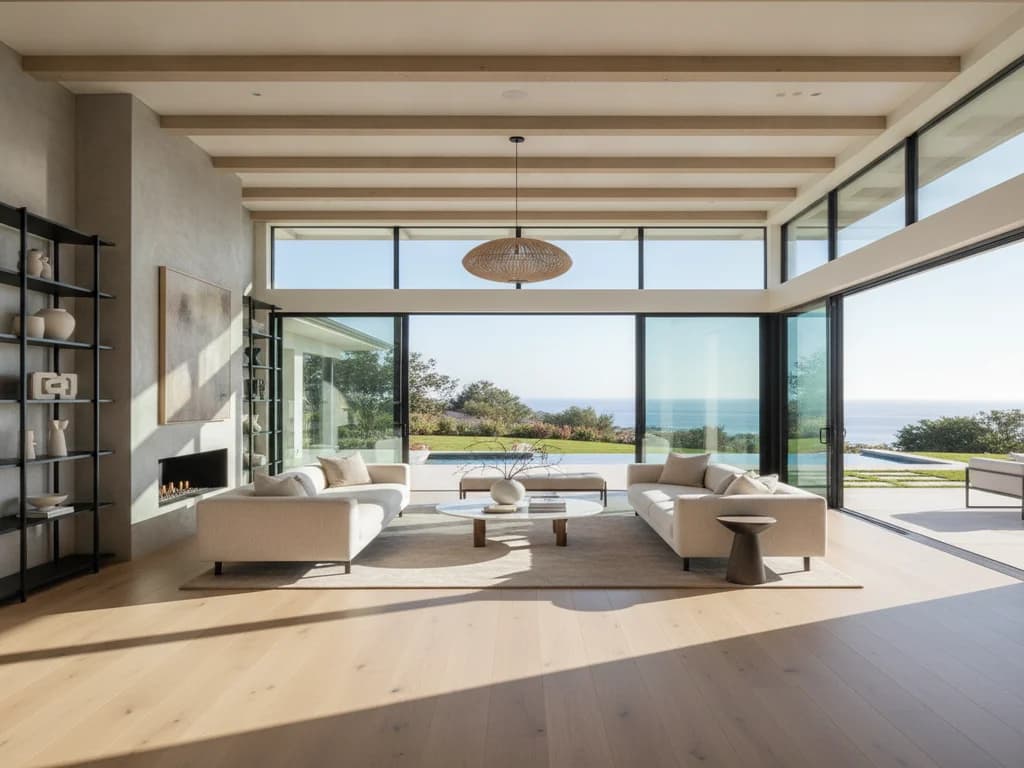
Custom Flooring for Your Tahoe Home
Call (916) 749-0272 for a free estimate on hardwood and luxury flooring anywhere on the California side of the lake.