Species
Hickory Flooring
One of the hardest domestic hardwoods at 1,820 lbf, with bold grain and dramatic color variation, well suited to busy mountain and family homes. Also the most seasonally active.
Character
Why Hickory
Hardness
Hickory is one of the hardest common domestic species (Janka around ~1,820, well above oak), so it resists dents and heavy traffic well.
Look
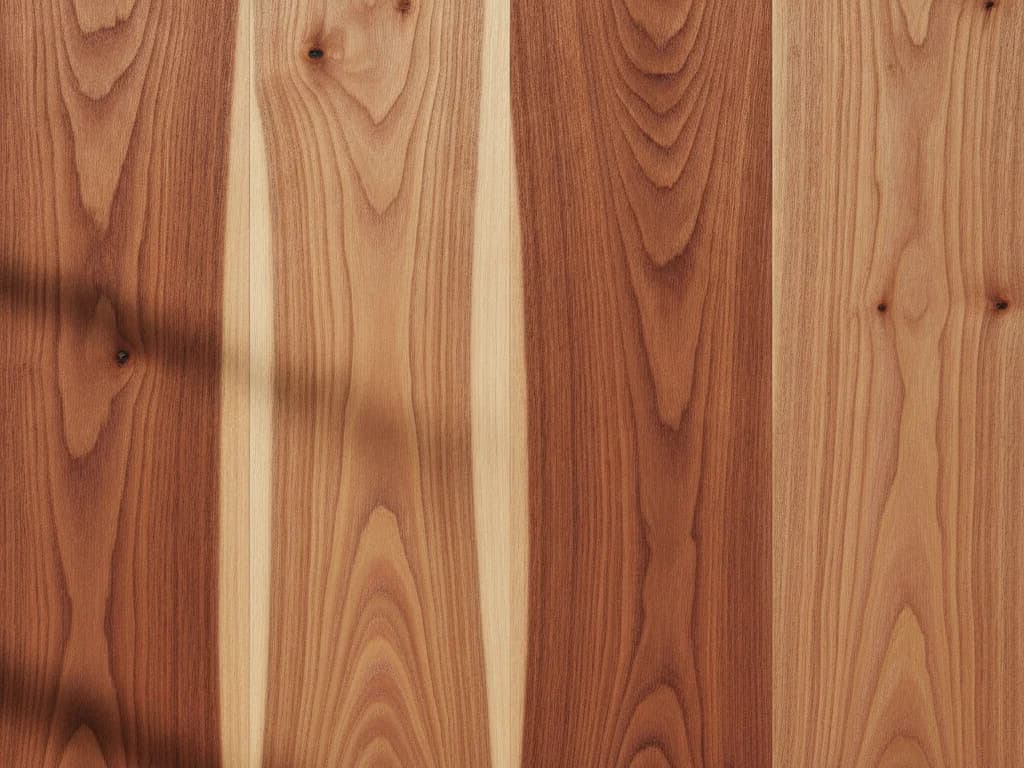
Strong grain and wide color swings from pale sapwood to reddish-brown heartwood — a rustic, high-character look, especially in wider planks.
Best use
Great for mudrooms, entries, cabins, and active households where durability and a rugged aesthetic both matter.
Hickory at a Glance
- Type
- Species
- Janka Hardness
- 1,820 lbf (Group figure across hickory species) — Very hard — among the hardest widely available flooring woods.
- Seasonal Movement
- A 5″ board losing 2 points of moisture content narrows 0.041″ plainsawn, or 0.026″ quartersawn — the plainsawn face moves about 1.6× as much. FPL reports one figure across the true hickories, as it does for Janka.
Janka side-hardness per USDA Forest Products Laboratory, Wood Handbook (FPL-GTR-190), Table 5-3, side hardness (lbf). Higher numbers resist denting; how visible a dent is depends on grain and color, not hardness alone.
Movement computed from the Hickory, true coefficients (CR 0.00259, CT 0.00411) in FPL-GTR-282 Table 13–5, applied through Equation 13–3 across an 8%→6% moisture-content drop. FPL scopes those coefficients to 6–14% moisture content, so this is a lower bound on what a dry heated winter actually does, not a worst case. The same coefficients applied to a real climate.
Best For
High-traffic mountain and family homes wanting maximum hardness and bold, rustic character.
How We Install It
Available solid or engineered; because hickory reacts to humidity, careful acclimation and moisture testing matter — engineered construction helps at altitude.
Explore related
See it in a mountain home, explore Lake Tahoe flooring, or view all wood species.
Sources
- USDA Forest Products Laboratory — Wood Handbook (FPL-GTR-190), Ch. 5 — Mechanical properties of wood, including Janka side-hardness (Table 5-3).
- USDA Forest Products Laboratory - Wood Handbook (FPL-GTR-282), Ch. 13 — Dimensional change coefficients (Table 13-5) and Equation 13-3, behind the seasonal-movement figures.
- National Wood Flooring Association (NWFA) — Industry authority on wood-flooring species characteristics, grading, and installation.
Species characteristics reflect published industry and government references; individual boards vary by grade, cut, and finish. Figures are general to the species and are not a grading or performance guarantee for a specific product.
Good to Know
Frequently Asked Questions
Is hickory the most durable wood floor?
It's among the hardest common domestic hardwoods — noticeably harder than oak or walnut — so it stands up very well to dents and traffic. Durability also depends on the finish and install, which we handle for the local climate.
Does hickory work in mountain homes?
Yes — its hardness suits busy ski-and-cabin households. Hickory does move with humidity, so we recommend engineered construction, proper acclimation, and moisture-tested subfloors for altitude installs.
How much does hickory move seasonally?
More than any other common flooring hardwood, which is the trade-off for its hardness. FPL gives true hickory a tangential coefficient of 0.00411 - the highest of the species we install - so a 5-inch plainsawn board narrows about 0.041 inch across a two-point moisture drop, against 0.038 for white oak and 0.027 for walnut. Hickory is an excellent floor in a house whose humidity is genuinely controlled, and a demanding one in a house left cold and unhumidified for months at a time.
Why does hickory look so varied board to board?
Because hickory has an unusually wide contrast between its pale sapwood and its much darker heartwood, and most flooring grades include both. That variation is exactly why some people choose it and why others rule it out, so it is worth seeing a real sample laid out over several square feet rather than judging it from one board or a photograph.
Related
Keep Reading
Related pages: Hardwood Flooring, Engineered Hardwood, Luxury Vinyl Plank, and Reviews.
Install Hickory in Your Home
Call (916) 749-0272 — we'll bring hickory samples and give you an honest estimate.