Format
Rift & Quarter-Sawn Oak Flooring
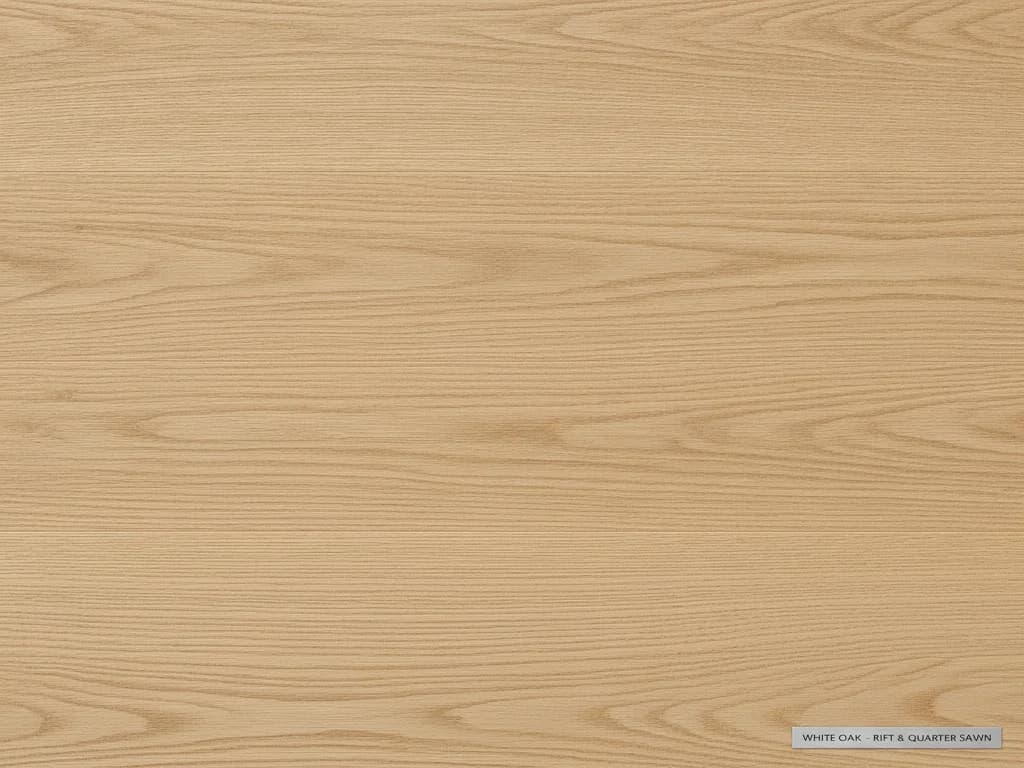
Oak milled at a different angle to the growth rings, giving straight linear grain and ray-fleck figure that moves about half as much as plainsawn oak. Rift and quarter-sawn, explained.
Character
Why Rift & Quarter-Sawn Oak
Look
Rift-sawn gives long, straight, uniform grain lines; quarter-sawn adds distinctive medullary ray flecks. Together they read clean, architectural, and high-end.
Stability
Because of how the boards are cut relative to the growth rings, rift and quarter-sawn oak move less across their width than plain-sawn — a real advantage in mountain humidity swings and over radiant heat.
Value
This milling yields fewer boards per log, so it costs more than plain-sawn oak — you're paying for the grain and the stability.
Rift & Quarter-Sawn Oak at a Glance
- Type
- Format
- Seasonal Movement
- A 5″ board losing 2 points of moisture content narrows 0.038″ plainsawn, or 0.019″ quartersawn — the plainsawn face moves about 1.9× as much. These two figures are the whole argument for this cut.
Movement computed from the White oak, white (Quercus alba) coefficients (CR 0.00194, CT 0.00376) in FPL-GTR-282 Table 13–5, applied through Equation 13–3 across an 8%→6% moisture-content drop. FPL scopes those coefficients to 6–14% moisture content, so this is a lower bound on what a dry heated winter actually does, not a worst case. The same coefficients applied to a real climate.
Best For
Modern and transitional homes wanting a clean, linear grain and maximum dimensional stability.
How We Install It
Available solid or engineered; its stability makes it a strong candidate over radiant-compatible subfloors. We acclimate and moisture-test before install.
Explore related
See it in a mountain home, explore Lake Tahoe flooring, or view all wood species.
Sources
- USDA Forest Products Laboratory - Wood Handbook (FPL-GTR-282), Ch. 13 — Dimensional change coefficients (Table 13-5) and Equation 13-3, behind the seasonal-movement figures.
- National Wood Flooring Association (NWFA) — Industry authority on wood-flooring species characteristics, grading, and installation.
Species characteristics reflect published industry and government references; individual boards vary by grade, cut, and finish. Figures are general to the species and are not a grading or performance guarantee for a specific product.
Good to Know
Frequently Asked Questions
What's the difference between rift and quarter-sawn?
They're both about the angle the board is cut relative to the log's growth rings. Rift-sawn gives very straight, linear grain with no flecking; quarter-sawn shows the same straight grain plus dramatic ray-fleck figure. Many floors blend the two ('rift & quartered') for a clean, stable look.
Is quarter-sawn oak better for radiant heat?
Its cut makes it move less across the width than plain-sawn oak, which is helpful over radiant and in altitude humidity swings. We still recommend engineered construction and proper moisture prep for radiant installs — we'll spec the right build.
How much more stable is rift and quartersawn oak, exactly?
About twice as stable across the width. That is not a marketing figure - it is the ratio between the two coefficients the USDA Forest Products Laboratory publishes for American white oak: 0.00194 radial against 0.00376 tangential. A rift or quartersawn board presents the radial dimension across its width, so a 5-inch board moves about 0.019 inch across a two-point moisture change where the same board plainsawn moves 0.038. That is the entire reason the cut costs more.
Is rift and quartersawn worth the price premium?
It is where the floor is wide, sits over radiant heat, or lives in a house with a real seasonal humidity swing - which describes most of the mountain and foothill work we do. The cut yields less usable board per log, which is what the premium pays for, and it buys roughly half the seasonal movement plus a straight, calm grain with no cathedral figure. In a tightly conditioned house with narrower boards, plainsawn oak is entirely adequate and the premium is harder to justify.
Related
Keep Reading
Related pages: Hardwood Flooring, Engineered Hardwood, Luxury Vinyl Plank, and Reviews.

Install Rift & Quarter-Sawn Oak in Your Home
Call (916) 749-0272 — we'll bring rift & quarter-sawn oak samples and give you an honest estimate.