Materials
The Best Wood Species for Mountain Homes
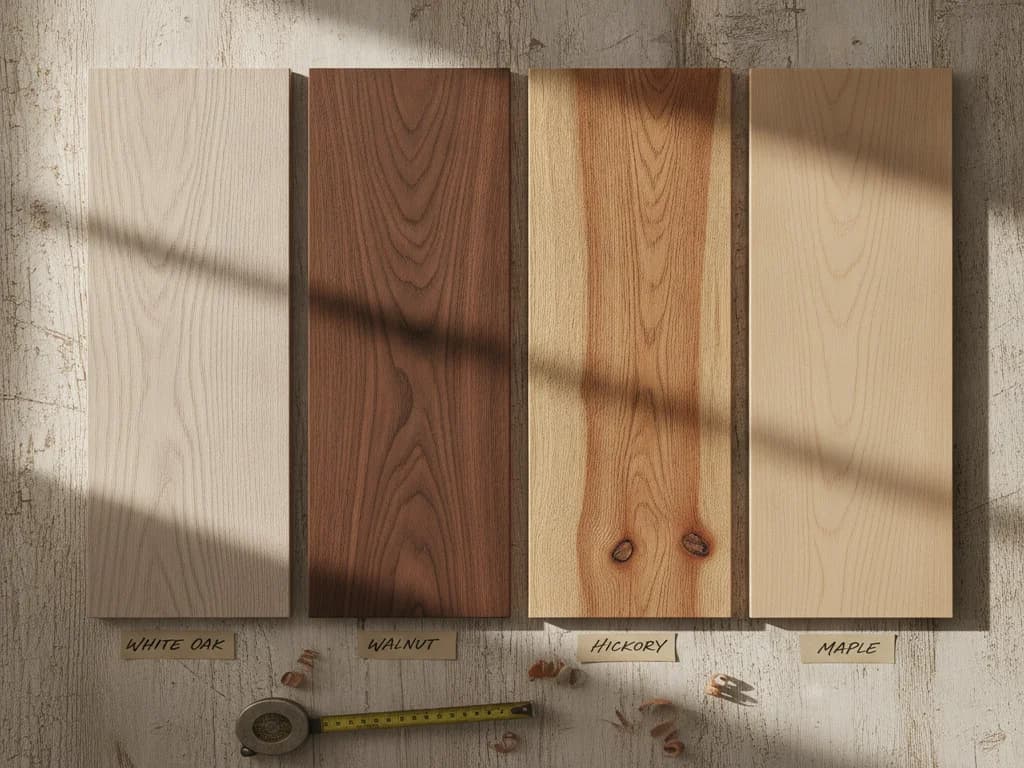
White oak, walnut, hickory, hard maple — each brings a different mix of hardness, stability, and character. Here's how to match species to a mountain home.
Materials · 9 min read
Published July 16, 2026 · Updated July 28, 2026
Species is where a mountain floor gets its personality — and a good part of its durability. The right choice balances how a wood looks against how hard it wears and how calmly it handles the big humidity swings a Sierra home puts it through. Here's how the species we work with most stack up, where each one shines, and why the four things nobody asks about — sawing method, grade, finish chemistry, and how the color shifts over years — end up mattering more than the hardness number people start with.
White Oak: The Mountain-Modern Default
White oak has become the default for a reason. At roughly 1,360 on the Janka scale it takes daily traffic, dogs, and ski-boot entries well. More usefully, its pores are plugged with tyloses — a natural growth that closes off the vessels in the heartwood. That's why white oak has historically been the wood for barrels and boat timbers, and it gives the flooring a genuine edge in resisting moisture penetration, which matters in a seasonal climate.
The look is the other half of the case. White oak carries cooler, browner undertones where red oak runs pink, so it accepts the soft, natural, greige-to-warm-brown finishes people want up here without fighting them. It's also tannin-rich, which makes it the only common species that responds properly to reactive and fumed finishes — the treatments that darken the wood chemically rather than sitting a pigment on top of it.
You'll hear it sold as European or French oak and as American white oak. For the purposes of choosing a species, treat them as one: the practical differences come down to grade, grain, and milling rather than a performance gap that would change your decision.
Red Oak: Perfectly Good, With a Color Caveat
Red oak sits just below at roughly 1,290 Janka — a difference too small to notice in service. It's a legitimately durable floor and it's what's already installed under the carpet in a great many Northern California homes built in the last fifty years.
Two real differences. Its pores are open rather than plugged, so it drinks stain more readily and shows a stronger cathedral grain pattern. And the undertone is pink to salmon, which fights the cool grays and soft browns that define the current mountain palette. Stain can push it toward neutral, but the undertone tends to reassert itself as the finish ages. Where red oak makes obvious sense is in matching or extending an existing red oak floor, where the alternative is a visible seam between two species. White oak versus red oak covers the color question in more depth.
Walnut: Warmth and Depth, With a Softer Surface
Walnut is the choice when you want richness — deep chocolate-brown tones, a straight elegant grain, and a warmth that reads as high-end without any stain at all. The tradeoff is hardness: at roughly 1,010 Janka walnut is meaningfully softer than oak, hickory, or maple, so it dents and scratches more readily.
Two things people don't expect. American black walnut has dramatically pale sapwood against its dark heartwood, and much of the flooring on the market is steam-treated to blend the two, which produces a more uniform floor but a slightly flatter color than unsteamed material. And walnut lightens with UV exposure rather than darkening — the opposite of cherry — so a walnut floor under big south-facing mountain glass will mellow toward a warmer, softer brown over years, and anything sitting on it for a season will leave a lighter footprint.
None of that disqualifies walnut. Plenty of beautiful mountain homes use it. It's simply better suited to primary bedrooms, studies, and formal living areas than to a mudroom or the main path in from a snowy deck.
Hickory: The Toughest of the Bunch
If durability is the priority, hickory is hard to beat — at roughly 1,820 Janka it's the hardest of the common domestic species we use, and it shrugs off the kind of abuse that would mark softer woods. It also has the most dramatic character: wide swings from pale sapwood to darker heartwood, plus knots and grain movement that give a rustic, cabin-appropriate look.
That personality is the catch. Hickory reads busy, so it's a love-it-or-leave-it grain rather than the quiet backdrop white oak provides, and the natural color variation makes it a poor candidate for a uniform stain — you're buying the variation whether you wanted it or not. It's also harder on tools and on installers, and its density means it can chip at the edges if it's worked carelessly, so it's worth confirming your crew has run it before.
Hard Maple: Clean, Pale, and Durable
Hard maple lands at roughly 1,450 Janka with a smooth, subtle, nearly grainless look that skews pale and contemporary. It's a good fit for bright, minimal interiors where you don't want grain competing with the architecture, and it's the traditional gymnasium and bowling-alley floor for a reason.
Two cautions. Maple is diffuse-porous, meaning its pores are small and evenly distributed rather than concentrated in growth rings, and that structure absorbs stain unevenly — it blotches. Getting a dark stain to land uniformly on maple takes a conditioner or a toned finish system and real skill, and it's why maple is often happiest kept light and natural. The second caution is subtler: because the surface is so uniform and pale, an individual dent has nothing to hide behind. A mark that would disappear into hickory's variation reads clearly on maple.
Why Softwoods Are a Different Category
Fir, pine, hemlock, and cedar come up in mountain conversations because they're the traditional Sierra cabin floor, but they belong in a separate bracket from everything above. Softwoods sit far below oak on the hardness scale — not marginally softer the way walnut is softer than hickory, but in a different range entirely. A dropped cast-iron pan leaves a permanent divot rather than a mark.
That's a specification fact, not a verdict. Softwood floors read as warm and historically correct in a way no hardwood imitates, and the denting is inseparable from the look people want. What it means practically is that softwood cannot be evaluated on the same axis as the species above: you are not choosing a durable floor and accepting some softness, you are choosing a floor that will visibly record everything that happens on it. In a full-time mountain house with real traffic we don't spec new softwood, and we'd say so plainly rather than let someone discover it in year two.
Reclaimed and Character Grades: Age You Can't Fake
Reclaimed oak occupies its own category. Material milled from old barn timbers, factory joists, and similar sources carries nail holes, checks, saw marks, and a density from slow old-growth ring spacing that new lumber doesn't have. In a cabin interior it reads as genuinely old because it is.
The practical notes are real, though. Reclaimed material comes in limited, inconsistent lots, so ordering enough the first time matters more than usual — a matching second run may not exist. Expect more waste, more hand-sorting during layout, and a higher installed cost for the labor rather than just the material. And reclaimed solid boards have often already lived through a century of moisture cycling in an unconditioned building, which is not the same thing as being stable in a heated house. It still needs the same acclimation and moisture testing as anything else.
What Janka Numbers Do and Don't Tell You
It's tempting to rank species purely by Janka, but the test measures one specific thing: the force required to embed a steel ball halfway into the wood. That's a real, comparable measurement of dent resistance from a concentrated impact — a dropped pan, a chair leg, a stiletto heel.
It says nothing about scratch resistance, which is almost entirely a property of the finish rather than the wood. A hard species under a worn finish scratches readily; a softer species under a durable two-component finish — the Bona Traffic HD and Loba tier — resists surface marking well. And Janka says nothing about dimensional stability, which is what actually determines whether a floor gaps or cups in a seasonal climate — hickory is the hardest species here and among the more restless ones dimensionally. Oak versus hickory versus maple works through the practical comparison.
Sawing Method Matters More Than the Ranking
How the log is cut changes the board more than most people expect. Plain-sawn material is cut straight through the log, yields the most usable lumber, costs the least, and produces the familiar cathedral-arch grain — and it also moves the most across its width, because the growth rings run roughly parallel to the face.
Rift and quarter-sawn oak is cut so the rings run more vertically through the thickness of the board. That orientation cuts seasonal movement across the width substantially, and it does so for any species you apply it to — which is what makes it a lever worth pulling independently of which wood you've chosen.
In a home with wide humidity swings this is one of the highest-value upgrades available. Rift and quartered material costs more, because the mill gets less of it out of the same log, and it buys real stability that a higher hardness number never will.
Grade Is the Setting You Actually Feel
Grade describes how much natural variation the boards are allowed to contain — knots, mineral streaking, sapwood, color range — and it is not a measure of quality. A select or clear grade gives a calm, uniform floor with minimal knots. A character or rustic grade includes knots, streaks, and wide color variation.
For a mountain house this is often the single most consequential decision, and it cuts against instinct: character grade hides wear far better. A new scratch on a clear-grade floor is the only irregularity in the room. The same scratch on a character-grade floor joins a hundred other marks and disappears. Character grade also usually costs less. If your floor is going to take real traffic from real boots, grade is where to lean rustic.
How Species Takes Stain and Texture
Finish behavior varies by species more than showroom samples suggest. White oak's tannin content makes it uniquely responsive to reactive stains and fuming; it also takes conventional stains in the DuraSeal class evenly and holds a wire-brushed texture cleanly, since brushing removes the softer earlywood and leaves the dense grain proud. Red oak stains readily but pushes warm. Maple resists even staining and generally wants to stay light. Hickory's built-in color range fights any attempt at uniformity.
Sheen matters as much as color. A matte or near-matte surface scatters light and hides fine scratching, while gloss reflects it and reveals every mark — which is why almost every mountain floor we spec lands matte. Hardwax oils like Rubio Monocoat penetrate rather than forming a film, which gives a very natural low-sheen look and the useful property of spot-repairability, at the cost of a more involved maintenance routine than a film finish.
Matching Species to Rooms
Think in zones. Entries, hallways, kitchens, and the paths in from a snowy deck reward the hardest, most stable options — white oak or hickory, in a character grade, in a matte finish. Primary living areas can go almost any direction depending on the look you're after, with white oak the safe, versatile default. Bedrooms, studies, and formal spaces are where a softer, richer wood like walnut earns its place, since they see gentler wear.
One practical constraint: mixing species across an open floor plan rarely reads as intentional unless there's an architectural break to justify it — a step, a doorway, a change of room. Running two species that meet in the middle of a great room usually looks like a compromise, because it is. And across all of it, remember that grade, sheen, and color hide or reveal wear as much as species does.
There's no single "best" species for a mountain home, only the best fit for your rooms, your traffic, and the look you're chasing. Renaissance Floors works in engineered and solid hardwood across the California side of the Tahoe/Truckee region and greater Sacramento, and we're glad to walk your space and talk through species honestly. Call (916) 749-0272 for a free estimate.
This article is part of our guide to how flooring materials differ, which covers what separates the materials structurally, and the vocabulary the trade uses to describe them.
Good to Know
Frequently Asked Questions
What is the best wood species for a mountain home?
White oak is the most common answer and a well-founded one: it is dimensionally stable, has a tight tannin-rich grain, and takes stain and texture evenly. Hickory is the choice where hardness matters most, and walnut where color depth matters more than surface hardness.
Is Janka hardness the most important factor?
No. Janka measures resistance to denting under a steel ball, which is real and comparable — the figures on our species pages come from the USDA Forest Products Laboratory Wood Handbook — but it says nothing about scratch resistance, which is a property of the finish, or about how visible wear will be, which is a property of grade and color.
What is the difference between white oak and red oak?
White oak runs slightly harder, has pores plugged with tyloses that give it better moisture resistance, and carries a cooler brown undertone. Red oak has open pores, a stronger cathedral grain, and a pink to salmon undertone that tends to reassert itself through stain as the finish ages.
Which wood species hides scratches best?
A character grade with visible variation, in a matte or wire-brushed finish, disguises marks far better than a clean uniform grade in gloss — regardless of species. This is why a softer wood in the right grade and finish can look better after five years than a harder wood in the wrong one.
Is walnut too soft for a mountain home?
It is softer than oak or hickory, which makes it a poor choice for entries, mudrooms, and heavy-traffic hallways. In a primary bedroom or a formal living room where its color depth is the point and traffic is light, it remains a legitimate choice.
Why is maple hard to stain dark?
Maple is diffuse-porous, with small pores spread evenly through the wood rather than concentrated in growth rings, so stain absorbs unevenly and blotches. Achieving a uniform dark tone requires a conditioner or a toned finish system and real skill, which is why maple is usually kept light.
What is rift and quarter-sawn oak, and is it worth the cost?
It is oak cut so the growth rings run more vertically through the board rather than parallel to its face, which cuts seasonal movement across the width substantially and produces a straight, linear grain. In a climate with wide humidity swings, that stability is usually worth the premium.
Should I choose a clear grade or a character grade?
For a house that takes real traffic, character grade is usually the better choice and often the cheaper one. Knots, streaks, and color variation give new scratches somewhere to disappear into, whereas on a clear grade every mark is the only irregularity on the floor.
Does species affect how much the floor moves seasonally?
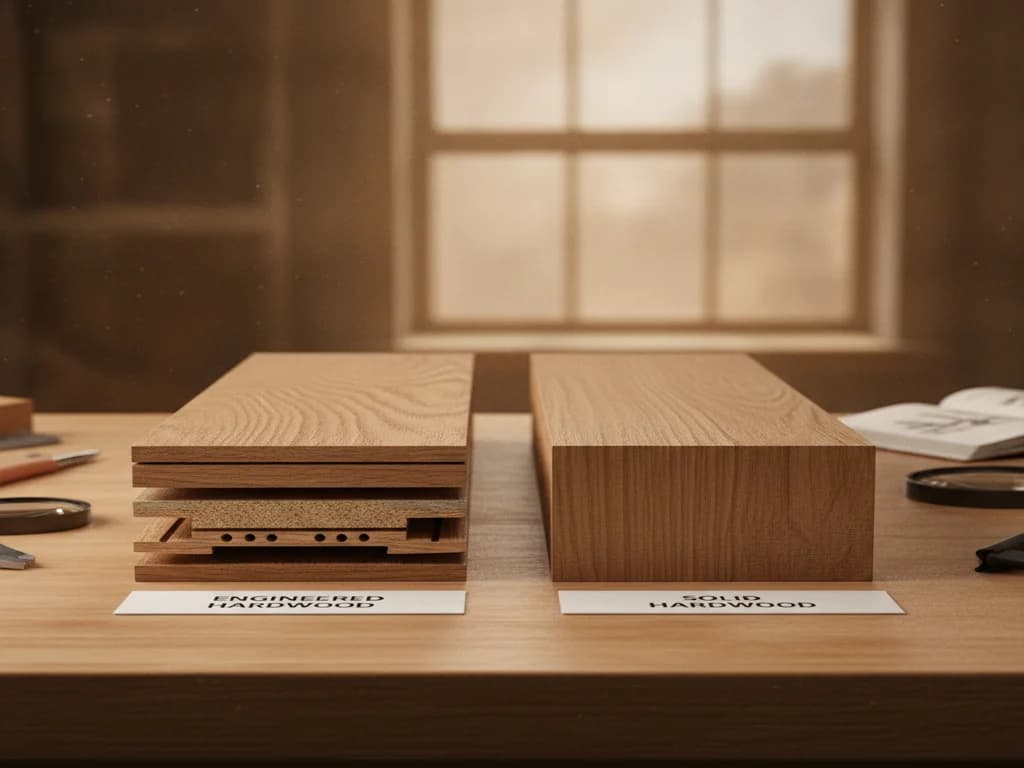
Yes, though construction matters more. Species differ in how much they expand and contract with moisture, but the difference between solid and engineered construction is larger than the difference between two species — which is why engineered is the usual mountain recommendation whatever the species on top.
Is fir or pine a good flooring choice for a mountain home?
As a new installation in a house with real traffic, no — softwoods sit far below oak on the hardness scale, in a different range rather than marginally lower, so they record every impact permanently. They read as warm and historically correct, but the denting is inseparable from that look.
Written by
Owner & Lead Installer, Renaissance Floors
15+ years of hands-on flooring experience across Greater Sacramento & Northern California. Works on hardwood and engineered installation, refinishing, subfloor preparation, and moisture testing — and writes these guides from what the jobs actually teach.
CSLB C-15 licence #1060673
Related
Keep Reading
Related pages: Squeaks, Water Damage, European White Oak, and French Oak.
Ready for Floors You'll Love?
Ready to talk through your project? Free estimates throughout Greater Sacramento & Northern California.