Materials
Engineered vs. Solid Hardwood at Altitude: Which Wins?
In mountain homes with big humidity swings, radiant heat, and slab floors, engineered hardwood usually wins. Here's why — and when solid still makes sense.
Materials · 10 min read
Published July 16, 2026 · Updated July 28, 2026
Both engineered and solid hardwood are real wood, and both can look stunning in a mountain home. The question isn't which is "better" in the abstract — it's which one behaves better in a house that swings from bone-dry winters to humid summers, often runs radiant heat, and frequently sits on a concrete slab. At altitude, those conditions push the decision toward engineered more often than not. Here is the mechanical reasoning behind that, and the cases where it doesn't hold.
The Real Problem at Altitude Is Movement
Wood is hygroscopic — it takes on and gives off moisture from the air around it, expanding when it's humid and shrinking when it's dry. A Sierra home living space might sit at 45–55% relative humidity during a warm, monsoon-influenced summer afternoon, then drop into the teens or lower once the wood stove and forced-air heat run all winter. That's a wide annual swing, and it's the single biggest reason mountain floors fail. Every board that moves with the seasons is a board that can gap in January and cup in July.
The goal of choosing the right material isn't to stop wood from moving — you can't — it's to keep that movement small and even enough that you never notice it. Everything that follows is a variation on that one idea: which construction, which width, which install method, and which subfloor keep the movement below the threshold where it becomes visible.
How Cross-Lamination Actually Works
Solid hardwood is one piece of wood, and wood moves far more across the grain than along it. A solid plank therefore grows and shrinks across its width through the year while staying almost exactly the same length. Nothing opposes that movement except the fasteners and the neighboring boards, which is why the movement shows up as gaps or as pressure between boards.
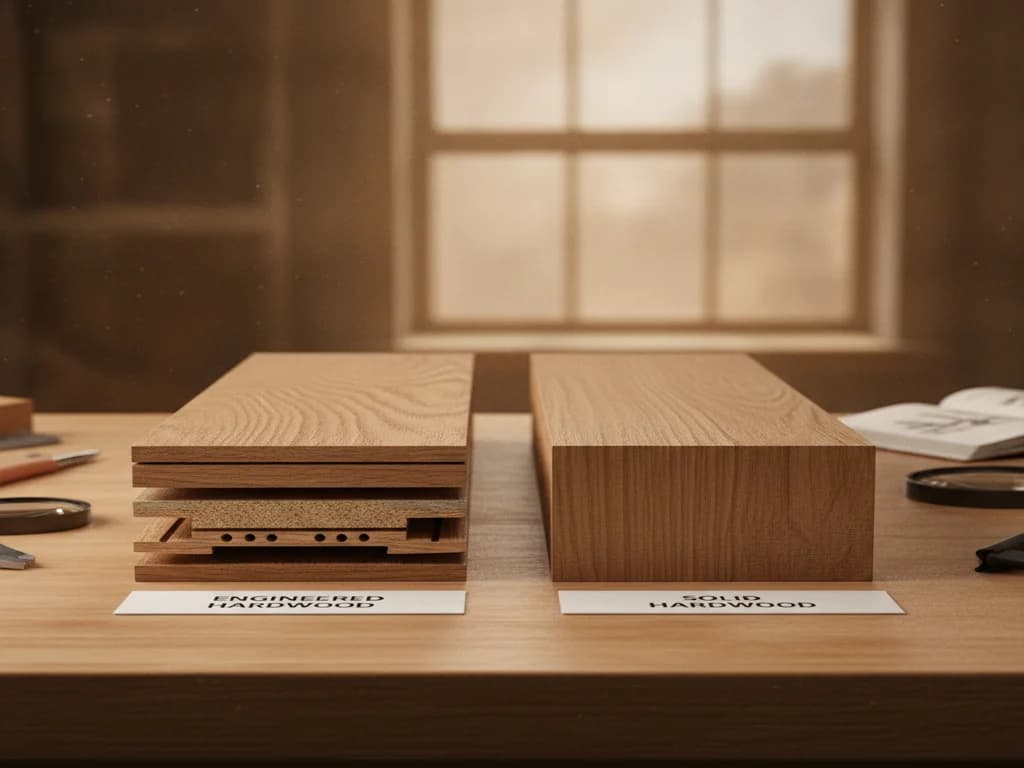
Engineered planks are built from a real hardwood wear layer bonded over a cross-laminated core — multiple thinner plies stacked so the grain of each layer runs perpendicular to the one below it. That opposition is the whole point. When the top layer wants to expand across its width, the ply beneath it is oriented along its own grain in that direction and barely moves at all, so it physically restrains the layer above. The plies hold each other in check, and the finished plank expands and contracts far less than a solid board of the same species and width. This is the same principle that makes plywood dimensionally stable, applied to a floor.
Not All Engineered Cores Behave the Same
"Engineered" describes a category, not a quality level, and the core is where the differences live. Multi-ply birch or poplar plywood cores are the workhorse: many thin layers, good stability, good screw and fastener holding, and enough thickness to support a substantial wear layer. Mills like Mirage, Lauzon, Hallmark Floors, and DuChâteau build in this general class, though construction varies product to product and the spec sheet is what matters, not the name.
Below that sit HDF-core products — a dense fiberboard core, usually thinner and usually paired with a thin veneer. They are stable in the sense that they don't swell seasonally with humidity, but they are far less forgiving of liquid water, they can't be refinished, and they don't hold a staple or cleat, so they're floating-only. Then there's sawn-lumber core, where the plies are solid sawn wood rather than rotary-peeled veneer; it feels closest to solid underfoot and takes a nail well, at a price to match.
The practical takeaway for a mountain home is that a thick multi-ply or sawn core with a genuine sawn wear layer gets you nearly all the benefits of solid wood with the stability you actually need, while a thin HDF-core product is a different purchase entirely — closer in ownership terms to laminate than to hardwood, whatever the top layer is made of.
Wear Layer Is the Number That Decides Everything Else
The wear layer is the real wood above the core, and its thickness determines how long the floor lives. Thin veneers are peeled off a log on a lathe and measured in fractions of a millimeter; sawn wear layers are cut like lumber and are substantially thicker, which is why they can be sanded.
Two details are worth asking about. First, how the top layer was produced: a sawn face shows the grain the way a solid board does, while a rotary-peeled veneer can show a distinctive repeating figure because it was unrolled off the log rather than cut through it. Second, how much material sits above the tongue, which is the number that governs sanding rather than the overall plank thickness. A thick plank with a thin veneer is still a thin-veneer floor.
Nobody volunteers this on a showroom tag. Ask, and get the answer in writing, because it is the difference between a floor you can refinish in twenty years and one you replace.
Why Plank Width Amplifies the Difference
Movement is proportional to width. A board twice as wide moves roughly twice as much across its face for the same change in moisture content, which means the seasonal gap between two wide boards is roughly twice as wide as between two narrow ones — from the identical humidity swing, with the identical species and the identical installer.
This is the crux of the mountain-modern problem. The wide, calm planks that define the look are exactly the boards that punish a wide humidity swing, and at altitude that swing is wider than in the valley. Engineered construction is what resolves the conflict: cross-lamination suppresses the underlying movement enough that width stops being the deciding risk. If you want the full picture on how width changes the floor, wide plank versus standard width covers the aesthetic and cost side too. In a mountain house, treat width as a stability decision first.
How Each One Gets Installed
Installation method is not a free choice; it follows from the construction. Solid hardwood is nailed or stapled to a wood subfloor, full stop. Engineered can be nailed, glued down, or floated, and each has consequences. Nailing gives the most solid underfoot feel and the most traditional sound. Full-spread glue-down bonds the plank to the substrate, which is the standard for engineered over concrete and the quietest, most solid-feeling of the three over a slab. Floating installs are fastest and cheapest, need no fasteners or adhesive, and sound the most hollow, which is why we rarely recommend them in a great room where the acoustics matter.
The tradeoffs are worth understanding before you choose a product, since some engineered products only support one or two of these methods. Nail-down versus glue-down versus floating walks through it in detail.
Slabs, Basements, and Below-Grade Levels
A lot of Tahoe-area and foothill homes pour concrete slabs, and many have lower levels that sit partly below grade. This is where the decision usually stops being close. Solid hardwood generally shouldn't be nailed or glued directly to concrete on grade, and it is not recommended below grade at all, because the moisture load from the ground is a constant one-directional pressure that solid wood has no defense against.
Engineered is designed for it: glued or floated over a slab with a proper moisture barrier, over a tested substrate, it is the standard approach in a basement level or a slab-on-grade great room. If a solid floor is non-negotiable over concrete, the workaround is a plywood subfloor built over the slab with a vapor retarder between, which adds height, cost, and a headroom problem at every doorway and stair. Usually the engineered plank is the better answer than the workaround.
Radiant Heat Compatibility
Radiant heat gently warms the floor from below, which drives moisture out of the wood and exaggerates seasonal shrinkage. Engineered's stable core tolerates that back-and-forth far better than solid, which is why most radiant manufacturers approve engineered and are cautious about solid. As a rule of thumb, keep the finished floor surface around 80°F (27°C) or below, whatever product you choose, and bring the system up and down gradually rather than in sharp jumps.
Two secondary points matter in a mountain build. Wood is an insulator, so a thicker floor over the tubing means the system runs warmer to deliver the same room temperature — another argument against stacking a solid floor over a slab-mounted system. And quarter-sawn material behaves better over radiant than plain-sawn, for the same reason it behaves better everywhere else. Our radiant heat flooring page goes deeper on system design and commissioning.
Sound, Feel, and What You Notice Barefoot
This is the category where solid still has real defenders, and they aren't wrong. A nailed solid floor over a wood subfloor has a density and a low, solid sound underfoot that a floating engineered floor does not reproduce. You notice it most in a hallway and on stairs.
But the comparison people actually imagine — solid versus floating engineered — is not the only comparison available. A thick, nailed or fully glued engineered floor closes most of that gap, and in a slab-on-grade room a glued engineered floor feels more solid than anything else you could put there. Underlayment choice matters too on a floating install: a dense quality pad takes a meaningful amount of the hollowness out, though it does not eliminate it.
The Refinishing Question
The old knock on engineered is that you can't refinish it — that's outdated, but it needs a caveat. What matters is the thickness of the wear layer. A quality engineered floor with a thick sawn wear layer can typically be sanded and refinished one to several times over its life, much like a solid floor, while a thin veneer product can only be lightly screened and recoated.
Solid wood does hold an edge here: with more material above the tongue, it can generally take more full sandings over the decades. That said, most floors are recoated far more often than they are sanded, and a screen-and-recoat costs a fraction of a full refinish and takes almost no material off the floor. For most homeowners the practical refinishing life of a good engineered floor is more than they will ever use. If a floor is meant to outlive you and be sanded by the next two owners, that's a legitimate point in solid's favor.
What Each Costs Over the Life of the Floor
Material pricing overlaps heavily — a premium engineered plank costs more than commodity solid oak, and cheap engineered costs less than either. The more useful comparison is the total installed picture. Engineered over a slab avoids building a plywood subfloor. Engineered in wide planks avoids the callbacks and remediation that wide solid boards invite up here. Solid buys additional refinish cycles decades out.
The realistic framing is that engineered usually costs less to get right in a mountain home and solid costs less to keep alive over a very long horizon — and which of those matters depends entirely on how long you intend to own the house.
When Solid Hardwood Still Makes Sense
None of this makes solid wood the wrong answer — it's just the right answer in fewer mountain situations. If you're installing over a wood subfloor above grade, in a home whose humidity is kept reasonably steady, and you're using a narrower board width, solid hardwood is a proven, beautiful choice with a very long life.
There are two cases where we actively favor it. One is matching or extending an existing solid floor, where introducing a different construction at a doorway creates a height and appearance problem that outweighs the stability argument. The other is a full-time residence with managed humidity where the owner genuinely intends multiple refinishes over decades. Solid also carries a certain traditional appeal, and for some homeowners the idea of a full-thickness plank matters. The key is matching it to the conditions: a stable subfloor, no direct-to-slab install, no aggressive radiant swings, and disciplined acclimation before it ever goes down.
The Honest Tradeoff
Engineered wins on stability, radiant compatibility, slab and below-grade installs, and wide-plank width — which is exactly the profile of most mountain homes. Solid wins on maximum refinishing life, on matching existing floors, and on the traditional full-thickness feel, in the narrower set of homes whose conditions support it. Neither is a compromise on "real wood," because both are real wood.
The mistake is choosing on price or habit instead of on how your specific house behaves through the seasons. Answer four questions first — what's under the floor, how the house is heated, how wide the boards are, and whether the house is conditioned when nobody's in it — and the material usually chooses itself.
We spec engineered and solid hardwood for mountain, cabin, and foothill homes across the California side of the Tahoe/Truckee region and greater Sacramento, and we walk every space before recommending one over the other. If you'd like a straight read on which fits your subfloor, heat source, and plank width, Renaissance Floors offers free estimates — call (916) 749-0272.
This article is part of our guide to how flooring materials differ, which covers what separates the materials structurally, and the vocabulary the trade uses to describe them.
Good to Know
Frequently Asked Questions
Why is engineered hardwood recommended at altitude?
Because the binding constraint is dimensional movement. Mountain homes run drier through the heating season, so wood has a wider annual swing to absorb, and engineered construction — a veneer over a cross-laminated core — moves far less across its width than a solid board of the same species.
Can solid hardwood work in a mountain home?
Yes, in a home that is occupied year-round with interior humidity kept in a reasonable band, installed over a wood subfloor above grade in a narrower board width. What it does not suit is a second home left unconditioned for weeks at a time, which produces the widest swing and the most movement.
What is the difference between engineered hardwood cores?
Multi-ply plywood cores are the durable standard and hold fasteners well. Sawn-lumber cores feel closest to solid wood underfoot and cost the most. HDF cores are thinner, floating-only, cannot be refinished, and tolerate liquid water poorly, which puts them closer to laminate in ownership terms.
Can engineered hardwood be installed over a concrete slab?
Yes, and it is the standard approach — glued down or floated over a tested slab with a proper moisture barrier. Solid hardwood over concrete requires building a plywood subfloor over the slab first, which adds height and cost and creates transition problems at doorways and stairs.
Can you put hardwood in a basement or below-grade room?
Engineered hardwood, yes, over a slab that has passed moisture testing and with the right vapor barrier. Solid hardwood is not recommended below grade at all, because ground moisture applies constant one-directional pressure that a single piece of wood has no way to resist.
Does engineered hardwood work with radiant heat?
It is the usual recommendation, provided the specific product is rated for radiant and the system is commissioned gradually per the manufacturer's instructions. Solid wood over radiant is possible but far less forgiving, because it responds more sharply to the temperature cycling underneath it.
How many times can engineered hardwood be refinished at altitude?
The same rule applies as anywhere: it depends entirely on wear-layer thickness, not on the category or the elevation. A thick sawn wear layer can take a sanding or two; a thin-veneer product is built to be screened and recoated rather than sanded. Ask about the wear layer before buying.
Does engineered hardwood feel hollow underfoot?
A floating engineered floor can, which is the source of the reputation. A nailed or fully glued engineered floor feels substantially more solid, and over a concrete slab a glued engineered floor feels more solid than any alternative. Installation method affects the feel more than the category does.
Is wide-plank flooring a bad idea in the mountains?
Not with engineered construction, which is precisely why wide-plank engineered is so common up here. A wider board moves proportionally more across its width for the same change in moisture, so wide solid boards are the least forgiving combination — engineered removes most of that risk.
Is engineered hardwood cheaper than solid?
Not reliably — premium engineered costs more than commodity solid oak, and the ranges overlap heavily. The clearer difference is in installed cost over a slab, where engineered avoids building a plywood subfloor, and in remediation cost, where wide solid boards at altitude invite problems engineered avoids.
Written by
Owner & Lead Installer, Renaissance Floors
15+ years of hands-on flooring experience across Greater Sacramento & Northern California. Works on hardwood and engineered installation, refinishing, subfloor preparation, and moisture testing — and writes these guides from what the jobs actually teach.
CSLB C-15 licence #1060673
Related
Keep Reading
Related pages: Flooring Glossary, Chevron, European White Oak, and French Oak.
Ready for Floors You'll Love?
Ready to talk through your project? Free estimates throughout Greater Sacramento & Northern California.