Materials
Engineered vs. Solid Hardwood: Which Is Right for You?
Both are real wood — but they're built differently and perform differently. Here's how to tell which one fits your home.
Materials · 8 min read
Published July 14, 2026 · Updated September 12, 2026
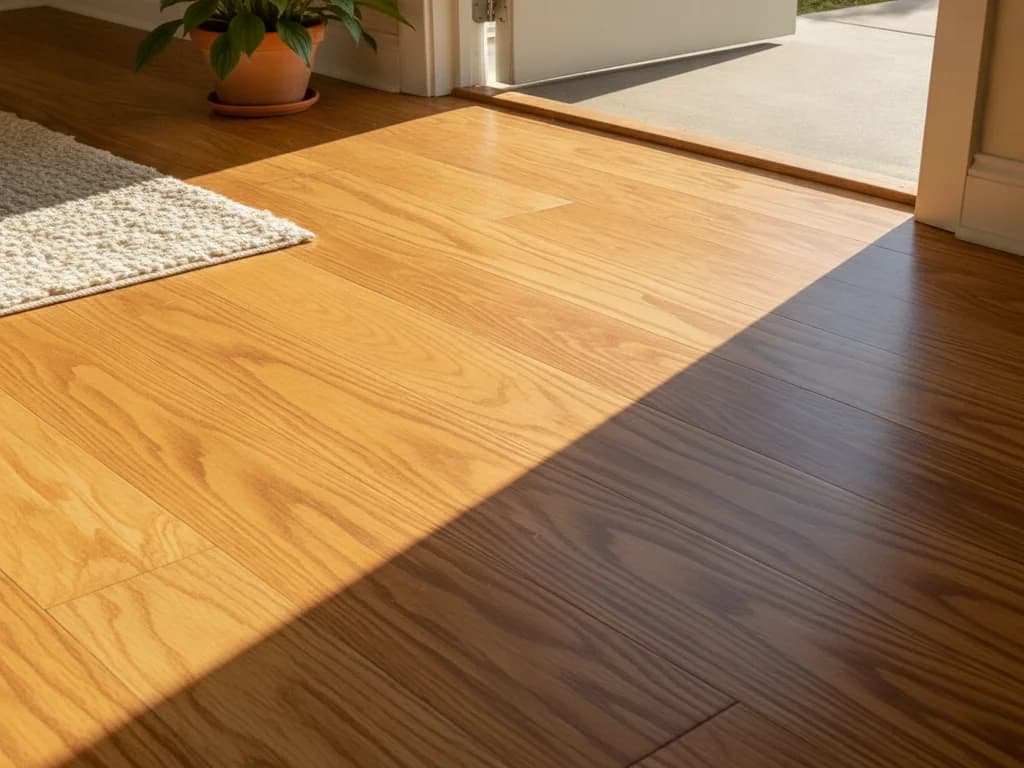
"Engineered hardwood" and "solid hardwood" both mean real wood floors — the confusion is usually about construction, not authenticity. Once you understand how each is built, the decision usually gets a lot simpler, because it comes down to where in the house you're installing, what your subfloor is actually doing underneath, and how much wood you want sitting above the tongue for the next thirty years.
If you want the two put side by side on a single screen, our engineered vs. solid comparison does that. What follows is the longer reasoning behind it — the part that decides which one belongs in your house rather than which one wins on paper.
What Engineered Hardwood Actually Is
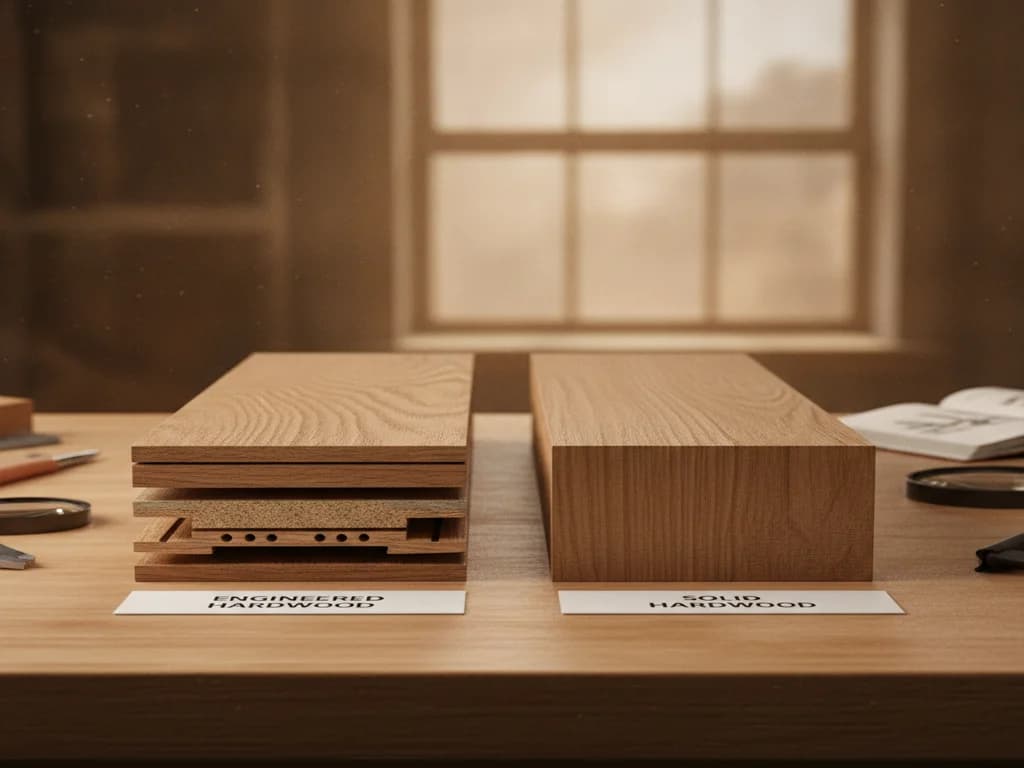
Solid hardwood is a single piece of wood milled to a plank shape, most commonly 3/4 inch thick, with a tongue on one edge and a groove on the other. Everything above that tongue is sandable wood. That is the whole product: one species, one board, top to bottom.
Engineered hardwood is a genuine hardwood veneer bonded over a manufactured core. The surface you walk on and refinish is real wood of the species named on the box — white oak is white oak whether it is 3/4 inch of it or 4 millimeters of it. Underneath sits a core built from cross-laminated plywood, a high-density fiberboard, or in some products a stack of hardwood plies. Engineered is not a wood-look imitation; laminate and vinyl are the imitations, and both are printed. Engineered hardwood is wood that has been assembled rather than sawn whole.
Core Construction, Ply Count, and Why It Matters
Not all engineered cores are equal, and this is where price differences that look arbitrary start making sense. A plywood core runs its plies at right angles to one another, so each layer restrains the layer above and below it from moving across its width. More plies generally mean a stiffer, flatter, more stable board, and cores in the range of seven to eleven plies behave noticeably better than a thin three-ply build over long open runs.
High-density fiberboard cores are a different animal. HDF is dense, flat, and inexpensive, and it holds a tight click profile well, which is why so many floating engineered floors use it. It is also a wood-fiber product, which means standing water is a real threat to it in a way it is not to a marine-grade plywood core. If a floor is going into a kitchen, a laundry room, or anywhere a supply line runs, core material is worth asking about specifically.
The Wear Layer Is the Spec That Decides the Next Thirty Years
On solid hardwood, the usable wood is everything above the tongue, and it is generous. On engineered, the usable wood is the veneer, and it varies enormously between products — from paper-thin faces measured in fractions of a millimeter up to thick sawn faces of several millimeters. Two floors that look identical in a showroom can be a decade apart in useful life for exactly this reason.
How the veneer was cut matters too. A rotary-peeled face is unwound from a log like a roll of tape and can show a swirled, repeating grain. A sliced or dry-sawn face is cut the way a solid board is cut and reads like solid wood, because visually it is. Thicker sawn faces cost more, look better, and give you room to sand.
The practical rule we use: if a floor might ever need a full sand and refinish, it needs a veneer thick enough to lose material and survive. If the veneer is thin, plan on that floor being maintained with light recoats and eventually replaced rather than restored. Neither is wrong. Buying the second one while believing you bought the first one is the expensive mistake.
Both Move With Moisture — One Moves Much Less
Wood is hygroscopic. It gives up moisture to dry air and takes it back from humid air until it reaches equilibrium with its surroundings, and as its moisture content changes it changes dimension. Almost all of that movement happens across the width of a board, not along its length. A solid plank is one piece of wood reacting as one piece, so it swells and shrinks across its width freely.
Cross-laminated engineered construction fights that. Because each ply is oriented against its neighbors, the layer that wants to expand across its width is glued to layers that want to expand along their length and will not budge. The board still moves — anyone who tells you engineered wood is dimensionally inert is selling something — but it moves a fraction of what a comparable solid board does through the same swing.
That difference is why humidity control shows up in every manufacturer's warranty. The NWFA guidance of roughly 30 to 50 percent relative humidity is the band both constructions are happiest in, and Sacramento-region homes spend a good part of the year pushed toward the dry end of it: valley heat outside, air conditioning running for months, then furnace heat in winter. Solid hardwood in a house that swings hard tells on you at the seams. Engineered mostly does not.
Grade Level and Subfloor Usually Make the Decision for You
Solid hardwood wants to be nailed or stapled into a wood subfloor. That is its native installation, and it needs joists or a nailable substrate to bite into. In a great deal of newer construction across the Sacramento region the ground floor is a concrete slab, and you cannot nail into a slab. That single fact decides more of these projects than any preference about aesthetics.
Below grade — basements, walk-out lower levels — is engineered territory for the same reason plus one more: vapor drives upward through concrete continuously, and solid wood sitting on top of that is a moisture problem waiting to be discovered. Whatever goes over a slab, the slab should be tested first with an in-situ relative-humidity probe per ASTM F2170 rather than a plastic-sheet guess, and prepped to something like ASTM F710 before an adhesive touches it. Installers measure the wood itself with pin or pinless meters from makers like Wagner or Lignomat, and the number that matters is the gap between the wood's moisture content and the subfloor's, not either one alone.
Radiant heat is the other clean dividing line. A heated slab cycles the floor above it through a temperature and moisture range on purpose, every day, all winter. That is a job for a stable engineered assembly and an approved product — the details are worth reading before you commit, and we cover them in our radiant heat flooring guide.
Plank Width Pushes the Answer Toward Engineered
Movement scales with width. A board twice as wide moves roughly twice as far across its face for the same change in moisture content, which is why a 2 1/4 inch strip floor from the 1950s can survive decades of neglect while a 9 inch solid plank in the same house opens visible gaps every summer.
This is the main reason the wide, long, low-gloss planks in current demand are overwhelmingly engineered. It is not a shortcut or a downgrade. It is the only construction that reliably holds a wide board flat across seasons. If you have fallen for a wide-plank look, you have effectively already chosen engineered, and the real tradeoffs of wide plank versus standard width are worth reading before you finalize a width.
Installation Method Follows From Construction
Solid gets nailed. Engineered can be nailed over a wood subfloor, glued directly to a prepared slab, or floated over an underlayment with a click profile, depending on the product. More options is genuinely useful — but the method changes how the finished floor feels and sounds, not just what it costs, and the differences between nail-down, glue-down, and floating are worth understanding before you sign off on a bid.
Glue-down is the quietest and most solid-feeling of the three and is what we lean toward over slabs. Floating is the fastest and the most forgiving of minor subfloor variation, and it is the one most likely to sound hollow if the prep was rushed or the underlayment was an afterthought. A floating floor also has to be kept free at every wall, cabinet toe-kick, and door jamb so it can move as an assembly, which is not optional detail work.
Sound, Feel, and Finish Options
Installed well over a sound subfloor, most people cannot tell solid from engineered underfoot with their shoes on. The surface is the same species with the same hardness, so a white oak engineered floor at roughly 1360 on the Janka scale dents exactly like a white oak solid floor at roughly 1360 — hardness is a property of the wood, not the build.
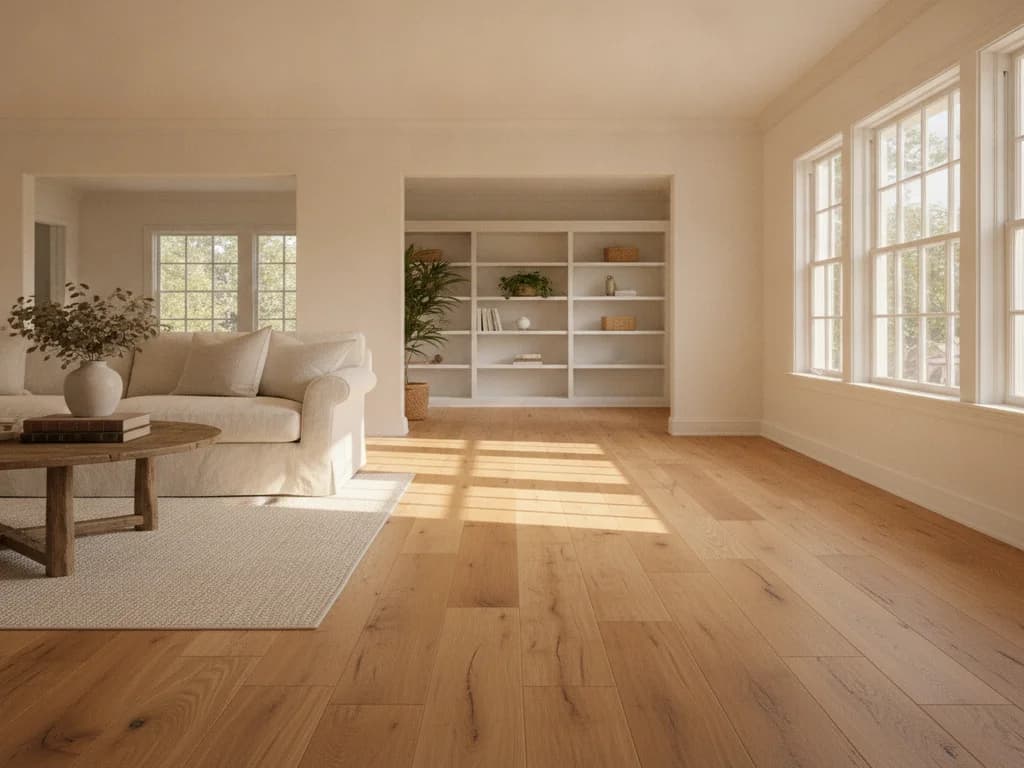
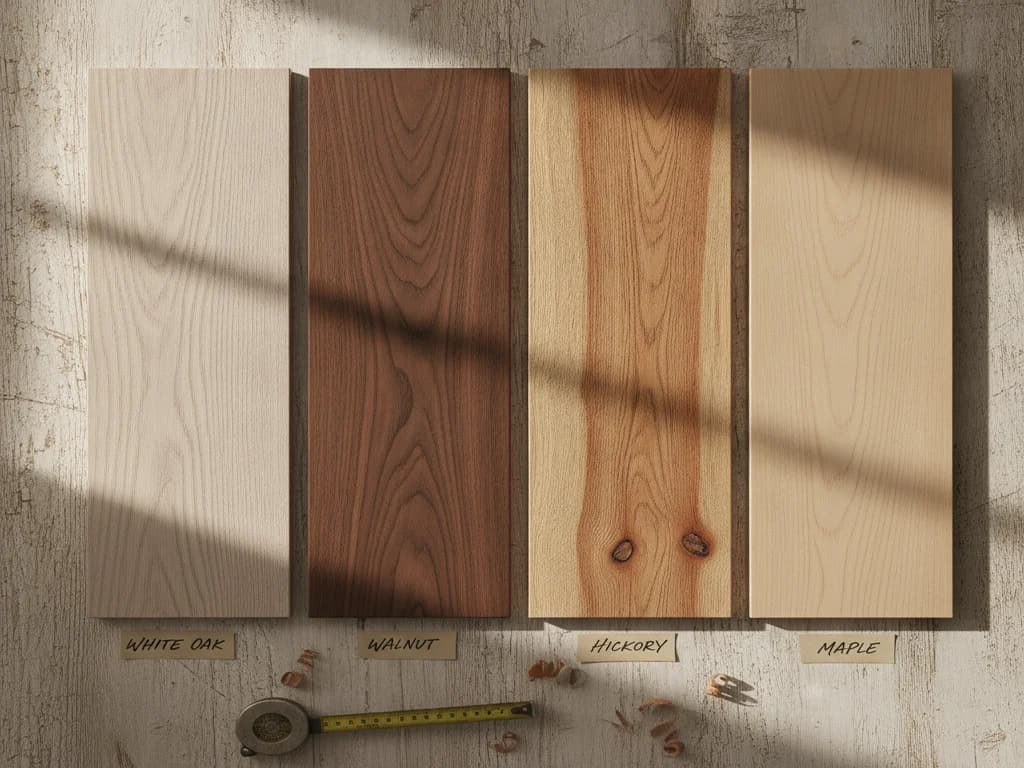
Both take the same finishes: a two-component waterborne system (Bona Traffic HD is the benchmark most installers name), a penetrating hardwax oil like Rubio Monocoat, or a factory-cured aluminum-oxide finish on a prefinished board. Prefinished engineered arrives with a finish more durable than anything that can be applied on site, and site-finished floors — solid or engineered — give you a flush, bevel-free surface and complete control of the color. If you are drawn to a particular species and want to see how the grain behaves before deciding, our American white oak page walks through it.
How to Read a Spec Sheet Without Getting Sold
Four numbers tell you nearly everything about an engineered floor: overall thickness, wear-layer thickness, core material, and ply count. A fifth, how the veneer was cut, tells you how it will look. Mills operating at the level of Mirage, Lauzon, or DuChâteau publish all of it plainly. When a product sheet is vague about wear layer — "real wood veneer," no measurement — that vagueness is itself the answer.
The other thing to read is the warranty, specifically whether the finish warranty and the structural warranty are the same document. They usually are not, and the finish warranty is usually the shorter one. Neither warranty survives a floor installed outside the manufacturer's humidity range, which brings the question back around to your house rather than the box.
How We'd Decide in Your Home
Slab on grade, radiant heat, a below-grade room, or a wide plank you have already fallen for: engineered, with the thickest veneer and best core the budget allows. Wood subfloor above grade, a narrower board, a stable well-conditioned house, and a plan to keep this floor for the rest of the time you own the place: solid hardwood is still the strongest long-term value, because you can sand it repeatedly and it never becomes a replacement job.
Everything else in between is genuinely a coin flip decided by product quality rather than category, which is why the honest version of this comparison is less "engineered or solid" and more "which specific floor, over which specific subfloor."
If you're not sure which one fits your space, Renaissance Floors offers free, no-pressure estimates — we'll look at your subfloor, test what needs testing, and tell you plainly what will perform where you're installing. Call (916) 749-0272.
This article is part of our guide to how flooring materials differ, which covers what separates the materials structurally, and the vocabulary the trade uses to describe them.
Explore related
Good to Know
Frequently Asked Questions
Is engineered hardwood real wood?
Yes. The surface is a genuine hardwood veneer — the same species, grain, and finish options as solid wood. What differs is the construction underneath: a plywood or HDF core in cross-laminated layers, which is what gives it dimensional stability that solid wood cannot match. Laminate and vinyl use printed images; engineered hardwood does not.
Can engineered hardwood be refinished?
It depends entirely on the wear layer. A thick sawn veneer can take a full sand and refinish, sometimes more than once. A thin rotary-peeled veneer cannot survive aggressive sanding and is limited to light abrasion and a recoat. Ask for the wear-layer measurement in millimeters before you buy, because the category name tells you nothing on its own.
How thick should the wear layer be on engineered hardwood?
Thicker is better, and the honest threshold is whatever allows the floor to be sanded at least once. Products range from fractions of a millimeter up to several millimeters of sawn face. If a spec sheet says only real wood veneer with no measurement, treat that as a thin veneer until proven otherwise.
Can engineered hardwood be installed over concrete?
Yes, and it is one of the main reasons to choose it. Solid hardwood is not recommended over a slab because it cannot be nailed into concrete and responds sharply to vapor drive from below. Whatever goes down, the slab should be moisture-tested with an in-situ relative-humidity probe under ASTM F2170 and prepped properly before adhesive is applied.
Can solid hardwood be installed over radiant heat?
Generally no, and most manufacturers will not warrant it. Radiant systems deliberately cycle the floor through daily temperature and moisture changes, and a solid board reacts to that across its full width. Engineered construction rated by its maker for radiant use is the standard answer, installed with the system commissioned and running beforehand.
Which is more expensive, engineered or solid hardwood?
It depends far more on species, grade, plank width, and wear-layer thickness than on the category. A premium wide-plank engineered floor with a thick sawn veneer can cost more than a narrow solid strip floor in a common species. Installed cost also shifts with method, since gluing, nailing, and floating are different labor.
Does engineered hardwood feel different underfoot?
Installed well over a sound subfloor, most people cannot tell the difference. A floating engineered floor can sound slightly hollower than a nailed or glued one, which is a function of the installation method rather than the material — the same product glued down feels notably more solid.
Why are wide-plank floors usually engineered?
Because movement scales with width. A board twice as wide moves roughly twice as far across its face for the same change in moisture content, so a wide solid plank opens seasonal gaps that a narrow strip floor never shows. Cross-laminated construction is what keeps a wide board flat through the year.
Which should I choose for a whole-home installation?
If the home is on a slab or has below-grade rooms, engineered handles the range better and lets you run one material throughout without changing construction at the stairs. If the house is above grade on a wood subfloor and you want a floor that can be sanded repeatedly across decades, solid hardwood is still the stronger long-term choice.
Written by
Owner & Lead Installer, Renaissance Floors
15+ years of hands-on flooring experience across Greater Sacramento & Northern California. Works on hardwood and engineered installation, refinishing, subfloor preparation, and moisture testing — and writes these guides from what the jobs actually teach.
CSLB C-15 licence #1060673
Related
Keep Reading
Related pages: Flooring Glossary, Chevron, European White Oak, and French Oak.
Ready for Floors You'll Love?
Ready to talk through your project? Free estimates throughout Greater Sacramento & Northern California.