Homeowner Tips
Acclimating Hardwood in a Dry Mountain Climate
In dry, high-elevation Sierra homes, skipping acclimation and moisture testing is how floors gap, cup, and check. Here's how it's done right.
Homeowner Tips · 9 min read
Published July 16, 2026 · Updated July 28, 2026
Acclimation is the least glamorous step in a hardwood install and the one most often shortchanged — which is a shame, because in a dry mountain climate it's often the difference between a floor that stays flat for decades and one that gaps or cups the first season. If you take away one thing before your install, let it be this: the wood needs to reach terms with your home before it goes down, not after.
What Acclimation Actually Is
Every piece of wood has an equilibrium moisture content — the moisture level it settles at once it stops trading water with the air around it. That number tracks the humidity of the room it lives in. Wood that arrives on a delivery truck was stored somewhere else, at some other humidity, and it is almost never in balance with your home on day one. Acclimation is simply letting the flooring sit inside the finished, conditioned space until it stabilizes at the moisture content it will actually live at year-round. Nail down a plank that hasn't gotten there, and it will keep moving after installation — shrinking and pulling apart, or swelling and pushing into its neighbors.
It's worth being precise about what acclimation is not. It is not a waiting period. It is not a box of flooring sitting in a hallway for a week while the painters finish. It is a measurable condition the material either reaches or doesn't, and the only way to know which is to measure it.
The Number That Actually Matters
Moisture content is expressed as a percentage of the wood's oven-dry weight, and it's the number every decision in this article turns on. The NWFA points most interiors at roughly 30 to 50 percent relative humidity, and wood held in that band typically settles somewhere around 6 to 9 percent moisture content. Mills kiln-dry flooring to land inside that window, which is why a well-run project in a well-conditioned house often needs very little adjustment.
The problem is that the number is a target, not a guarantee. A pallet that sat in a humid warehouse, rode an open trailer through weather, or waited three weeks in a garage has had ample opportunity to drift. The board's history is invisible; only the meter tells you where it ended up.
Why the Mountain Target Runs Lower
Sierra and foothill homes swing hard between seasons: humid, monsoon-influenced summers and extremely dry winters, when wood stoves and forced-air heat can pull indoor humidity down into the teens. Altitude and low winter humidity mean the target equilibrium moisture content in a mountain home is often lower than what the same flooring would settle at in a coastal or valley house — sometimes noticeably so.
That has a consequence people miss. If your winter living room runs far below the 30 to 50 percent band, then a floor installed at a textbook moisture content is still going to dry down and shrink the first time the stove runs hard. The right move is to acclimate toward the conditions the house will actually hold, and if those conditions are extreme, to address them — with humidification, with a narrower board, or with engineered construction — rather than pretending a standard number applies. This is the same reasoning behind our usual recommendation of engineered over solid construction in mountain homes.
Meters, and What a Reading Is Worth
Pros measure with pin or pinless meters from makers like Wagner and Lignomat. Pin meters drive two small probes into the board and read electrical resistance between them; pinless meters scan the surface with a sensor pad and read a shallow depth without marking the wood. Both work. Both need to be set for the species being tested, because density changes the reading, and a meter left on a generic setting can be off by a full percentage point or more.
One reading is not data. We pull readings from boards spread across the lot, from different cartons and different parts of the stack, because a pallet does not dry evenly and the boards on the outside of a bundle behave differently from the ones buried in the middle. What matters is the spread as much as the average: a tight cluster means the material is settled, and a wide scatter means it's still moving.
Test the Subfloor, Not Just the Wood
Acclimation isn't only about the flooring — the surface underneath has to be in range too. Before anything goes down we take readings on both, and we look at the gap between them. NWFA guidance is that a wood subfloor and the flooring going over it should be within about four percentage points for narrow strip material, and within about two points for planks three inches and wider. A larger spread means one of them is going to move toward the other after the floor is nailed down, and the wood always wins that argument at the expense of the floor's flatness.
That tighter tolerance on wide planks is not a technicality. Wide-plank floors are what most mountain-modern homes want, and a wide board moving even slightly across its face shows far more than a narrow one does — which is why wide-plank versus standard-width is a moisture decision as much as an aesthetic one.
Concrete Slabs Need Their Own Test
A slab is a different animal, and a pin meter is the wrong tool for it. Concrete is tested for internal relative humidity using in-situ probes drilled into the slab under ASTM F2170, which reads the moisture deep inside rather than what has evaporated off the surface on a dry afternoon. A slab that reads fine on top can still be carrying enough moisture at depth to feed the underside of a wood floor for years.
Slab preparation follows ASTM F710 — clean, flat, sound, free of curing compounds and adhesive residue that would compromise a bond. On top of that, the assembly needs a proper vapor retarder, because no amount of acclimation upstairs protects a floor from moisture arriving from below. Newer construction on the California side of the Sierra puts plenty of living space directly on slab, and every one of those installs deserves the test rather than an assumption.
Acclimate With the House Running
Here's the part people miss: wood should acclimate to the home's normal operating conditions, not to a cold, empty jobsite. That means the HVAC or radiant heat should be running and the house held at roughly the temperature and humidity you'll actually live in before and during acclimation. Setting flooring inside an unheated cabin in November tells you nothing useful, because the day you fire up the wood stove and the heat, the whole environment changes and the wood starts chasing it.
Wet trades have to be finished first, too. Drywall mud, fresh paint, tile mortar, and self-leveling underlayment all release a large volume of water into a closed house, and a floor acclimating alongside them is equilibrating to a temporary swamp rather than to your home. Acclimation done in the home's real, conditioned state is the only kind that means anything.
Radiant Heat Changes the Order of Operations
A radiant floor system isn't just a heat source — during acclimation it's the thing that determines what the subfloor's moisture content will be. The sequence matters. The system gets commissioned and run before the flooring arrives, brought up in stages over several days rather than switched on at full output, so the slab or gypsum topping releases its residual moisture and the assembly reaches a steady state. Then we measure. Then the wood comes in and acclimates over a subfloor that is already at its service condition.
Do it the other way around — acclimate the wood, install it, then fire the radiant for the first time — and the subfloor dries out underneath a finished floor. The wood follows it down, and you get gapping across an otherwise perfect install.
Does Engineered Wood Need Acclimating Too?
Yes, though the conversation is different. Engineered planks move far less because their plies are cross-laminated against each other, and many manufacturers specify a shorter conditioning period as a result — some premium products are engineered to be installed with minimal on-site conditioning at all. What doesn't change is the testing. The subfloor still has to be measured, the slab still has to pass its RH test, and the room still has to be at living conditions.
The failure we see with engineered isn't the plank moving; it's the plank installed over a subfloor nobody checked. Stability in the material buys you tolerance for a wider seasonal swing. It buys nothing at all against a wet slab.
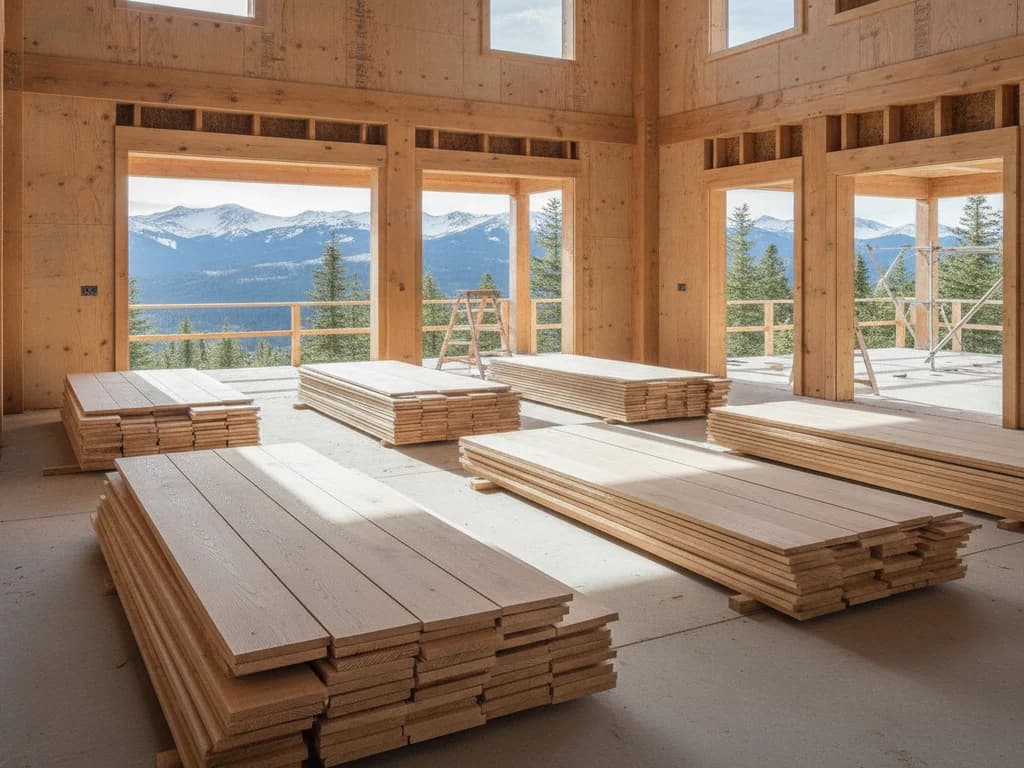
How the Material Should Sit While It Settles
Boards can only exchange moisture with air they're actually touching, and a sealed carton is very good at preventing that. Cartons get opened and the material cross-stacked with spacers between layers so air moves through the stack. It goes in the middle of the room it will be installed in, up off a concrete slab, away from exterior walls, and well clear of supply registers, sunny south-facing glass, and the wood stove — all of which create a local microclimate that will condition one end of a bundle differently from the other.
Stacking flooring against an exterior wall in a mountain house in winter is a reliable way to produce boards that read at two different moisture contents from the same carton.
When the Wood Arrives Too Far Off
Sometimes the readings come back badly out of range, and the honest answer is that acclimation won't fix it on a normal schedule. Wood carrying several points more moisture than the house will hold does not shed that in a week, and a bundle that arrived overdried can pick moisture back up unevenly, cupping in the stack before it's ever installed. Occasionally the right call is to send material back rather than install it and hope.
This is the conversation nobody wants to have on install day, which is exactly why the measurement happens before the crew and the adhesive show up. A two-day delay is inconvenient. A floor that has to come out is not.
What Goes Wrong When You Skip It
The failures are predictable. Wood installed too wet shrinks as it dries down over the first heating season and opens gaps between boards — thin dark lines you'll see all winter. Wood installed too dry swells when summer humidity returns and, with nowhere to go, the edges lift into cupping. Push that further and the floor can buckle away from the subfloor entirely. In very dry conditions, boards that lose moisture too fast can surface-check — fine cracks that open along the grain.
None of these are finish problems or installer sloppiness in the usual sense; they're moisture problems, baked in before the first plank was ever fastened. That also makes them expensive to correct, because sanding a cupped floor flat while it's still swollen removes material that you need back when the boards dry and the crown appears. Timing a repair means waiting out a full seasonal cycle, which is a long time to live with a floor you just paid for.
How We Handle It
We deliver the flooring into the finished, climate-controlled space, get the home operating at its real conditions, and let the wood acclimate while we take meter readings on both the flooring and the subfloor rather than working to a fixed calendar. We write the numbers down — jobsite temperature and relative humidity, subfloor readings, flooring readings — because a documented starting point is the only way to tell later whether a floor moved because of the material, the install, or how the house has been run since. Engineered wide-plank white oak, which we favor for mountain homes, moves less to begin with, but it still gets tested and acclimated. Stability doesn't excuse skipping steps.
We'd rather lose a couple of days up front than chase a cupped or gapped floor after the fact. Homeowners have a part in it too: keep the house running through the install week, and expect the ongoing humidity habits that protect the floor afterward to start the day it goes down.
If you're planning a hardwood project in a dry, high-elevation home and want it done in a way that survives the first winter and the first summer, Renaissance Floors is a licensed CSLB C-15 contractor and we moisture-test and acclimate every install. Call (916) 749-0272 for a free estimate.
This article is part of our guide to caring for a floor, which covers what actually shortens a floor's life, and the maintenance that measurably extends it.
Good to Know
Frequently Asked Questions
How long should hardwood acclimate before installation?
There is no universal number, which is why any contractor quoting a fixed figure is guessing. What matters is the wood reaching equilibrium with the home's real conditions, verified by moisture readings on both the flooring and the subfloor rather than by counting days on a calendar.
What moisture content should hardwood be at before installation?
Most interiors held at the 30 to 50 percent relative humidity range NWFA points to will settle wood somewhere around 6 to 9 percent moisture content. The more useful target is whatever your specific home actually holds year-round, since a mountain house that runs far drier in winter shifts that window down.
Does acclimation matter more at altitude?
Yes, because the swing is wider. Mountain homes run drier through the heating season than valley homes, so wood installed at the wrong moisture content has further to move. That is also why engineered construction is frequently the better recommendation up here.
Can I acclimate flooring in a garage?
No. A garage is not the environment the floor will live in — it is colder, damper, and unconditioned. Acclimating there equilibrates the wood to the wrong target, which is worse than not acclimating at all because it produces false confidence.
Should flooring be left in the boxes to acclimate?
No. Sealed cartons prevent the boards from exchanging moisture with the room, so the material sits unchanged while the calendar runs. Cartons should be opened and the flooring cross-stacked with spacers so air circulates through the whole stack rather than around the outside of it.
Does engineered hardwood need to be acclimated?
Usually yes, though often for a shorter period, since cross-laminated construction moves far less than solid wood and some manufacturers specify minimal on-site conditioning. The subfloor testing does not get shortened at all, because a stable plank offers no protection against a wet slab underneath it.
How do you test a concrete slab for moisture?
With in-situ relative humidity probes drilled into the slab following ASTM F2170, which measure conditions inside the concrete rather than at the surface. Surface readings are unreliable because a slab can dry on top on a warm day while still holding substantial moisture at depth.
Should the heating be on while flooring acclimates?
Yes. The house needs to be at its normal living temperature and humidity so the wood equilibrates to real conditions. This matters especially in a second home that normally sits unconditioned — tell your installer if that is the case, because it changes the plan.
Should radiant heat be running before hardwood is installed?
It should be commissioned and brought up in stages beforehand, so the slab or topping releases residual moisture and reaches a steady state before the wood arrives. Installing first and firing the system later dries the subfloor under a finished floor, which produces gapping.
What happens if hardwood is not acclimated?
It moves after installation instead of before. Wood installed wetter than its service condition shrinks and opens gaps; installed drier, it swells and can cup or buckle against the walls. Neither is repairable by refinishing, because the problem is dimensional rather than cosmetic.
Written by
Owner & Lead Installer, Renaissance Floors
15+ years of hands-on flooring experience across Greater Sacramento & Northern California. Works on hardwood and engineered installation, refinishing, subfloor preparation, and moisture testing — and writes these guides from what the jobs actually teach.
CSLB C-15 licence #1060673



Related
Keep Reading
Related pages: Alex Both — Owner & Lead Installer, Scratches & Dents, European White Oak, and French Oak.

Ready for Floors You'll Love?
Ready to talk through your project? Free estimates throughout Greater Sacramento & Northern California.