Homeowner Tips
When to Refinish vs. Replace Your Hardwood Floors
A tired hardwood floor doesn't always need to be torn out. Here's how to tell whether refinishing will bring it back — or whether it's time to replace.
Homeowner Tips · 9 min read
Published July 14, 2026 · Updated September 12, 2026
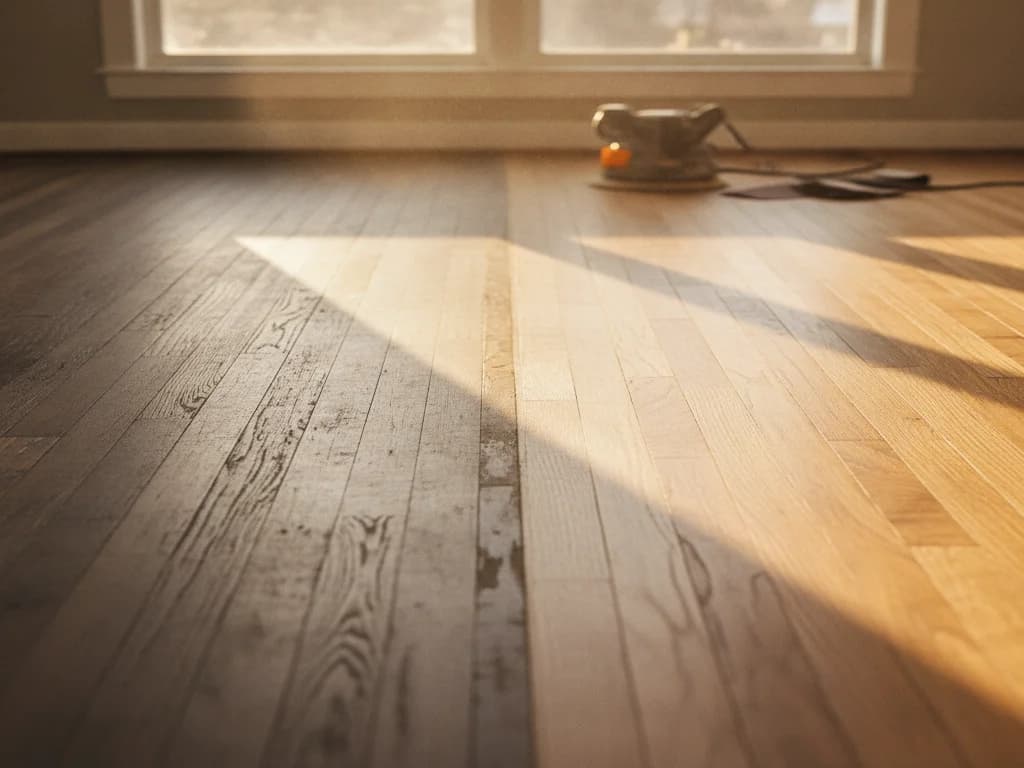
A hardwood floor that's lost its shine, picked up scratches, or just looks dated doesn't automatically mean a full replacement. Refinishing can bring a tired floor back to like-new condition at a fraction of the disruption of tearing it out — but it isn't the right call in every situation, and the version of refinishing your floor needs may be much lighter than you assume. Here's how to read the floor you have, and what actually happens once the machines come out.
Where the Wear Actually Lives: Finish, Wood, or Structure
Almost every refinishing question resolves once you work out which of three layers is damaged. The finish is the film on top, and wear that lives there looks like dullness, hazing, traffic paths that have gone matte while the edges of the room stayed shiny, and fine scratching you can feel with a fingernail but that has no color to it. The wood is underneath, and damage there has color: gray or black staining, deep gouges, a dent with crushed fibers, a sun-faded band beside a window. Structure is below both, and it shows as movement, squeaks, hollow sound, boards that flex, or a floor that has cupped or buckled.
Finish wear is the cheapest problem in flooring and the easiest to fix. Wood damage costs a full sand and is solvable while there is material left to remove. Structural problems are not refinishing problems at all, and sanding a floor that moves gets you a beautifully finished floor that still moves.
Simple Checks That Tell You Which Layer Is Worn
There are a few things you can check yourself in ten minutes. Put a few drops of water on a worn traffic lane and leave them for a couple of minutes. If they bead and wipe away clean, there is finish left there. If they darken the wood or leave a mark, the finish is gone or nearly gone in that spot and the wood is taking on moisture directly. Do the same test in a protected area, like under a rug or inside a closet, to see what an intact area looks like on the same floor.
Compare a traffic lane against a protected corner in raking light, standing at one end of the room with the light low rather than looking straight down. That comparison tells you how much sheen has actually been lost. Then find an exposed edge somewhere: a floor vent cutout, a threshold at a doorway, or the run of floor under a removed transition. That is where you can see the floor in cross-section and judge how much wood sits above the tongue on a solid floor, or how thick the real-wood wear layer is on an engineered one. Guessing at that from the surface is the single most common mistake homeowners make about their own floors.
How Much Wood Is Left to Sand
Solid hardwood is wood all the way down to the tongue, which usually leaves room for several full sandings across a long service life; how many depends on how aggressive the previous ones were rather than on any published number. Engineered hardwood is different in kind rather than degree. The real wood is a veneer over a plywood or composite core, and thickness varies enormously between products, from paper-thin at the value end to several millimeters on floors built to be sanded. A thick wear layer can take a full sand once or twice. A thin one cannot take one at all.
There is no way to know which you have from the top surface, which is why the vent cutout matters. If a previous owner refinished the floor and you have no records, an installer looking at an exposed edge can usually tell you within a reasonable margin. If the answer is that there is not enough left, that is not the end of the road: it moves you toward a recoat, or toward the comparison between refinishing and replacing, where the math depends on the floor's remaining life rather than on how it looks today.
When a Screen-and-Recoat Is Enough
A screen-and-recoat abrades the existing finish with a fine screen or a maroon pad, cleans the surface thoroughly, and applies one or two fresh coats on top. No wood is removed. It is dramatically faster and cheaper than a full refinish, produces far less dust, and puts the rooms back in use sooner. The catch is that it only renews the finish. Anything with color in it — staining, graying, deep scratches into the wood — will still be there afterward, under a new coat.
The window for a recoat is open while wear is still confined to the finish, and it closes the moment traffic lanes reach bare wood, because a coat applied over a bare patch will not match and the exposed wood has usually already picked up dirt and moisture. Waxed floors and some factory finishes also need testing first, since new finish will not bond to a contaminated or non-compatible surface, and adhesion failure means peeling later. The practical decision between a screen-and-recoat and a full refinish comes down to that single question of whether the damage has color.
What a Full Sand-and-Finish Actually Involves
A full refinish is a sequence, and each step exists for a reason. Sanding starts with a coarse grit chosen for the condition of the floor — coarse enough to flatten and remove old finish, no coarser, because every unnecessary pass costs wood — and steps up through progressively finer grits. Skipping a grit leaves scratches from the previous one that the finer paper cannot remove, and those scratches show up under stain as visible lines. A large belt or planetary machine handles the field, an edger works the perimeter where the big machine cannot reach, and corners and stair returns get scraped or sanded by hand. The transition between edger and field work is where amateur jobs give themselves away, which is why a final pass with a buffer or multi-disc machine is used to blend the two.
If the floor is being stained, the surface may be water-popped first: a light, even application of water raises the grain and opens the wood so stain penetrates more deeply and evenly, which produces a richer, more uniform color. After sanding, the floor is vacuumed and tacked meticulously, because anything left on the floor gets sealed under the first coat permanently. Then comes a sealer or first coat, an abrasion between coats so the next one bonds, and two or more finish coats depending on the system and the expected traffic. Floor refinishing done properly is mostly preparation; the coats are the short part.
Choosing a Finish: Waterborne, Oil-Modified, and Hardwax Oil
The finish decides how the floor looks, how it ages, and how you will maintain it. Waterborne polyurethanes dry fast, have relatively low odor and VOC content, and stay clear over time rather than yellowing, which keeps a white oak floor looking pale and neutral for years. The two-component commercial-grade products — Bona Traffic HD and Loba 2K Supra are the standard names — are considerably more abrasion resistant than single-component versions and are what we would specify in a household with dogs or heavy traffic; lighter single-component waterbornes such as Bona Mega suit quieter homes at lower cost.
Oil-modified polyurethane is the traditional option: slower to dry, higher odor during application, and it ambers with age, adding a warm golden cast that some people want on a red oak floor and some people specifically do not want on white oak. Hardwax oils — Rubio Monocoat is the one most homeowners have heard of — work differently again. They penetrate the wood rather than building a film, give a very natural matte look with visible texture, and can be spot-repaired in a worn area without recoating the whole room — in exchange for a maintenance routine of periodic re-oiling and a surface with less film protection. The full tradeoff between water-based and oil-based polyurethane is worth understanding before you pick a color, because the finish chemistry constrains the color.
Sheen Is a Maintenance Decision, Not Just a Look
Sheen is usually chosen as an aesthetic and then lived with as a maintenance regime. Gloss reflects like a mirror and puts every micro-scratch, dust mote, and paw print on display. Matte scatters light and hides most of it, which is why nearly every current wood floor is matte or satin rather than semi-gloss. Satin sits in between and is the safe default in a busy house. The one caveat is that very flat finishes can show smudging and footprints in certain lights, so the choice between matte and satin is worth making on a sample in your own room rather than in a showroom.
Stain Color, Species, and Why Samples Have to Be on Your Floor
Stain color is a reaction between a pigment and a particular piece of wood, not a paint chip. Red oak has a pink-to-red undertone that pulls warmth into any stain applied over it, while white oak reads browner and more neutral and takes cool and gray tones far more predictably — the same product from a range like DuraSeal will land in a different place on each. Maple and birch are dense and close-grained, which makes them prone to blotching and means they need either a conditioner, a different approach entirely, or an honest conversation about staying natural. Hickory's natural color variation stays visible through almost any stain.
The only reliable way to choose is to have sample boards made from your actual floor after sanding, in the actual room, and to look at them in daylight and at night. A color that looks perfect on a supplier's board in a warehouse routinely looks wrong in a west-facing Sacramento living room at four in the afternoon.
Dust, Odor, and How Long the House Is Out of Use
Modern equipment with containment captures most sanding dust, but fine dust still migrates, so sealing adjacent rooms and shutting down HVAC during heavy sanding are both worth doing. The occupancy question is really about the finish. Waterborne systems are lower odor and allow lighter foot traffic sooner; oil-modified takes longer between coats and holds odor longer, which matters if anyone is staying in the house. In both cases drying and curing are different things: a floor can feel dry to the touch and still be curing underneath for a period measured in days to weeks. Furniture goes back before rugs do, because a rug trapping solvent under itself on an uncured floor can leave a permanent mark. Once the floor is in service, ordinary hardwood care is what determines how long it is before you are reading this again.
What Refinishing Cannot Fix
Refinishing is a surface operation. It does not fix squeaks, because those come from fasteners and subfloor movement below the wood. It does not correct boards that were installed badly, and it does not undo cupping or buckling caused by a moisture problem that is still active — sanding a cupped floor flat while it is still wet produces a crowned floor once it dries. Pet urine that has penetrated into the wood is deeper than any safe sanding depth and normally means those boards are cut out and replaced. And no amount of sanding adds wood back to a floor that has already been taken to its limit.
Getting an Honest Read on Your Floor
The only reliable way to know which of these your floor needs is an in-person look at an exposed edge, at the wear pattern in raking light, and at whether the subfloor is doing anything it shouldn't. Photographs consistently miss the details that decide it. Plenty of floors that homeowners have written off need a recoat and a weekend; plenty of floors that look fine from the doorway have a moisture problem that has to be solved before anyone sands anything.
If your hardwood is looking tired and you're not sure whether it needs a recoat, a full refinish, or replacement, Renaissance Floors offers free estimates for homeowners in Roseville and the Greater Sacramento and Northern California area. Call (916) 749-0272 and we'll give you a straight answer after actually looking at your floor.
This article is part of our guide to caring for a floor, which covers what actually shortens a floor's life, and the maintenance that measurably extends it.
Explore related
Good to Know
Frequently Asked Questions
What is the difference between a screen-and-recoat and a full refinish?
A screen-and-recoat abrades the existing finish and adds fresh coats without sanding to bare wood, so it renews the surface while the wood is untouched. A full sand-and-finish removes the finish and a thin layer of wood, which is what lets it remove stains, deep scratches, and color in the wood itself.
How do I know if my hardwood floor can be refinished?
On solid hardwood the question is how much wood remains above the tongue, and on engineered it is the thickness of the real-wood wear layer. In both cases the honest check is looking at an exposed edge such as a floor vent cutout or a threshold, rather than judging from the surface.
How can I tell if my floor just needs a recoat?
Put a few drops of water on a worn traffic lane. If they bead and wipe away clean, finish remains and a recoat is likely enough. If they darken the wood or leave a mark, the finish is gone in that area and a full sand is the realistic option, since new finish will not blend over bare wood.
Which finish is best for hardwood floors?
For most households a two-component waterborne polyurethane offers the best combination of abrasion resistance, low odor, and color stability, since it does not yellow with age. Oil-modified polyurethane costs less and ambers over time, and hardwax oil gives a natural matte look that can be spot-repaired but needs periodic re-oiling.
Does refinishing hardwood floors create a lot of dust?
Modern sanding equipment with dust containment removes most of it, but no system is perfect and fine dust migrates through a house. Sealing off adjacent rooms, shutting HVAC down during heavy sanding so the return does not distribute dust, and removing soft furnishings from the work area are all worth doing.
How long does refinishing hardwood floors take?
Site-finished work means sanding, then staining if you are changing color, then multiple coats with drying time between each. The rooms are out of use for that period, and the finish continues curing afterward before rugs and heavy furniture go back. We give a realistic day count with the estimate.
Can refinishing fix pet stains?
Only if the discoloration is still in the finish. Urine that has soaked into the wood leaves a dark mark deeper than the amount of material that can safely be sanded away, so those boards are normally cut out, replaced with matching stock, and blended before the floor is finished.
Can I change the color of my hardwood floor by refinishing it?
Yes, within limits set by the species. Red oak carries a pink undertone that pulls warmth into any stain, while white oak takes cool and gray tones far more predictably, and maple resists stain unevenly. Sample boards made from your own sanded floor are the only reliable way to choose a color.
When can I put furniture and rugs back after refinishing?
Furniture generally returns once the finish has dried enough for light traffic, but area rugs wait considerably longer because trapping solvent under a rug on uncured finish can leave a permanent mark. Follow the finish manufacturer's cure schedule rather than judging by how dry the surface feels.
Will refinishing fix a squeaky or uneven floor?
No. Squeaks come from fasteners moving and subfloor panels flexing beneath the flooring, and sanding the surface does not touch either. Similarly, a floor that has cupped because of an active moisture problem will cup again, or crown, if it is sanded flat before the moisture source is corrected.
Written by
Owner & Lead Installer, Renaissance Floors
15+ years of hands-on flooring experience across Greater Sacramento & Northern California. Works on hardwood and engineered installation, refinishing, subfloor preparation, and moisture testing — and writes these guides from what the jobs actually teach.
CSLB C-15 licence #1060673

Related
Keep Reading
Related pages: Hard Maple, Parquet, European White Oak, and French Oak.

Ready for Floors You'll Love?
Ready to talk through your project? Free estimates throughout Greater Sacramento & Northern California.