Homeowner Tips
The Best Flooring for Dogs and Busy Households
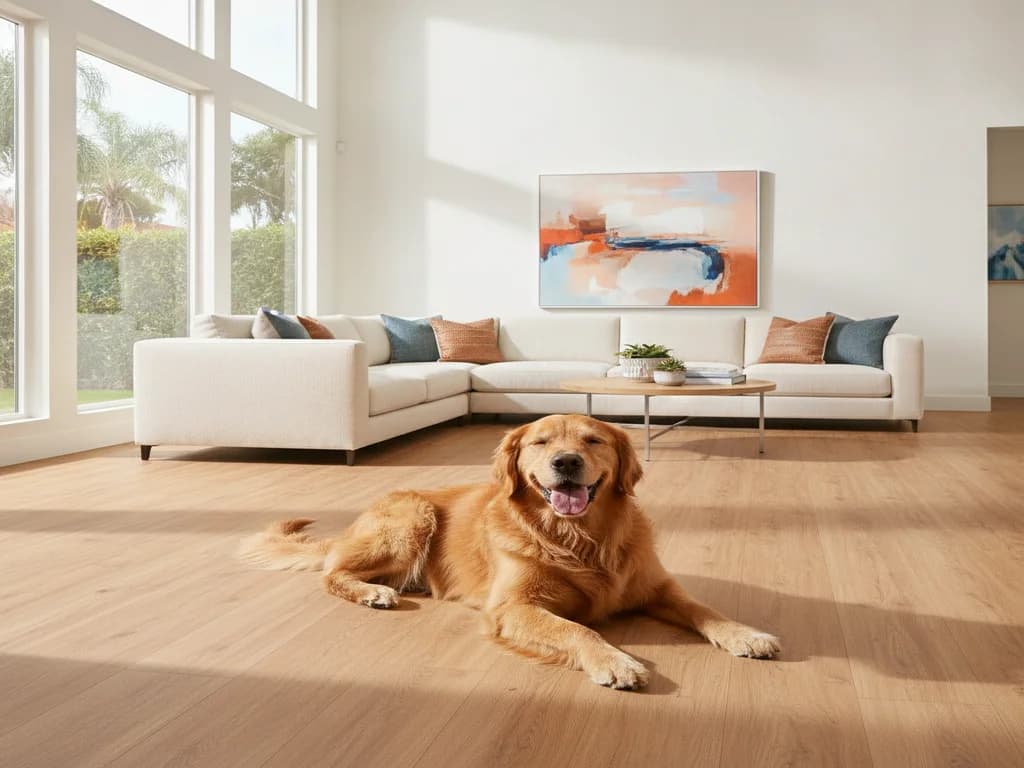
Scratch resistance, traction, and easy cleanup matter most with pets. These floors hold up beautifully to real family life.
Homeowner Tips · 8 min read
Published July 14, 2026 · Updated September 12, 2026
If you share your home with dogs, cats, or a busy household of kids and guests, your floors take a different kind of abuse than a showroom sample ever sees. Claws, water bowls, muddy paws, dropped toys, and constant foot traffic all test a floor in ways that matter more than how it looks on day one. The useful question is not which floor is pet-proof, because none of them are. It is which of the three ways floors fail in pet homes is most likely to happen in yours.
The Three Ways Floors Fail in a Pet Household
Abrasion is the first: fine scratching from nails and from the grit that paws carry in, which dulls a finish gradually and shows up first in the paths a dog actually runs. Impact is the second: dents from a dog launching off a bed, a dropped ceramic bowl, or a crate leg. Staining and odor is the third, and it is the only one of the three that can end a floor's life outright rather than just age it. These are different problems with different solutions, and most of the confusion in pet flooring advice comes from treating them as one. A floor can be excellent at resisting dents and mediocre at resisting scratches, or effectively immune to both and still ruined by a puppy that was not house-trained for six months.
Why Janka Hardness Predicts Dents, Not Scratches
The Janka scale measures the force required to embed a steel ball halfway into a wood sample, which makes it a dent test. Among common domestic species, hickory sits around 1820, hard maple around 1450, white oak around 1360, red oak around 1290, and walnut around 1010. That spread is real and it matters for impact: a floor in hickory genuinely takes a dropped bowl better than one in walnut. What Janka does not predict is scratching, because a nail mark is almost always a scratch in the finish film sitting on top of the wood, not a groove in the wood itself. This is why homeowners are sometimes disappointed after paying for the hardest species available and still seeing fine lines across the hallway within a year. They bought dent resistance and expected scratch resistance.
The Finish and the Grade Do More Than the Species
Once you understand that nail marks live in the finish, the finish becomes the most important specification on a wood floor for a pet household. Two-component waterborne finishes — Bona Traffic HD and Loba 2K Supra are the names installers reach for — are formulated for commercial abrasion resistance and hold up considerably better than a standard single-component coating, at a higher material cost. Hardwax oils such as Rubio Monocoat take a different approach entirely: less film on the surface, more penetration into the wood, and the ability to spot-repair a worn area without recoating a whole room, which some pet owners prefer even though the surface itself is less protected.
Sheen does more work than most people expect. A high-gloss surface behaves like a mirror and shows every micro-scratch across it, while a matte or satin surface scatters light and hides the same wear, which is most of why matte and satin finishes dominate current wood flooring. Grade and texture finish the job. A character grade with knots, mineral streak, and color variation camouflages marks that a clean, uniform, single-tone floor puts on display, and a wire-brushed texture breaks up reflections so that individual scratches never read as a line.
Traction, Stairs, and Older Dogs
Dogs need to grip a floor to move confidently, and a slick surface takes that away. The result is a dog that splays its legs, hesitates at doorways, or avoids a room entirely, and it gets worse with age, weight, and any joint problem. Texture is what solves it: wire-brushed or hand-scraped wood, or luxury vinyl with a genuine embossed surface rather than a smooth printed one. Stairs are the highest-consequence place in the house for this, because a slip on a landing is a different event from a slip in a hallway. Adding stair runners or treads is the single most effective traction change most households can make, and it also cuts the impact noise of a dog running up and down.
Urine Is a Different Problem Than Spilled Water
A tipped water bowl and a urine accident are not the same event. Urine carries salts and, as it breaks down, ammonia, and that chemistry reacts with wood and with some finishes rather than simply sitting on top of them. Left long enough it darkens the wood well below the surface, which is why pet urine staining is one of the few things a full sand-and-finish cannot reliably remove; the sanding depth available is a fraction of a millimeter and the stain has gone deeper. Worse, on a floor with seams that are not sealed, liquid reaches the subfloor and the smell stays there long after the surface has been cleaned, which is how homes end up with an odor that survives replacing the visible floor.
The variable you actually control is time. A puddle found in five minutes is a wipe. A puddle found the next morning on a wood floor is often a permanent mark. If your household includes a puppy in training, a senior dog with incontinence, or a cat that has opinions about its litter box, weigh that fact heavily and put a waterproof material in the rooms where accidents actually happen rather than trying to make every floor in the house survive them.
Where Luxury Vinyl Plank Earns Its Reputation
For most pet households, luxury vinyl plank is the straightforward answer, and its reputation is deserved for specific reasons rather than marketing ones. The plank itself is waterproof, so a missed accident does not swell or stain the material. The wear layer is a clear protective film measured in mils, and the difference between a 12 mil residential product and a 20 mil or thicker one is the difference between a floor that shows traffic in a few years and one that does not, so wear layer is the number to compare across lines like COREtec, Shaw Floorté, or Karndean. Damage is repairable one plank at a time, which matters when a single incident would otherwise mean refinishing a room.
The honest caveat is that a waterproof plank is not the same thing as a waterproof floor. On a floating installation, liquid that sits long enough finds the seams, travels underneath, and sits between the floor and the subfloor where nothing evaporates. The plank is fine; the smell is not. This is a cleanup-speed problem rather than a product defect, but it is worth knowing before assuming waterproof means unattended.
Tile and Carpet in the Rooms Where Each Still Fits
Tile is effectively immune to claws and to moisture, which makes it the correct choice for mudrooms, laundry rooms, and the run of floor where a dog comes in from a wet yard. Its weak point is grout, which is porous unless it is an epoxy or a high-performance formulation, so large-format tile with fewer joints performs better in a pet zone than a small mosaic. The tradeoffs are that it is cold and hard underfoot, which older dogs feel, and that a dropped dish breaks on it every time.
Carpet is the worst surface in the house for accidents, because it absorbs rather than sheds and the pad underneath it absorbs more. It still has a legitimate place in bedrooms, on stairs as a runner, and anywhere an old dog needs a soft, grippy place to lie down. The point is to choose it deliberately for those rooms rather than by default across a floor plan.
Nail Click, Impact Noise, and What Actually Quiets a Floor
Hard-surface floors amplify two sounds pet owners notice: the click of nails and the thud of a dog running. Trimmed nails address the first directly, and an underlayment addresses the second. A floating floor over a slab is the worst case, since the cavity under the planks acts as a drum, and a quality acoustic underlayment noticeably reduces it. Glue-down installations are quieter than floating ones because there is no cavity at all. Rugs and runners in the paths a dog actually uses do more than any product specification.
The Habits That Matter More Than the Material
Nail length is the highest-leverage habit in the house. If you can hear clicking on a hard floor, the nails are long enough to be doing damage, and a trim every few weeks changes what your floor looks like in five years. After that it is grit control: a proper walk-off mat outside and a second one inside, which is more important than it sounds in a Sacramento-area summer, when yards are dry and paws carry in fine dust that behaves like sandpaper. A tray under the water bowl catches the daily splash that otherwise sits at one edge of the floor for years. A towel by the back door during the rainy season handles the rest. None of this is complicated, and it consistently outperforms buying a harder floor. The routine care habits for hardwood apply the same way in a pet household, just with less margin for skipping them.
Matching the Floor to Your Actual Dog
An eighty-pound dog that sprints through the house needs impact and abrasion resistance, which means either luxury vinyl with a thick wear layer or a harder species in a character grade with a two-component finish. A small, calm, older dog needs traction far more than hardness, so texture and runners matter more than species. A household still in house-training, or one with a senior dog that has accidents, should put a waterproof surface in the rooms where accidents happen and stop trying to protect wood from a problem wood cannot win. Most homes end up mixing materials for exactly this reason, and there is nothing inconsistent about wood in the living room and a waterproof floor in the mudroom and laundry.
If you want a recommendation based on your real pets and household rather than a generic pitch, Renaissance Floors offers free estimates for homeowners in Roseville and the Greater Sacramento and Northern California area. Call (916) 749-0272 and we will tell you honestly what will hold up in your home.
This article is part of our guide to how to choose a floor, which covers the order the decisions actually come in, and which constraints are real rather than preference.
Explore related
Good to Know
Frequently Asked Questions
What flooring is best for dogs?
Luxury vinyl plank with a wear layer of 20 mils or thicker suits most dog households, because it is waterproof at the plank, resists abrasion, and can be repaired one plank at a time. Where you want real wood, a harder species in a character grade with a matte two-component finish is the combination that holds up.
Do dog nails scratch hardwood floors?
Yes, but they mark the finish rather than the wood in most cases, which is why the finish matters more than the species. Keeping nails trimmed makes a substantial difference, and a matte or wire-brushed surface in a character grade disguises the marks that do appear far better than a high-gloss uniform floor.
Does wood hardness actually matter with pets?
It matters for denting, not for scratching. The Janka scale measures resistance to a steel ball being pressed into the wood, so a harder species like hickory at roughly 1820 handles a dropped bowl or a dog jumping off furniture better than walnut at roughly 1010. Nail scratches happen in the finish regardless of species.
What flooring is best for dog accidents and urine?
Luxury vinyl and tile, because both are waterproof at the surface and liquid can be wiped up before it reaches the subfloor. Carpet is the worst choice, since it and the pad beneath it hold moisture and odor. Wood sits in between: a prompt wipe is usually fine, but standing urine stains and can reach the subfloor.
Can pet urine stains be sanded out of hardwood?
Only if the discoloration is still in the finish. Urine that has soaked into the wood leaves a dark mark deeper than the fraction of a millimeter a sanding can safely remove, so those boards are normally cut out and replaced, then blended into the surrounding floor before refinishing.
Is glossy flooring bad for dogs?
It can be. A glossy surface gives less traction, and dogs, especially older or larger ones, can struggle to get purchase on it and will sometimes avoid the room. A matte or textured finish is easier for them to move on, and it hides scratches better, so it is the better choice on both counts.
What flooring is best for an older dog that slips?
Texture is what provides grip, so wire-brushed or hand-scraped wood and embossed luxury vinyl outperform smooth, glossy surfaces. Runners on stairs and in hallways matter more than the floor itself for a dog with mobility problems, since stairs are where a slip has real consequences.
Is luxury vinyl plank scratch-proof with dogs?
No flooring is scratch-proof, but a thick wear layer resists claw marks far better than a wood finish does. Wear layer thickness in mils is the specification that predicts this, not the plank's overall thickness or its price, so compare that number directly between products.
Should I avoid wood floors entirely if I have pets?
No. Plenty of homes with dogs have wood floors that look good for years. The combination that works is a harder species, a character grade, a matte finish, trimmed nails, and prompt cleanup of accidents. What does not work is a soft species in a uniform grade with a gloss finish in a busy household.
How do I stop the clicking and echo of dogs on hard floors?
Trim nails first, since length is what causes the click. For the drumming sound of a dog running, a quality acoustic underlayment beneath a floating floor makes a real difference, glue-down installations are quieter still because there is no cavity, and runners along the paths pets actually use handle the rest.
Written by
Owner & Lead Installer, Renaissance Floors
15+ years of hands-on flooring experience across Greater Sacramento & Northern California. Works on hardwood and engineered installation, refinishing, subfloor preparation, and moisture testing — and writes these guides from what the jobs actually teach.
CSLB C-15 licence #1060673
Related
Keep Reading
Related pages: Luxury Vinyl Plank vs. Laminate, Matte vs. Satin Finish, European White Oak, and French Oak.
Ready for Floors You'll Love?
Ready to talk through your project? Free estimates throughout Greater Sacramento & Northern California.