Homeowner Tips
Caring for Wood Floors in a Vacation Home
A mountain home that sits empty between visits puts wood floors through humidity swings and freeze-thaw. Here's how to protect them year-round.
Homeowner Tips · 9 min read
Published July 16, 2026 · Updated July 28, 2026
Wood floors in a full-time home settle into a steady rhythm — heat runs, life happens, humidity stays roughly stable. A vacation home in the mountains lives a harder life. It sits closed up and often unheated for weeks, then swings back to warm and occupied when you arrive, and it does that through the dry cold of a Tahoe winter and the humid warmth of summer.
The distinctive thing about caring for a floor in a house you don't live in is that most of the care happens while you're not there. It's less a cleaning routine than a set of standing conditions you leave behind — and a short list of things to check the moment you walk back in.
The Real Enemy Is Humidity Swing
Wood constantly gains and loses moisture with the air around it, expanding when the air is humid and shrinking when it's dry. In a home nobody is regulating, that swing runs wider and faster than in an occupied house — parched in a heated-then-abandoned winter, damp in a shut-up summer. The result can be gaps that open in winter and cupping or crowning in summer.
The single best thing you can do is narrow that swing. NWFA guidance points interiors at roughly 30 to 50 percent relative humidity, and a floor held anywhere inside that band year-round will essentially never give you trouble. A floor that drops to single digits in February and climbs back in July is being asked to move twice a year, every year, for the life of the house.
Set the Thermostat for the Floor, Not the Bill
It's tempting to kill the heat entirely to save money while you're away, but a floor pays for it. Letting a mountain cabin go fully cold means the interior tracks every outdoor extreme, and it invites the freeze-thaw and condensation cycles that stress both floors and the home.
Hold the house at a modest set-back temperature instead — warm enough to keep the interior stable and to protect pipes and finishes. Two details make it work better. Keep interior doors open so the conditioned air actually circulates rather than leaving closed guest rooms at their own microclimate. And avoid the deep-setback-then-blast pattern, where the house sits at 45 degrees for a month and gets driven to 70 in three hours on arrival; the floor cares about the rate of change nearly as much as the range. A smart thermostat that lets you bring the house up gradually the day before you arrive solves this for the cost of a thermostat.
Know Your Numbers Before You Guess
You can't manage a swing you can't see. A pair of inexpensive wireless hygrometers — one upstairs, one on the lowest level — reporting to your phone turns humidity from a theory into a number, and it costs less than a single board replacement.
What you're looking for is not a perfect reading but a pattern. Which room runs driest in January. How fast the house dries out after the heat comes on. Whether the lower level stays damp through summer. Those patterns tell you where a humidifier belongs, whether a dehumidifier is worth running in the shoulder season, and — if a floor does start to move — which end of the year caused it.
Humidifying a House Nobody Is In
Portable humidifiers are useless for this purpose because they need refilling. If your winters run genuinely dry, the option that works in an empty house is a whole-home humidifier plumbed into the HVAC system, which runs unattended and can be set to hold a floor target.
That's a real expense and it isn't always justified. The honest calculus: it's worth it if the house holds a wide-plank solid floor, if you're seeing seasonal gaps that bother you, or if the house is heated hard all winter by a wood stove. It's usually not worth retrofitting for a stable engineered floor in a house that stays within a reasonable band on its own. The question is worth answering before installation rather than after the first winter.
The Departure Routine
Five minutes before you lock up prevents most of what goes wrong. Dry any standing water, particularly at entries and around tubs and sinks. Empty and clean anything that holds water. Set the thermostat to its holding temperature rather than off. Close blinds or shades on the south and west glass. Open interior doors. And walk past the water heater, under the sinks, and around the dishwasher one last time.
Consider shutting off the main water supply if the house will be empty for more than a couple of weeks and the system tolerates it. A supply line that lets go in an unoccupied house is the single most destructive thing that can happen to a wood floor, and it's the failure mode that turns a floor problem into a whole-house problem.
The Arrival Walk-Through
Make a quick walk-through part of every arrival, in the same order every time so you notice change rather than detail. Look for new gaps between boards or any cupping, which tells you the humidity has been swinging. Check entries and windows for water stains or condensation damage. Scan under sinks and around the water heater. Notice any musty smell that hints at hidden moisture, and pay attention to sound — a new squeak or a soft, hollow spot underfoot means something moved.
Photograph anything that concerns you, from the same position each visit. A floor changing slowly is very hard to judge from memory across a two-month gap, and a photo series is what tells you whether a gap is seasonal and self-correcting or genuinely getting worse. Catching water damage early turns a board-level repair into a minor fix instead of a full-room replacement.
A Cleaning Routine Simple Enough to Survive Neglect
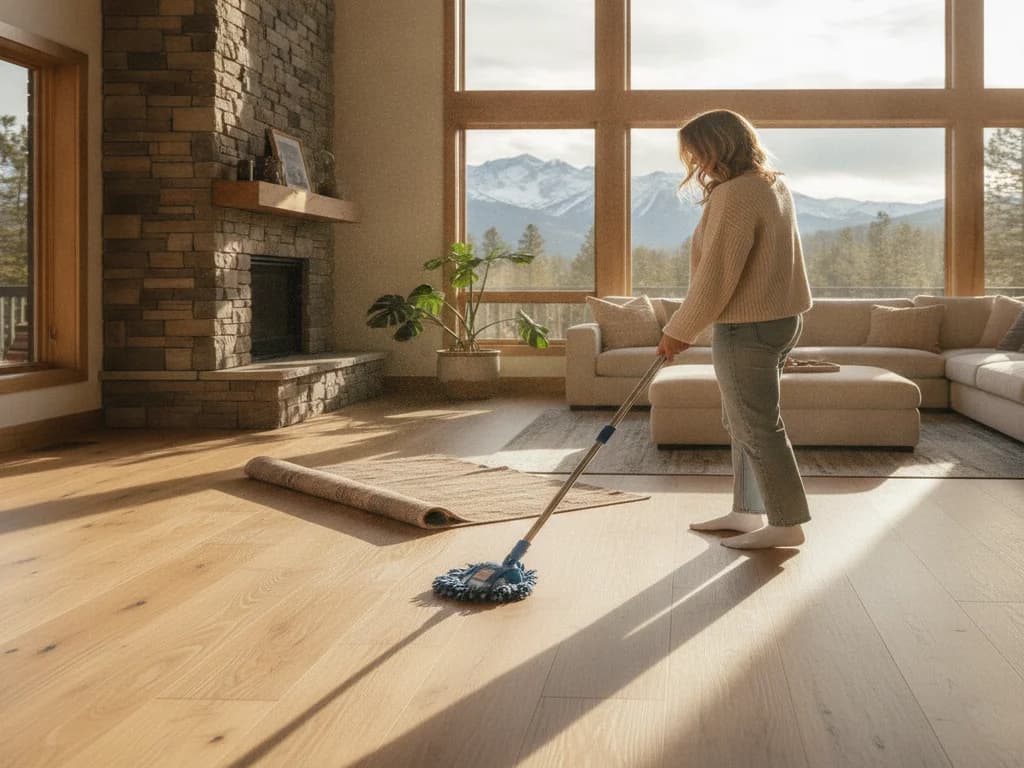
Wood floors want less than people think. Sweep or dust-mop to lift grit, then damp-mop — never wet — with a cleaner made for wood finishes. Grit is the main agent of wear: sand and road grit act like sandpaper underfoot and dull a finish faster than anything else, which is why picking it up matters more than any product you apply afterward.
Because a vacation home isn't cleaned constantly, the arrival-and-departure clean carries most of the load. Knock down the grit when you get there, and dry any water before you leave. If someone else cleans the house, leave the correct product on site with a short written note; the most common source of finish damage in second homes is a well-intentioned person using whatever was under the sink. Our hardwood care guide has the full routine.
Products That Quietly Ruin a Finish
A few things do slow, cumulative damage that's easy to miss until it's expensive. Steam mops drive hot moisture into seams and are the fastest way to damage a wood floor while believing you're cleaning it. Oil soaps leave a residue that builds up, dulls the surface, and — the part that costs money — can prevent a future recoat from bonding, forcing a full sand instead. Vinegar and water etches some finishes over time. Furniture polish and anything advertised as adding shine leave a slick film.
Match the product to the finish rather than to the species. Film finishes in the polyurethane class want a pH-neutral wood floor cleaner, the kind Bona and similar makers produce. Penetrating hardwax oils in the Rubio Monocoat class want their own soap and periodic re-oiling, which is a different routine entirely — if you inherited the floor and don't know which you have, find out before buying anything.
Water You Do Not See
The freeze-thaw problem for floors is really a water problem, and in an empty house it has time to work. Ice dams at the roof edge push meltwater back under shingles and down inside walls, where it can reach a floor from a direction nobody inspects. Condensation runs down cold single-pane glass and collects at the base of a wall. A slow supply-line drip behind a dishwasher goes unnoticed for six weeks.
Keep gutters and drainage carrying snowmelt away from the house, address ice damming as a roof and insulation problem rather than a flooring one, and put inexpensive leak sensors under sinks, behind the dishwasher and washing machine, and near the water heater. Sensors that alert your phone are worth the small premium in a house you can't check.
Sun, Big Glass, and Uneven Fading
Mountain houses are built around their views, and UV intensity is higher at altitude than at sea level. That combination fades floors faster than most owners expect — and because a second home's furniture rarely moves, the fading is uneven in a way that's obvious the day you finally shift a rug.
Wood changes color under light no matter what you do; the goal is making it change evenly. Rotate rugs and move furniture periodically rather than leaving the same arrangement for a decade. Close shades on the south and west sides when you leave, which costs nothing and does the most. UV-filtering window film helps meaningfully on a wall of glass you can't shade. And know your species: walnut lightens under UV where oak ambers, so the direction of the change depends on what's on your floor. Sun fading covers what can and can't be corrected later.
Felt, Rugs, and Furniture That Keeps Moving
Vacation homes get rearranged more than primary residences — extra beds appear, tables get pushed together, and it's often done by people who aren't thinking about the floor. Felt pads on every leg, checked once a season, are the cheapest insurance in the building; a pad that's worn through or has picked up grit is worse than no pad, because it's now sandpaper on a fixed point.
Rugs should have a breathable pad rather than a solid rubber-backed mat, which traps moisture against the finish and can discolor it. And in a house where furniture gets dragged rather than lifted, felt glides on the pieces that move most are worth the ten minutes.
Recoat Before You Need to Refinish
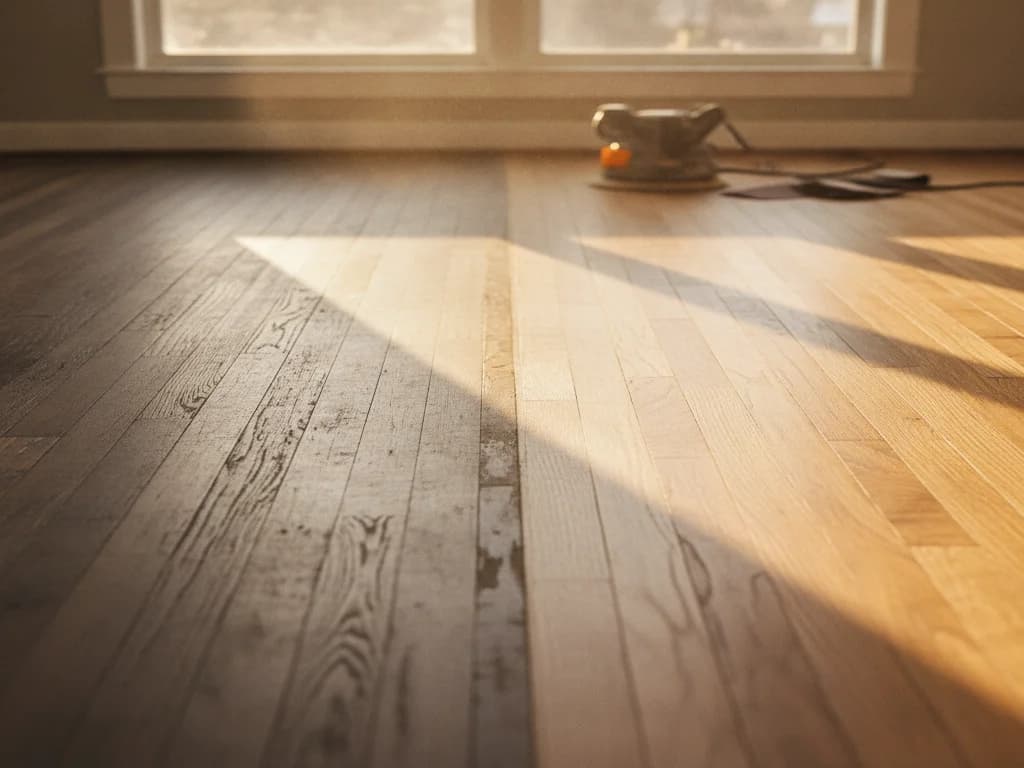
A finish wears from the top down, and the smart moment to act is while wear is still in the finish and hasn't reached the wood. A screen-and-recoat abrades the existing surface and lays a fresh coat over it — no sanding to bare wood, no dust of a full refinish, a fraction of the cost, and the floor's thickness untouched.
Miss that window and traffic wears through to bare wood, which lets water and dirt into the fiber and turns a recoat into a full sand. In a second home the tell is the traffic path from the entry to the kitchen going flat and dull while the room's edges still look right. Because nobody watches the floor daily, this is worth checking deliberately once a year. Screen-and-recoat versus full refinish explains where the line falls.
Why the Install Quality Still Matters
All of this care is far easier when the floor was installed for intermittent use in the first place. A floor that was acclimated to the home's real conditions and moisture-tested before installation, with the right expansion room around the perimeter, has the built-in tolerance to ride out swings that would buckle a rushed job.
That perimeter gap is the detail worth knowing about, because it's the one thing you can't add later. Wood needs room to grow at every wall, under every baseboard, and around every fixed object, and a floor installed tight to the walls has nowhere to go when summer humidity arrives. If your floors were installed well, sensible maintenance is usually enough. If they weren't, no routine fully makes up for it.
If your Tahoe or Truckee vacation home needs floors that can handle life between visits — or you want an honest read on floors that are already moving — Renaissance Floors is glad to help. Call Alex at (916) 749-0272 for a free estimate from a licensed CSLB C-15 contractor.
This article is part of our guide to caring for a floor, which covers what actually shortens a floor's life, and the maintenance that measurably extends it.
Good to Know
Frequently Asked Questions
Should I turn the heat off in a vacation home with wood floors?
Not completely. Letting the house swing freely through winter is exactly the condition that causes cupping and gapping. Holding a modest baseline temperature keeps interior conditions within a narrower band, which is what the floor needs, and it protects plumbing at the same time.
What humidity should I keep a vacation home at for wood floors?
NWFA guidance points interiors at roughly 30 to 50 percent relative humidity, and holding anywhere inside that band year-round is what keeps a floor from moving. The practical goal is narrowing the annual swing rather than hitting an exact number on any given day.
What should I check when I arrive at a vacation home?
Walk the floor for cupping, crowning, or gaps that were not there last time, look under sinks and around appliances for slow leaks, and check entries for water that came in under a door. Every one of these is cheap to fix early and expensive once it has spread.
Should I shut off the water when I leave a vacation home?
For absences longer than a couple of weeks, yes, if the system tolerates it. A supply line failing in an empty house is the single most destructive event a wood floor can face, because the water runs for days or weeks rather than the minutes it would take someone home to notice.
Do I need a humidifier for a mountain second home?
It depends on how dry the house actually runs, which is why measuring first is worth more than guessing. A whole-home unit plumbed into the HVAC is the only kind that works unattended, and it is most justified where a wide-plank solid floor is showing seasonal gaps you dislike.
Can I use a steam mop on wood floors?
No. Steam drives hot moisture into the seams between boards and into the finish itself, and it does cumulative damage that is easy to miss until a seam lifts or the finish clouds. A barely damp mop with a cleaner made for the finish is what the floor actually wants.
Why should I avoid oil soap on hardwood floors?
It leaves a residue that builds up and dulls the surface, and more expensively, it can prevent a future screen-and-recoat from bonding properly. That turns a straightforward maintenance coat into a full sand down to bare wood, which costs several times more and removes floor thickness.
How do I stop uneven fading in a house with big windows?
Rotate rugs and move furniture periodically so the wood changes color evenly, close shades on the south and west glass when you leave, and consider UV-filtering film on a wall of glass. UV intensity is higher at altitude, so mountain homes fade faster than valley ones.
Is engineered flooring better for a second home?
Generally yes. A house that sits unoccupied and unconditioned swings further in temperature and humidity than a lived-in one, and engineered construction absorbs that far better than solid wood. It is the single most useful decision for a property that is empty much of the year.
What cleaning routine works for an occasionally used home?
A simple one that a cleaner or guest will actually follow: sweep or vacuum the grit, damp-mop with a cleaner made for the floor's finish, and never a steam mop. Leaving the correct product on site with a short note prevents most of the damage we see in second homes.
Written by
Owner & Lead Installer, Renaissance Floors
15+ years of hands-on flooring experience across Greater Sacramento & Northern California. Works on hardwood and engineered installation, refinishing, subfloor preparation, and moisture testing — and writes these guides from what the jobs actually teach.
CSLB C-15 licence #1060673
Related
Keep Reading
Related pages: Squeaks, Water Damage, European White Oak, and French Oak.

Ready for Floors You'll Love?
Ready to talk through your project? Free estimates throughout Greater Sacramento & Northern California.