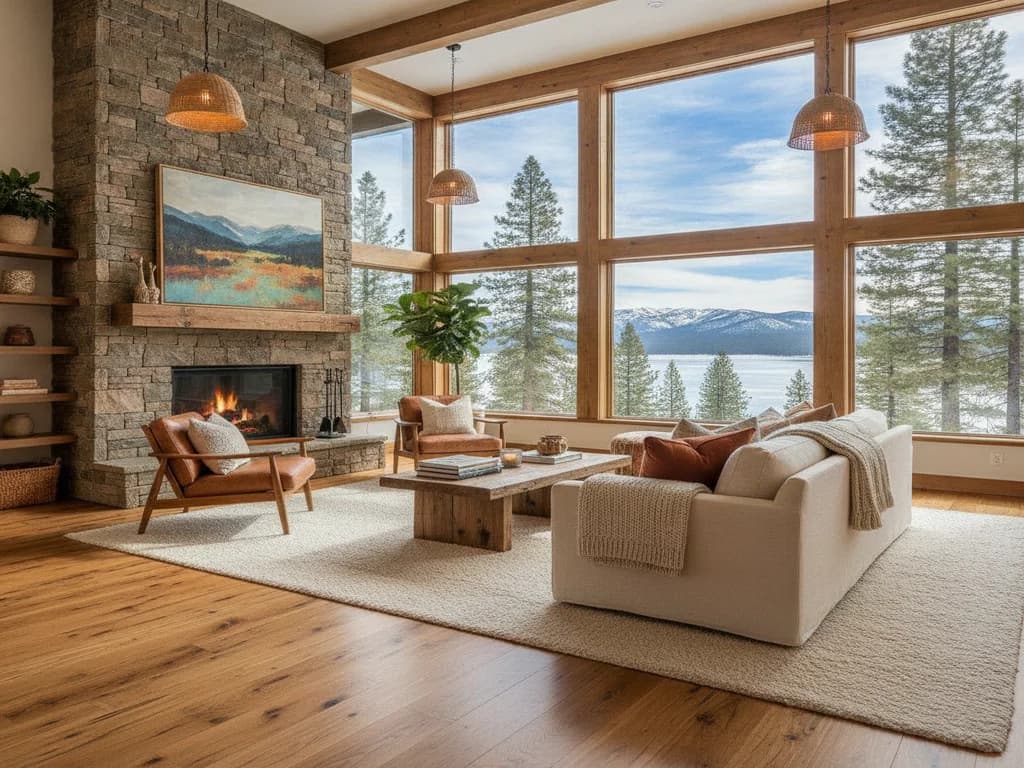
Local Guide
Flooring for South Lake Tahoe & Meyers Homes
Cabins and mountain homes on the California side face deep snow, high altitude, and hard-working rentals. Here's how to choose floors that last.
Local Guide · 7 min read
Published July 16, 2026 · Updated July 28, 2026
South Lake Tahoe and Meyers sit high on the California side of the basin, where winters are long, the snow runs deep, and a big share of homes work double duty as vacation rentals. Choosing flooring here is as much about durability and moisture control as it is about looks — and the right choice pays off every single season.
The South Shore Is Not One Climate
South Lake Tahoe proper runs along the shoreline at roughly 6,200 feet, and Meyers sits a few miles southwest up Highway 50, tucked into the Upper Truckee valley at a slightly higher elevation on the way to Echo Summit. That short distance matters more than it looks. Lake Tahoe does not freeze, and a body of water that size moderates the air along the shore, so homes through the Al Tahoe, Bijou, and Stateline corridors ride out winter nights a little softer than places set back from the water. Meyers and Christmas Valley sit in a bowl that collects cold air overnight, which means the furnace runs harder and longer through the season.
That difference lands directly on your floor. A house that heats hard for months holds drier indoor air, and dry indoor air is what pulls moisture out of wood and shrinks it. Two South Shore homes ten minutes apart can therefore ask different things of the same plank: the lakeside condo may sit in a fairly narrow humidity band all winter, while the Meyers house on the valley floor swings further and needs more stability engineered into the product. We would rather specify for the house in front of us than for the region on a map, and the general playbook we work from is laid out in our guide to mountain home flooring.
Elevation adds one more wrinkle that homeowners rarely think about: at this altitude the air simply holds less moisture to begin with, so a heated interior gets dry faster and stays dry longer than the same house would at valley elevation. It is not the snow outside that stresses a wood floor. It is the months of dry, heated air inside.
Your Heating System Is Part of the Spec
How a South Shore home is heated tells us as much as where it sits. Older cabins around town still run wall furnaces or a single forced-air system with long duct runs, and those produce uneven results — rooms near the registers go dry while back bedrooms stay cool. A wood stove or insert, which plenty of homes here still lean on as a primary heat source, creates the driest air in the house within a radius of the stove, and boards in that zone shrink more than boards twenty feet away. When we see a stove, we plan for it: species and construction that tolerate a local dry spot, and expansion detailing that does not assume the whole floor behaves identically.
Ductless mini-splits, increasingly common in remodels here, heat room by room, which often means unheated or lightly heated spaces down the hall. Wood does not mind a cool room; it minds a room whose conditions differ sharply from the room next door, because the floor is continuous and the air is not. And in-floor radiant, common in newer South Shore builds and gut remodels, is the gentlest of the lot but the most particular about product selection and startup. If your home has it or is getting it, read our radiant heat flooring overview before you fall in love with a sample, because it narrows the field.
The practical ask is small: tell your installer how you actually run the house. A home kept at a steady temperature all winter is a different job from one that drops to fifty degrees on Monday and gets pushed to seventy on Friday afternoon.
What Is Under a South Shore Floor
A lot of the housing stock here was built between the 1960s and the 1980s, and much of it sits over a vented crawlspace or a post-and-pier foundation rather than a slab. That construction is worth understanding before you choose anything. A vented crawl in snow country means the cavity beneath your floor is cold and often damp, especially in spring when snowpack is melting into the ground around and under the house. Moisture moves from wet to dry, and a warm, dry room above a cold, damp crawl creates exactly that gradient.
The fixes are not exotic. A ground vapor retarder over exposed soil, sound crawlspace drainage, insulation in contact with the subfloor rather than sagging away from it, and a subfloor moisture reading taken before anything is fastened down. Where we find elevated readings, we deal with the cause first — a floor installed over an active moisture problem will telegraph it within a season, usually as cupping or as the slow, quiet failure described in our notes on moisture under flooring.
Newer South Shore construction and many rebuilt homes sit on slab, and slabs get tested differently: relative humidity probes set into the concrete per ASTM F2170, with surface prep judged against ASTM F710. A slab that has been under snow-shedding roof runoff for thirty winters deserves that testing regardless of how dry the surface feels on a July morning.
Getting Material Up the Hill
This is the South Shore detail nobody warns you about. Flooring for these projects is almost always trucked up from the valley, and it arrives having spent hours in an unheated trailer climbing Echo Summit in winter. Cold cartons brought into a warm room collect condensation on the wrapping, and material that is opened too soon can pick up moisture it will later shed inside your finished floor.
We plan around it. Material comes off the truck and into conditioned space, not the garage and not a covered deck, and it sits there with the house running at the temperature you actually live at. Delivery windows get scheduled with weather in mind, because a chain-control day is not the day to be moving pallets. And on a second home that has been closed up, the heat goes on well before the material arrives, not the morning of. None of that is glamorous, and all of it is the difference between a floor that stays flat and a floor that gaps in February.
A Room-by-Room Map for South Shore Floor Plans
The typical layout here — a split-level or A-frame with the entry at grade, living space up, bedrooms tucked under — concentrates abuse in specific places, and the smart move is to match material to zone rather than running one product wall to wall.
The entry and whatever serves as a mudroom take snowmelt, road cinder, and ski boots all season, and that is a job for tile or a waterproof luxury vinyl plank with a genuine boot area, not for hardwood hoping to be spared. Main living areas, where you want warmth underfoot and the look people come to Tahoe for, are where engineered wide-plank white oak earns its place. Bedrooms and lofts can go either way, though wood upstairs over a great room benefits from an acoustic underlayment. Bathrooms and laundry stay waterproof, always. And the garage-to-house door, which in many South Shore homes sees more daily traffic than the front door, deserves the same treatment as the front entry rather than being an afterthought.
Keeping to two products across the house, rather than five, also pays off later: fewer transitions to detail, fewer profiles to match, and a realistic chance of finding a repair plank in ten years.
Rentals Set a Higher Bar
The South Shore has one of the densest concentrations of vacation rentals in the Sierra, and a rental floor is a different specification from a family floor. Dozens of guests a season, wheeled luggage, no one taking their boots off unprompted, and a house that sits cold between bookings all push toward harder wear layers, matte sheens that hide scuffs, and materials that can be repaired plank by plank between stays rather than refinished. If the property is permitted for short-term rental, treat the floor as equipment rather than decor and specify accordingly.
Basin Rules, in General Terms
Because South Lake Tahoe and Meyers sit inside the Lake Tahoe basin, the region falls under Tahoe Regional Planning Agency oversight alongside the City of South Lake Tahoe and El Dorado County. For an interior floor replacement, that usually is not a major hurdle. Basin properties do carry considerations around land coverage, drainage, and best-management practices that come into play on larger remodels, and anything touching structure or exterior work is a different conversation. We confirm current requirements with the issuing agency for the specific address rather than relying on general advice, and we are happy to help you understand where your home stands as part of planning the work.
What We Usually End Up Recommending
For most South Shore homes: engineered wide-plank white oak through the living spaces, in a matte or wire-brushed surface that hides grit and traffic, with a wear layer thick enough to be sanded at least once; waterproof plank or tile at every exterior door, in baths, and in laundry; a real entry zone with mats that hold water instead of spreading it; and an installation that treats moisture testing and conditioned staging as part of the job rather than a formality. Keep the house heated through winter even when you are away, keep a simple cleaning routine like the one in our hardwood care guide, and a floor here will outlast several sets of ski gear.
Whether you are updating a South Lake Tahoe cabin, finishing a Meyers remodel, or outfitting a rental that has to look great and take a beating, the right engineered wood or LVP will hold up beautifully to snow-country living. Renaissance Floors offers free, no-pressure estimates across the California side of the basin — call Alex at (916) 749-0272 to talk through the smartest choice for your home.
This article is part of our guide to how to choose a floor, which covers the order the decisions actually come in, and which constraints are real rather than preference.
Good to Know
Frequently Asked Questions
What flooring works best in South Lake Tahoe?
Engineered wood for main living areas and luxury vinyl where snowmelt and grit arrive daily — entries, mudrooms, and rental units. The elevation and the heating season together produce a wide interior humidity swing, and both materials handle that better than solid wood.
Do you install flooring in Meyers?
Yes. Meyers sits southwest of South Lake Tahoe along Highway 50 at a slightly higher elevation, in a valley that collects cold air overnight. Homes there generally run their heat harder through the season, which argues for engineered construction even more strongly than at lake level.
Is luxury vinyl a downgrade in a Tahoe home?
Not in the rooms where it belongs. In an entry that receives snow, grit, and wet boots every day through the season, a waterproof floor that can be repaired plank by plank is the better engineering answer — and pairing it with engineered wood in the living spaces is a common, sensible split.
Does a wood stove affect which floor I should choose?
It does. A stove creates the driest air in the house within its immediate radius, so boards near it lose more moisture than boards across the room. We plan expansion detailing and product construction around that local dry zone rather than assuming the whole floor sits in identical conditions.
My cabin is over a crawlspace. Does that change anything?
Yes, and it is worth addressing before you shop. A vented crawl in snow country stays cold and often damp through spring melt, which drives moisture upward toward a warm, dry room. A ground vapor retarder, sound drainage, and subfloor moisture readings come first.
How long does flooring need to sit in the house before installation?
Long enough to reach equilibrium with how you actually run the home, which is a condition rather than a fixed number of days. What matters more on the South Shore is where it sits: inside conditioned space with the heat running, never staged in a garage or on a covered deck.
What should I know before installing wood floors at 6,000 feet?
That the air is drier than you expect and stays that way for months once the heat is on. Acclimation and moisture testing of both the wood and the subfloor are not formalities, and homes that sit unheated between visits need that discussed before the material is ordered, not after.
Are there local rules that affect flooring work here?
Interior floor covering is generally straightforward, but any work touching structure, and anything in the Tahoe basin more broadly, can involve additional review from TRPA alongside the city or county. We confirm the current requirements with the issuing agency for the specific address rather than relying on general advice.
Should a South Shore rental get a different floor than a family home?
Usually a different specification of the same materials. Rentals see more traffic in a season than a family home sees in years, so the priorities shift toward thicker wear layers, matte finishes that disguise scuffs, and products that can be repaired one plank at a time between bookings.
Written by
Owner & Lead Installer, Renaissance Floors
15+ years of hands-on flooring experience across Greater Sacramento & Northern California. Works on hardwood and engineered installation, refinishing, subfloor preparation, and moisture testing — and writes these guides from what the jobs actually teach.
CSLB C-15 licence #1060673

Related
Keep Reading
Related pages: Site-Finished vs. Prefinished Hardwood, SPC vs. WPC Rigid Core Vinyl, European White Oak, and French Oak.
Ready for Floors You'll Love?
Ready to talk through your project? Free estimates throughout Greater Sacramento & Northern California.