Local Guide
Flooring for Truckee & North Tahoe Homes: A Local Guide
From Tahoe Donner cabins to Martis Camp estates, here's how to choose wood floors that hold up to deep snow, dry winters, and life at 6,000-plus feet.
Local Guide · 7 min read
Published July 16, 2026 · Updated September 12, 2026
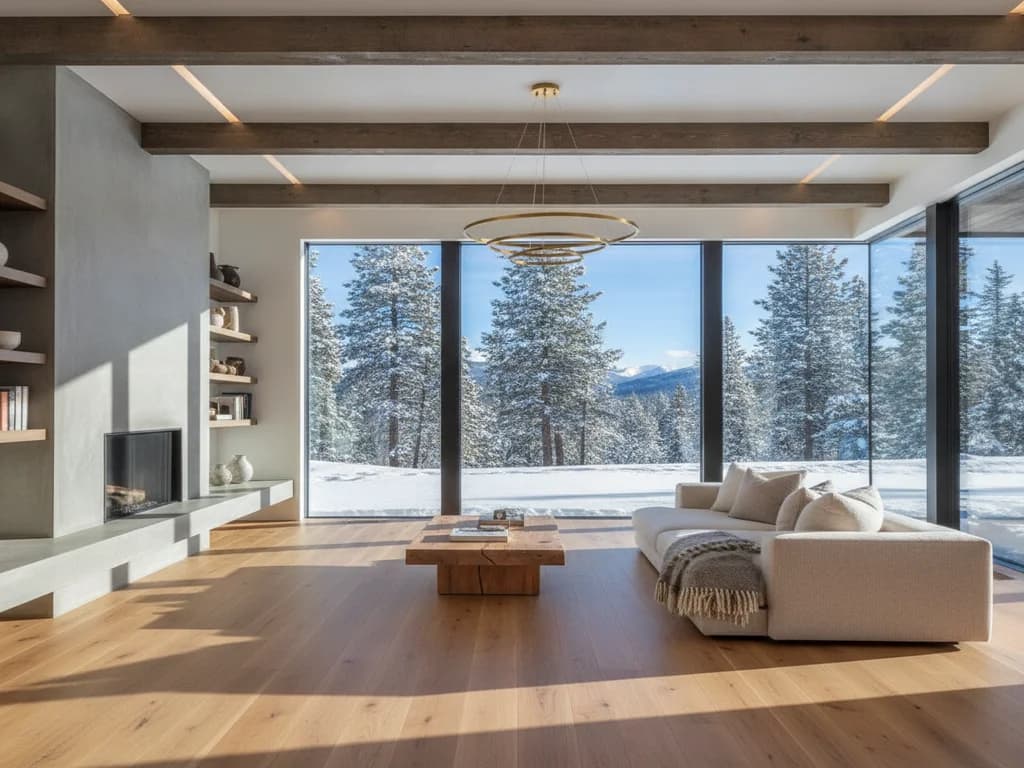
Truckee and the North Tahoe shore are some of the most demanding places in California to install a wood floor — and some of the most rewarding to get right. Between deep-snow winters, bone-dry indoor air, and homes that range from 1970s A-frames to brand-new mountain-modern estates, the flooring that thrives here is chosen with the climate in mind, not just the color chip.
One Region, Several Different Winters
The area covers a lot of ground and a lot of styles. Downtown Truckee sits near 5,800 feet, while Tahoe Donner, Prosser, and Glenshire climb higher into the pines, and the ridgetop estates of Martis Camp and the runs at Northstar push the elevation and the exposure further still. Drop toward the water and you are in Kings Beach, Carnelian Bay, and Tahoe City along the North Shore, where lakefront cabins and full-time family homes sit right around 6,225 feet at lake level.
Here is the part that surprises people: the town of Truckee, despite being lower than the lake, is generally the colder place to spend a winter night. It sits in a river valley that collects and holds cold air after dark, while the lake — which does not freeze — moderates the shoreline communities a few miles away. Ridge properties at elevation get a third pattern again: less cold pooling, far more wind and sun exposure, and snow that arrives sideways.
For a floor, that translates into different heating behavior and therefore different interior humidity. A Glenshire house that runs its heat hard from October through May holds drier air for longer than a Carnelian Bay home a short drive away, and the specification follows the house rather than the region. Our broader guidance for the Lake Tahoe area applies across all of it, but the details get set on site.
Newer Stock Means Different Substrates
A meaningful share of the housing here was built or gut-remodeled in the last few decades, and that changes the conversation before material selection even starts. Instead of the plank subfloors and vented crawlspaces common in older lakeside cabins, we are usually working over engineered floor trusses or I-joists, thick plywood or OSB sheathing, and increasingly a poured underlayment over the top.
Newer does not mean automatically ready. Long joist spans deflect more than short ones, and deflection is what produces movement and squeaks under a hard surface later. Sheathing that sat open to weather during a Truckee winter build cycle can carry moisture long after framing is closed in. And new construction schedules routinely put flooring in before the house has ever been run at a normal temperature, which is the fastest way to install a floor into conditions that will not exist again. We take subfloor moisture readings and flatness measurements on new homes with exactly the same seriousness as on a 1970s cabin, and we want the heat running and stable before material is opened.
Radiant Heat and Gypcrete: What Goes Over It
In-floor radiant is common here, and in much of the newer stock the tubing is embedded in a lightweight gypsum underlayment poured over the subfloor. That surface is not ordinary concrete, and treating it as if it were causes real problems. Gypsum underlayments have their own drying requirements, their own surface strength, and their own primer and adhesive rules, and both the underlayment manufacturer and the flooring manufacturer have to be satisfied before anything goes down. A soft or dusty surface will not hold an adhesive bond no matter how good the adhesive is.
The fastening decision follows from that. Nailing into a gypsum pour is generally off the table, which leaves glue-down or floating installations, and each has consequences for sound, feel, and repairability — the tradeoffs are covered in our comparison of nail-down, glue-down, and floating installations. Whatever the method, the product itself has to be rated for radiant service, the surface temperature has to stay moderate, and the system needs to be brought up gradually rather than shocking cold planks with sudden heat. If your home has radiant or is getting it, our radiant heat flooring overview is worth reading before you shop, because it narrows the field considerably.
Snowmelt systems in driveways and entries are a related but separate matter. They do not affect the flooring directly, but they change what arrives at the door — often less snow and more standing water — and that is worth planning the entry around.
Condos and Ski-Lease Units: Sound Is a Constraint
If your property is a condominium or a unit above another unit, the flooring decision is partly a legal one. Associations around Northstar, in Truckee's multi-family developments, and along the North Shore commonly set minimum impact and airborne sound ratings for hard-surface flooring over occupied space, and many require the underlayment assembly to be documented and approved before installation. Replacing carpet with a hard surface is exactly the change those rules exist to govern.
That is not a reason to avoid wood or plank — it is a reason to read the rules first. Rated acoustic underlayments — QuietWalk publishes assembly ratings for exactly this situation — are designed for it, and the assembly rating depends on the whole sandwich rather than any single layer, so the underlayment, the flooring, and the structure all have to be considered together. We would rather see the association's requirements before we quote than after we install.
Design Review, Access, and When the Work Can Happen
In a gated or covenanted community — Martis Camp, Tahoe Donner, Lahontan, and others — ask the association what it requires of contractors before the work is scheduled: architectural review, construction hours, gate access, and seasonal limits are the questions to settle. Interior flooring is usually the least contentious kind of work, but the logistics still bite: access has to be arranged, work hours may be limited, and in deep winter the practical question is whether a truck can reach the house at all.
That is why we schedule mountain work with weather in the plan. Material delivery is timed against forecasts and chain controls, staging happens inside conditioned space rather than a garage or a covered deck, and the material is given time to come into balance with how the house actually runs before it is fastened down. Skipping that step is still the single most common cause of failed mountain floors, and the fuller explanation lives in our mountain home flooring guide.
The Garage Is the Real Front Door
In Truckee, most people do not use the front door between November and April. They come in through the garage, in boots, carrying gear, having just brushed a foot of snow off a vehicle. Meanwhile the actual front door is behind a drift, and its threshold spends the winter under snow shed off the roof.
Design around the truth rather than the floor plan. The garage entry needs the same treatment the front entry gets in the brochure: waterproof flooring, a boot zone with somewhere to sit, matting long enough to matter, and a floor that can be wet without consequence. And where the roof sheds onto a walkway or deck against the house, keep an eye on what that meltwater does at the threshold, because water pushed under a door does damage no floor product can design around.
Why Engineered Wide-Plank White Oak Wins Up Here
For most Truckee and North Tahoe homes, engineered wide-plank white oak remains the sweet spot. An engineered board is built from a real hardwood wear layer bonded over a cross-layered core, and that construction moves far less through the region's humidity swings than a solid plank would — which matters most in the 7- and 8-inch wide plank widths these homes are designed around, since a wider board shows more total movement for the same change in moisture. You still get a genuine white oak surface that can be sanded and refinished down the road, and white oak's hardness, in the neighborhood of 1,300-plus on the Janka scale, stands up well to grit, pets, and heavy traffic.
Sheen and texture do quiet work here too. A matte or wire-brushed surface hides the fine scratching that road cinder produces all winter, while gloss puts every mark under a spotlight. It is a rare case where the fashionable choice and the practical one are the same.
Permits and Jurisdiction, in General Terms
Where your home sits changes who oversees the work. Properties inside the incorporated Town of Truckee fall under the town's own building department, while the unincorporated North Tahoe communities — Kings Beach, Carnelian Bay, Tahoe City, and the surrounding areas — are handled by Placer County out of its Tahoe office. Properties inside the Lake Tahoe basin also sit under Tahoe Regional Planning Agency oversight, which rarely affects an interior floor replacement but does come into play on larger remodels.
Interior floor covering is usually straightforward. Anything that touches structure, changes floor height at a stair or an egress door, or forms part of a broader remodel can be a different answer. We confirm current requirements with the issuing agency for the specific address rather than relying on general advice, and we are glad to point you in the right direction as part of planning your project.
Let's Talk About Your Home
Whether you are restoring a Tahoe Donner cabin, finishing a Martis Camp build, or replacing tired carpet in a North Shore family home, the right engineered floor will look beautiful and hold up to real mountain living. Renaissance Floors offers free, no-pressure estimates across the California side of the Truckee-Tahoe region — call Alex at (916) 749-0272 to walk your space and talk through what will genuinely last.
This article is part of our guide to how to choose a floor, which covers the order the decisions actually come in, and which constraints are real rather than preference.
Good to Know
Frequently Asked Questions
What flooring is best for a Truckee home?
Engineered wide-plank white oak in the main living spaces, in most cases. It delivers the mountain-modern look people want in these homes while handling the region's wide seasonal humidity swing far better than solid wood, particularly in properties that are not occupied year-round.
Do you work throughout North Lake Tahoe?
Yes, across the California side — Truckee and the North Shore communities. We do not work in Nevada, including Incline Village, Crystal Bay, and the Nevada side of the lake, because our CSLB licence is a California licence.
Does radiant heat change which floor I can use?
It narrows it. The product has to be rated for radiant, engineered construction is strongly preferred for stability, and the system needs bringing up to temperature gradually according to the manufacturer's instructions. Getting the commissioning wrong can damage a floor that was otherwise correctly specified.
Can I install wood flooring over gypcrete?
Usually yes, but not by nailing it down. Lightweight gypsum underlayment has its own drying, surface strength, and priming requirements, so glue-down or floating installation is the realistic path, and both the underlayment maker and the flooring maker have to be satisfied before work starts.
Does my condo association restrict hard-surface flooring?
Many in this region do, particularly for units above occupied space. Associations commonly set minimum impact and airborne sound ratings and require the underlayment assembly to be approved in advance, so the rules are worth reading before selecting a product rather than after.
How does deep snow affect flooring choices?
Mainly at the entries, where snowmelt and grit arrive constantly through the season. That is a strong argument for tile or luxury vinyl in the entry zone regardless of what runs through the rest of the house, and for an entry design that actually captures water.
Is new construction easier to floor than an old cabin?
Not automatically. Newer homes bring longer joist spans, sheathing that may have weathered during the build, and construction schedules that install flooring before the house has ever been heated normally. Moisture readings and flatness checks matter just as much as in older stock.
Can flooring be installed in the middle of winter up here?
Often, with planning. The constraints are access and staging rather than the work itself — delivery has to be timed around storms and chain controls, and material needs to sit inside conditioned space with the heat running rather than in a garage or under a deck cover.
Are permits needed for flooring work in Truckee?
Interior floor covering is generally straightforward, but anything touching structure can require review, and jurisdiction varies across the region between the Town of Truckee, Placer County, and TRPA within the basin. We confirm current requirements with the issuing agency for the specific address.
Written by
Owner & Lead Installer, Renaissance Floors
15+ years of hands-on flooring experience across Greater Sacramento & Northern California. Works on hardwood and engineered installation, refinishing, subfloor preparation, and moisture testing — and writes these guides from what the jobs actually teach.
CSLB C-15 licence #1060673

Related
Keep Reading
Related pages: Water-Based vs. Oil-Based Polyurethane, American White Oak vs. European Oak, European White Oak, and French Oak.
Ready for Floors You'll Love?
Ready to talk through your project? Free estimates throughout Greater Sacramento & Northern California.