Buying Guide
Wide-Plank White Oak: The Heart of the Mountain-Modern Look
Wide-plank white oak defines the mountain-modern home — fewer seams, calm grain, and warmth. Here's how to choose and install it right at altitude.
Buying Guide · 9 min read
Published July 16, 2026 · Updated July 28, 2026
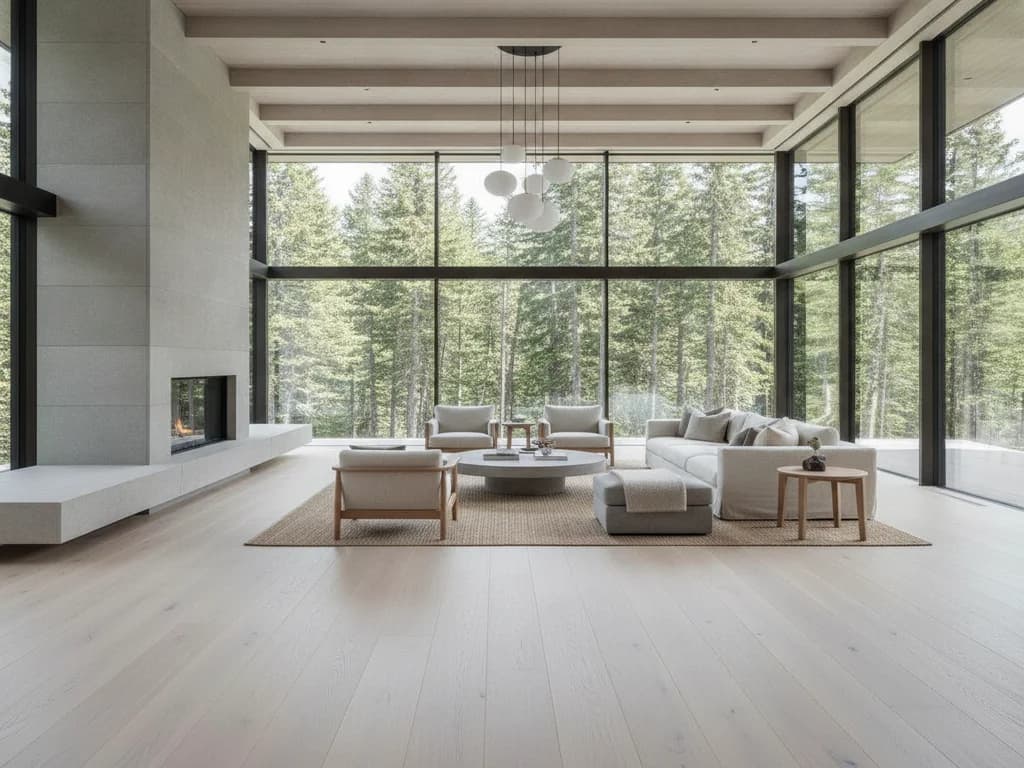
Walk into almost any beautifully done mountain-modern home and look down: odds are you're standing on wide-plank white oak. It has quietly become the signature floor of the style, and for good reason. Here's what makes it work, and what it takes to install it well in the Sierra.
Why Wide-Plank White Oak Reads as "Mountain-Modern"
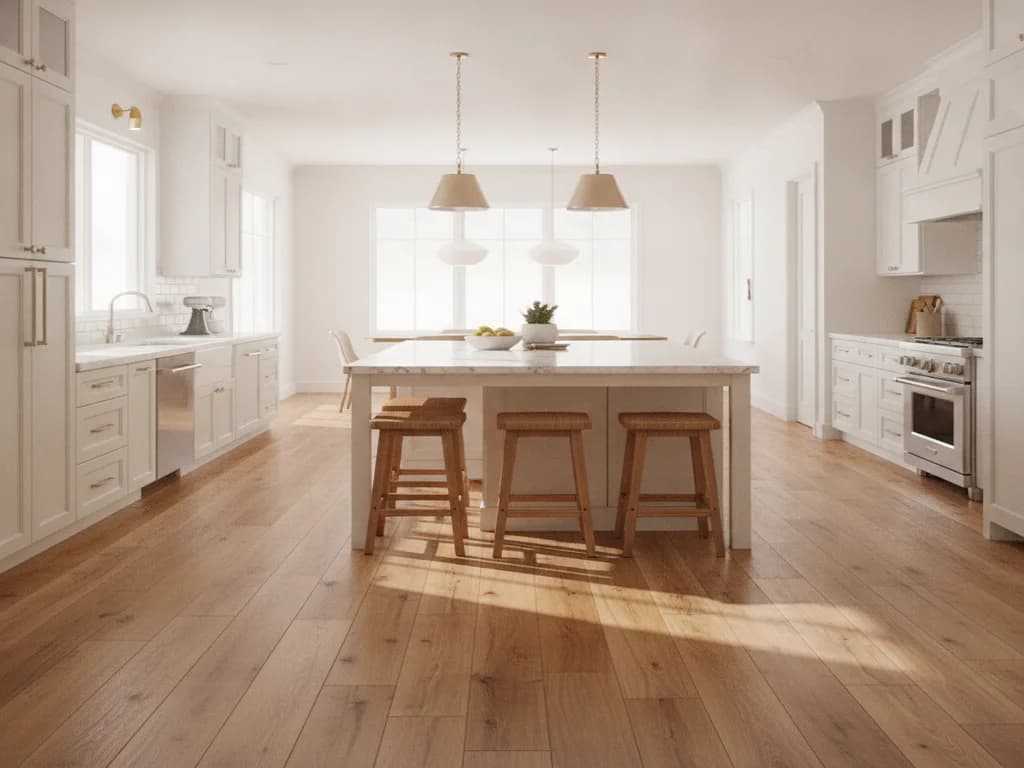
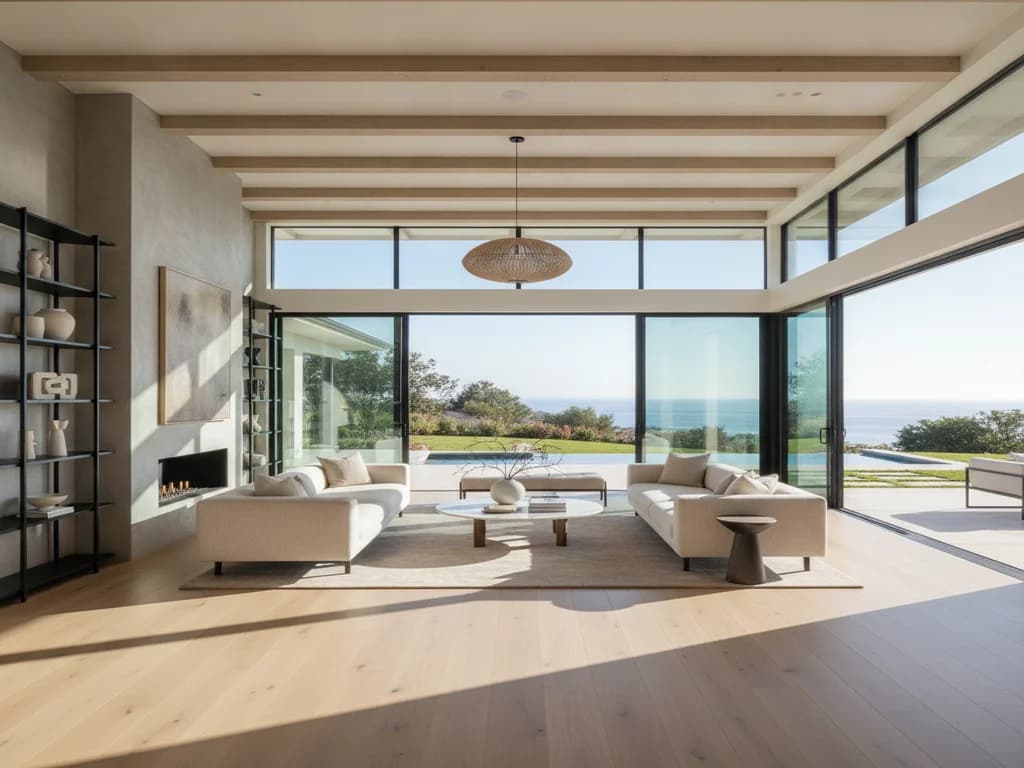
The look starts with proportion. Wide planks — commonly in the 7- to 9-inch range, sometimes wider — mean fewer seams across a room, and fewer seams read as calm, open, and expansive. That's exactly the feeling mountain-modern architecture is after: big windows, clean lines, warm natural materials, and floors that recede rather than compete. Narrow strip flooring, by contrast, creates a busy grid of lines that can feel more traditional.
White oak brings the other half of the equation. Its grain is straighter and more subdued than red oak, and its natural tone leans warm-neutral rather than pink, which is why it pairs so easily with the whites, greiges, blacks, and raw-wood accents this style favors. It also has a structural quirk worth knowing: white oak's pores are largely blocked by natural growths called tyloses, which is why it is closed-pored, takes reactive and penetrating finishes evenly, and is the oak historically used for barrels. It's genuinely hard-wearing too, landing around 1,360 on the Janka scale, so it stands up to real family life while still looking refined.
What "Wide" Actually Means, and How Wide Is Too Wide
In practice the term covers everything from about five inches up, and the mountain-modern default sits in the seven-to-nine-inch band. Wider exists and can be spectacular, but the returns flatten and the demands rise.
Match width to room. A nine-inch board in a compact bedroom can look like the floor was borrowed from a bigger house, while a five-inch board in a great room with twenty feet of glass looks busy. Length matters just as much and gets far less attention: a floor supplied in long, random lengths reads calm and architectural, while one heavy in short pieces produces a choppy pattern of end joints no width can rescue. Ask what the length distribution actually is before you order, not just the width. The broader tradeoffs between widths are covered in our comparison of wide plank versus standard width.
Sawing Method Changes the Whole Floor
This is the specification that separates two floors that are both labeled white oak and look nothing alike.
Plain sawn, sometimes called flat sawn, is cut for yield and produces the familiar cathedral or flame figure — big, sweeping arcs of grain. It is the most available and the most affordable, and it has the most visual movement, which some people love and others find distracting across a wide board.
Rift and quartered lumber is cut at a different angle to the growth rings and produces long, straight, tight grain instead of cathedrals. Quartersawn also reveals the medullary rays as flecks of light figure across the face, a distinctive look that not everyone wants. Two things follow: it costs more, because it yields less usable material from a log, and it moves less across its width for the same change in moisture, which is a real advantage in wide boards and a dry climate. If you want the calmest, most linear version of this floor, rift and quartersawn oak is what you are actually looking for, and it is worth knowing that before you shop rather than wondering why one sample looks so much quieter than another.
Grade: How Much Character Do You Want
Grade describes the amount of natural variation the mill allows into the run — knots, mineral streaks, color variation, sapwood, and small checks. It is not a quality ranking. A select or premium grade gives a clean, uniform, gallery-like floor. A character or rustic grade includes knots and color range, sometimes with filled knots, and reads warmer and more organic.
In a mountain house, character grade has a practical argument on top of the aesthetic one: natural variation camouflages the scratches, dents, and grit marks that a winter of ski gear guarantees, while a very clean floor shows every one of them. Grade also affects how much material you buy, since a run with more character usually carries a higher waste factor once the installer culls boards that do not work in visible areas.
American vs European White Oak
Both are genuinely white oak, and neither is the better wood. American white oak and the European species differ modestly in average color and grain — European material is often slightly warmer and more variable, American slightly straighter and more uniform — and the more consequential difference is commercial. European oak is widely produced in the very wide, very long formats and the fumed and reactive finishes that define this look, so the width and finish you want may steer the origin more than any inherent property does. Our side-by-side on white oak versus European oak goes through where they actually diverge.
The Engineered Build: Wear Layer, Core, and Edge
Nearly every wide-plank floor going into mountain homes is engineered, because a wide solid board moves the most across its width in exactly the dry, swinging conditions these houses have. But engineered is a category, not a spec, and the differences inside it are large.
The wear layer is the real hardwood on top, and its thickness determines how many times the floor can be sanded and refinished over its life. A thick sawn wear layer behaves like solid wood at the surface and can be refinished multiple times. A thin one, particularly a rotary-peeled veneer, may tolerate a light screen and recoat but not a genuine sanding. How the wear layer is produced matters too: sawn faces show the same grain a solid board would, while rotary peeling can produce a repeating, slightly washed appearance that looks off in wide formats.
Underneath, cores vary from multi-ply hardwood plywood to high-density fiberboard. Plywood cores generally hold fasteners and adhesives better and are the common choice for glue-down and nail-assisted installations in wide widths.
The edge detail is a small decision with a big visual effect. A square or micro-bevel edge reads seamless and contemporary and is what most mountain-modern interiors want, but it is unforgiving of any subfloor unevenness. A deeper bevel hides small height differences between boards and emphasizes each plank individually.
Finish Systems: Factory, Hardwax Oil, and Site-Finished
Factory-applied UV-cured finishes, typically loaded with aluminum oxide, are the toughest surface available and arrive fully cured, so the house is usable immediately with no dust and no odor. The tradeoff is that the finish stops at the plank edges and a future repair means blending a factory product on site.
Hardwax oil systems — Rubio Monocoat is the name the style is associated with — penetrate rather than forming a thick film. They mark more readily than a hard film finish, but worn areas can be cleaned and re-oiled in place without sanding, which suits a mountain entry that is going to take punishment every winter regardless.
Site-finished floors are sanded flat after installation and coated in place, which produces a truly monolithic surface with no micro-bevels at all — the flattest, most seamless version of this look. Commercial-grade waterborne systems such as Bona Traffic HD or Loba 2K Supra deliver the durability a mountain house needs. The cost is time and disruption, and in a second home that has to be empty during the work, that is a real consideration. Our comparison of site-finished and prefinished flooring weighs it properly.
Color: Natural, White-Washed, Fumed, and Smoked
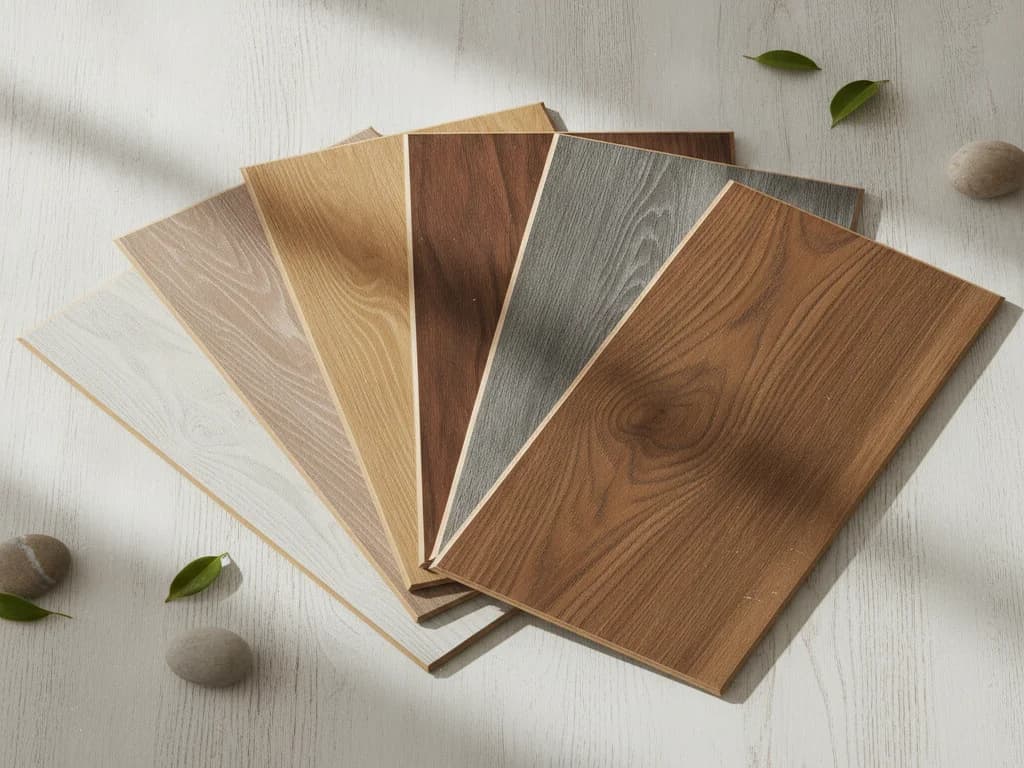
White oak's tannin content is what makes its color range so wide. Reactive stains and ammonia fuming chemically alter the tannins rather than sitting on top of the wood, which produces the deep smoked and grayed tones that look nothing like a pigment stain — and which vary board to board because tannin content varies board to board. That variation is the point, but it means a small sample cannot fully predict a whole floor.
Natural and lightly white-washed tones keep rooms bright and airy and are the most forgiving of dust and pale grit. Smoked and fumed oaks go richer and moodier and show pale scratches more readily. And every wood floor changes over time: unfinished and clear-finished white oak ambers with light exposure, and in a mountain-modern house with a wall of south- or lake-facing glass, that happens faster and more unevenly than most homeowners expect. Rugs and furniture leave outlines. Planning for sun fading with filtering glazing and by rotating rugs keeps the change even rather than stopping it, because stopping it is not on the menu.
What Installation Actually Demands
Wide planks are less forgiving than narrow ones, so prep is everything. The subfloor has to be genuinely flat — high and low spots that a narrow strip would bridge will telegraph through a wide board and can cause hollow spots and movement underfoot. We measure flatness and correct it before a single plank goes down, and the tolerance we work to is tighter than what a strip floor would require.
Fastening follows from the width. Wide-plank engineered floors are frequently glued down, or glue-assisted over a nailed installation, to lock the boards flat and quiet across their width. And no matter how stable the product is, it still gets acclimated to the home's real running conditions and moisture-tested against the subfloor before install — non-negotiable in a climate that swings the way ours does.
Layout is worth a conversation before the first row goes down. Running planks along the long axis of a room usually reads best, and running them so incoming window light rakes along the boards rather than across the end joints hides seams. In an open plan, the direction gets chosen once for the whole floor, which sometimes means a room reads slightly differently than it would in isolation.
Stairs, Transitions, and the Details That Give It Away
The finish carpentry is where a wide-plank floor either looks designed or looks installed. Stair treads and nosings should be milled to match the floor, not approximated with a bolt-on nosing in a different sheen — stairs are the most-viewed square footage in the house and the first thing a critical eye lands on. Our overview of stairs, treads, and runners covers the options.
The same applies where the floor meets tile at a mudroom, where it meets a slider threshold, and at any change in height. Flush transitions cost more in labor and look enormously better than a surface strip screwed over the joint. So does a plank layout planned so that a sliver rip does not land at the most visible doorway in the house.
What Drives the Cost
Wide-plank white oak generally costs more than standard-width flooring, and the drivers are stackable rather than singular: width and length, sawing method, grade, wear layer thickness, origin, and finish system each move the number. On the labor side, tighter flatness tolerances, adhesive installation, and matched stair work all add real hours.
What you are buying is a floor that looks like the architecture was designed around it, ages gracefully, can be refinished down the road, and defines the whole feel of the home. For most mountain-modern projects, it's the detail people remember.
If you're drawn to that clean, open, warm-oak look for a Tahoe, Truckee, or foothills home, Renaissance Floors would be glad to walk your space and talk through width, sawing, grade, finish, and the engineered options that hold up best at altitude. Call (916) 749-0272 for a free, no-pressure estimate.
This article is part of our guide to how to choose a floor, which covers the order the decisions actually come in, and which constraints are real rather than preference.
Good to Know
Frequently Asked Questions
Why is wide-plank white oak so popular in mountain homes?
Scale and texture. Wider boards read as calmer and more architectural in the large open rooms these homes tend to have, and white oak's tight, tannin-rich grain takes wire-brushing and matte finishes evenly. It is a look that also happens to hide wear well.
Should wide-plank flooring be engineered or solid?
Engineered, in almost every mountain application. A wider board moves more across its width for the same change in moisture, so wide solid boards are the least forgiving combination available — and the mountain humidity swing is the widest we work with.
What is the difference between plain sawn and rift and quartered oak?
The angle of the cut relative to the growth rings. Plain sawn yields the familiar cathedral figure and costs less. Rift and quartered yields long straight grain, shows medullary ray fleck, moves less across its width, and costs more because a log yields less of it.
How thick should the wear layer be on engineered wide-plank oak?
Thick enough to be sanded, if you want the floor to be refinishable. A thick sawn wear layer behaves like solid wood at the surface and tolerates multiple refinishes, while a thin rotary-peeled veneer may only support a light screen and recoat before reaching the core.
Is European white oak better than American white oak?
Neither is better. They differ modestly in average color and grain uniformity, and the more practical difference is commercial: European oak is widely produced in the very wide, very long formats and fumed finishes this look calls for, so the format you want often steers the origin.
What does wire-brushed mean?
The surface has been mechanically brushed to remove softer early wood, leaving the harder grain slightly raised. The result is texture you can feel, more visual depth, and — practically — a surface that disguises scratches and foot traffic far better than a smooth one.
Will white oak floors change color over time?
Yes. Clear-finished white oak ambers with light exposure, and in a home with large south- or lake-facing glass at altitude that happens faster and more unevenly than people expect. Rugs and furniture leave outlines, so rotating them keeps the change even.
Do wide planks need more subfloor preparation?
Yes. Flatness tolerances are tighter because a long, wide board bridges dips rather than following them, which produces hollow spots and movement underfoot. Adhesive-assist methods are also common with wide planks, and they depend on a properly prepared substrate.
How wide is wide-plank flooring?
In practice the term usually means boards from about five inches up, with seven to nine inches common in mountain-modern interiors. The wider the board, the stronger the case for engineered construction and the more the subfloor preparation matters.
Should the floor direction follow the room or the windows?
Usually the long axis of the room, with an eye on the light. Running planks so that incoming window light rakes along the boards rather than across the end joints hides seams, and in an open plan the direction is chosen once for the entire floor.
Written by
Owner & Lead Installer, Renaissance Floors
15+ years of hands-on flooring experience across Greater Sacramento & Northern California. Works on hardwood and engineered installation, refinishing, subfloor preparation, and moisture testing — and writes these guides from what the jobs actually teach.
CSLB C-15 licence #1060673
Related
Keep Reading
Related pages: European White Oak, French Oak, American White Oak, and Hardwood Flooring.
Ready for Floors You'll Love?
Ready to talk through your project? Free estimates throughout Greater Sacramento & Northern California.