Buying Guide
The Best Flooring for Kitchens
Kitchens face water, dropped dishes, grease, and nonstop foot traffic. Here's what actually performs where cooking happens.
Buying Guide · 10 min read
Published July 14, 2026 · Updated September 12, 2026
Kitchens ask more of a floor than almost any other room in the house. Between water at the sink, grease near the stove, dropped dishes, dragged chairs, and the kind of daily foot traffic that never really stops, a kitchen floor needs to look good and hold up to real abuse at the same time. It is also the room where the floor interacts with everything else — cabinets, appliances, plumbing, and the rooms it opens into — which means several of the decisions that matter most have nothing to do with which material you like. Here's how the common options actually compare, and what else has to be settled before anyone orders anything.
The Short Answer
For most kitchens, waterproof luxury vinyl plank is the safest all-round choice: standing water does not harm it, dropped pans mostly bounce off it, and it is warmer and softer underfoot than tile. Planning range in our market: roughly $5–10 per square foot installed.
Tile is the most water- and wear-proof floor you can put in a kitchen, and the hardest and coldest one to stand on; the grout near the range needs sealing to stay clean. Roughly $10–20 per square foot installed.
Engineered hardwood is the real-wood option that suits a kitchen, as long as spills get wiped rather than left and the appliance supply lines get checked. Roughly $8–15 per square foot installed.
Solid hardwood works in a lightly used kitchen with good habits, but a slow dishwasher or ice-maker leak damages it faster than any other option here. Roughly $10–20 per square foot installed.
Laminate is the one to avoid: even water-resistant laminate has a fiberboard core that swells permanently once water reaches an edge. Carpet is not a realistic kitchen floor.
Those figures are the planning bands behind our cost calculator, not quotes — subfloor condition, removing the old floor, and how the job is sequenced around the cabinets all move the real number. The rest of this guide is the reasoning behind the ranking.
Water Resistance Comes First
Sinks, dishwashers, and refrigerator ice makers all create opportunities for water to end up on the floor, often without anyone noticing right away. Luxury vinyl plank with a waterproof core and tile are both strong choices here, since neither is damaged by standing water the way solid hardwood can be. Engineered hardwood with a quality finish tolerates occasional spills reasonably well if they're wiped up promptly, but it's not built for water that sits, and a slow leak under a dishwasher or fridge can go undetected long enough to cause real damage.
Laminate is the one to be careful with. Even products marketed as water-resistant have a fiberboard core, and once water reaches a swollen edge the damage is permanent — there is no drying it back to flat. In a kitchen we would rather put in a mid-range vinyl than a premium laminate.
Where Kitchen Water Actually Comes From
Homeowners plan for splashes at the sink. Splashes are not what ruins kitchen floors.
The failures we get called about are slow and hidden. A dishwasher door gasket that weeps a little every cycle, wetting the floor under the front edge of the machine where nobody looks. A refrigerator ice-maker line — usually the small plastic supply tubing — that develops a pinhole and wicks water under the cabinet run for weeks. A garbage disposal connection that drips into the sink base, soaks through the cabinet floor, and reaches the flooring from underneath. A sink supply valve that seeps at the packing nut.
Every one of those happens under something, out of sight, over a long period. That is the scenario a kitchen floor is really being specified for, and it is why material choice matters more here than in a room where the only water risk is a dropped glass. It is also why we suggest looking under the sink and pulling the fridge out once a year: catching a slow leak early is worth more than any product upgrade. If it has already gone on a while, water damage in a kitchen is usually a subfloor and cabinet problem before it is a flooring problem.
Durability Under Daily Traffic
Kitchens see some of the heaviest foot traffic in a home — cooking, cleanup, kids grabbing snacks, pets underfoot — all concentrated in a relatively small area, and concentrated further into two or three lanes: sink to stove, fridge to counter, doorway to island. Those lanes take a disproportionate share of the wear, which is why a kitchen floor rarely wears evenly.
A durable wear layer matters more here than in a formal living room that sees lighter use. Tile is essentially immune to abrasion from foot traffic, though grout is not. Quality LVP with a thick wear layer — the kind of specification found in light-commercial lines from makers like Shaw Floorté or Mohawk SolidTech — holds up well to daily use and dropped items. Hardwood can dent under dropped pans or heavy cookware, though a harder wood species, a character grade with visible grain, and a matte finish all help minimize how visible that wear becomes over time. A high-gloss kitchen floor in a busy house looks tired years before a matte one that has taken exactly the same abuse.
Point Loads: Refrigerators, Islands, and Dropped Pans
Foot traffic is spread out. The other loads in a kitchen are not, and they cause a different kind of damage.
A full refrigerator concentrates several hundred pounds onto four small wheels or rollers. On a floating floor, sliding it out for cleaning can drag or shift planks; on vinyl, a hard roller left in one place for years can leave a permanent dimple. Rolling it in and out on a sheet of hardboard is a two-minute precaution that prevents both. Bar stools at an island are a similar story in miniature — dragged dozens of times a day, they are the most reliable source of scratches in any kitchen, and felt pads that are actually replaced when they wear out do more for a kitchen floor than the product upgrade most people are considering.
Dropped cookware is where materials really diverge. Cast iron dents wood, chips tile, and mostly just bounces off vinyl. Tile is also the only one of the three where a dropped pan can crack the material outright, which is a repair rather than a blemish.
Comfort Where You Stand the Longest
Kitchens are where people stand still the longest — prepping, cooking, doing dishes — so comfort underfoot is a practical consideration rather than a luxury, and it is the one thing tile genuinely does worst. Tile is the hardest and coldest surface in the house, and standing on it for an hour is different from walking across it. An anti-fatigue mat at the sink and range is the usual answer, and radiant heat under tile solves the cold half of the problem convincingly.
LVP has more give and feels warmer than tile, with WPC-core products noticeably softer than dense SPC ones. Hardwood offers a similar warmth with a little more resilience than tile, though its performance around standing water is the tradeoff. If someone in the household cooks for hours at a time or has knee or back issues, this factor deserves more weight than it usually gets in a showroom conversation.
Grease, Stains, and Cleanability
Grease splatter near the stove and general kitchen grime call for a floor that's easy to wipe clean without special treatments. Tile and LVP both clean up with routine mopping. Hardwood can be cleaned similarly but benefits from wood-safe cleaners rather than anything overly wet or abrasive, since standing liquid and harsh chemicals affect the finish over time, and a hard-wearing two-component water-based finish of the Bona Traffic HD sort tolerates kitchen duty better than a softer consumer-grade coating.
Grout is the asterisk on tile. In a kitchen, grout collects grease and turns darker near the range whether or not anyone spills anything, and an unsealed or poorly maintained joint absorbs it permanently. Choosing a mid-tone grout rather than a bright white one, sealing it, and resealing on a schedule is the difference between tile that looks clean in year eight and tile that does not — our tile care guide covers the routine. Larger-format tile with fewer joints is also a legitimate way to reduce the problem rather than manage it.
Under the Cabinets or Up to Them: The Order of Operations
This is the kitchen question almost nobody asks before signing, and it determines what is possible later.
Flooring installed before the cabinets runs continuously underneath them. Flooring installed after the cabinets stops at the toe kick. Running under is the more forgiving arrangement in one specific way: appliance bays end up at the same height as the surrounding floor, and a future cabinet change does not leave a bare strip. Running up to finished cabinets uses less material and is the norm in a flooring-only remodel where the kitchen is staying.
The complication is floating floors. A floating floor must be free to move, so it cannot be pinned under a cabinet run or a heavy island — trapping it is what causes buckling and separated seams later. This means in a full kitchen remodel with vinyl or laminate, the sequence usually runs cabinets first, floor second, with the plank stopping at the toe kick and appliance bays handled deliberately. Glue-down and nail-down floors do not have this constraint. It is worth settling the sequence with the cabinet installer and the flooring installer in the same conversation rather than discovering the conflict on the day.
Appliance Clearance and Floor Height
Dishwashers live in a fixed opening under the counter, and a new floor that adds height to that opening can leave too little clearance to slide the machine back in or out without damaging the floor or the appliance. It happens more often than it should, and the fix on installation day is never a good one.
Two related details are worth checking before ordering: whether the new floor plus underlayment sits higher than the old one, and whether the range needs to slide out past a raised threshold. Where the floor stops at the toe kick, the appliance bay needs its own thought — either a filler piece at the same height or plank run into the bay — because a fridge sitting on the subfloor while the rest of the kitchen sits a half-inch higher makes the fridge lean and stops the doors sealing properly.
How Kitchen Lighting Shows a Floor
Kitchens have more light sources aimed at the floor than any other room: recessed downlights, under-cabinet strips grazing across the surface, and often a window over the sink. That combination is unusually revealing.
Low-angle light from under-cabinet fixtures shows every crumb, smear, and streak on a glossy floor, and it exaggerates any unevenness in the subfloor as a visible ripple. It also punishes low-quality embossing on vinyl, because a texture that does not line up with the printed grain becomes obvious in raking light. Mid-tone floors with visible grain or pattern variation hide crumbs, dust, and pet hair far better than very dark or very light uniform surfaces — a dark floor in a kitchen shows every speck of flour and every dog hair, and a very pale one shows every crumb of coffee grounds. Matte finishes are the safer choice here for the same reason.
Rugs, Mats, and the Sink Zone
The area in front of the sink is the wettest square yard in the house and the one most people cover with a decorative runner. On tile or vinyl that is fine. On wood it needs thought: a rubber-backed mat traps moisture against a wood finish and can leave a permanent outline, and a mat that stays damp under a wood floor's finish is worse than no mat at all. A washable cotton rug with a breathable pad, shaken out and washed regularly, is the better arrangement.
At the range, an anti-fatigue mat is worth having on any hard floor, and it doubles as protection against dropped cookware in exactly the spot where cookware gets dropped.
Open-Concept Kitchens
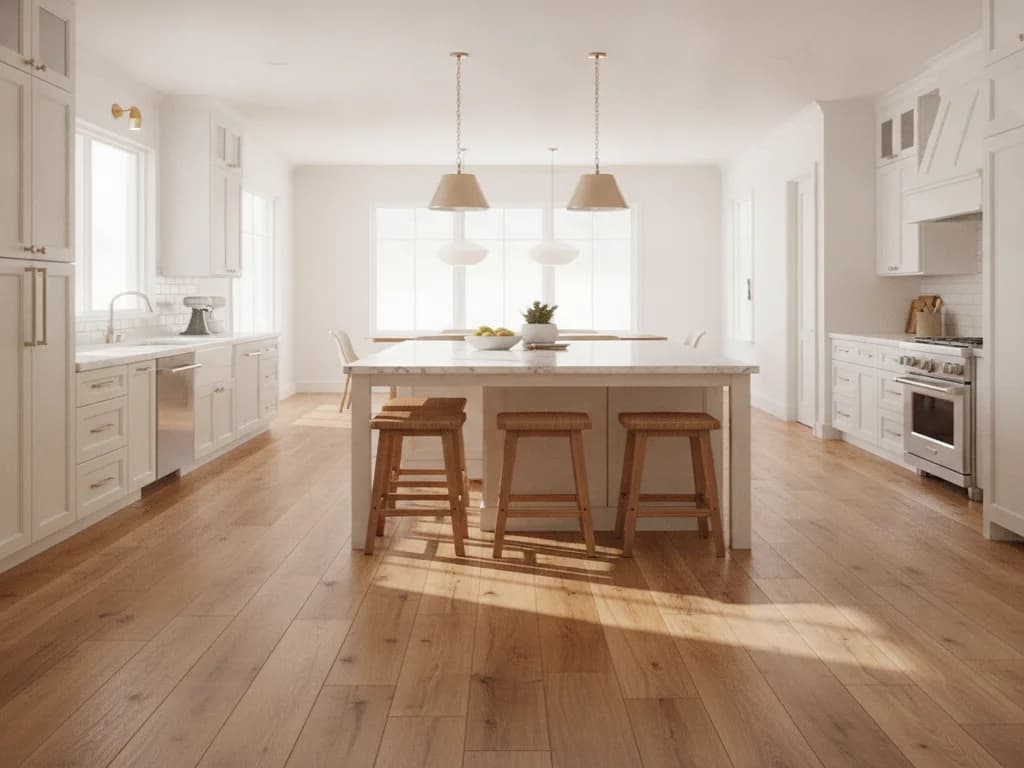
Many newer homes have kitchens that flow directly into a dining or living area with no clear transition point. In that layout, most homeowners choose one consistent material across the whole open space rather than switching floors mid-room, which usually means leaning toward LVP or engineered hardwood that can handle the kitchen's demands without looking out of place in the adjoining living space.
The consequence deserves stating plainly: in an open plan, the kitchen sets the requirement for every room the floor reaches. A material that would be perfectly reasonable in a closed-off living room is not a reasonable choice if that same floor runs under the dishwasher. Tile is a strong option too, though its harder, cooler feel is worth considering if the same floor extends into a room where people sit and relax.
Our Honest Take
There's no single best kitchen floor — only the best floor for how your kitchen is actually used, how it connects to the rest of your home, and how much water exposure it realistically sees. Waterproof LVP is often the most forgiving all-around choice for busy kitchens, tile suits heavy water exposure and a more traditional look, and hardwood works well in kitchens with lighter use and good habits around spills. What separates a kitchen floor that still looks right in a decade is usually not the material but the details: sequencing with the cabinets, appliance clearance, felt on the stools, and finding the slow leak early.
If you're weighing kitchen flooring options and want a straight answer for your specific layout, Renaissance Floors offers free estimates and can walk your kitchen with you to recommend what will genuinely hold up. We serve Roseville and the Greater Sacramento & Northern California area — reach us at (916) 749-0272.
This article is part of our guide to how to choose a floor, which covers the order the decisions actually come in, and which constraints are real rather than preference.
Explore related
Good to Know
Frequently Asked Questions
What is the best flooring for a kitchen?
Luxury vinyl plank and tile are the most forgiving, because both tolerate water at the surface and clean easily. Engineered hardwood is a strong choice where you want real wood and are willing to wipe spills promptly. Solid hardwood is workable but less forgiving, and carpet is not a realistic option.
Can I put hardwood in a kitchen?
Yes, with realistic expectations. Wood in a kitchen means wiping spills rather than leaving them, and accepting that an unnoticed appliance leak is a genuine risk to the floor. Engineered handles it better than solid because it moves less with moisture, and a hard-wearing finish helps.
Is tile too hard to stand on in a kitchen?
It is the least forgiving surface underfoot, which matters because a kitchen is where you stand still for long stretches. An anti-fatigue mat at the sink and range is the usual answer. Luxury vinyl, particularly over a WPC core, is noticeably softer if standing comfort is a priority.
What flooring hides kitchen mess best?
Mid-tone floors with visible grain or pattern variation hide crumbs, dust, and pet hair far better than very dark or very light uniform surfaces. A matte finish also disguises smears and footprints that a gloss surface highlights under kitchen downlights and under-cabinet lighting.
Should the kitchen match the rest of the house?
In an open-concept home, running one material throughout usually looks better and avoids awkward transitions — but it means the kitchen's water requirement now applies to every room the floor reaches. Where the kitchen is a separate room, a different, more water-tolerant material is a perfectly reasonable choice.
Should flooring go under kitchen cabinets or up to them?
Both are legitimate. Running the floor under the cabinets keeps appliance bays level and simplifies a future kitchen change; stopping at the toe kick uses less material and suits a flooring-only project. The exception is a floating floor, which must never be pinned under cabinets or a heavy island.
Will a new kitchen floor stop my dishwasher from coming out?
It can, and this is worth checking before ordering. A dishwasher sits in a fixed opening under the counter, so a floor that raises the height in front of it may leave too little clearance to slide the machine out for service. Measure the existing opening and the new floor build-up together.
Is laminate flooring okay in a kitchen?
It is the material we are most cautious about there. Even water-resistant laminate has a fiberboard core, and once an edge swells from a slow appliance leak the damage cannot be dried back to flat. In a kitchen, a mid-range luxury vinyl generally outperforms a premium laminate.
How do I protect a kitchen floor from bar stools and chairs?
Felt pads on every leg, replaced when they wear flat or collect grit, which most people never do. Dragged stool legs at an island are the most reliable source of scratches in a kitchen, and a worn-out felt pad with sand embedded in it is effectively sandpaper on a swivel.
What grout color is best for a kitchen floor?
A mid-tone grout rather than bright white. Kitchen grout darkens near the range from airborne cooking grease whether or not anything spills, so a light joint will not stay light. Sealing the grout and resealing periodically, plus larger-format tile with fewer joints, both reduce the maintenance.
Written by
Owner & Lead Installer, Renaissance Floors
15+ years of hands-on flooring experience across Greater Sacramento & Northern California. Works on hardwood and engineered installation, refinishing, subfloor preparation, and moisture testing — and writes these guides from what the jobs actually teach.
CSLB C-15 licence #1060673


Related
Keep Reading
Related pages: Nail-Down vs. Glue-Down vs. Floating, Oak vs. Hickory vs. Maple, European White Oak, and French Oak.

Ready for Floors You'll Love?
Ready to talk through your project? Free estimates throughout Greater Sacramento & Northern California.