Cost & Value
How Much Does It Cost to Install Hardwood Floors?
Hardwood pricing depends on species, subfloor condition, and removal — here's what actually moves the number, in ranges, not guesswork.
Cost & Value · 8 min read
Published July 14, 2026 · Updated September 12, 2026
"How much will this cost?" is almost always the first question homeowners ask, and it's a fair one — but hardwood pricing has enough moving parts that a single number rarely tells the whole story. Below is a plain-language breakdown of what actually drives the cost up or down, so you can walk into an estimate with realistic expectations rather than guessing.
If you want planning ranges to work from while you read, our cost guide and cost calculator provide them. What this article adds is the reasoning behind why those ranges are as wide as they are, and which of the variables below is likely to be the one that moves your number.
What Is Actually Inside a Hardwood Number
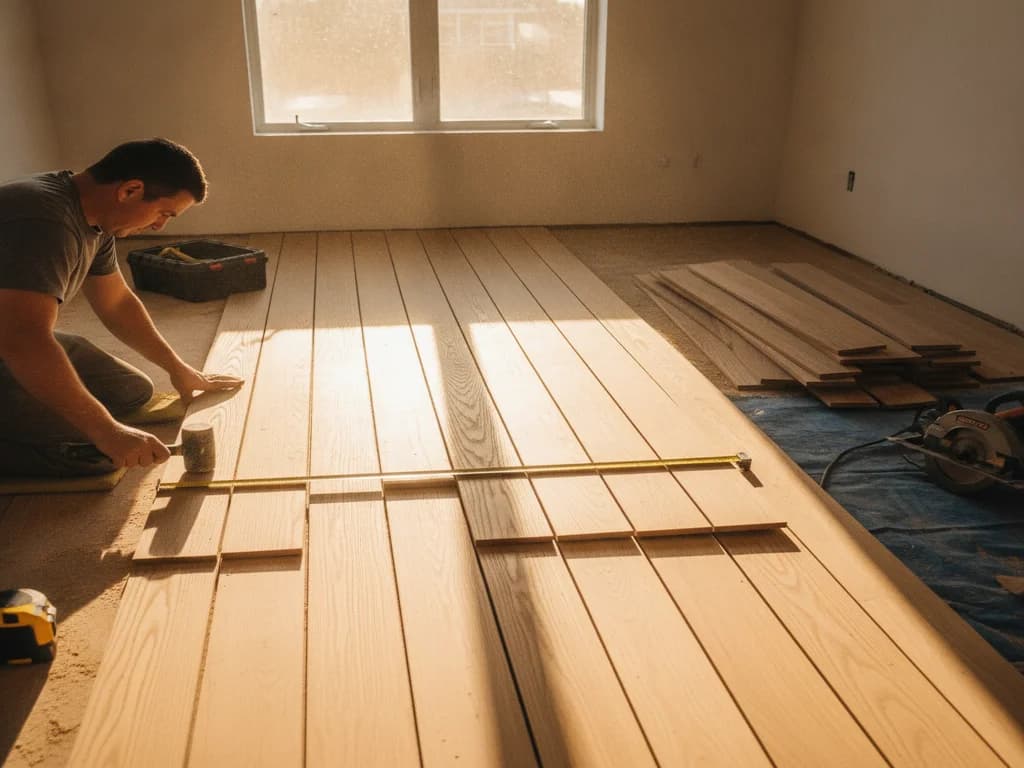
A finished hardwood floor is not a material purchase with installation added. It is roughly a dozen line items, and the material is only one of them: tear-out and disposal of what is there now, subfloor correction, moisture testing, underlayment or vapor retarder where required, the flooring itself with an allowance for cuts and culls, fasteners or adhesive, transitions and thresholds at every doorway, shoe molding or base, stair work if there are stairs, and on a site-finished job the sanding, staining, and multiple coats of finish with dry time between each one.
The single most common source of sticker shock is comparing an advertised per-square-foot material price against a full installed quote. Those two numbers are not measuring the same thing, and the gap between them is not markup — it is the other eleven line items.
Species, Grade, and Milling Set the Material Price
Wood species is usually the biggest swing factor. Domestic species tend to sit at a more accessible price point, while exotic or specialty species and wider, longer plank formats generally cost more per square foot. Engineered hardwood spans a wide range too, depending on the thickness of the real-wood wear layer and the quality of the core underneath it. As a rough, general sense of range you'll see across the market: material alone can run anywhere from the lower end for standard domestic species up to considerably more for premium or wide-plank products — species and grade matter more than most people expect.
Grade is the part people miss. Within a single species, the higher grades are selected for clear, consistent, longer boards with minimal character, and character grades carry knots, mineral streak, and shorter lengths. That grading affects material price directly, and it affects labor indirectly: a lot of short boards means more time laying out the floor and more culling on site.
Milling quality is the third layer. Boards from mills that hold tight tolerances go down flat and tight, and boards from loose-tolerance runs cost the installer time at every row. That time is real, and a bid that accounts for it is not padded.
Prefinished or Site-Finished Changes the Whole Job
These are two different projects that happen to produce a wood floor. Prefinished boards arrive with a factory-cured finish, get installed, and the room is usable the same day. Site-finished floors go down bare and are then sanded flat, stained if you want color, and coated multiple times with dry time between coats — professional waterborne systems from makers like Bona, Loba, or Pallmann for the topcoats, and stain lines like DuraSeal for color.
Site-finished costs more in labor and takes the rooms out of use for longer. What it buys is a completely flush surface with no bevels between boards, exact color control matched in your own light, and the ability to blend seamlessly into existing wood elsewhere in the house. Prefinished buys speed, a factory finish that is harder than anything applied on site, and a lower installed cost. Our site-finished vs. prefinished comparison goes through the tradeoff in detail, and it is worth settling before you start collecting bids, because quotes for the two are not comparable.
Nail-Down, Glue-Down, and Float Are Different Labor
Nail-down over a sound wood subfloor is the most predictable method and generally the most cost-efficient for solid hardwood. Glue-down, typical for engineered wood over a slab, carries the cost of the adhesive itself — which is not a small line on a large floor — plus the prep the adhesive manufacturer requires and the slower, more exacting pace of setting boards into wet adhesive. Floating installations are fast but demand a flatter subfloor than most people assume and are not appropriate for every product.
The method is usually dictated by the subfloor rather than chosen freely, which is why it is not really a lever you can pull to save money. Our breakdown of nail-down, glue-down, and floating covers how the choice gets made and what each does to the finished floor.
Subfloor Prep: The Line Item Nobody Can See Yet
This is the factor that surprises homeowners most. A flat, dry, structurally sound subfloor keeps a project moving efficiently. A subfloor with moisture issues, squeaks, unevenness, or old adhesive residue needs to be corrected before new flooring goes down — skipping that step leads to problems well beyond the cost of doing it right the first time. We always inspect the actual subfloor before quoting, because guessing here is how project costs get wildly inaccurate.
What that correction involves varies. Squeaks generally mean refastening the subfloor to the joists, which is straightforward but time-consuming across a whole floor and is much cheaper to do now than after the finish floor is down — our page on floor squeaks explains why the fix has to happen at this stage. Unevenness means sanding down high spots or filling low ones to the flatness tolerance the flooring manufacturer specifies. On concrete, it means in-situ relative-humidity testing under ASTM F2170 and preparation to the standard of ASTM F710 before an adhesive is trusted to hold.
None of this is visible while the old floor is still in place, which is the entire reason a real quote and a phone quote diverge.
Tear-Out Varies More Than Anything Else
If there's existing flooring to remove — carpet, tile, old vinyl, or a previous hardwood installation — that adds both labor and disposal cost. Tile removal in particular can take meaningfully longer than pulling up carpet or vinyl, especially if there's mortar or backer board to deal with underneath.
The range here is wide. Carpet and pad come up fast and haul away light. Glued-down vinyl leaves adhesive that has to be scraped or encapsulated. Tile set in mortar over a mud bed is demolition work, generates heavy debris measured by weight rather than area, and often requires dust containment. A previous nail-down hardwood floor means pulling the boards and then removing hundreds of staples or cleats from the subfloor before anything new can go down.
It is always worth asking a bidder whether removal, disposal fees, and haul-away are inside their number or outside it, because that single ambiguity accounts for a lot of quotes that look cheaper than they are.
Stairs, Transitions, and Trim
Stairs are the most labor-intensive square footage in any house. Each tread and riser is a fitted piece, nosings have to be milled or purchased to match the floor, returns have to be mitered, and none of it can be rushed. A staircase in a hardwood job is priced per step for a reason, and it is normal for a modest run of stairs to carry labor comparable to a fair-sized room.
Transitions are the quiet version of the same problem. Every doorway to a room staying carpeted or tiled needs a threshold sized to the height difference, cut and fastened. Every place the floor meets a slider, a hearth, or a cabinet toe-kick is a detail. Then there is base and shoe molding, which either gets removed and reinstalled or gets added new, and either way it is a carpentry line item that many homeowners do not picture when they think about flooring.
Pattern Work, Plank Width, and Cut Waste
A straight run of plank in an open rectangular room is the fastest thing an installer can do. Everything else is slower. Diagonal layouts increase cutting and waste. Herringbone and chevron are dramatically more labor — every board is cut and fitted, the layout has to be laid out precisely from a centerline, and the pattern is unforgiving of error. Borders, inlays, and medallions are their own scope entirely.
Width matters too. Wide planks cover ground faster but are less forgiving of a subfloor that is not flat, often require adhesive assist alongside fasteners, and cull at a higher rate because a bowed wide board is harder to pull tight than a bowed narrow one. And every job orders more material than the measured square footage, because cuts, culls, and a box of attic stock for future repairs all come out of the same order.
Room Count Beats Square Footage
Larger, simpler, more open floor plans are generally more cost-efficient per square foot than small, chopped-up rooms with lots of closets, doorways, and transitions, since labor time doesn't scale down proportionally with smaller spaces. A whole-floor project also typically prices better per square foot than several small, disconnected rooms done separately.
The mechanism is straightforward: the slow parts of installing a floor are the edges, not the field. Racking boards across an open great room is fast. Fitting around a closet, a doorway, a hearth, a bay window, and a cabinet run is not. Two houses with identical square footage can differ substantially in cost purely on how many rooms that square footage is divided into.
Mobilization has the same shape. One trip with one setup for a whole floor costs less than the same area spread over three visits months apart, which is worth knowing if you are considering phasing a project by room.
How to Compare Two Quotes Fairly
Put the two bids side by side and check five things: is removal and disposal in or out, is subfloor correction included or listed as an allowance, are transitions and trim in the number, is the material identified specifically enough to price it independently, and is the finish prefinished or site-applied. Nearly every meaningful difference between two hardwood quotes lives in one of those five lines.
A bid that is lower because it excludes subfloor correction is not lower. It is the same job with the uncertainty moved onto you, and it will resurface as a change order the day the old floor comes up.
Why We Don't Quote Sight-Unseen
Between species, grade, installation method, subfloor condition, removal needs, and layout complexity, two houses of the exact same square footage can land at very different price points — which is why any number given without seeing the space is really just a guess dressed up as a quote. The only way to get an accurate number for your home is a real walkthrough.
If you want an honest, no-pressure number for your specific project, Renaissance Floors offers free estimates — we'll walk your space, look at your subfloor, and give you a real range based on what's actually in your home, not a generic average. You can also read how we approach a hardwood floor installation before you call (916) 749-0272.
This article is part of our guide to what flooring actually costs, which covers how flooring is priced, what moves the number, and where the money goes that nobody quotes for.
Explore related
Good to Know
Frequently Asked Questions
Why won't you quote hardwood flooring over the phone?
Because the largest variable is the part nobody can see yet. Subfloor flatness, soundness, and moisture only become visible when the existing floor comes up, and they routinely change the scope of a job. A number quoted sight-unseen is a guess, and it is the kind of guess that gets revised upward once work starts.
What does a hardwood flooring quote actually include?
A complete quote covers the material, tear-out and disposal of the existing floor, whatever the subfloor needs to be flat and sound, the correct fasteners or adhesive for the method, transitions and thresholds at every doorway, and trim. On site-finished work it also covers sanding, staining, and multiple coats of finish.
Is prefinished or site-finished hardwood cheaper?
Prefinished is generally less expensive to install and much faster, because the finish is applied and cured at the factory. Site-finished costs more in labor and takes the rooms out of use for longer, but gives a flush surface with no bevels between boards and full control over the stain color.
What makes one hardwood job cost more than another?
Species and grade move the material price; plank width and pattern move the labor. Beyond that, subfloor correction, stairs, curves, medallions, and herringbone or chevron layouts all carry more labor than a straightforward run of plank in an open room.
How much do stairs add to a hardwood flooring cost?
Stairs are priced per step rather than by area, because each tread, riser, nosing, and mitered return is an individually fitted piece of carpentry. They are the most labor-intensive part of almost any hardwood project, and a short staircase can carry labor comparable to a fair-sized room.
Does removing the old floor add much to the cost?
It varies more than people expect. Carpet and pad come up quickly; glued-down vinyl, tile set in mortar, or multiple layers of old flooring take considerably longer and generate more disposal. It is worth asking whether removal and haul-away are included in any quote you are comparing.
Is herringbone more expensive to install than straight plank?
Considerably. Every board in a herringbone or chevron floor is cut and fitted to a layout established from a precise centerline, the pattern shows any accumulated error, and waste runs higher. The material may be identical to a straight-lay floor while the labor is in a different category entirely.
Why is subfloor prep a separate line on the estimate?
Because it cannot be measured accurately until the existing floor is removed. Honest estimates either carry it as a defined allowance or list the specific corrections found during the walkthrough. A quote that omits it entirely has not eliminated the work, only moved the risk of it onto the homeowner.
How do I compare two hardwood flooring quotes?
Check five lines on each: whether removal and disposal are included, whether subfloor correction is included or an allowance, whether transitions and trim are in the number, whether the material is identified specifically enough to price independently, and whether the finish is factory-applied or done on site.
Written by
Owner & Lead Installer, Renaissance Floors
15+ years of hands-on flooring experience across Greater Sacramento & Northern California. Works on hardwood and engineered installation, refinishing, subfloor preparation, and moisture testing — and writes these guides from what the jobs actually teach.
CSLB C-15 licence #1060673


Related
Keep Reading
Related pages: Hard Maple, Parquet, European White Oak, and French Oak.
Ready for Floors You'll Love?
Ready to talk through your project? Free estimates throughout Greater Sacramento & Northern California.