El Dorado Hills
Floor Installation in El Dorado Hills
Complete flooring installation — demo, subfloor leveling, layout, install, transitions, and trim — managed by one accountable team from start to finish.
Local Conditions
What Floor Installation Has to Contend With in El Dorado Hills
El Dorado Hills Conditions That Affect Floor Installation
El Dorado Hills sits at about 768 feet in El Dorado County. El Dorado Hills sits in the Sierra foothills at about 768 feet, above the valley floor but not high enough to change the flooring calculus dramatically. At the nearest long-term station, Sacramento, the July normal daily high is 93.8°F and relative humidity in the NWS Sacramento record averages about 78% at 4 AM against 30% at 4 PM in July; the foothill position brings slightly cooler nights. That wide daily humidity swing is what a wood floor has to absorb here.
Winters are mild and wet, and the foothill setting brings noticeably more rain than the valley's 19.87-inch annual normal, though measurable snow is rare at the community's core elevation and limited to occasional light dustings in the higher eastern subdivisions. Freezes are light; the wet season runs November through the early spring. Winter conditions shift the same variables the other way — longer cure times, and floors installed at their contracted size that will grow once the house warms.
Subfloor and Foundation Work
El Dorado Hills' post-1990 subdivisions are predominantly slab-on-grade, but the defining local factor is terrain, not just era: the community climbs across foothill slopes, so slabs sit on engineered cut-and-fill pads and hillside lots require County grading permits. The ground is decomposed-granite foothill soil — the USDA maps the representative western-El-Dorado series (Andregg, weathered from granodiorite) as coarse-textured, well drained, and low in shrink-swell, with shallow metamorphic Auburn soils on steeper slopes — so expansive-clay heave is far less of a concern here than in the valley basins. What matters instead is slab flatness over cut-and-fill and confirming pad moisture with an in-situ RH test (ASTM F2170) before a rigid floor. NAHB's Census Survey of Construction tabulation (89.9% slab for new Pacific-division homes in 2024) is regional context. Foundation and pad conditions are confirmed on site.
Foundation type is the first thing that narrows the material list, and concrete narrows it hard. A slab rules out a nailed-down solid wood floor and puts the decision between engineered, vinyl plank, laminate, and tile — each of which handles concrete differently. We test the slab for moisture before recommending any of them, because the test result, not the budget, is what determines which methods are actually available.
A raised floor opens the material list back up — a sound wood subfloor accepts nail-down, glue-down, and floating installations alike. The condition of the crawlspace is what we check first, since a moisture problem underneath will eventually reach whatever we put on top.
Source: NAHB analysis of the Census Bureau Survey of Construction, foundation type by region (2024)
El Dorado Hills Homes We Work In
Overwhelmingly post-1990 master-planned housing — Serrano grew out of the El Dorado Hills Specific Plan the county adopted in July 1988, with its first villages entitled in October 1992, and Blackstone (the 1998 Valley View Specific Plan) built out through the 2000s. ACS 2020–2024 5-year estimates place 77.1% of El Dorado Hills' 18,791 housing units in 1990-or-later construction, 35.3% of it built 2000–2009 alone, with the median year built in the 2000s and effectively no pre-1970 stock. Homes are frequently large, custom or semi-custom, on hillside lots. El Dorado Hills's 1990s, 2000s, and 2010s homes tend to bring their own surprises once the old floor comes up — subfloor thickness, previous patches, and height differences at doorways. We plan transitions and thresholds around what's actually under there rather than around a nominal drawing.
Before We Quote
Planning Around El Dorado Hills
Conditions specific to El Dorado Hills that shape an installation plan:
- With 77% of homes built since 1990 on slab-on-grade pads, slab moisture testing and vapor-barrier prep are standard, and because many slabs sit on engineered cut-and-fill, flatness across a large open plan is worth confirming before a rigid floor.
- Decomposed-granite foothill soils (USDA Andregg series) are low in shrink-swell, so seasonal clay heave is a minor factor here compared with the valley — the local variables are terrain, pad flatness, and hillside drainage rather than expansive clay.
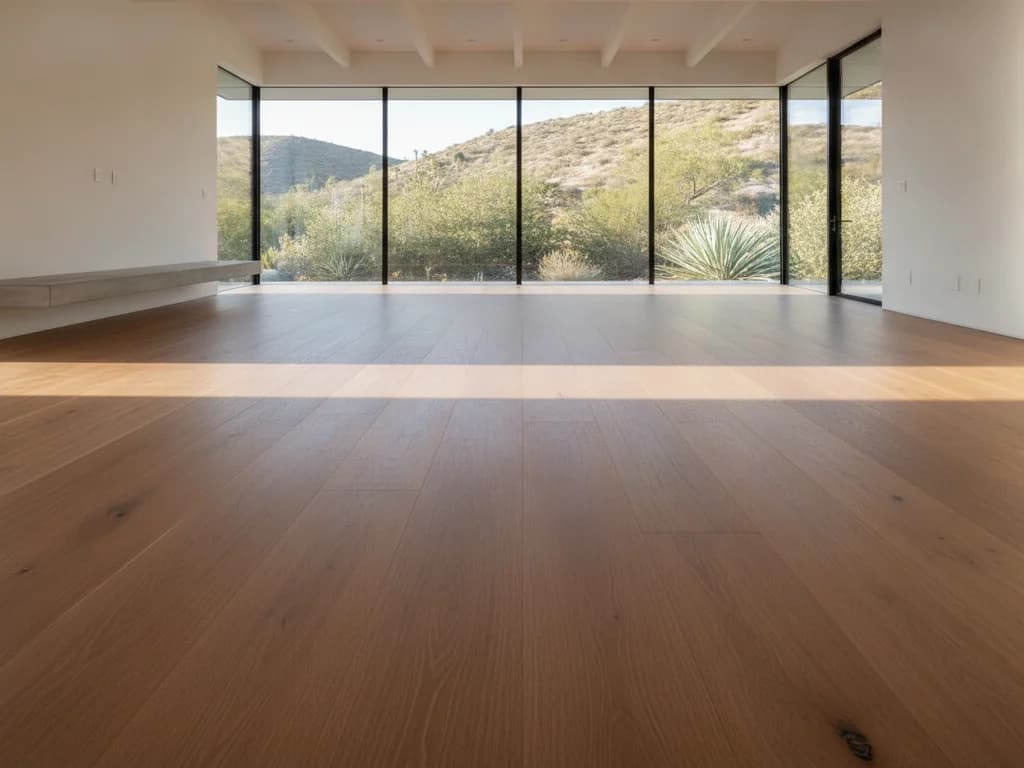
- Large custom homes on hillside lots frequently carry wide-plank hardwood across long, connected great-room plans, where consistent acclimation and expansion detailing across the whole floor matter more than in a compartmentalized layout.
Permits & Jurisdiction
Who Has Jurisdiction in El Dorado Hills
Building permits and inspections for El Dorado Hills properties go through El Dorado County Planning and Building Department, Building Division. El Dorado Hills is unincorporated, so permits and inspections run through El Dorado County's Building Division rather than a city; hillside work also requires a County grading permit.
Requirements change. Confirm current rules with the issuing agency before work begins.
We install floor installation throughout El Dorado Hills, including Serrano, Blackstone, Governors Village, Ridgeview, Highland View, Promontory, and the surrounding area.
Sources
Where These El Dorado Hills Details Come From
The local conditions above are drawn from these public sources.
- Climate of Sacramento, California — NWS Sacramento (rev. August 2010): July normal high 93.8°F, RH 78% at 4 AM / 30% at 4 PM, annual precipitation 19.87 in valley baseline, snow disregarded (nearest long-term station to El Dorado Hills)
- El Dorado Hills CDP, CA housing profile — US Census ACS 2020–2024 5-year, Table B25034 Year Structure Built, place FIPS 0621880 (18,791 units; 77.1% built 1990+, 35.3% built 2000–2009) via Census Reporter
- Which Foundation Type Is Most Common in Your Region? — NAHB tabulation of US Census Bureau Survey of Construction, Aug 2025 (Pacific division 89.9% slab in 2024)
- Andregg series — USDA-NRCS Official Series Description (coarse-loamy soil weathered from granodiorite, foothills 200–1,500 ft, well drained); low shrink-swell per SSURGO linear extensibility of 1.5%
- El Dorado County staff report, Serrano Village A-14 — the El Dorado Hills Specific Plan, Development Agreement and EIR adopted by the Board of Supervisors on July 18, 1988; Villages A, B and Village Green entitled under a vesting tentative map in October 1992
- El Dorado County — Planning and Building Department, Building Division (authority for unincorporated El Dorado Hills)
- El Dorado Hills, California — elevation 768 ft, unincorporated CDP (Wikipedia, citing USGS GNIS)
More in This Area
Other Flooring Services in El Dorado Hills
Good to Know
Frequently Asked Questions
Do you install floor installation in El Dorado Hills?
Yes. Renaissance Floors installs floor installation throughout El Dorado Hills and the surrounding El Dorado County area. Call (916) 749-0272 for a free estimate.
What happens before the first plank goes down?
We flatten the subfloor to tolerance, repair soft or squeaky areas, and on concrete test slab moisture with an in-situ relative-humidity probe (ASTM F2170). Wood and many resilient products also acclimate in your home first, so they reach the moisture content they will actually live at.
Why does the subfloor matter so much?
Because most flooring failures are subfloor failures wearing a floor's clothes. A finished floor can only be as flat, quiet, and well-bonded as the base under it — an uneven subfloor telegraphs through vinyl, cracks tile, and makes wood squeak.
How do I get an estimate in El Dorado Hills?
Call (916) 749-0272 or request a free estimate online. We'll schedule a convenient in-home visit in El Dorado Hills, measure your space, and give you an honest written quote.
Related
Keep Reading
Related pages: Floor Refinishing in Lincoln, Floor Repair in Lincoln, Floor Installation, and El Dorado Hills.

Ready for Floors You'll Love?
Free estimates on floor installation throughout El Dorado Hills and El Dorado County.