Buying Guide
Tile vs. Luxury Vinyl for Bathrooms
Bathrooms mean daily water exposure. Here's how tile and waterproof LVP actually compare on performance, feel, and cost.
Buying Guide · 9 min read
Published July 14, 2026 · Updated September 12, 2026
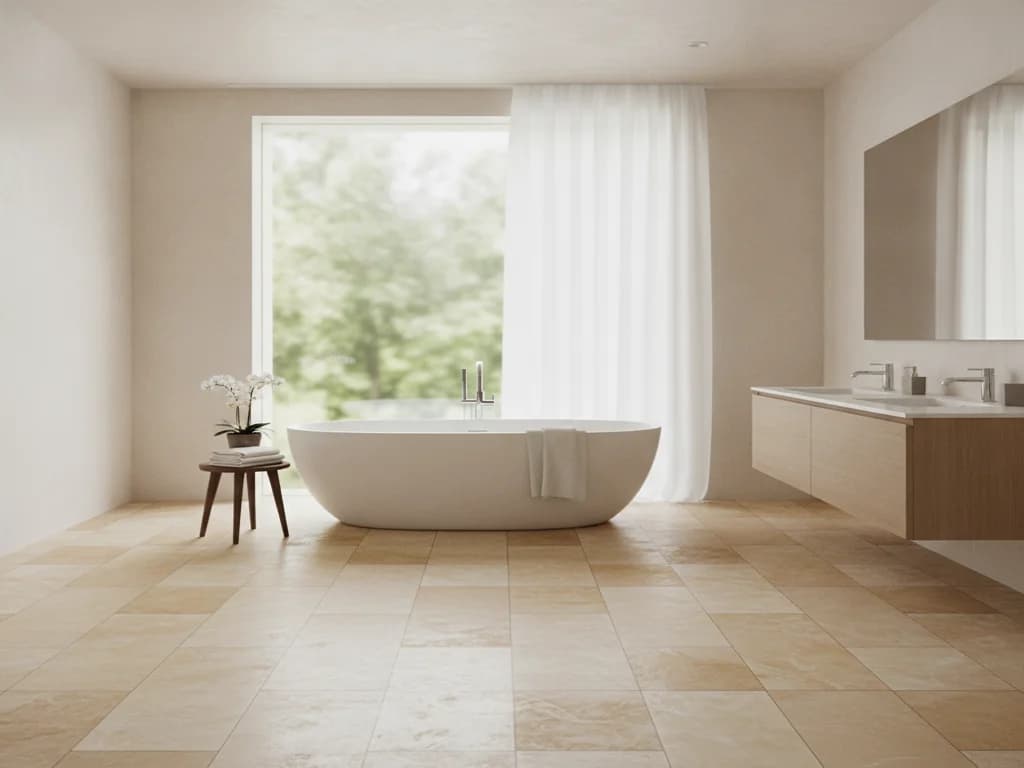
Bathrooms are the one room in the house where water isn't an occasional risk — it's a daily certainty. Showers, tubs, sinks, and toilets all mean regular moisture exposure, which narrows the field of realistic flooring options considerably. Tile and luxury vinyl plank are the two most common choices we're asked to compare for bathrooms, and each has real strengths. The useful comparison is not which one survives water, because both do. It is how each one fails, what has to happen underneath it, and which set of tradeoffs you would rather live with.
Water Performance and How Each Fails
Tile, properly installed over a correctly detailed substrate, is essentially impervious to water — it's been the standard bathroom material for generations for exactly that reason. Waterproof luxury vinyl has closed that gap substantially, with rigid cores that handle standing water without warping or delaminating.
What separates them is the failure mode. Tile fails at the joints and at the perimeter: grout that has cracked or was never sealed lets water through to the setting bed, and if there is no membrane below, it reaches the substrate. The damage is slow, hidden, and usually discovered when a tile sounds hollow or a wall stain appears in the room below. Vinyl fails at the seams too, but differently — the planks themselves are unaffected, so water passes through the joints, spreads across the subfloor, and sits under a floor that will not let it dry upward. In both cases the flooring outlives the structure beneath it, which is the argument for treating any bathroom leak as urgent even when the floor looks perfect.
The one place where tile is unambiguously ahead: it is the only one of the two that can continue up the wall into a shower, so a tiled bathroom can be a single continuous waterproof system rather than a floor and a separate wet area.
What Goes Under the Floor Matters More Than the Floor
In a bathroom, the assembly beneath the finish surface does most of the work, and this is where the two materials diverge sharply in what they demand.
Tile in a wet area needs a waterproofing membrane — a sheet or liquid-applied system over the substrate, with corners, changes of plane, and penetrations detailed properly. Tile and grout are not a waterproofing system. In a shower or on a tub deck this is not optional, and on a main bathroom floor it is good practice, particularly upstairs. Tile also needs an appropriate backer, and the TCNA and ANSI installation standards specify what is acceptable for each condition. It is entirely fair to ask a contractor which membrane system they use and why; the answer tells you a great deal about the rest of the job.
Vinyl asks for less underneath but is fussier about flatness. A rigid plank spans a low spot rather than settling into it, so dips telegraph as flex at the seams. And over a slab it still needs the concrete moisture-tested, because vapor drive from below has to go somewhere and a vapor-resistant floor gives it nowhere to go.
Subfloor Deflection and Why Tile Cracks
This is the single most important thing to know before choosing tile in a bathroom, and the one most rarely raised in a showroom.
Tile is rigid and brittle. It has no ability to flex with the floor beneath it, so if the framing moves, something has to give — either the grout joints or the tile itself. Industry standards express the requirement as a deflection limit: ceramic tile generally requires a floor system that deflects no more than the span divided by 360 under load, and natural stone requires roughly twice that stiffness at span over 720. An older bathroom with undersized or widely spaced joists, or a long span with no blocking, can fall short of that, and no amount of care in the tile setting compensates for a bouncy floor. That is the origin of most cracked tile we are asked to look at — the floor moved, not the tile.
Vinyl has no such requirement. A floating plank floor tolerates a floor that flexes, which is why it is often the pragmatic answer in an older upstairs bathroom where stiffening the framing is not realistic. Uncoupling membranes exist to help tile live over a marginal floor, and they are worth specifying, but they are not a substitute for a floor stiff enough to begin with.
Feel Underfoot and the Cold-Floor Problem
This is where the two materials diverge most in daily life. Tile is hard and cold, and a bathroom is the room you are most likely to enter barefoot, first thing, on a January morning. Vinyl has more give and reads as warmer — not because it is warmer, but because it conducts heat away from your foot far more slowly than a dense ceramic or stone tile does.
Tile is also the less forgiving surface for anything dropped on it and for anyone who falls. In a bathroom used by children or by someone with mobility concerns, that is a legitimate factor rather than a footnote. A bath mat covers the worst of it, and radiant heat covers the rest.
Radiant Heat Under Each
Bathrooms are the most common room in a house to get electric floor heating, and it changes the comparison considerably.
Tile is the ideal surface over radiant heat. It conducts well, it has no temperature restriction worth worrying about, and it turns the material's biggest weakness — coldness — into its biggest strength. A heated tile floor in a bathroom is one of the few upgrades nobody regrets.
Vinyl can go over radiant heat, but with conditions. Most rigid-core products approve it up to a maximum subfloor surface temperature, the system has to be configured not to exceed it, and temperature changes should be gradual rather than abrupt. Vinyl also insulates more than tile does, so the same system delivers less heat to the room through it. If floor heating is part of the plan, that is a real argument in tile's favor.
Slip Resistance in a Wet Room
Slip resistance is a property of the surface, not of the material category, and both materials come in versions that are fine and versions that are not.
For tile there is an actual measurement: the ANSI A137.1 standard specifies a wet dynamic coefficient of friction of at least 0.42 for level interior floors expected to be walked on wet, and reputable tile carries a published figure. Polished porcelain and polished stone frequently do not meet it. Smaller-format tile helps for a second reason — more grout joints mean more texture and more channels for water — which is why small mosaic is the traditional choice on a shower floor.
Vinyl does not carry the same published figure as commonly, but textured surfaces perform well, and vinyl has a secondary advantage: it is a softer landing if a slip does happen. Whichever you choose, a bath mat at the tub or shower exit is doing more for safety than the flooring specification is.
Grout: The Real Maintenance Item
Grout is the reason people who have lived with tile sometimes choose vinyl the second time around. It is porous unless it is an epoxy or a modern high-performance formulation, it absorbs whatever is spilled on it, and in a bathroom it collects soap film and the residue of every cleaning product used on it.
Managing it is a routine, not a one-time job: seal cementitious grout after installation, reseal periodically, avoid acidic and abrasive cleaners that erode it, and keep the room ventilated so the joints dry between uses. Mid-tone grout stays looking right far longer than bright white. Epoxy grout costs more and is harder to install well, but it does not need sealing and resists staining, which is worth considering for a bathroom floor specifically. Our tile care guide covers the routine in more detail.
Vinyl has no grout, and that is not a small thing. The maintenance is a damp mop, and the seams need nothing.
Toilet Flanges, Thresholds, and Floor Height
Bathrooms are small rooms with a lot of fixed things in them, and floor height is a real constraint rather than a detail.
The toilet flange should sit level with or slightly above the finished floor so the wax seal compresses correctly. Adding a new floor over an old one raises the floor relative to the flange, and a flange that ends up below the finished surface is the cause of a slow, smelly leak that only shows up months later. The fix is straightforward — an extension ring, or resetting the flange — but only if someone plans for it before the toilet goes back down.
The other heights that matter: the threshold at the door, where a bathroom floor meeting a hallway floor at a different level needs a proper transition; the clearance under a vanity toe kick if the floor is running up to it rather than under it; and the shower curb or entry, where the relationship between the bathroom floor and the shower pan decides whether water runs the right way. Tile and vinyl build up to different thicknesses, so this is a genuine input into the material decision, not an afterthought.
Installation, Repair, and Reversibility
Tile installation is more labor-intensive and typically costs more in labor than vinyl, given substrate prep, waterproofing, layout, and precise cutting around fixtures. It is also more permanent — removing tile later is demolition, and in an upstairs bathroom it can mean replacing the substrate too.
Vinyl installs faster, is easier to update down the road, and is dramatically easier to repair. A damaged plank can be lifted and swapped without disturbing the rest of the floor. Replacing a cracked tile means matching it, breaking it out without damaging its neighbors, and re-grouting, and a discontinued tile can turn a one-tile repair into a whole-floor job. Keeping a box of spare tile from the original run is the cheap insurance almost nobody takes.
Design, Resale, and the Half-Bath Exception
Tile has long been the traditional, expected bathroom material, and it offers essentially unlimited pattern, color, and layout options, including in the shower itself. Buyers and appraisers still tend to view tile as the standard in bathrooms, particularly in primary baths and in showers and tub surrounds. Vinyl has come a long way visually and offers wood-look options many homeowners prefer, especially where the bathroom opens off a bedroom or hallway with wood-look floors and the continuity looks deliberate.
Half baths and powder rooms are the reasonable exception to all of this. They see no shower, no tub, and minimal standing water, which makes them the one bathroom where the floor can simply match the adjacent hallway without any performance compromise at all.
Where the Two Often Meet in the Middle
It's common for bathrooms to use tile in the shower or tub surround, where water exposure is heaviest and most sustained, and either tile or waterproof vinyl on the main floor area. This matches the material to how much water each surface actually sees rather than assuming the whole room needs identical treatment. It is also frequently the answer in a house that has vinyl running through the bedrooms and hallway — vinyl on the bathroom floor for continuity, tile in the wet area where it belongs.
Making the Right Call for Your Bathroom
Both tile and quality waterproof vinyl are legitimate, durable bathroom choices. Tile wins on permanence, on radiant heat, on wet-area continuity, and on how buyers read a primary bath. Vinyl wins on warmth underfoot, on tolerance of a flexing older floor, on repairability, and on the absence of grout. Neither is a compromise; they solve the bathroom's water problem in different ways, and the deciding factors are usually comfort, the condition of the floor structure, and whether floor heating is part of the plan.
If you're planning a bathroom flooring project and want honest guidance on which material fits your space and budget, Renaissance Floors offers free estimates for homeowners throughout Roseville and the Greater Sacramento & Northern California area. Call (916) 749-0272 to get started.
This article is part of our guide to how to choose a floor, which covers the order the decisions actually come in, and which constraints are real rather than preference.
Explore related
Good to Know
Frequently Asked Questions
Is tile or luxury vinyl better for a bathroom?
Both are genuinely suitable. Tile is the more permanent surface and the traditional choice for a full bath, particularly in wet areas. Luxury vinyl is warmer underfoot, softer, faster to install, and easier to repair. The decision usually comes down to comfort and budget rather than to water performance.
Does a tiled bathroom need waterproofing behind the tile?
In a shower or on a tub deck, yes. Tile and grout are not a waterproofing system on their own — a membrane goes behind them. It is worth asking any contractor which membrane system they use and why, because this is the detail that decides whether a wet area lasts.
Is luxury vinyl slippery when wet in a bathroom?
It can be, as can polished tile. Slip resistance is a property of the surface texture rather than the material category, so a textured vinyl and a matte or small-format tile with more grout lines both perform better than a smooth glossy surface of either type.
Which is easier to repair in a bathroom?
Luxury vinyl, comfortably. A damaged plank can be lifted and replaced without disturbing the rest of the floor. Replacing a cracked tile means matching the tile, breaking it out without damaging neighbors, and re-grouting — and a discontinued tile can turn a small repair into a full floor.
Can I put luxury vinyl in a shower?
No. Luxury vinyl is a floor product, not a shower system. Wet-area walls and pans need a tiled or purpose-built waterproof assembly. Vinyl is appropriate for the bathroom floor outside the shower enclosure.
Why does bathroom tile crack?
Usually because the floor structure moves more than tile can tolerate. Tile is brittle and rigid, and industry standards call for a floor deflecting no more than span over 360 for ceramic and about span over 720 for natural stone. A bouncy older floor cracks tile no matter how well it was set.
Can luxury vinyl go over radiant floor heat in a bathroom?
Usually yes, subject to the manufacturer's maximum subfloor surface temperature, with the heating system configured not to exceed it and temperature changes made gradually. Tile remains the better conductor, so the same heating system will make a tiled bathroom feel warmer than a vinyl one.
Does a new bathroom floor affect the toilet?
It can. The toilet flange should sit level with or slightly above the finished floor so the wax seal compresses properly, and a new floor laid over an old one raises the floor relative to the flange. An extension ring or resetting the flange solves it, but only if it is planned before the toilet is reinstalled.
How often does bathroom grout need sealing?
Cementitious grout should be sealed after installation and resealed periodically, with the interval depending on the sealer and how heavily the room is used. Epoxy grout does not require sealing and resists staining, which is why it is worth considering for a bathroom floor despite the higher installation cost.
Is vinyl plank acceptable in a bathroom for resale?
In secondary baths and powder rooms it reads as entirely normal, especially where it continues the flooring from an adjoining hallway or bedroom. In a primary bathroom, buyers and appraisers still tend to expect tile, particularly in the shower and tub surround, so that is where tile is worth the extra labor.
Written by
Owner & Lead Installer, Renaissance Floors
15+ years of hands-on flooring experience across Greater Sacramento & Northern California. Works on hardwood and engineered installation, refinishing, subfloor preparation, and moisture testing — and writes these guides from what the jobs actually teach.
CSLB C-15 licence #1060673


Related
Keep Reading
Related pages: Choosing a Floor, European White Oak, French Oak, and American White Oak.

Ready for Floors You'll Love?
Ready to talk through your project? Free estimates throughout Greater Sacramento & Northern California.