Loomis
Floor Refinishing in Loomis
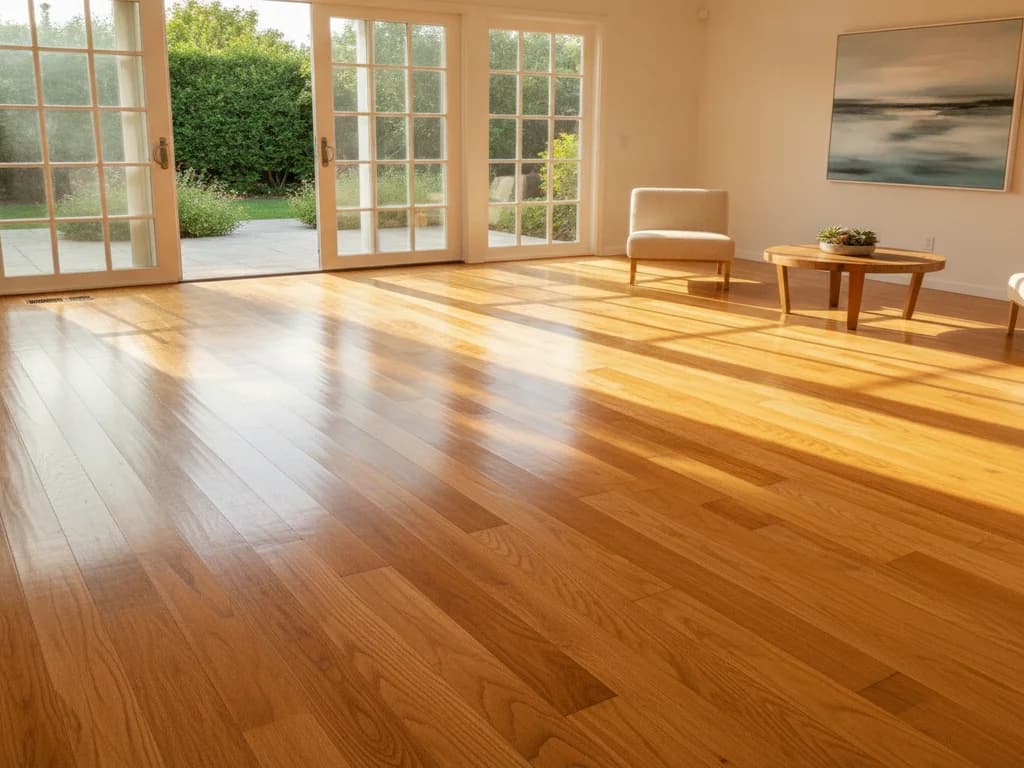
Hardwood refinishing — dustless sanding, custom stain, and durable finish coats that bring worn floors back to life without a full replacement.
Local Conditions
What Floor Refinishing Has to Contend With in Loomis
Loomis Conditions That Affect Floor Refinishing
Loomis sits at about 404 feet in Placer County. Loomis sits on the low granitic Loomis Basin bench at about 404 feet — the transition between the valley floor and the true foothills, only marginally warmer and wetter than the valley. At the nearest long-term station, Sacramento, the July normal daily high is 93.8°F with summer relative humidity swinging from roughly 78% before dawn to 30% by mid-afternoon. Acclimating wood to the conditioned interior handles that swing.
Winters are mild and wet, with light overnight freezes and essentially no accumulating snow at this low bench elevation — unlike the higher foothill towns to the east. The wet season runs November through March, so the moisture load is a valley-edge one rather than a high-foothill one. Cold, damp conditions do the reverse and stretch cure times, which mostly costs patience — a floor that is walkable is not yet a floor that is ready for furniture or rugs.
Seasonal Gaps in Loomis Floors, by the Numbers
Seasonal gaps between boards are a common reason people ask about refinishing, and Loomis's measured climate shows how much of that gapping is simply the wood moving with the seasons. Measured at Lincoln Regional Airport, then brought to 70°F, the air averages 37.4% relative humidity over the heating season and 49.1% over summer, which settles wood at roughly 7.3% and 9.1% moisture content. For a traditional 2¼-inch oak strip floor that is about 0.015 inch of seasonal shrinkage per board (about 1/66 inch); for 5-inch plank, about 0.034 inch. Gaps in that range that open in winter and close by summer should not be filled — filler packed into a winter gap gets crushed out, or pushes the boards toward cupping, once the wood takes its moisture back.
What's Under the Finish
Loomis's older, rural, larger-lot homes are a genuine mix of slab-on-grade and raised perimeter/crawlspace foundations — more raised than a new-tract suburb, given the 1960s–1980s peak of the stock. The ground works in the floor's favor: the Loomis Basin surface is granitic, weathered from granodiorite, and the characteristic Andregg coarse sandy loam is well drained with low shrink-swell. That means little of the seasonal slab heave that expansive valley clay produces, so slab-direct installs are well supported — while the raised-foundation share of the older ranch homes still calls for a crawlspace and subfloor-moisture check. The regional new-build benchmark (NAHB Census Survey of Construction, 89.9% slab for new Pacific-division homes) is context, not Loomis's mixed older reality. Foundation type is confirmed on site.
A slab affects what can be refinished at all. Wood over concrete is usually engineered or glued-down, and an engineered floor can only be sanded if its wear layer is thick enough to survive it — some can take a full sanding, many can take one light pass, and some cannot be sanded at all. We measure the wear layer before quoting rather than after starting.
Raised floors are where the best refinishing candidates live: solid wood over a crawlspace, often with decades of wear and plenty of thickness left. It is also where cupping comes from. Sanding a cupped floor flat before the crawlspace moisture is fixed produces a floor that goes concave the other way once it dries — so the moisture reading comes first and the sanding comes second.
Source: NAHB analysis of the Census Bureau Survey of Construction, foundation type by region (2024)
Loomis Homes We Work In
Semi-rural, larger-lot housing with an equestrian and agricultural heritage rather than dense subdivision. ACS 2020–2024 5-year estimates place about 78% of Loomis's roughly 3,136 housing units in 1960–1999 construction — peaking in the 1970s (24.9%) and 1980s (22.0%) — with the median year built in the late 1970s, only a small fruit-shipping historic core (Old Town) predating 1950, and a luxury custom-estate segment such as the gated Sierra De Montserrat at the upper end. Loomis's 1960s, 1970s, and 1980s stock is where refinishing pays off most: homes of that period often have original wood under carpet, and when the wear layer is intact, refinishing keeps a floor that cannot be bought new. We check thickness at a vent or a doorway before recommending it.
Before We Quote
Planning Around Loomis
Loomis conditions that affect a refinishing job:
- Loomis's granitic Loomis Basin soils (Andregg series) are well drained with low shrink-swell, so slab heave is far less of a concern than in the valley's expansive-clay pockets — favorable ground for slab-direct hardwood, engineered, and tile.
- The 1960s–1980s rural stock carries a real share of raised, crawlspace-borne floors alongside slab, so which prep applies is a per-home question settled by a crawlspace and moisture check rather than a neighborhood assumption.
- Larger horse-property and estate homes here often run wide-plank and premium wood across long, open plans, where uniform acclimation and expansion detailing across connected rooms matter more than in a compartmentalized floor plan.
- At the valley-edge 404-foot bench, the moisture regime is milder than the higher foothills — no accumulating snow and less rain than Auburn or the Gold Country towns — so seasonal wood movement is closer to a valley home's than a mountain one's.
Permits & Jurisdiction
Who Has Jurisdiction in Loomis
Building permits and inspections for Loomis properties go through Town of Loomis Building Division. Loomis is an incorporated town (1984) that runs its own in-house Building Division rather than contracting to Placer County; a Town of Loomis business license is required on permits.
Requirements change. Confirm current rules with the issuing agency before work begins.
We install floor refinishing throughout Loomis, including Historic Old Town Loomis, Loomis Basin, Blue Anchor, Horseshoe Bar, Sierra De Montserrat.
Sources
Where These Loomis Details Come From
The local conditions above are drawn from these public sources.
- Climate of Sacramento, California — NWS Sacramento (rev. August 2010): July normal high 93.8°F, RH 78% AM / 30% PM, annual precipitation 19.87 in (nearest long-term station; Loomis at 404 ft is a marginally warmer/wetter valley edge)
- Loomis, CA housing profile — US Census ACS 2020–2024 5-year, Table B25034 Year Structure Built, place FIPS 0643140 (~3,136 units; ~78% built 1960–1999, wide MOE) via Census Reporter
- Which Foundation Type Is Most Common in Your Region? — NAHB tabulation of US Census Bureau Survey of Construction, Aug 2025 (Pacific division 89.9% slab in 2024)
- Andregg series — USDA-NRCS Official Series Description (granitic Loomis Basin; well drained, weathered mainly from granodiorite); SSURGO Placer County Western Part (CA620) linear extensibility 1.5%, the low shrink-swell class
- Town of Loomis — Building Division
- Loomis, California — elevation 404 ft, incorporated town (Wikipedia, citing USGS GNIS)
More in This Area
Other Flooring Services in Loomis
Good to Know
Frequently Asked Questions
Do you install floor refinishing in Loomis?
Yes. Renaissance Floors installs floor refinishing throughout Loomis and the surrounding Placer County area. Call (916) 749-0272 for a free estimate.
Can my floor be refinished, or does it need replacing?
If the wear is still in the finish rather than in the wood, a screen-and-recoat abrades the existing finish and adds a fresh coat without sanding to bare wood — faster, cheaper, and far less disruptive. Once traffic lanes have worn through to bare wood or stains have reached the wood itself, that window has closed and it needs a full sand-and-finish.
How disruptive is refinishing?
Site-finished work means sanding, staining, and multiple coats with dry time between them, so the rooms are out of use for longer than a prefinished installation. We give a realistic day count up front and tell you how long the finish needs to cure before rugs and heavy traffic go back.
How do I get an estimate in Loomis?
Call (916) 749-0272 or request a free estimate online. We'll schedule a convenient in-home visit in Loomis, measure your space, and give you an honest written quote.
Related
Keep Reading
Related pages: Floor Installation in San Francisco, Floor Repair in San Francisco, Floor Refinishing, and Loomis.
Ready for Floors You'll Love?
Free estimates on floor refinishing throughout Loomis and Placer County.