Shingle Springs
Engineered Hardwood in Shingle Springs
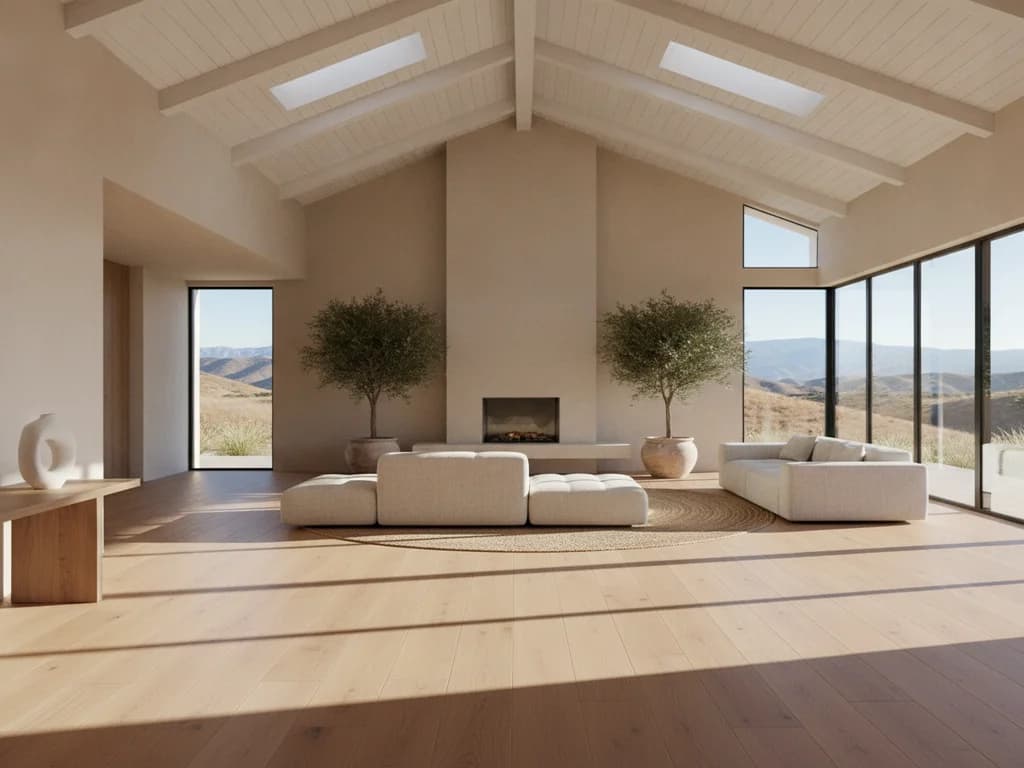
Engineered European oak and wide-plank hardwood — a genuine hardwood surface over a dimensionally stable core that handles humidity and heat.
Local Conditions
What Engineered Hardwood Has to Contend With in Shingle Springs
Shingle Springs Conditions That Affect Engineered Hardwood
Shingle Springs sits at about 1,421 feet in El Dorado County. Shingle Springs is a semi-rural US-50 foothill community at about 1,421 feet with hot, dry summers. There is no local weather station; the nearest long-record gauge is Placerville, several miles east and a few hundred feet higher, so Shingle Springs runs marginally warmer and drier than that reading. The seasonal swing between rainless summers and a wet winter is what a wood floor has to absorb, handled by acclimating the material on site.
Winters are mild and wet, with light overnight freezes and only rare, non-persistent snow at this mid-low foothill elevation. Annual rainfall is likely in the mid-to-high 30-inch range — more than the valley, a touch less than higher Placerville — falling mostly November through March. Through winter the same stability works in reverse: the core resists the swelling that a solid floor would show as the house takes on moisture. Stable is not inert, though — the expansion gap at the perimeter still gets set properly.
What Shingle Springs's Humidity Asks of Engineered Hardwood
In Shingle Springs the case for engineered hardwood rests more on plank width and slab than on climate, and the measurements show why. Hourly dewpoint readings from Auburn Municipal Airport, 21 miles away, put that air at a median 32.5% relative humidity once it is heated to 70°F over winter — 34% of those hours under NWFA's 30% minimum — rising to 45.9% in summer. A solid 5-inch white oak board living through that, at roughly 6.6% to 8.6% equilibrium moisture content, changes width by about 0.038 inch between seasons. A cross-laminated core exists to restrain that movement; how much it restrains depends on the product's construction, so we go by the manufacturer's stated humidity range for the specific floor rather than a general rule.
Subfloor and Foundation Work
On Shingle Springs' rural, sloped, larger-lot parcels the foundation mix runs to slab-on-grade in the dominant 1970s–80s tracts alongside raised and stepped foundations on the steeper lots; the NAHB Census Survey of Construction figure of 89.9% slab describes new homes only. The ground is granitic- and metamorphic-derived El Dorado foothill soil — rocky and gravelly, moderately deep, generally low-to-moderate in shrink-swell, with clay-rich pockets carrying more movement. Because the bulk of the stock is now 40–50 years old, the recurring realities are dated subfloor assemblies, slab moisture on the older pads, and drainage across rocky, sloped ground — not the century-old-subfloor conditions of the deep-historic towns. Foundation and substrate conditions are confirmed on site.
A slab is the single biggest reason engineered hardwood gets specified at all. A dimensionally stable core can go over concrete where solid wood cannot — floated, or glued down with a moisture-control membrane. That is not a free pass: we still test the slab per ASTM F2170, still grind or fill it flat to the manufacturer's tolerance, and still match the adhesive system to the reading we get. Skipping the test is how a glue-down floor comes loose.
Over a crawlspace, engineered goes down by nail, staple, glue, or float, so the method follows the subfloor rather than the other way round. We flatten the subfloor first — engineered plank is stiff, and it bridges dips instead of following them, which is what produces hollow spots underfoot.
Source: NAHB analysis of the Census Bureau Survey of Construction, foundation type by region (2024)
Shingle Springs Homes We Work In
Predominantly a 1970s–1980s rural foothill build-out on larger lots, wrapped around a small historic core. ACS 2020–2024 5-year estimates place roughly 69% of Shingle Springs' approximately 1,539 housing units in 1970–1989 construction — the 1970s the peak at about 38% — with the median year built in the late 1970s and only a small pre-1940 remnant from the Gold Rush shingle-mill village. (Small-sample estimates; treat shares as approximate.) In Shingle Springs's 1970s and 1980s housing, engineered often wins on height as much as on moisture: a thinner assembly clears existing door jambs, appliance toe-kicks, and the transitions to rooms that aren't being redone, which matters when only part of the house is getting new floor.
Before We Quote
Planning Around Shingle Springs
A few Shingle Springs conditions change how we plan an engineered hardwood install:
- Most Shingle Springs homes are now 40–50 years old (a 1970s–80s peak), so slab moisture on the older pads and dated subfloor assemblies are the common starting points rather than historic-plank repair.
- Rural, sloped lots bring a real share of raised and stepped foundations, so crawlspace access and moisture, plus level transitions between floor levels, are decided lot by lot.
- Granitic and metamorphic foothill soils here are rocky and generally low-to-moderate in shrink-swell, so drainage over rocky ground is a bigger flooring-prep factor than the expansive-clay heave of the valley.
- Hot, dry summers alternating with a wet foothill winter widen seasonal wood movement, so solid or engineered wood is acclimated on site and expansion space is set for this climate.
Permits & Jurisdiction
Who Has Jurisdiction in Shingle Springs
Building permits and inspections for Shingle Springs properties go through El Dorado County Planning and Building Department, Building Division. Shingle Springs is unincorporated, so it has no city building department — permits and inspections run through El Dorado County (nearby Placerville is a separate incorporated city).
Requirements change. Confirm current rules with the issuing agency before work begins.
We install engineered hardwood throughout Shingle Springs, including Historic Shingle Springs, French Creek, Ponderosa, North Shingle.
Sources
Where These Shingle Springs Details Come From
The local conditions above are drawn from these public sources.
- Placerville CA NOAA co-op station 046960 (nearest long-record gauge, ~6 mi E and ~450 ft higher; ~38-40 in annual precipitation — Shingle Springs at ~1,421 ft runs marginally warmer/drier)
- Shingle Springs CDP, CA housing profile — US Census ACS 2020–2024 5-year, Table B25034 Year Structure Built, place FIPS 0671554 (~1,539 units; ~69% built 1970–1989; large MOE) via Census Reporter
- Which Foundation Type Is Most Common in Your Region? — NAHB tabulation of US Census Bureau Survey of Construction, Aug 2025 (Pacific division 89.9% slab in 2024)
- Soil Survey of the El Dorado Area, California — USDA-NRCS (granitic and metamorphic foothill soils; rocky, moderately deep, low-to-moderate shrink-swell)
- El Dorado County — Planning and Building Department, Building Division (authority for unincorporated Shingle Springs)
- Shingle Springs, California — elevation 1,421 ft, unincorporated foothill CDP, shingle-mill name origin (Wikipedia, citing USGS GNIS)
More in This Area
Other Flooring Services in Shingle Springs
Good to Know
Frequently Asked Questions
Do you install engineered hardwood in Shingle Springs?
Yes. Renaissance Floors installs engineered hardwood throughout Shingle Springs and the surrounding El Dorado County area. Call (916) 749-0272 for a free estimate.
Is engineered hardwood real wood?
Yes — the surface is a genuine wood veneer over a dimensionally stable core, usually plywood or HDF. The cross-laminated construction moves far less with humidity than solid wood, which is why it works over slabs, in basements, and in wide-plank formats where a solid board would be least stable.
Can engineered hardwood be refinished?
It depends entirely on wear-layer thickness, and it varies by product rather than by category. Some can be sanded once or twice; others are built to be replaced when worn. It is a fair question to ask before buying, and we will tell you honestly which one you are looking at.
How do I get an estimate in Shingle Springs?
Call (916) 749-0272 or request a free estimate online. We'll schedule a convenient in-home visit in Shingle Springs, measure your space, and give you an honest written quote.
Related
Keep Reading
Related pages: Engineered Hardwood, Shingle Springs, Hardwood Flooring, and Luxury Vinyl Plank.
Ready for Floors You'll Love?
Free estimates on engineered hardwood throughout Shingle Springs and El Dorado County.