West Sacramento
Laminate Flooring in West Sacramento
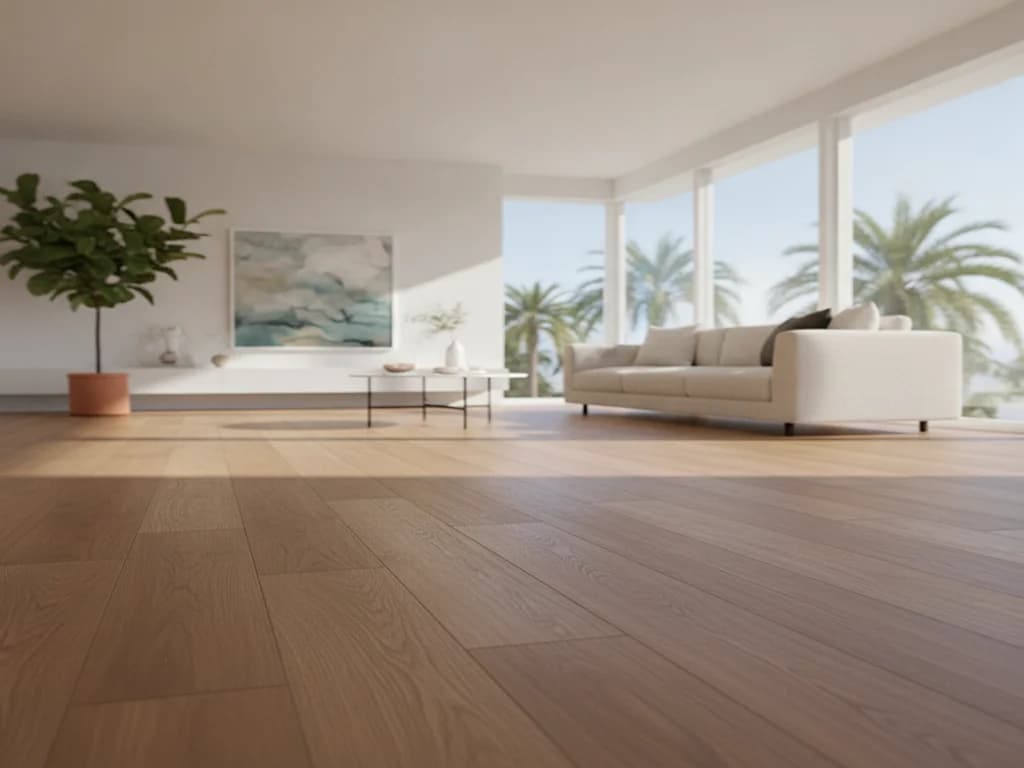
Modern laminate with realistic wood and stone visuals and a tough wear layer — a smart, budget-conscious upgrade installed to exacting standards.
Local Conditions
What Laminate Flooring Has to Contend With in West Sacramento
West Sacramento Conditions That Affect Laminate Flooring
West Sacramento sits at about 20 feet in Yolo County. West Sacramento sits on the low valley floor near river level, directly across the Sacramento River from downtown. At the genuinely-local station, NWS Sacramento City, the July normal daily high is 92.5°F, and relative humidity in the NWS Sacramento record averages about 78% at 4 AM against 30% at 4 PM in July. That wide daily humidity swing is what a wood floor has to absorb here.
Winters are mild and wet, with more than half the 19.87-inch annual precipitation normal falling in the November-through-February rainy season and dense, persistent 'tule' fog on stagnant mornings. Being low and near the river behind levees, the area has an occasional flood context; NWS Sacramento reports snow so rare its occurrence 'may be disregarded as a climatic feature.' In winter the floor contracts, and gaps at the joints are the visible sign that it was installed without enough room to move in the first place.
Subfloor Prep
West Sacramento carries the strongest slab-moisture story of the Sacramento-region cities, and it comes from the ground. The city sits on low Delta and river-basin alluvium behind levees, where the USDA maps fine-textured, poorly drained basin clays — the Sacramento series and its companions Clear Lake and Willows. The Sacramento series description is emphatic: natural drainage poor to very poor, a water table that fluctuates between the surface and 60 inches, clay content of 60–70 percent, and seasonal cracks 3/8 to 1 inch wide — classic high-shrink-swell vertic clay. Pair that high, fluctuating water table and expansive clay with the roughly 90% slab-on-grade share of new Pacific-division construction (NAHB/Census Survey of Construction, 2024) and slab moisture is the central variable here, not a footnote: calcium-chloride and in-situ RH testing (ASTM F2170), vapor retarders, and moisture-tolerant assemblies are far more warranted than in the foothill-granite towns. The older near-river core adds raised-floor crawlspace moisture on top of that. Foundation and moisture conditions are confirmed on site.
Laminate over concrete lives or dies on the underlayment. The core of a laminate plank is fiberboard: the wear layer sheds spills, but the core swells irreversibly if it takes on moisture from below. Over slab that means a vapor retarder is not optional, and it means testing the concrete rather than assuming a newer slab is dry. Flatness matters as much as it does for vinyl — laminate's click joints fail the same way over a dip.
Over a crawlspace, laminate needs the same two things: a flat, sound subfloor and a moisture path that has been dealt with underneath rather than covered over. A damp crawlspace under a fiberboard-core floor is a slow failure, and it shows up first as swollen, peaked joints.
Source: NAHB analysis of the Census Bureau Survey of Construction, foundation type by region (2024)
West Sacramento Homes We Work In
A distinctly bimodal housing stock. ACS 2020–2024 5-year estimates split West Sacramento's 20,826 units between a large mid-century core — 19.0% built in the 1950s and about 34.5% predating 1970, in the historic Bryte, Broderick, and Washington districts near the river — and a big 2000s wave, 28.9% built 2000–2009 in Southport, The Rivers, and the Bridge District, with the median year built in the 1990s. The two populations call for very different flooring approaches. In West Sacramento's 1950s and 2000s homes, laminate is usually going over a subfloor that has carried carpet for a long time. We pull it and look at what's actually there — the underlayment and the flatness correction are what separate a laminate floor that feels solid from one that clicks and gives underfoot.
Before We Quote
Planning Around West Sacramento
Some West Sacramento conditions change how a laminate floor gets planned:
- The area's basin clays (USDA Sacramento series) hold 60–70% clay with a water table that can rise to the surface, so slab moisture and vapor emission are the central concern — calcium-chloride or in-situ RH testing and a proven vapor retarder should precede any rigid or moisture-sensitive floor.
- High-shrink-swell vertic clay moves seasonally, cracking to more than 20 inches deep in dry months, which is why moisture-tolerant flooring and correct expansion detailing matter more here than in the granite foothills.
- The bimodal stock means two prep approaches in one city: post-2000 Southport and Bridge District homes are slab-on-grade, while the historic Bryte, Broderick, and Washington core mixes older raised, crawlspace-borne floors that carry their own moisture risk.
- Older near-river homes can carry pre-1980 materials of concern under later floors, worth identifying before a tear-out rather than after.
Permits & Jurisdiction
Who Has Jurisdiction in West Sacramento
Building permits and inspections for West Sacramento properties go through City of West Sacramento Community Development Department, Building Division. West Sacramento is an incorporated Yolo County city and issues its own permits through its Building Division — not through Yolo County or the City of Sacramento across the river.
Requirements change. Confirm current rules with the issuing agency before work begins.
We install laminate flooring throughout West Sacramento, including Southport, Bryte, Broderick, Washington, The Rivers, Bridge District, and the surrounding area.
Sources
Where These West Sacramento Details Come From
The local conditions above are drawn from these public sources.
- Climate of Sacramento, California — NWS Sacramento (rev. August 2010): July normal high 92.5°F, RH 78% at 4 AM / 30% at 4 PM, annual precipitation 19.87 in, tule fog, snow disregarded (local station is Sacramento City, across the river)
- West Sacramento, CA housing profile — US Census ACS 2020–2024 5-year, Table B25034 Year Structure Built, place FIPS 0684816 (20,826 units; bimodal — 19.0% 1950s, 28.9% 2000–2009) via Census Reporter
- Which Foundation Type Is Most Common in Your Region? — NAHB tabulation of US Census Bureau Survey of Construction, Aug 2025 (Pacific division 89.9% slab in 2024)
- Sacramento and Willows series — USDA-NRCS Official Series Descriptions (poorly drained basin clay, 60–70% clay, water table 0–60 in, high shrink-swell vertic cracking)
- City of West Sacramento — Community Development Department, Building Division
- West Sacramento, California — elevation 20 ft, incorporated 1987, Yolo County (Wikipedia, citing USGS GNIS)
More in This Area
Other Flooring Services in West Sacramento
Nearby Areas
Laminate Flooring Near West Sacramento
Good to Know
Frequently Asked Questions
Do you install laminate flooring in West Sacramento?
Yes. Renaissance Floors installs laminate flooring throughout West Sacramento and the surrounding Yolo County area. Call (916) 749-0272 for a free estimate.
Is laminate the same as luxury vinyl?
No. Laminate is a printed image layer under a clear wear layer over a fiberboard core — durable underfoot, but not wood and not waterproof the way an SPC or WPC vinyl core is. Even water-resistant laminate swells at the seams under standing water.
Where does laminate work best?
Bedrooms, living rooms, home offices — moderate-traffic dry areas, where it performs well and looks convincing. For kitchens, bathrooms, or basements where water exposure is routine we would usually steer you to luxury vinyl instead and say why.
How do I get an estimate in West Sacramento?
Call (916) 749-0272 or request a free estimate online. We'll schedule a convenient in-home visit in West Sacramento, measure your space, and give you an honest written quote.
Related
Keep Reading
Related pages: Laminate Flooring, West Sacramento, Hardwood Flooring, and Engineered Hardwood.

Ready for Floors You'll Love?
Free estimates on laminate flooring throughout West Sacramento and Yolo County.