Colfax
Engineered Hardwood in Colfax
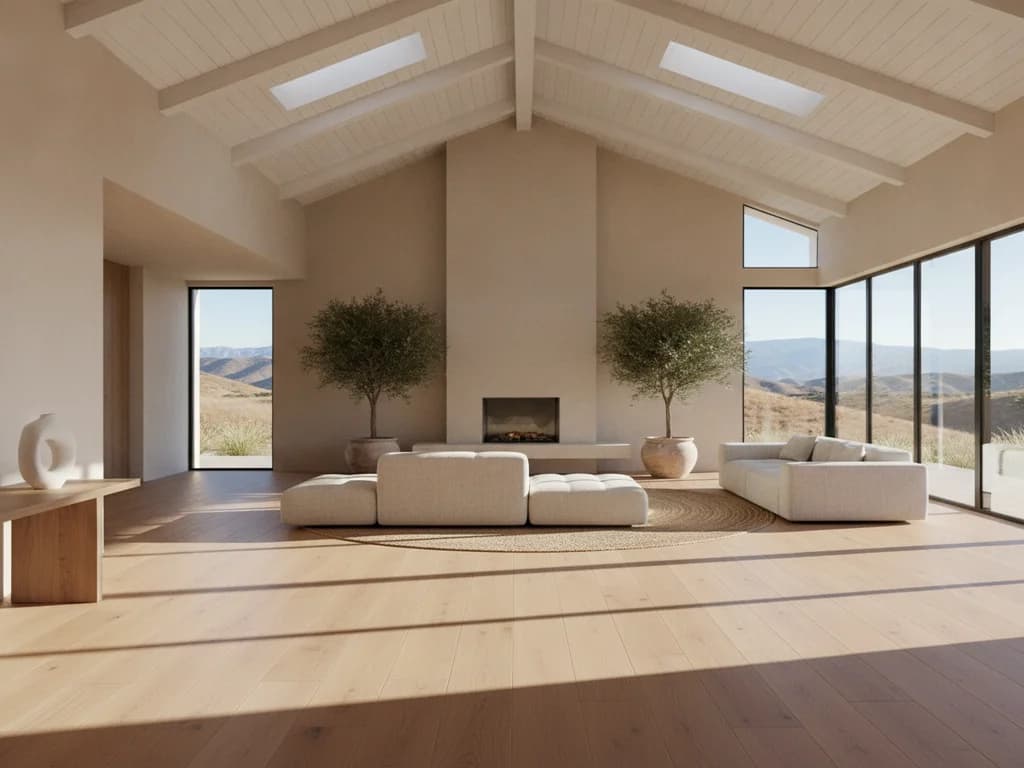
Engineered European oak and wide-plank hardwood — a genuine hardwood surface over a dimensionally stable core that handles humidity and heat.
Local Conditions
What Engineered Hardwood Has to Contend With in Colfax
Colfax Conditions That Affect Engineered Hardwood
Colfax sits at about 2,425 feet in Placer County. Colfax is a mid-foothill town at about 2,425 feet on the western Sierra slope, cooler than the valley — the NOAA co-op station at the edge of town records a July average high near 88°F — with hot, dry, essentially rainless summers. The floor here lives between those bone-dry summers and a heavy wet winter, so acclimating wood to the home's conditioned interior is the way that seasonal swing is managed. Engineered hardwood exists precisely for climates like this. With Colfax summer highs near 88°F and air conditioning drying the house out, a cross-laminated or multi-ply core moves far less across the grain than solid wood does, so seasonal gapping is much less pronounced. It is the reason we recommend engineered over wide plank widths in particular — the wider the board, the more a solid version would move.
Winters are cool and genuinely wet: the Colfax station records about 47 inches of annual precipitation — well over twice the valley — concentrated November through March, real overnight freezes, and modest snow (7.7 inches in a normal year, falling on only three or four days) that accumulates at 2,425 feet but melts between systems. Prolonged wet-season subfloor exposure and freeze at slab edges are the winter concerns. Through winter the same stability works in reverse: the core resists the swelling that a solid floor would show as the house takes on moisture. Stable is not inert, though — the expansion gap at the perimeter still gets set properly.
What Colfax's Humidity Asks of Engineered Hardwood
The case for engineered hardwood in Colfax is measurable. Hourly dewpoint readings from Nevada County Air Park, Grass Valley, 9 miles away, put that air at a median 26.3% relative humidity once it is heated to 70°F over winter — 59% of those hours under NWFA's 30% minimum — rising to 37.4% in summer. A solid 5-inch white oak board living through that, at roughly 5.6% to 7.3% equilibrium moisture content, changes width by about 0.024 inch between seasons. A cross-laminated core exists to restrain that movement; how much it restrains depends on the product's construction, so we go by the manufacturer's stated humidity range for the specific floor rather than a general rule. Winter moisture content here drops below the 6% where FPL publishes its coefficients, so the movement figures are calculated from 6% and understate the real swing.
Subfloor and Foundation Work
Colfax's pre-war and hillside homes skew toward raised perimeter and post-and-pier foundations, with slab-on-grade across the newer 1970s–2000s stock — a real mix rather than the slab-dominant profile of the NAHB new-construction figure (89.9% slab for new Pacific-division homes). The setting is the Sierra metamorphic foothill belt: the mapped soils in town — Mariposa, Josephine, Sites, and Cohasset series — weather from slate, schist, and metavolcanic bedrock, with the dominant Mariposa hitting weathered rock about 28 inches down on slopes to 50 percent — rocky, well drained, and low in shrink-swell. Many lots are cut into hillside, so combined with roughly 47 inches of annual rain, hillside drainage and crawlspace moisture are the dominant subfloor risks here, not expansive-clay heave. Foundation and drainage conditions are confirmed on site.
A slab is the single biggest reason engineered hardwood gets specified at all. A dimensionally stable core can go over concrete where solid wood cannot — floated, or glued down with a moisture-control membrane. That is not a free pass: we still test the slab per ASTM F2170, still grind or fill it flat to the manufacturer's tolerance, and still match the adhesive system to the reading we get. Skipping the test is how a glue-down floor comes loose.
Over a crawlspace, engineered goes down by nail, staple, glue, or float, so the method follows the subfloor rather than the other way round. We flatten the subfloor first — engineered plank is stiff, and it bridges dips instead of following them, which is what produces hollow spots underfoot.
Source: NAHB analysis of the Census Bureau Survey of Construction, foundation type by region (2024)
Colfax Homes We Work In
A barbell of railroad-era historic homes and a later hillside-suburban wave. ACS 2020–2024 5-year estimates put about 14% of Colfax's roughly 1,069 housing units in pre-1940 construction — the 1860s Central Pacific Railroad and Gold Rush core around the depot — alongside a large 1970s–2000s build-out that pulls the median year built to 1987. Historic raised-foundation homes sit near newer hillside builds. (Small-city estimates; treat shares as approximate.) In Colfax's 1980s and 1990s housing, engineered often wins on height as much as on moisture: a thinner assembly clears existing door jambs, appliance toe-kicks, and the transitions to rooms that aren't being redone, which matters when only part of the house is getting new floor.
Before We Quote
Planning Around Colfax
A few Colfax conditions change how we plan an engineered hardwood install:
- Colfax's ~47 inches of annual rain on steep, rocky metamorphic lots makes hillside drainage and crawlspace moisture the leading subfloor risks — well ahead of the expansive-clay heave that drives valley slab prep.
- The railroad-era historic core, about 14% of the stock built before 1940, brings raised foundations, plank subfloors, and out-of-level framing — original floors here are often candidates for refinishing and repair rather than replacement.
- Real winter freezes and modest snow at 2,425 feet, followed by dry summers, widen seasonal wood movement, so solid or engineered wood is acclimated on site and expansion detailing is set for a mid-foothill climate.
- The newer 1970s–2000s hillside homes are generally on slab or stepped foundations in their first service life, so substrate replacement is less often needed there than in the historic downtown.
Permits & Jurisdiction
Who Has Jurisdiction in Colfax
Building permits and inspections for Colfax properties go through City of Colfax Building Department. Colfax runs its own Building Department rather than delegating to the county; parcels with a Colfax (95713) address that lie outside city limits — Weimar and the Iowa Hill outskirts — permit through Placer County, so jurisdiction is confirmed by parcel.
Requirements change. Confirm current rules with the issuing agency before work begins.
We install engineered hardwood throughout Colfax, including Historic Downtown Colfax, Railroad District, Illinoistown, Ben Taylor.
Sources
Where These Colfax Details Come From
The local conditions above are drawn from these public sources.
- Colfax CA NOAA co-op station USC00041912 (NCEI 1991–2020 normals; an HCN reference-grade station at the edge of town): July average high 87.7°F, annual precipitation 47.04 in, annual snowfall 7.7 in on ~3–4 snow days
- Colfax, CA housing profile — US Census ACS 2020–2024 5-year, Table B25034/B25035 Year Structure Built, place FIPS 0614498 (~1,069 units; 14.1% pre-1940, median 1987; large MOE) via Census Reporter
- Which Foundation Type Is Most Common in Your Region? — NAHB tabulation of US Census Bureau Survey of Construction, Aug 2025 (Pacific division 89.9% slab in 2024)
- Mariposa, Josephine, Sites, and Cohasset series — USDA-NRCS OSDs / SSURGO point sampling inside city limits (slate- and schist-derived foothill soils; Mariposa bedrock ~28 in, LEP 1.5, well drained, slopes to 50%)
- City of Colfax — Building Department
- Colfax, California — elevation ~2,425 ft, historic railroad city (Wikipedia, citing USGS GNIS)
More in This Area
Other Flooring Services in Colfax
Good to Know
Frequently Asked Questions
Do you install engineered hardwood in Colfax?
Yes. Renaissance Floors installs engineered hardwood throughout Colfax and the surrounding Placer County area. Call (916) 749-0272 for a free estimate.
Is engineered hardwood real wood?
Yes — the surface is a genuine wood veneer over a dimensionally stable core, usually plywood or HDF. The cross-laminated construction moves far less with humidity than solid wood, which is why it works over slabs, in basements, and in wide-plank formats where a solid board would be least stable.
Can engineered hardwood be refinished?
It depends entirely on wear-layer thickness, and it varies by product rather than by category. Some can be sanded once or twice; others are built to be replaced when worn. It is a fair question to ask before buying, and we will tell you honestly which one you are looking at.
How do I get an estimate in Colfax?
Call (916) 749-0272 or request a free estimate online. We'll schedule a convenient in-home visit in Colfax, measure your space, and give you an honest written quote.
Related
Keep Reading
Related pages: Laminate Flooring in Fairfield, Luxury Vinyl Plank in Fairfield, Engineered Hardwood, and Colfax.
Ready for Floors You'll Love?
Free estimates on engineered hardwood throughout Colfax and Placer County.