Colfax
Tile Flooring in Colfax
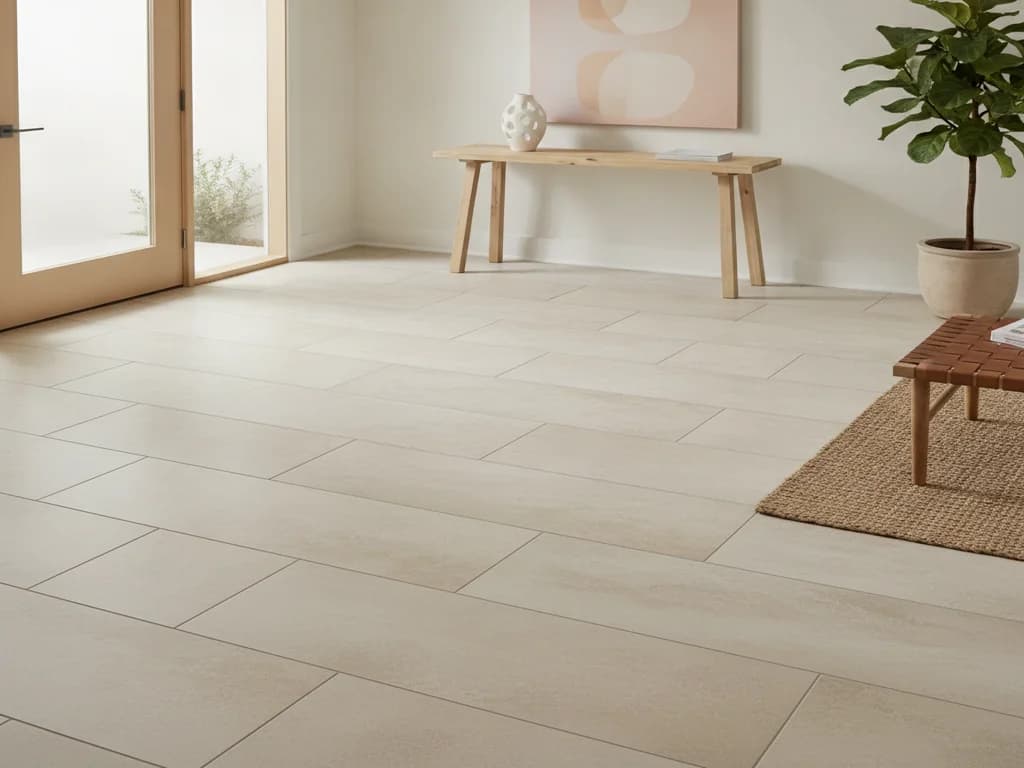
Porcelain and ceramic tile for entries, kitchens, and baths — set on a properly prepared substrate with laser-level layout and clean grout work.
Local Conditions
What Tile Flooring Has to Contend With in Colfax
Colfax Conditions That Affect Tile
Colfax sits at about 2,425 feet in Placer County. Colfax is a mid-foothill town at about 2,425 feet on the western Sierra slope, cooler than the valley — the NOAA co-op station at the edge of town records a July average high near 88°F — with hot, dry, essentially rainless summers. The floor here lives between those bone-dry summers and a heavy wet winter, so acclimating wood to the home's conditioned interior is the way that seasonal swing is managed. Tile itself is unbothered by Colfax heat — near 88°F outside, an unheated tile floor is one of the few surfaces in the house that stays cool. What heat does affect is the installation: thinset open time shortens in hot, dry conditions, so summer work gets staged in smaller sections so every tile is set into mortar that is still live.
Winters are cool and genuinely wet: the Colfax station records about 47 inches of annual precipitation — well over twice the valley — concentrated November through March, real overnight freezes, and modest snow (7.7 inches in a normal year, falling on only three or four days) that accumulates at 2,425 feet but melts between systems. Prolonged wet-season subfloor exposure and freeze at slab edges are the winter concerns. Cold slows cure times at the other end of the year, and grout and mortar both need to be held above their minimum cure temperature to reach full strength. On a winter job that means heat in the space, not just a tarp over the door.
Substrate Preparation
Colfax's pre-war and hillside homes skew toward raised perimeter and post-and-pier foundations, with slab-on-grade across the newer 1970s–2000s stock — a real mix rather than the slab-dominant profile of the NAHB new-construction figure (89.9% slab for new Pacific-division homes). The setting is the Sierra metamorphic foothill belt: the mapped soils in town — Mariposa, Josephine, Sites, and Cohasset series — weather from slate, schist, and metavolcanic bedrock, with the dominant Mariposa hitting weathered rock about 28 inches down on slopes to 50 percent — rocky, well drained, and low in shrink-swell. Many lots are cut into hillside, so combined with roughly 47 inches of annual rain, hillside drainage and crawlspace moisture are the dominant subfloor risks here, not expansive-clay heave. Foundation and drainage conditions are confirmed on site.
A slab is the friendliest substrate tile can have — provided its cracks are respected rather than tiled over. A crack that is still moving will come through the tile above it, so it gets treated with a crack-isolation membrane or honored with a movement joint. Slab flatness is what governs large-format tile in particular: the bigger the tile, the less the substrate can deviate before lippage shows at every edge.
Over a wood-framed floor, tile is a deflection question before it is a tile question. A floor system that flexes more than the assembly allows will crack grout first and tile second, regardless of how well it was set. We check joist span and subfloor thickness, add a second layer or a proper uncoupling membrane where the structure calls for it, and tell you if the answer is that the floor needs stiffening.
Source: NAHB analysis of the Census Bureau Survey of Construction, foundation type by region (2024)
Colfax Homes We Work In
A barbell of railroad-era historic homes and a later hillside-suburban wave. ACS 2020–2024 5-year estimates put about 14% of Colfax's roughly 1,069 housing units in pre-1940 construction — the 1860s Central Pacific Railroad and Gold Rush core around the depot — alongside a large 1970s–2000s build-out that pulls the median year built to 1987. Historic raised-foundation homes sit near newer hillside builds. (Small-city estimates; treat shares as approximate.) In Colfax's 1980s and 1990s homes, the framing was often designed to the code of its day rather than to today's large-format tile, so the deflection check matters more, not less. It is the reason we survey the floor structure in older homes before quoting tile.
Before We Quote
Planning Around Colfax
A few Colfax conditions shape how we approach a tile floor:
- Colfax's ~47 inches of annual rain on steep, rocky metamorphic lots makes hillside drainage and crawlspace moisture the leading subfloor risks — well ahead of the expansive-clay heave that drives valley slab prep.
- The railroad-era historic core, about 14% of the stock built before 1940, brings raised foundations, plank subfloors, and out-of-level framing — original floors here are often candidates for refinishing and repair rather than replacement.
- Real winter freezes and modest snow at 2,425 feet, followed by dry summers, widen seasonal wood movement, so solid or engineered wood is acclimated on site and expansion detailing is set for a mid-foothill climate.
- The newer 1970s–2000s hillside homes are generally on slab or stepped foundations in their first service life, so substrate replacement is less often needed there than in the historic downtown.
Permits & Jurisdiction
Who Has Jurisdiction in Colfax
Building permits and inspections for Colfax properties go through City of Colfax Building Department. Colfax runs its own Building Department rather than delegating to the county; parcels with a Colfax (95713) address that lie outside city limits — Weimar and the Iowa Hill outskirts — permit through Placer County, so jurisdiction is confirmed by parcel.
Requirements change. Confirm current rules with the issuing agency before work begins.
We install tile flooring throughout Colfax, including Historic Downtown Colfax, Railroad District, Illinoistown, Ben Taylor.
Sources
Where These Colfax Details Come From
The local conditions above are drawn from these public sources.
- Colfax CA NOAA co-op station USC00041912 (NCEI 1991–2020 normals; an HCN reference-grade station at the edge of town): July average high 87.7°F, annual precipitation 47.04 in, annual snowfall 7.7 in on ~3–4 snow days
- Colfax, CA housing profile — US Census ACS 2020–2024 5-year, Table B25034/B25035 Year Structure Built, place FIPS 0614498 (~1,069 units; 14.1% pre-1940, median 1987; large MOE) via Census Reporter
- Which Foundation Type Is Most Common in Your Region? — NAHB tabulation of US Census Bureau Survey of Construction, Aug 2025 (Pacific division 89.9% slab in 2024)
- Mariposa, Josephine, Sites, and Cohasset series — USDA-NRCS OSDs / SSURGO point sampling inside city limits (slate- and schist-derived foothill soils; Mariposa bedrock ~28 in, LEP 1.5, well drained, slopes to 50%)
- City of Colfax — Building Department
- Colfax, California — elevation ~2,425 ft, historic railroad city (Wikipedia, citing USGS GNIS)
More in This Area
Other Flooring Services in Colfax
Nearby Areas
Tile Flooring Near Colfax
Good to Know
Frequently Asked Questions
Do you install tile flooring in Colfax?
Yes. Renaissance Floors installs tile flooring throughout Colfax and the surrounding Placer County area. Call (916) 749-0272 for a free estimate.
Does a tiled bathroom need waterproofing behind the tile?
In a shower or on a tub deck, yes. Tile and grout are not waterproofing on their own — a real membrane system goes behind them. It is worth asking any contractor which membrane they are using and why.
Is grout maintenance-free?
No. Cementitious grout should be sealed and will need periodic resealing, especially in kitchens and bathrooms. Subfloor flatness and deflection also matter more with tile than almost anything else — an uneven or bouncy floor cracks tile, and correcting it is not optional work.
How do I get an estimate in Colfax?
Call (916) 749-0272 or request a free estimate online. We'll schedule a convenient in-home visit in Colfax, measure your space, and give you an honest written quote.
Related
Keep Reading
Related pages: Laminate Flooring in Folsom, Luxury Vinyl Plank in Folsom, Tile Flooring, and Colfax.
Ready for Floors You'll Love?
Free estimates on tile flooring throughout Colfax and Placer County.