Lake of the Pines
Floor Refinishing in Lake of the Pines
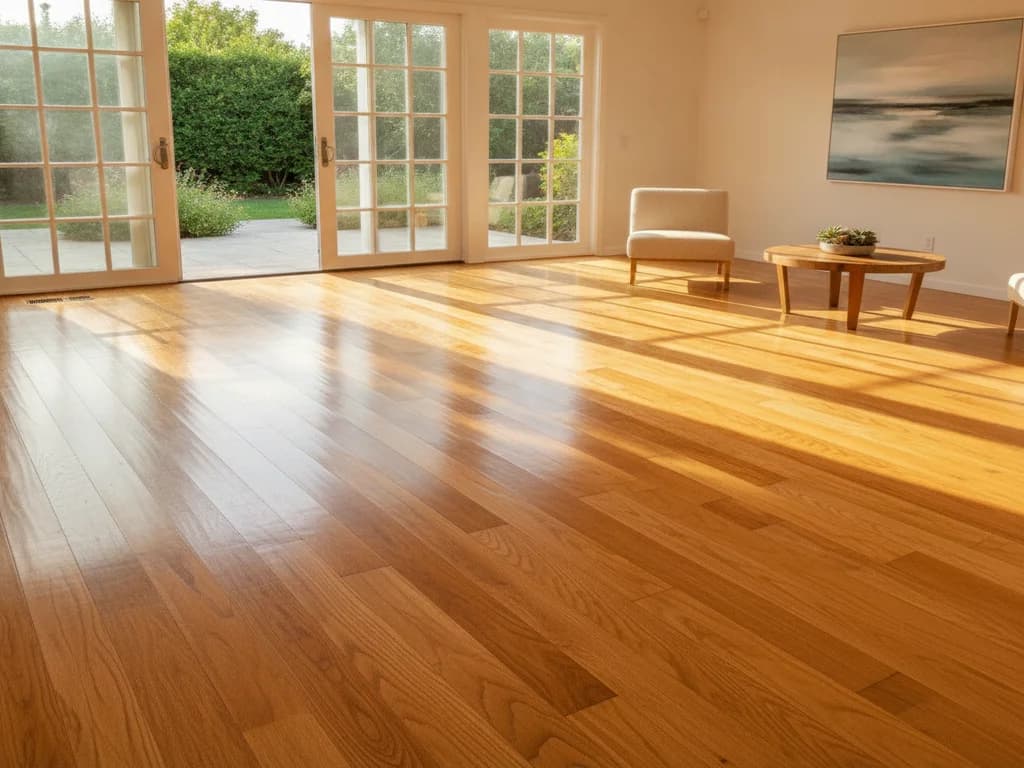
Hardwood refinishing — dustless sanding, custom stain, and durable finish coats that bring worn floors back to life without a full replacement.
Local Conditions
What Floor Refinishing Has to Contend With in Lake of the Pines
Lake of the Pines Conditions That Affect Floor Refinishing
Lake of the Pines sits at about 1,516 feet in Nevada County. Lake of the Pines sits at about 1,516 feet in the Sierra foothills, and the nearest current-normals record at broadly similar elevation — the Auburn co-op station roughly 11 miles southwest at 1,292 feet, about 225 feet below the community — puts July normal highs near 92.7°F with hot, dry, essentially rainless summers. That is several degrees warmer than Grass Valley 16 miles north at 2,411 feet, so this is a hot-summer foothill site rather than a cool upper-foothill one, and wood flooring is acclimated to the conditioned interior before installation. Lake of the Pines summers near 93°F change the finishing schedule more than the sanding. Waterborne finishes flash off faster in hot, dry air, which shortens the working window and makes lap marks easier to leave behind; we adjust application pace and airflow to the conditions in the house that day rather than to a fixed timetable.
Winters are wet but mild by Nevada County standards. The Auburn reference station records roughly 36 inches of annual precipitation — about double the Sacramento Valley, but far short of the 55 to 60 inches measured in the Grass Valley and Nevada City area — with little to no accumulating snow; published snowfall figures for the station range from zero to a few inches a year. Lake of the Pines lies below the usual snow line, so the freeze-thaw and snow-load conditions that drive flooring decisions in the higher county largely do not apply, and the winter concern here is rain-driven drainage on sloping lots rather than snowmelt. Cold, damp conditions do the reverse and stretch cure times, which mostly costs patience — a floor that is walkable is not yet a floor that is ready for furniture or rugs.
Seasonal Gaps in Lake of the Pines Floors, by the Numbers
Seasonal gaps between boards are a common reason people ask about refinishing, and Lake of the Pines's measured climate shows how much of that gapping is simply the wood moving with the seasons. Measured at Auburn Municipal Airport, then brought to 70°F, the air averages 32.5% relative humidity over the heating season and 45.9% over summer, which settles wood at roughly 6.6% and 8.6% moisture content. For a traditional 2¼-inch oak strip floor that is about 0.017 inch of seasonal shrinkage per board (about 1/59 inch); for 5-inch plank, about 0.038 inch. Gaps in that range that open in winter and close by summer should not be filled — filler packed into a winter gap gets crushed out, or pushes the boards toward cupping, once the wood takes its moisture back.
What's Under the Finish
No dataset publishes residential foundation type by city, so this is inference from the era profile rather than a foundation census. Because the community is entirely post-1960 — nothing built before 1960, median year 1980 — none of the historic raised-foundation housing that defines Grass Valley exists here; what is present is 1970s and 1980s foothill subdivision construction on sloping wooded lots, which in practice mixes slab-on-grade on the flatter pads with raised or stepped foundations where the ground falls away. NAHB's tabulation of the Census Survey of Construction puts new Pacific-division homes at 89.9% slab, so newer infill trends slab. Soils here are the mapped Boomer, Rescue, and Sobrante series — deep to moderately deep, well-drained foothill Alfisols with clay-enriched subsoil and moderately slow permeability, on lots typically sloping 16 to 22 percent. Winter rain does not sheet away quickly; it perches on the clay horizon and moves laterally downslope, so the issue is subsurface and surface water arriving at the uphill side of foundations. Foundation type, subfloor condition, and drainage are confirmed on site, and slab moisture is verified by RH testing (ASTM F2170) before any resilient or engineered installation.
A slab affects what can be refinished at all. Wood over concrete is usually engineered or glued-down, and an engineered floor can only be sanded if its wear layer is thick enough to survive it — some can take a full sanding, many can take one light pass, and some cannot be sanded at all. We measure the wear layer before quoting rather than after starting.
Raised floors are where the best refinishing candidates live: solid wood over a crawlspace, often with decades of wear and plenty of thickness left. It is also where cupping comes from. Sanding a cupped floor flat before the crawlspace moisture is fixed produces a floor that goes concave the other way once it dries — so the moisture reading comes first and the sanding comes second.
Source: NAHB analysis of the Census Bureau Survey of Construction, foundation type by region (2024)
Lake of the Pines Homes We Work In
The most era-concentrated housing stock in the service area, and the cleanest to plan around. ACS 2020–2024 5-year estimates put 43.6% of the CDP's 2,463 housing units in the 1970s and 31.3% in the 1980s — 74.9% of everything in two decades — with a median year built of 1980 and 80.3% of units predating 1990. The community was platted almost entirely in a single year — Western Lake Properties, Inc. recorded 1,945 of its roughly 1,996 lots between March and December 1967 — and the ACS records no housing units at all built before 1960: there is no historic Gold Rush stock inside the gates. The stock is 95.9% single-family detached and 87.7% owner-occupied. Lake of the Pines's 1970s and 1980s stock is where refinishing pays off most: homes of that period often have original wood under carpet, and when the wear layer is intact, refinishing keeps a floor that cannot be bought new. We check thickness at a vent or a doorway before recommending it.
Before We Quote
Planning Around Lake of the Pines
Lake of the Pines conditions that affect a refinishing job:
- With 74.9% of homes built in the 1970s and 1980s and a median year built of 1980, this is remarkably uniform stock reaching the end of its original and second-generation flooring life — which also means pre-1980 sheet vinyl, resilient tile, and adhesives are routinely encountered and are identified before any tear-out rather than disturbed.
- The Auburn reference station 11 miles away, about 225 feet below the community, records roughly 36 inches of rain and effectively no accumulating snow, so unlike Grass Valley this is a wet-winter but snow-free site — seasonal wood movement is moderate and driven by the swing from rainless low-90s summers to wet winters, not by snowmelt or freeze-thaw.
- About 7.1% of the CDP's units — 174 homes — are held for seasonal, recreational, or occasional use, and homes that sit with the HVAC off for stretches swing further in interior humidity than continuously conditioned ones, which favors engineered hardwood or rigid-core products over wide solid plank in second homes.
- Roughly 2,000 homes ring the lake and golf course on sloping wooded lots, so lake- and fairway-facing rooms carry large glazing and long daily sun exposure that fades finishes unevenly, while year-round pine litter and grit track to entries — arguments for UV-stable finishes and a hard-wearing entry transition.
Permits & Jurisdiction
Who Has Jurisdiction in Lake of the Pines
Building permits and inspections for Lake of the Pines properties go through Nevada County Community Development Agency, Building Department. Lake of the Pines is unincorporated, so despite the Auburn mailing address and 95602 ZIP the permit authority is Nevada County, not the City of Auburn and not Placer County — a common and costly mix-up on this side of the county line. Separately, the community is governed by the Lake of the Pines Association, a California common interest development under the Davis-Stirling Act — and its recorded covenants state plainly that the Environmental Control Committee has no jurisdiction over the interior portions of any improvement, so interior flooring needs no association review (garage conversions are the one exception). Access is through the front gate off Magnolia Road onto the community's private streets, so crew and delivery access is arranged with the association gate in advance.
Requirements change. Confirm current rules with the issuing agency before work begins.
We install floor refinishing throughout Lake of the Pines, including Lakeshore North, Lakeshore South, Lone Pine Estates, Sunset Terrace, Lake of the Pines Townhomes.
Sources
Where These Lake of the Pines Details Come From
The local conditions above are drawn from these public sources.
- Auburn, CA co-op station NOAA USC00040383 (nearest current-normals record for Lake of the Pines, ~11 mi SW; station elevation 1,292 ft per NOAA vs the community's 1,516 ft): July normal high 92.7°F, annual precipitation ~36 in (1991–2020 normals); no snowfall normals published
- Lake of the Pines, CA housing profile — US Census ACS 2020–2024 5-year, Table B25034 Year Structure Built, place FIPS 0639690 (2,463 units; 43.6% 1970s, 31.3% 1980s, 74.9% combined, 0 units built before 1960), with B25035 median year built 1980, B25004 seasonal/recreational/occasional use 174 units, B25024 95.9% single-family detached, B25003 87.7% owner-occupied
- Which Foundation Type Is Most Common in Your Region? — NAHB tabulation of US Census Bureau Survey of Construction, Aug 2025 (Pacific division 89.9% slab in 2024)
- Boomer, Rescue, and Sobrante series — USDA-NRCS Official Series Descriptions / SSURGO point sampling inside the CDP (deep to moderately deep, fine-loamy Alfisols with clay-enriched subsoil; moderately slow permeability; representative slopes 16–22%; the Auburn series appears only as a 2–4% minor component)
- Nevada County Community Development Agency, Building Department — permit authority for unincorporated Nevada County including Lake of the Pines (Building Permit Application Handbook)
- Lake of the Pines, California — elevation 1,516 ft, gated CDP in Nevada County, laid out by developers in the 1960s, reservoir created by damming Magnolia Creek in the Bear River watershed, accessed through the main entrance from Magnolia Road; place FIPS 06-39690 (Wikipedia, citing USGS GNIS and the 2020 Census)
- Lake of the Pines Association — the gated community's governing body, a nonprofit mutual benefit corporation under California's Davis-Stirling Common Interest Development Act; ~2,000 homes around a ~230-acre man-made lake (first filled 1967, surface elevation 1,507 ft) with a golf course the Association describes as 20 holes; 11665 Lakeshore North, Auburn, CA 95602
- Higgins Corner, California — real unincorporated Nevada County community adjacent to Lake of the Pines, 12.5 mi south of Grass Valley (Wikipedia)
More in This Area
Other Flooring Services in Lake of the Pines
Nearby Areas
Floor Refinishing Near Lake of the Pines
Good to Know
Frequently Asked Questions
Do you install floor refinishing in Lake of the Pines?
Yes. Renaissance Floors installs floor refinishing throughout Lake of the Pines and the surrounding Nevada County area. Call (916) 749-0272 for a free estimate.
Can my floor be refinished, or does it need replacing?
If the wear is still in the finish rather than in the wood, a screen-and-recoat abrades the existing finish and adds a fresh coat without sanding to bare wood — faster, cheaper, and far less disruptive. Once traffic lanes have worn through to bare wood or stains have reached the wood itself, that window has closed and it needs a full sand-and-finish.
How disruptive is refinishing?
Site-finished work means sanding, staining, and multiple coats with dry time between them, so the rooms are out of use for longer than a prefinished installation. We give a realistic day count up front and tell you how long the finish needs to cure before rugs and heavy traffic go back.
How do I get an estimate in Lake of the Pines?
Call (916) 749-0272 or request a free estimate online. We'll schedule a convenient in-home visit in Lake of the Pines, measure your space, and give you an honest written quote.
Related
Keep Reading
Related pages: Floor Repair in Placerville, Floor Installation in Pleasanton, Floor Refinishing, and Lake of the Pines.

Ready for Floors You'll Love?
Free estimates on floor refinishing throughout Lake of the Pines and Nevada County.