Penn Valley
Floor Refinishing in Penn Valley
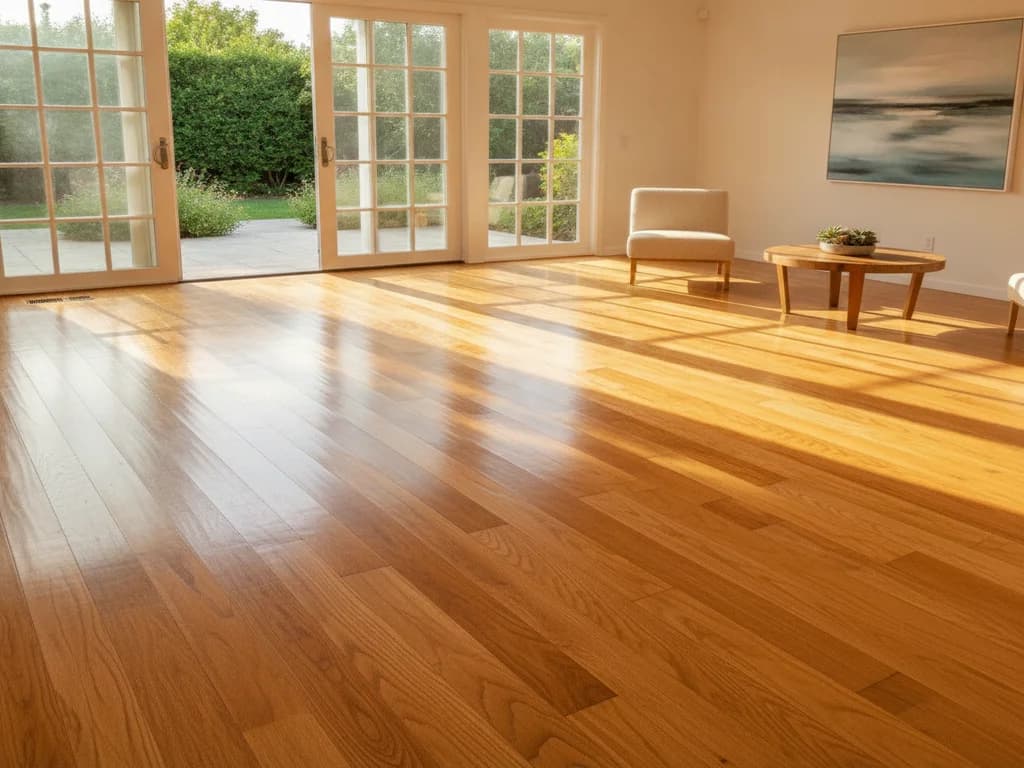
Hardwood refinishing — dustless sanding, custom stain, and durable finish coats that bring worn floors back to life without a full replacement.
Local Conditions
What Floor Refinishing Has to Contend With in Penn Valley
Penn Valley Conditions That Affect Floor Refinishing
Penn Valley sits at about 1,401 feet in Nevada County. Penn Valley sits at about 1,401 feet — roughly a thousand feet below Grass Valley — in an open foothill basin, so its summers run hotter and drier than the higher Nevada County towns. The nearest long-record station at broadly matching elevation is the Auburn co-op, about 18 miles south at 1,292 feet — roughly 110 feet below Penn Valley — which records a July normal high of 92.7°F against Grass Valley's 87°F. Summers here are hot and effectively rainless, so wood flooring needs on-site acclimation to the conditioned interior before installation. Penn Valley summers near 93°F change the finishing schedule more than the sanding. Waterborne finishes flash off faster in hot, dry air, which shortens the working window and makes lap marks easier to leave behind; we adjust application pace and airflow to the conditions in the house that day rather than to a fixed timetable.
Winters are wet but not alpine. The Auburn reference station records roughly 37 inches of annual precipitation, with Penn Valley-specific estimates ranging about 33 to 41 inches — well over the Sacramento Valley but only about two-thirds of what falls on Grass Valley and Nevada City — and no measurable average annual snowfall. Snow is an occasional event at this elevation rather than a recurring seasonal load, so the winter issue here is rain and standing water on a flat basin floor, not snowmelt or freeze-thaw. Cold, damp conditions do the reverse and stretch cure times, which mostly costs patience — a floor that is walkable is not yet a floor that is ready for furniture or rugs.
Seasonal Gaps in Penn Valley Floors, by the Numbers
Seasonal gaps between boards are a common reason people ask about refinishing, and Penn Valley's measured climate shows how much of that gapping is simply the wood moving with the seasons. Measured at Auburn Municipal Airport, then brought to 70°F, the air averages 32.5% relative humidity over the heating season and 45.9% over summer, which settles wood at roughly 6.6% and 8.6% moisture content. For a traditional 2¼-inch oak strip floor that is about 0.017 inch of seasonal shrinkage per board (about 1/59 inch); for 5-inch plank, about 0.038 inch. Gaps in that range that open in winter and close by summer should not be filled — filler packed into a winter gap gets crushed out, or pushes the boards toward cupping, once the wood takes its moisture back.
What's Under the Finish
No dataset publishes foundation type by place, so this is inference from the era profile rather than a foundation census. With 64.3% of the stock built in the 1970s and a median year of 1975, Penn Valley's homes date from the period when slab-on-grade was already the Western default — NAHB's tabulation of the Census Survey of Construction puts new Pacific-division homes at 89.9% slab in 2024 — while the smaller 1950s and 1960s share (15.9% of units predate 1970) is where raised perimeter and crawlspace foundations are more likely. Soils matter more here than the foundation type — and they change parcel to parcel. Most of Penn Valley's mapped ground (the Boomer, Sierra, and Sobrante series) is well drained with moderate to moderately slow permeability, but the community also carries Shenandoah — a smectitic shrink-swell unit USDA classes as somewhat poorly drained and very slowly permeable, saturated within 30 inches of the surface through winter and early spring by lateral seepage off higher ground. A Shenandoah parcel behaves nothing like the well-drained lot next door, which is exactly why slab relative-humidity testing (ASTM F2170), vapor retarders, and crawlspace moisture checks are confirmed per parcel, on site, rather than assumed from the town.
Raised floors are where the best refinishing candidates live: solid wood over a crawlspace, often with decades of wear and plenty of thickness left. It is also where cupping comes from. Sanding a cupped floor flat before the crawlspace moisture is fixed produces a floor that goes concave the other way once it dries — so the moisture reading comes first and the sanding comes second.
Source: NAHB analysis of the Census Bureau Survey of Construction, foundation type by region (2024)
Penn Valley Homes We Work In
The most single-decade-concentrated housing stock in the service area. ACS 2020–2024 5-year estimates put 481 of Penn Valley's 748 housing units — 64.3% — in 1970s construction, with a median year built of 1975; the next largest decades are the 1990s (10.6%) and the 1950s (9.5%), and the survey records no units built before 1950 or after 2009. Margins of error are wide on a CDP this small, so treat these as the published point estimates rather than exact counts. The character is ranch-style and country homes on acreage, with working ranches and equestrian parcels around them; the survey also records zero units held for seasonal, recreational, or occasional use, so this is a full-time resident market rather than a second-home one. Penn Valley's 1970s stock is where refinishing pays off most: homes of that period often have original wood under carpet, and when the wear layer is intact, refinishing keeps a floor that cannot be bought new. We check thickness at a vent or a doorway before recommending it.
Before We Quote
Planning Around Penn Valley
Penn Valley conditions that affect a refinishing job:
- Nearly two-thirds of Penn Valley's homes — 64.3% of units, median year built 1975 — went up in a single decade, so the stock is remarkably consistent: 1970s-era subfloors and framing, original strip oak or carpet-over-plywood, and pre-1980 resilient flooring that should be identified before any tear-out.
- At 1,401 feet Penn Valley is about a thousand feet below Grass Valley, and the Auburn reference station 18 miles south at a nearly identical elevation records a hotter 91°F July high with roughly 37 inches of rain and no measurable snowfall — so this is a rain-and-drainage market, not a snow-load one, and the wide summer-dry to winter-wet swing is what drives wood acclimation and expansion spacing here.
- Penn Valley's ground splits: an open valley floor along the SR 20 and Squirrel Creek corridor rising into wooded slopes on the west and south, with mostly well-drained Boomer, Sierra, and Sobrante soils — but scattered Shenandoah parcels that USDA records as saturated within 30 inches of the surface every winter and spring, so lot drainage, vapor retarders, and slab moisture testing are settled parcel by parcel, before flooring rather than after.
- This is ranch and acreage country — the county's rural-residential designation sets a 1.5-acre minimum lot size and the surrounding land is blue-oak annual rangeland with working ranches, gravel drives, and horse property — so entries take in far more grit and abrasive dust than a subdivision, which argues for harder wear layers, generous entry matting, and finishes that tolerate scratching at the door.
Permits & Jurisdiction
Who Has Jurisdiction in Penn Valley
Building permits and inspections for Penn Valley properties go through Nevada County Community Development Agency, Building Department. Penn Valley is an unincorporated census-designated place, so it permits through Nevada County rather than any city — the cities of Grass Valley and Nevada City are separate permit authorities. The county's Building Department operates under the Community Development Agency and takes applications through its Citizen Access portal. Nothing establishes an HOA or architectural-review body over Penn Valley's own rural parcels; the Lake Wildwood Association governs the adjacent Lake Wildwood community, which is a separate place.
Requirements change. Confirm current rules with the issuing agency before work begins.
We install floor refinishing throughout Penn Valley, including Penn Valley Village Center, Western Gateway Park, Penn Valley Drive, Spenceville Road, Squirrel Creek.
Sources
Where These Penn Valley Details Come From
The local conditions above are drawn from these public sources.
- Auburn, CA co-op station NOAA USC00040383 (nearest current-normals record at broadly matching elevation — 1,292 ft per NOAA, about 18 mi south of Penn Valley's 1,401 ft): July normal high 92.7°F, annual precipitation ~36 in (1991–2020 normals); no snowfall normals published
- Penn Valley CDP, CA housing profile — US Census ACS 2020–2024 5-year, Table B25034 Year Structure Built and B25035 Median Year Built, place FIPS 0656518 (748 units ±229; 481 units ±203 built 1970–1979 = 64.3%; median year built 1975; no units recorded before 1950 or after 2009) via Census Reporter
- Which Foundation Type Is Most Common in Your Region? — NAHB tabulation of US Census Bureau Survey of Construction, Aug 2025 (Pacific division 89.9% slab in 2024)
- USDA-NRCS SSURGO / Official Series Descriptions — map units point-sampled inside the Penn Valley CDP: Boomer loam (5–30% slopes, wooded west/south side), Sierra sandy loam (2–15% slopes, the open valley floor), Sobrante loam, Auberry sandy loam, and SHENANDOAH sandy loam — a smectitic Aquic Palexeralf, somewhat poorly drained, very slowly permeable, saturated within 30 in of the surface in winter and early spring; confirm the map unit per parcel via Web Soil Survey
- Nevada County Community Development Agency — Building Department, the permit authority for unincorporated communities including Penn Valley; 950 Maidu Avenue, Nevada City; applications via the Citizen Access portal
- Penn Valley Area Plan (2020) — Nevada County (Village Center south of SR 20, six miles west of Grass Valley; plan area a relatively flat basin bifurcated by SR 20 with the perennial Squirrel Creek and Clear Creek running east to west; rural-residential minimum lot size of 1.5 acres; General Agriculture parcels within the plan boundary)
- Penn Valley, California — elevation 1,401 ft, unincorporated CDP in Nevada County, place FIPS 0656518, GNIS 1867050, population 1,593 (2020 census), land area 2.122 sq mi (Wikipedia, citing USGS GNIS and the US Census Bureau)
- Western Gateway Recreation & Park District — the roughly 87-acre oak-studded Western Gateway Park at 18560 Penn Valley Drive (most of it county-owned land operated by the district), serving the community since 1976; the community's civic center of gravity
More in This Area
Other Flooring Services in Penn Valley
Good to Know
Frequently Asked Questions
Do you install floor refinishing in Penn Valley?
Yes. Renaissance Floors installs floor refinishing throughout Penn Valley and the surrounding Nevada County area. Call (916) 749-0272 for a free estimate.
Can my floor be refinished, or does it need replacing?
If the wear is still in the finish rather than in the wood, a screen-and-recoat abrades the existing finish and adds a fresh coat without sanding to bare wood — faster, cheaper, and far less disruptive. Once traffic lanes have worn through to bare wood or stains have reached the wood itself, that window has closed and it needs a full sand-and-finish.
How disruptive is refinishing?
Site-finished work means sanding, staining, and multiple coats with dry time between them, so the rooms are out of use for longer than a prefinished installation. We give a realistic day count up front and tell you how long the finish needs to cure before rugs and heavy traffic go back.
How do I get an estimate in Penn Valley?
Call (916) 749-0272 or request a free estimate online. We'll schedule a convenient in-home visit in Penn Valley, measure your space, and give you an honest written quote.
Related
Keep Reading
Related pages: Floor Installation in Woodland, Floor Repair in Woodland, Floor Refinishing, and Penn Valley.
Ready for Floors You'll Love?
Free estimates on floor refinishing throughout Penn Valley and Nevada County.