Pleasanton
Floor Refinishing in Pleasanton
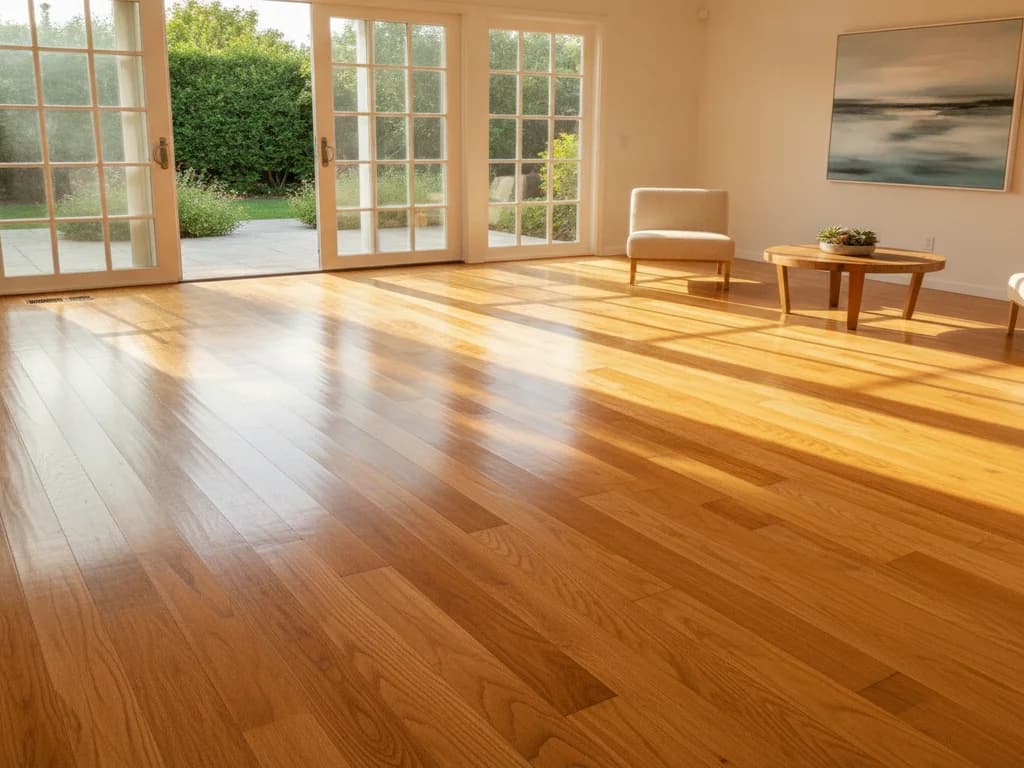
Hardwood refinishing — dustless sanding, custom stain, and durable finish coats that bring worn floors back to life without a full replacement.
Local Conditions
What Floor Refinishing Has to Contend With in Pleasanton
Pleasanton Conditions That Affect Floor Refinishing
Pleasanton sits at about 343 feet in Alameda County. No humidity-recording station sits in Pleasanton. The nearest, Livermore Municipal Airport 4.0 miles east, averages 34.0% relative humidity at 4 PM and 79.2% at 4 AM across the ten Julys 2015-2024 — a gap of about 45 points between those two hours, against about 20 points at bay-side Oakland International Airport.
Pleasanton lies inland of the East Bay hills. No NOAA station in Pleasanton carries 1991-2020 normals; the nearest stations with normals record July average highs of 87.7°F at Livermore Municipal Airport to the east and 71.6°F at the Oakland Museum station on the bay side of the hills. Cool, damp days in Pleasanton lengthen finish cure times compared with a hot, dry one — a scheduling factor rather than a quality one.
Seasonal Gaps in Pleasanton Floors, by the Numbers
Seasonal gaps between boards are a common reason people ask about refinishing, and Pleasanton's measured climate shows how much of that gapping is simply the wood moving with the seasons. Measured at Livermore Municipal Airport, then brought to 70°F, the air averages 36.3% relative humidity over the heating season and 52.9% over summer, which settles wood at roughly 7.1% and 9.7% moisture content. For a traditional 2¼-inch oak strip floor that is about 0.022 inch of seasonal shrinkage per board (about 1/45 inch); for 5-inch plank, about 0.049 inch. Gaps in that range that open in winter and close by summer should not be filled — filler packed into a winter gap gets crushed out, or pushes the boards toward cupping, once the wood takes its moisture back.
What's Under the Finish
Pleasanton has the most varied ground of any city in this service area. USDA-NRCS SSURGO maps forty-three distinct soil units inside the city limits — more than anywhere else covered here — and the largest of them, Positas gravelly loam, covers only 14.2%. They do not cluster. At one end, 45.8% of the city is mapped on soils in the lowest NRCS shrink-swell class, including Sycamore silt loam at 2.5% linear extensibility and Yolo loam at 2.2%. At the other, 21.3% rates high or very high, with Clear Lake clay at 9.5% and Sunnyvale clay loam over clay at 7.5%. Roughly a tenth of the city is very-high-expansivity ground while nearly half is stable. That range inside one jurisdiction is the fact that matters. A city-level generalisation about subgrade behaviour is close to useless in Pleasanton: two houses a mile apart can sit on soils that differ by a factor of four in how much they change length between the wet and dry seasons, so the substrate has to be established for the property rather than assumed from the town.
A slab affects what can be refinished at all. Wood over concrete is usually engineered or glued-down, and an engineered floor can only be sanded if its wear layer is thick enough to survive it — some can take a full sanding, many can take one light pass, and some cannot be sanded at all. We measure the wear layer before quoting rather than after starting.
Raised floors are where the best refinishing candidates live: solid wood over a crawlspace, often with decades of wear and plenty of thickness left. It is also where cupping comes from. Sanding a cupped floor flat before the crawlspace moisture is fixed produces a floor that goes concave the other way once it dries — so the moisture reading comes first and the sanding comes second.
Source: NAHB analysis of the Census Bureau Survey of Construction, foundation type by region (2024)
Pleasanton Homes We Work In
ACS 2020-2024 five-year estimates count 28,975 housing units, concentrated in the 1980s (24.1%), 1970s (19.7%), 1990s (16.7%) and 1960s (14.5%) — 75.0% of the stock was built between 1960 and 1999. Only 1.4% predates 1940. Pleasanton's 1960s, 1970s, 1980s, and 1990s stock is where refinishing pays off most: homes of that period often have original wood under carpet, and when the wear layer is intact, refinishing keeps a floor that cannot be bought new. We check thickness at a vent or a doorway before recommending it.
Before We Quote
Planning Around Pleasanton
Pleasanton conditions that affect a refinishing job:
- 75.0% of Pleasanton's housing units were built between 1960 and 1999, so most projects involve mid-to-late 20th century construction rather than pre-war or new-build assemblies.
- Pleasanton lists carpeting and similar finish work as exempt from a building permit, while noting that exempt work must still comply with Title 24 and the Pleasanton Municipal Code.
- Building and Safety accepts electronic plan-check submittals only.
- Pleasanton spans forty-three soil map units, the widest range in this service area, with 45.8% of the city in the lowest NRCS shrink-swell class and 21.3% rated high or very high — so subgrade behaviour is established per property here rather than generalised from the city.
Permits & Jurisdiction
Who Has Jurisdiction in Pleasanton
Building permits and inspections for Pleasanton properties go through City of Pleasanton Community and Economic Development Department, Building and Safety Division. Pleasanton's 'Work Except from a Permit' handout lists as exemption #6: 'Painting, papering, carpeting, and similar finish work.' The handout states that exempt work must still comply with Title 24 and the Pleasanton Municipal Code, and that a planning or zoning permit may still be required. Building and Safety accepts electronic plan-check submittals only.
Requirements change. Confirm current rules with the issuing agency before work begins.
We install floor refinishing throughout Pleasanton, including Downtown Pleasanton, Hacienda, Vineyard Avenue Corridor, Bernal, East Pleasanton, North Sycamore, and the surrounding area.
Sources
Where These Pleasanton Details Come From
The local conditions above are drawn from these public sources.
- U.S. Census Bureau ACS 2020-2024 5-year, table B25034 (Year Structure Built), Pleasanton city, CA
- City of Pleasanton — Permits, Forms and Fees (Building and Safety Division)
- City of Pleasanton — Downtown Specific Plan, adopted August 2019 (official planning-area name)
- USGS 3DEP elevation point query, Census place internal point (37.667185, -121.881230)
- NOAA NCEI 1991-2020 Monthly Climate Normals, station USW00023285 (Livermore Municipal Airport, CA) — nearest station with normals
- NOAA NCEI Local Climatological Data, hourly relative humidity, station 72492723285 (Livermore Municipal Airport) — July 2015-2024
- USDA-NRCS SSURGO by way of Soil Data Access — forty-three map units inside the Pleasanton city polygon, linear extensibility for each from chorizon.lep_r weighted across the 0-100 cm profile
- Shrink-swell classification from linear extensibility percent — USDA-NRCS thresholds and definition, hosted by the California Soil Resource Lab, UC Davis
- Pleasanton city, CA limits from Census TIGERweb Incorporated Places, used as the clip boundary for SSURGO
More in This Area
Other Flooring Services in Pleasanton
Nearby Areas
Floor Refinishing Near Pleasanton
Good to Know
Frequently Asked Questions
Do you install floor refinishing in Pleasanton?
Yes. Renaissance Floors installs floor refinishing throughout Pleasanton and the surrounding Alameda County area. Call (916) 749-0272 for a free estimate.
Can my floor be refinished, or does it need replacing?
If the wear is still in the finish rather than in the wood, a screen-and-recoat abrades the existing finish and adds a fresh coat without sanding to bare wood — faster, cheaper, and far less disruptive. Once traffic lanes have worn through to bare wood or stains have reached the wood itself, that window has closed and it needs a full sand-and-finish.
How disruptive is refinishing?
Site-finished work means sanding, staining, and multiple coats with dry time between them, so the rooms are out of use for longer than a prefinished installation. We give a realistic day count up front and tell you how long the finish needs to cure before rugs and heavy traffic go back.
How do I get an estimate in Pleasanton?
Call (916) 749-0272 or request a free estimate online. We'll schedule a convenient in-home visit in Pleasanton, measure your space, and give you an honest written quote.
Related
Keep Reading
Related pages: Floor Refinishing, Pleasanton, Epoxy Garage Floors, and Floor Installation.

Ready for Floors You'll Love?
Free estimates on floor refinishing throughout Pleasanton and Alameda County.