Service Area
Flooring in San Mateo
Renaissance Floors installs and refinishes hardwood, luxury vinyl, tile, and more for homeowners throughout San Mateo and the surrounding San Mateo County area.
CSLB #1060673
Licensed & Insured
Est. 2019
Family-Owned
15+ Years
Hands-On Experience
5.0★ Rated
22 Reviews on Thumbtack
Local, Licensed, Accountable
Flooring Contractor Serving San Mateo
San Mateo is part of San Mateo County, and it's one of the communities Renaissance Floors regularly works in. We're based in Roseville, CA and serve homeowners across Greater Sacramento & Northern California— from small refinishing jobs to full home installs. Every project starts with an honest look at your subfloor and your goals, followed by a clear, no-pressure estimate. There's no dispatched sales team and no guesswork: you work directly with the crew doing the installation, backed by our CSLB C-15 license and a workmanship warranty on every job.
Many San Francisco and Peninsula homes have original hardwood well worth refinishing rather than replacing. We handle the tighter access of urban and older homes carefully, and match new work seamlessly to existing floors.
San Mateo's own history begins before the town. The City's history page says a large Ohlone village once stood at today's Laurel Creek and El Camino Real, and its longer account records that Spanish explorers arrived in 1776, when Father Font named the creek they slept beside San Mateo Creek, and that in 1793 the mission fathers in San Francisco set up an outpost at that creek. The state lists California Historical Landmark No. 393, the Hospice (Outpost of Mission Dolores), with directions to the southwest corner of Baywood and El Camino Real. Then, in the City's words, 'On September 3, 1894, in a vote of 150 in favor of and 25 against incorporation, San Mateo became a town.' Today about 103,000 people live on about 12 square miles of land. A San Mateo mailing address does not always mean the city, though: the Census Bureau counts the Highlands and Baywood Park, both with addresses in ZIP code 94402, as unincorporated census-designated places.
The housing has a clear peak. The Census Bureau's 2020–2024 five-year estimates count about 42,600 housing units and put the median year built at 1965, give or take two years. The 1950s are the largest single decade, at about 21 percent of units; about 22 percent predate 1950 and about 70 percent predate 1980, while the 1940s, 1960s and 1970s each hold about 13 percent, too close to rank. Owners and renters each occupy roughly half of occupied homes, and detached houses and units in buildings of five or more are about 42 percent each. The City's neighborhood and HOA roster lists condominium associations alongside neighborhood groups, and one entry, the 19th Avenue Park Association, gives its boundaries as 'Eichler homes bounded by Delaware, Concar, and Grant.' Nothing on the roster describes those homes' foundations or heating. A build year or a style name raises questions about what lies under a floor; it doesn't answer them.
The permit rules are recent and mostly the state's. Ordinance No. 2025-09, adopted November 3, 2025 and effective December 3, 2025, adopts the 2025 California Residential Code 'as adopted and amended by the State of California' and deletes most of San Mateo's local residential amendments. The ordinance's text contains no reference to section 105.2 and no use of the word 'floor,' so the state's exempt-work list applies as written, and that list names 'Painting, papering, tiling, carpeting, cabinets, counter tops and similar finish work.' Flooring as such is not named, and subfloor, structural, plumbing and electrical work are separate questions. Historic properties add another layer. Ordinance No. 2026-06, effective June 17, 2026, requires a Certificate of Appropriateness 'for any alteration' to a Landmark or a Contributor within a Historic District on the San Mateo Historic Resources Inventory, and it defines major alterations by a property's 'exterior visual and/or historical qualities.' It never addresses interiors either way.
The ground differs between the bay edge and the hills. At five sampled bayside addresses, in North Shoreview, Lakeshore, Fiesta Gardens, Mariners Island and Glendale Village, USDA soil survey data map reclaimed tidal-flat land: a map unit of 65 percent urban land and 30 percent Orthents, a fill component whose record reads 'Shrink-swell potential is high.' At a sampled hillside address in Laurelwood the soil is Los Gatos loam, rated low for shrink-swell, with bedrock at 24 to 39 inches. The California Geological Survey's liquefaction zones, on its San Mateo quadrangle map released January 11, 2018, take in 15 of 21 sampled addresses, City Hall among them, while sampled points at 100 South B Street downtown and in Sunnybrae lie outside. No Alquist-Priolo Earthquake Fault Zone or mapped fault trace intersects city limits. These are sampled points, not parcel tests.
Water is mapped too. FEMA's National Flood Hazard Layer puts every sampled address in Zone X rather than a special flood hazard area, and the sampled bayside addresses carry the label 'area with reduced flood risk due to levee'; FEMA's levee data list the Coyote Point Levee and floodwalls on San Mateo Creek as City-owned and accredited. Special flood hazard areas do lie within the city, along the bay shoreline, the San Mateo Creek corridor and Marina Lagoon, and a new FEMA Letter of Map Revision took effect September 11, 2026, so any single address is worth checking on the current map. For rain, NOAA publishes a 1991–2020 normal of 19.30 inches a year for a volunteer CoCoRaHS gauge inside the city, San Mateo 0.8 NE, with December the wettest month. Temperature normals come from San Francisco International Airport, in unincorporated San Mateo County under 6 miles from City Hall, where September has the highest average high, 74.8°F, and January the coldest average low, 44.5°F.
Renaissance Floors is a licensed California C-15 flooring contractor (CSLB #1060673) based in Roseville. For a San Mateo floor, the first questions are whether the address is inside city limits, whether the work stays within finish work or reaches the subfloor, plumbing or wiring, whether the property is on the historic inventory or governed by an association, and what the address shows on the state liquefaction and FEMA flood maps. Free in-home estimates and a workmanship warranty.
Local Coverage
Neighborhoods We Serve in San Mateo
From Baywood to Downtown San Mateo, Renaissance Floors installs and refinishes floors across San Mateo.
Recent Work
A Sample of Our Craftsmanship
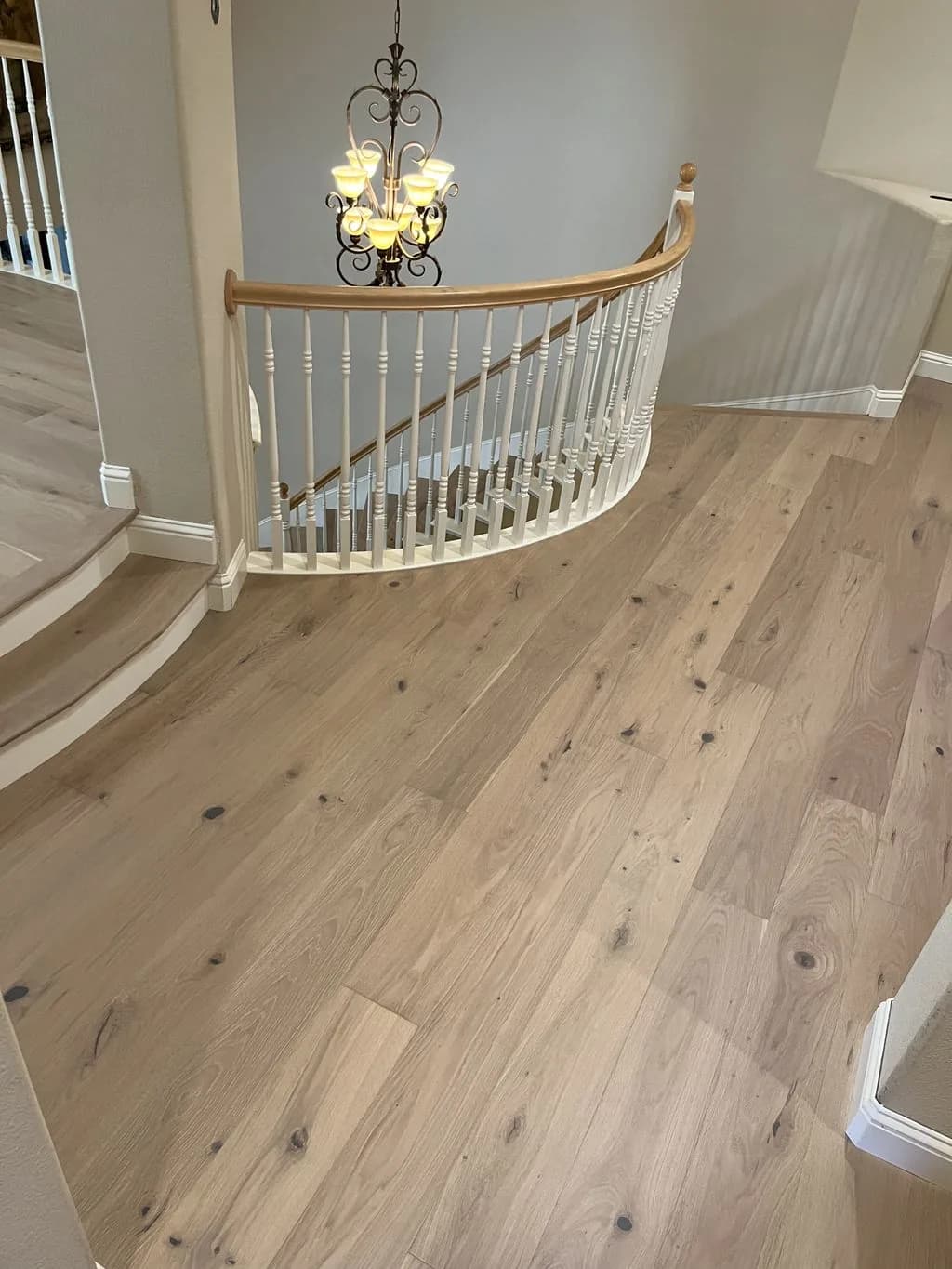
White Oak Hardwood
Great Room & Landing
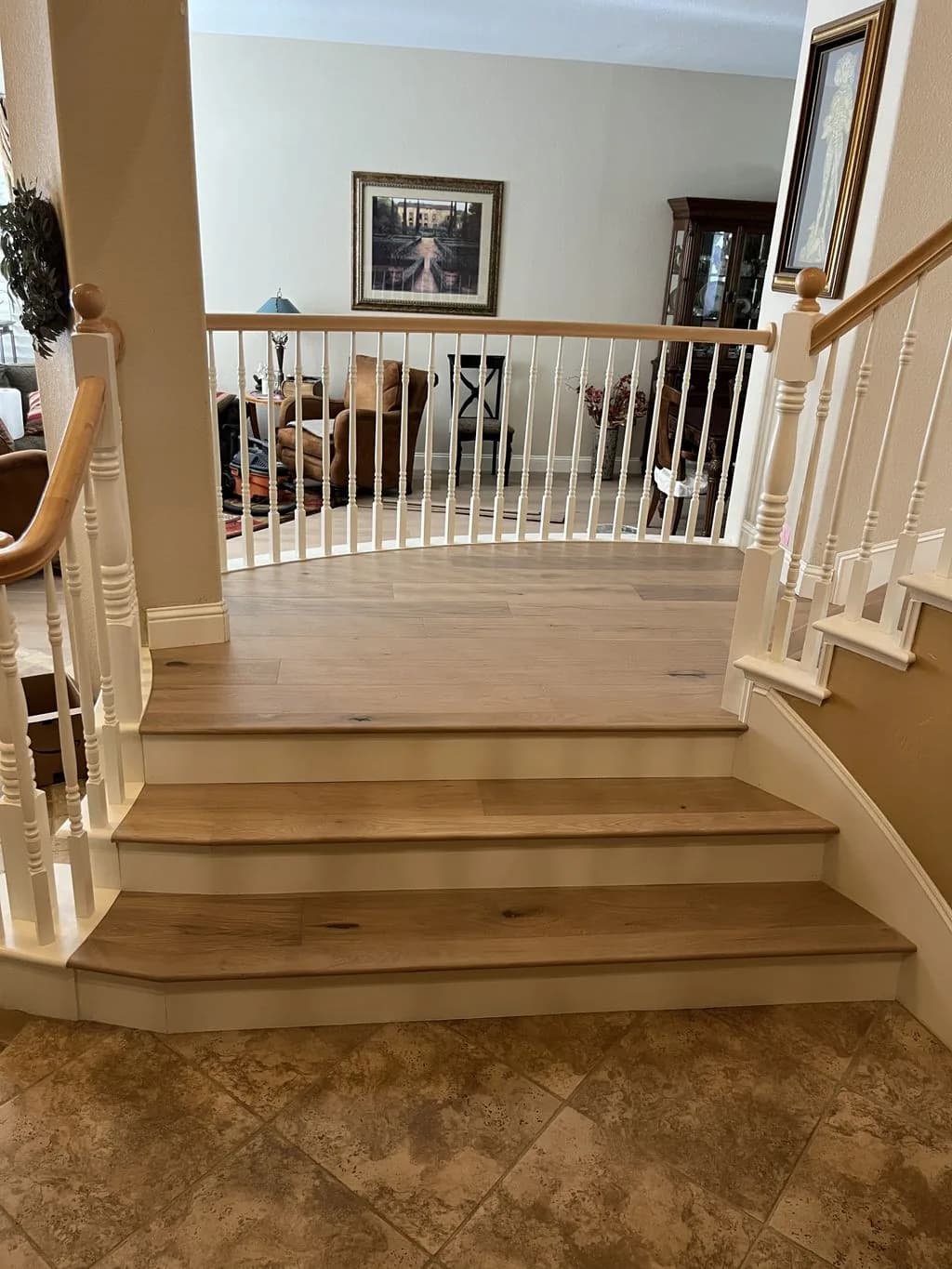
White Oak Hardwood
Staircase & Landing
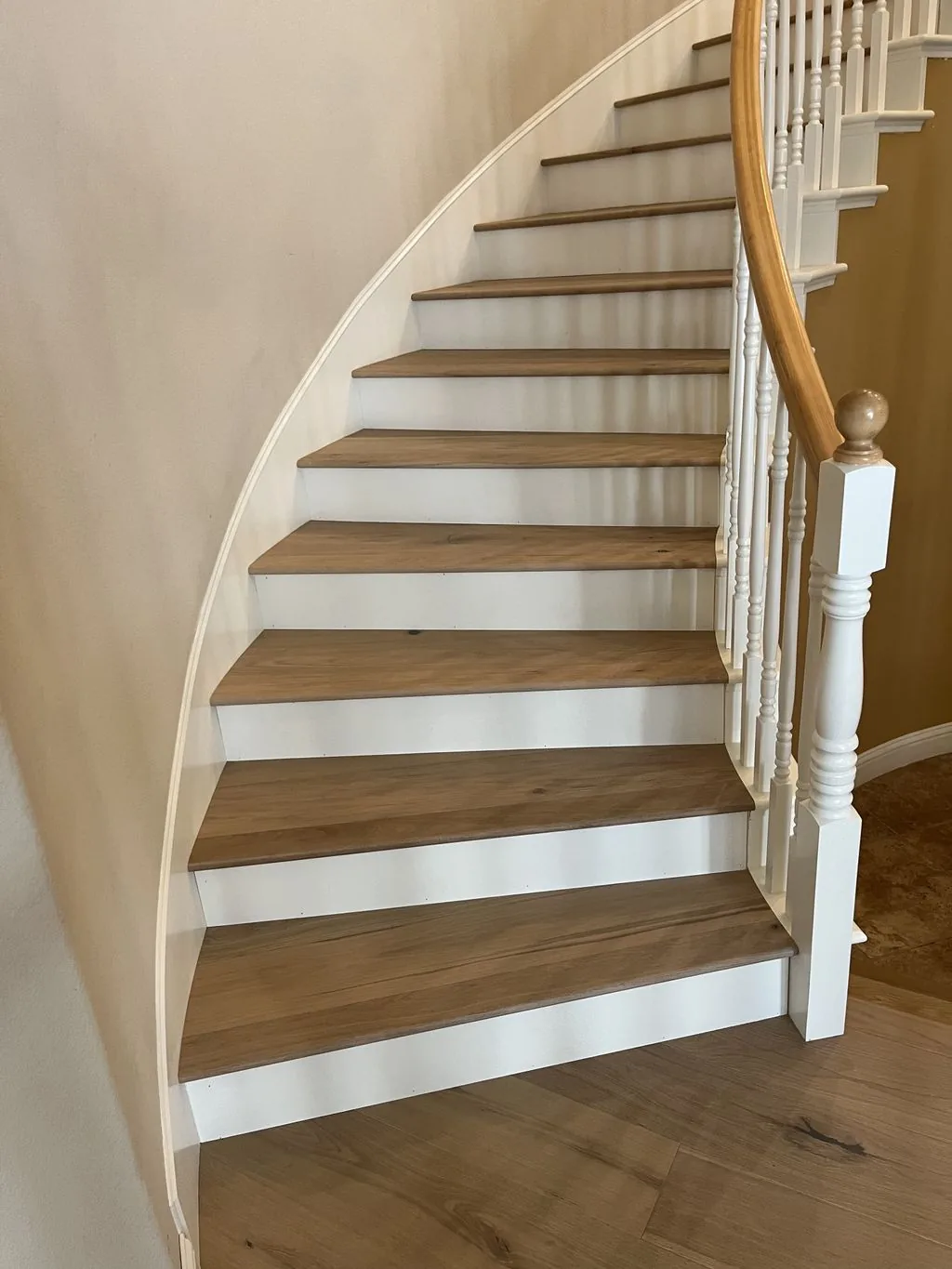
White Oak Hardwood
Curved Staircase
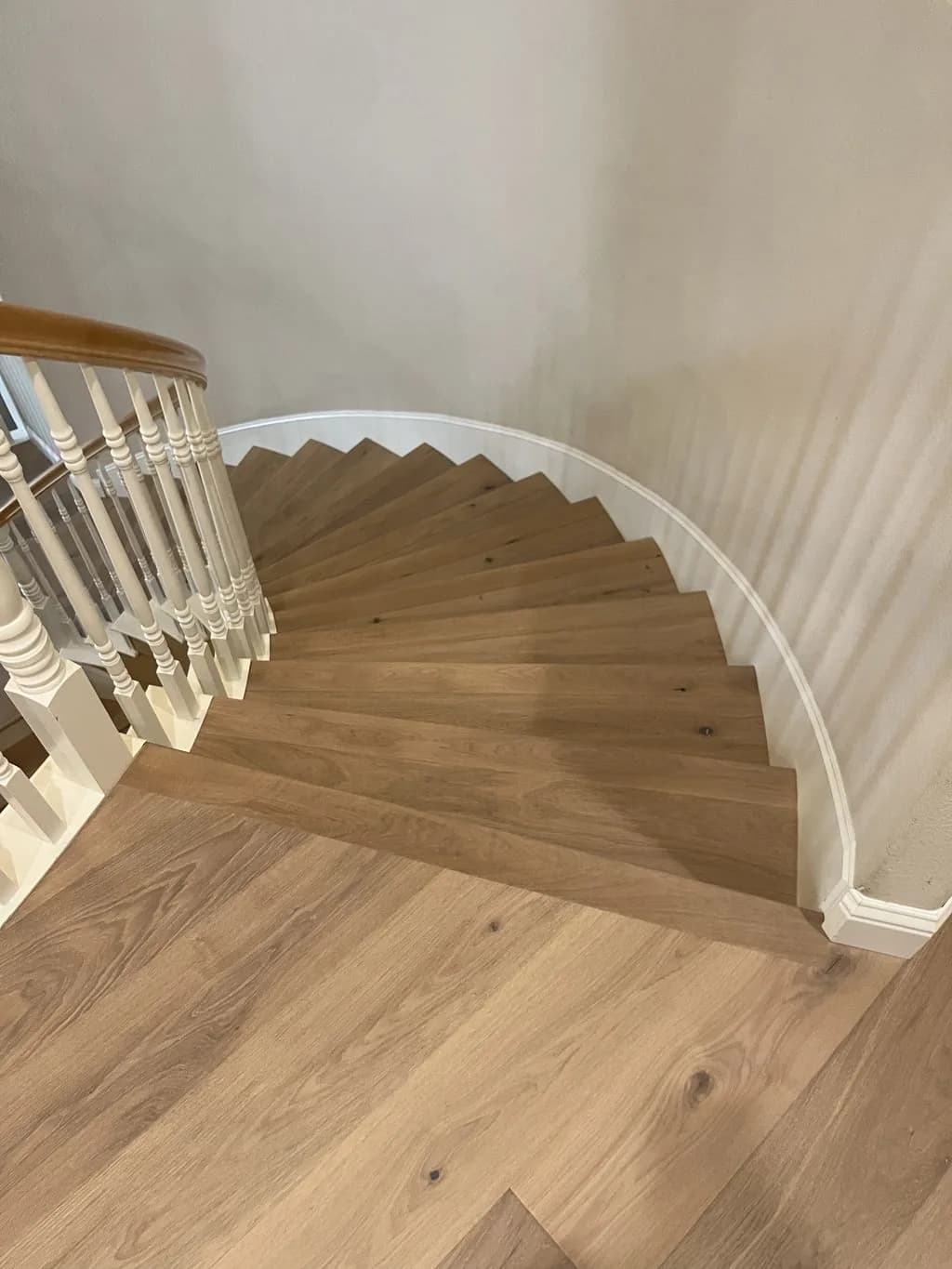
White Oak Hardwood
Stair Treads
Our Services
Flooring Services in San Mateo
From hardwood to luxury vinyl, here's how we help San Mateo homeowners upgrade their floors.
Hardwood Flooring
Solid oak, maple, and walkable heirloom-grade hardwood, precisely installed.
Hardwood Flooring in San MateoEngineered Hardwood
Real-wood wear layers built for California's climate swings.
Engineered Hardwood in San MateoLuxury Vinyl Plank
Waterproof, wood-look LVP for kitchens, baths, and busy households.
Luxury Vinyl Plank in San MateoLaminate Flooring
Durable, high-style laminate at a friendly price point.
Laminate Flooring in San MateoTile Flooring
Porcelain and ceramic tile set dead-level with crisp grout lines.
Tile Flooring in San MateoFloor Installation
Full-service installation from subfloor prep to final baseboard.
Floor Installation in San MateoFloor Refinishing
Sand, stain, and reseal tired hardwood back to new.
Floor Refinishing in San MateoFloor Repair
Board swaps, water damage, squeaks, and seamless patch-ins.
Floor Repair in San MateoLocal Considerations
What San Mateo Homes Need From a Floor
Climate, home age, and foundation type all shape the right flooring choice in San Mateo — here's what we account for.
The exempt-work list San Mateo didn't rewrite
Ordinance No. 2025-09, the 2025 Triennial Building Code Update, was introduced on October 20, 2025, adopted on November 3 with no council member opposed or absent, and took effect December 3, 2025. Its section 21 adopts the 2025 California Residential Code, with appendices for patio covers, sound transmission and swimming pool safety, 'as adopted and amended by the State of California,' and sections 22 through 27 delete six local residential amendment sections, leaving one on wall-bracing methods in Seismic Design Categories D0 through D2. A recital notes that Assembly Bill 130 'restricts cities and counties from adopting local amendments to the California Building Standards Code applicable to residential units until June 1, 2031, with certain exceptions.' The ordinance text has no '105.2' and no 'floor,' so the state list governs. In UpCodes' copy of the 2025 code, section R105.2 exempts 'Painting, papering, tiling, carpeting, cabinets, counter tops and similar finish work,' and the state's administrative text adds that exemptions 'shall not be deemed to grant authorization for any work to be done in any manner in violation of other provisions of law or this code.' Hardwood, laminate and vinyl plank are not named, so whether they count as similar finish work is a question for the City. The City's Express Building Permit list, for work needing no plan review or drawings, has no floor-covering item, and its Building Permits page says 'Simple alteration projects can often be approved while you wait' and gives a permit technician's number, (650) 522-7172.
Historic review written in exterior terms
San Mateo's preservation rules started downtown. The recitals of Ordinance No. 2026-06 record that Ordinance No. 1993-21, adopted in November 1993, was 'established to define the downtown historic district,' and that Ordinance No. 1995-13, in June 1995, remade the chapter as Historic Preservation and expanded its provisions citywide. Ordinance No. 2026-06, adopted May 18, 2026 and effective June 17, 2026, now states that 'A Certificate of Appropriateness is required for any alteration to a Landmark or Contributor within a Historic District listed in the San Mateo Historic Resources Inventory.' Its definition of a major alteration turns on a property's 'exterior visual and/or historical qualities,' and every example it gives, from street-facing elevations to windows, doors, cladding and additions, is exterior. Routine maintenance needs no certificate 'so long as maintenance and repair does not involve change in exterior design, material, or appearance,' and its examples include 'Ordinary maintenance and repair which does not require a building permit.' The ordinance uses the word 'interior' only in naming the Secretary of the Interior. It neither exempts interior work nor says that new floors need approval, and the current list of inventoried Landmarks and districts could not be found for this page. The owner of a listed property takes the scope to Planning before work begins.
A 1950s peak, an older core, and about half rented
The Census Bureau's 2020–2024 five-year estimates count 42,641 housing units in San Mateo, give or take 790, with a median year built of 1965, give or take two years. The 1950s supplied about 21 percent of them, the only decade that clearly leads. Before that, about 10 percent date to 1939 or earlier and about 13 percent to the 1940s, so 9,497 units, or 22.3 percent, predate 1950. The 1960s and 1970s each hold about 13 percent, like the 1940s and too close to rank, and the decades since 1980 each hold about 11 percent or less. About 70 percent of units predate 1980. The mix of buildings is as even as the mix of owners. About 42 percent of units are detached houses and about 10 percent attached, while buildings of five or more units hold about 42 percent, about 17 percent of all units in buildings of 50 or more; owners and renters each occupy roughly half of occupied homes, a difference inside the survey's margins. The City's roster lists condominium associations, and the 19th Avenue Park Association describes its area as 'Eichler homes bounded by Delaware, Concar, and Grant.' No source reviewed gives a slab-versus-raised split, or describes those homes' slabs or heating. In a shared building, an association adds a party to the decision; in any house, the build year only says what to look for.
Mailing address, ZIP code and city limits
The Census geocoder places 2320 Newport Street, a 'San Mateo' address in ZIP code 94402, in the Highlands census-designated place, not in the city, and the Census Bureau lists Baywood Park as a second unincorporated census-designated place next to the city. The City's neighborhood roster includes a San Mateo Highlands Community Association, but it also covers 'the immediate area of influence surrounding the City,' so being on the roster doesn't mean being inside city limits. The in-city neighborhood the roster names is Baywood, whose owners' association gives its boundaries as El Camino Real, the Hillsborough border, Notre Dame and Crystal Springs, and 21 Baywood Avenue geocodes inside the city. Unincorporated addresses fall under San Mateo County rather than the City's Building Division. ZIP codes blur the line further. By the Census Bureau's 2020 file relating ZIP code tabulation areas to places, about 60 percent of the land in 94402's area lies in the city and about 37 percent in the Highlands and Baywood Park, and about 87 percent of 94404's land is Foster City. The same caution applies to Earthquake Brace + Bolt: the California Residential Mitigation Program's 2025 list, 'based on ZIP Code only,' includes 94401 through 94404, but the retrofit 'is only done on wood-framed, pre-1980 homes with a raised foundation,' and the list says nothing about how many San Mateo homes are built that way.
Reclaimed bay edge, hillside loam
USDA Soil Data Access for the San Mateo County, Eastern Part, survey returns very different ground at sampled addresses. At 1400 Monte Diablo Avenue in North Shoreview, 1500 Marina Court in Lakeshore, 1001 Bermuda Drive in Fiesta Gardens, 625 Fathom Drive on Mariners Island and 500 East 40th Avenue in Glendale Village, the map unit is Urban land-Orthents, reclaimed complex, described with 'reclaimed lands, shore complexes, tidal flats, urban land.' It is 65 percent urban land, which has no soil-layer data, and 30 percent Orthents, a fill component rated 'Shrink-swell potential is high,' with a linear extensibility of 7.5 percent and about 50 percent clay in a layer 40 to 60 inches down; the component record also notes a seasonal zone of water saturation at the surface in January. Downtown at 100 South B Street, at Bay Meadows and at the College of San Mateo the map unit is about 85 percent urban land. At sampled points in Beresford Hillsdale, Sunnybrae and North Central the map unit is a cut-and-fill complex whose Orthents component is rated low. At 3471 Glendora Drive in Laurelwood, on 30 to 75 percent slopes, the soil is Los Gatos loam, rated low, with bedrock at 24 to 39 inches; its official description calls it well drained and formed in residuum from sandstone, shale and metasedimentary rock. High shrink-swell describes one component at a handful of points, not a neighborhood, and a slab or subfloor is judged in the house.
On the liquefaction map, behind the levee
The California Geological Survey's liquefaction zones for the San Mateo quadrangle, released January 11, 2018, include 15 of 21 addresses sampled inside the city: City Hall at 330 West 20th Avenue; 1400 and 725 Monte Diablo Avenue; 100 North Humboldt Street; 1900 and 2000 South Norfolk Street; bayside points in Shoreview-Parkside, Fiesta Gardens, Lakeshore, Mariners Island and Glendale Village; 2600 South Delaware Street at Bay Meadows; 401 Concar Drive; 1 Borel Avenue; and 2720 Alameda de las Pulgas. Six are outside, among them 100 South B Street downtown, 1031 South Delaware Street in Sunnybrae, 400 Occidental Avenue in San Mateo Park and the Laurelwood hillside point. No Alquist-Priolo Earthquake Fault Zone or mapped fault trace intersects city limits. FEMA's flood layer puts all 21 in Zone X. The bayside points are labeled 'area with reduced flood risk due to levee,' 725 Monte Diablo Avenue and 100 North Humboldt Street fall in the 0.2-percent-annual-chance area, and the rest map as minimal hazard. FEMA's levee data list the Coyote Point Levee and the San Mateo Creek floodwalls as owned by the City of San Mateo and accredited. Zone X is not a finding of no risk: special flood hazard areas intersect the city along the bay shoreline, the San Mateo Creek corridor and Marina Lagoon, and a new Letter of Map Revision, 24-09-0381P, took effect September 11, 2026. Check the address on the current map, and in a ground-floor room inside a mapped zone, weigh how a floor handles water.
Rain from a gauge in the city, temperature and humidity from airports
NOAA publishes 1991–2020 precipitation normals for a volunteer CoCoRaHS gauge inside city limits, San Mateo 0.8 NE (US1CASM0032): 19.30 inches a year, with December the wettest month at 4.54 inches, January at 3.78 and July at 0.01, and about 85 percent of the total falling from November through March. NCEI estimates normals for such gauges. For temperature, the nearest station with full normals to City Hall is San Francisco International Airport, in unincorporated San Mateo County, although from Laurelwood Redwood City's station is nearer. At the airport, September has the highest average high, 74.8°F, and the warmest mean, August the warmest average low, January the coldest average low at 44.5°F, and December the most rain, 4.14 of 19.64 inches a year. Its 72.6°F July average high sits between 66.3°F at San Francisco Downtown and 81.0°F at Redwood City. For hourly humidity the airport is not the nearest station: San Carlos Airport is about 4.1 miles from City Hall, against about 5.8 for SFO. Across the Julys of 2015 to 2024, SFO averaged 83.5 percent relative humidity at 4 AM and 61.3 percent at 4 PM, Local Standard Time, and San Carlos averaged 83.1 and 51.1 percent. Neither is San Mateo's own humidity, and neither is a reading inside a house; wood flooring is acclimated to the rooms it will live in.
Local Resources & References
Helpful San Mateo Resources
Authoritative local and industry references for permits, planning, and flooring standards.
- Ordinance No. 2025-09, 2025 Triennial Building Code Update — adopts the 2025 California Residential Code, effective December 3, 2025City of San Mateo
- 2025 California Residential Code, Chapter 1 (commercial copy of the state text) — section R105.2 exempt work, including 'tiling, carpeting'UpCodes
- More History — incorporation as a town on September 3, 1894City of San Mateo
- Neighborhood association and HOA listings — boundaries, including the 19th Avenue Park Association's 'Eichler homes' and the 'immediate area of influence surrounding the City'City of San Mateo
- San Mateo city — ACS 2020–2024 profile (place 0668252; year built, median year built, units in structure, tenure)US Census
- 1991–2020 monthly precipitation normals, San Mateo 0.8 NE CoCoRaHS gauge (US1CASM0032), inside city limitsNOAA NCEI
- 1991–2020 monthly normals, San Francisco International Airport (USW00023234), in unincorporated San Mateo CountyNOAA NCEI
- Earthquake Zones of Required Investigation, San Mateo quadrangle — liquefaction zones released January 11, 2018California Geological Survey
- National Flood Hazard Layer map service — flood zones, levees and Letters of Map RevisionFEMA
External links are provided for reference. Always confirm current requirements with the issuing agency.
Explore Flooring Services in San Mateo
Nearby
Nearby Cities We Serve in SF & the Peninsula
Good to Know
Frequently Asked Questions
Does Renaissance Floors serve San Mateo?
Yes. We install and refinish flooring throughout San Mateo and the surrounding San Mateo County area. Call (916) 749-0272 for a free estimate.
What flooring services do you offer in San Mateo?
We install hardwood, engineered wood, luxury vinyl plank, laminate, tile, and more in San Mateo, plus floor refinishing, repair, and full-service installation. See the full list below.
Are you licensed to work in San Mateo?
Yes. We hold CSLB C-15 license #1060673 (C-15 Flooring & Floor Covering) and carry insurance. We're based in Roseville, CA and serve San Mateo and all of Greater Sacramento & Northern California.
How do I get a free flooring estimate in San Mateo?
Call (916) 749-0272 or request an estimate online. We'll schedule a convenient in-home visit in San Mateo, measure your space, and give you an honest, no-pressure quote.
Do I need a building permit to replace flooring in San Mateo?
The exempt-work list San Mateo adopts names tiling and carpeting, not flooring as such. Ordinance No. 2025-09, effective December 3, 2025, adopts the 2025 California Residential Code without amending that list, which includes 'Painting, papering, tiling, carpeting, cabinets, counter tops and similar finish work.' Subfloor, structural, plumbing and electrical work are separate questions, so confirm your scope with a City permit technician at (650) 522-7172.
Does historic review apply to new floors in an older San Mateo home?
The City's rules don't say either way for interiors. Ordinance No. 2026-06, effective June 17, 2026, requires a Certificate of Appropriateness 'for any alteration' to a Landmark or a Contributor within a Historic District on the San Mateo Historic Resources Inventory, and defines major alterations by a property's 'exterior visual and/or historical qualities.' If your home is listed, ask Planning before work begins.
How old are San Mateo's homes?
Mostly built after 1950, around an older core. The Census Bureau's 2020–2024 estimates put the median year built at 1965, give or take two years. The 1950s are the largest decade, at about 21 percent of roughly 42,600 units; 22.3 percent predate 1950 and about 70 percent predate 1980. Owners and renters each occupy roughly half of occupied homes, and detached houses and units in buildings of five or more are about 42 percent each.
Is my bayside San Mateo home in a flood zone?
Check the address; the sampled bayside points are in Zone X, not a high-risk zone. FEMA's flood map puts sampled addresses in North Shoreview, Shoreview-Parkside, Fiesta Gardens and Lakeshore in Zone X, labeled 'area with reduced flood risk due to levee.' Zone X is not a finding of no risk; special flood hazard areas lie within the city along the shoreline, San Mateo Creek and Marina Lagoon, and a new FEMA map revision took effect September 11, 2026.
Is San Mateo in a liquefaction zone or an earthquake fault zone?
Many sampled addresses are in a liquefaction zone, and no fault zone lies within city limits. The California Geological Survey's San Mateo quadrangle map, released January 11, 2018, puts 15 of 21 sampled addresses, City Hall among them, inside a liquefaction zone, while sampled points at 100 South B Street downtown and in Sunnybrae are outside. No Alquist-Priolo Earthquake Fault Zone or mapped fault trace intersects the city. Look up the specific address.
Are the San Mateo Highlands and Baywood Park part of the City of San Mateo?
No. The Census Bureau counts the Highlands and Baywood Park as unincorporated census-designated places in San Mateo County, even though their addresses read San Mateo, ZIP code 94402; about 37 percent of the land in the Census Bureau's 94402 area lies in the two. The in-city neighborhood on the City's roster is Baywood. Unincorporated addresses fall under the County rather than the City's Building Division, so confirm the jurisdiction before applying for a permit.
How wet and humid is San Mateo, and does it matter for wood floors?
Wet in winter and nearly rainless in summer, with humidity measured at airports outside the city. NOAA's 1991–2020 normal for a volunteer rain gauge inside San Mateo is 19.30 inches a year, with December wettest. Across the Julys of 2015 to 2024, San Francisco International Airport averaged 83.5 percent relative humidity at 4 AM and 61.3 percent at 4 PM, and nearer San Carlos Airport 83.1 and 51.1 percent. Those are outdoor readings, so wood is acclimated inside the house.
Are San Mateo homes eligible for Earthquake Brace + Bolt?
The ZIP codes are listed, but the house has to fit the program. The California Residential Mitigation Program's 2025 list, which says eligibility is 'based on ZIP Code only,' includes 94401, 94402, 94403 and 94404. The retrofit 'is only done on wood-framed, pre-1980 homes with a raised foundation,' so whether a home qualifies depends on its construction. The list doesn't show how many San Mateo homes have raised foundations, and most of 94404's land is in Foster City.

Ready for Floors You'll Love?
Free, no-pressure flooring estimates throughout San Mateo and San Mateo County.