Service Area
Flooring in Palo Alto
Renaissance Floors installs and refinishes hardwood, luxury vinyl, tile, and more for homeowners throughout Palo Alto and the surrounding Santa Clara County area.
CSLB #1060673
Licensed & Insured
Est. 2019
Family-Owned
15+ Years
Hands-On Experience
5.0★ Rated
22 Reviews on Thumbtack
Local, Licensed, Accountable
Flooring Contractor Serving Palo Alto
Palo Alto is part of Santa Clara County, and it's one of the communities Renaissance Floors regularly works in. We're based in Roseville, CA and serve homeowners across Greater Sacramento & Northern California— from small refinishing jobs to full home installs. Every project starts with an honest look at your subfloor and your goals, followed by a clear, no-pressure estimate. There's no dispatched sales team and no guesswork: you work directly with the crew doing the installation, backed by our CSLB C-15 license and a workmanship warranty on every job.
Many San Francisco and Peninsula homes have original hardwood well worth refinishing rather than replacing. We handle the tighter access of urban and older homes carefully, and match new work seamlessly to existing floors.
Palo Alto is known for what began in a garage: California Historical Landmark No. 976, at 367 Addison Avenue, marks where William Hewlett and David Packard began developing their first product, an audio oscillator, in 1938. The city's housing, though, is mostly mid-century. The Census Bureau's 2020–2024 five-year estimates count about 29,200 housing units in a city of about 67,000 residents on 24 square miles of land, and put the median year built at 1963. The 1950s alone account for about a quarter of those units, the largest single decade; nearly 60 percent predate 1970, about 70 percent predate 1980, and about 13 percent were built in 1939 or earlier. More than half are detached single-family houses, about 30 percent sit in buildings of five or more units, and renters occupy about 45 percent of occupied homes.
The City has documented one part of that stock in detail. The Palo Alto Eichler Neighborhood Design Guidelines, adopted April 2, 2018, say that of the more than 11,000 homes Joseph Eichler built, 'some 2,700 were located in Palo Alto,' primarily in the city's central and southern areas; another passage of the same document puts the number at 'well over 2,000.' The guidelines list 31 tracts built from 1949 to 1974, from University Gardens to Los Arboles Addition No. 2, four of them labeled 'No Name,' and record that the last Eichler house was completed in Palo Alto on Guinda Street in 1975. Under 'Typical Characteristics of Eichler Residences,' the City opens with a caution — 'It may be difficult to generalize' — and then describes a 'post and beam construction method, built on a concrete slab foundation.' Its page on interior features holds the one sentence in the document that mentions flooring: 'Radiant heating is embedded in the concrete slab flooring.'
That sentence frames any floor laid in one of these houses. The guidelines add that the original radiant heating system 'was placed within a home's concrete slab foundation and may be difficult to repair without highly invasive intervention.' A slab that carries heating is not something to nail, screw or drill into blind, and the floor laid over it has to be a product its manufacturer approves for radiant heat, installed and operated within that manufacturer's limits. Because the City describes slab and radiant heat as typical rather than universal, whether a particular house still has its original system, a replacement, or a working one is established in the house, not assumed from the tract. The guidelines do not dictate the floor. They call themselves 'advisory (voluntary),' their focus is exterior compatibility and neighborhood cohesion, and even their section on systems upgrades asks that replacements be 'as minimally visible at the exterior of the residence as possible.' The Single Story Overlay districts that overlapped eleven Eichler tracts as of 2018 set a 17-foot maximum height and a limit of one habitable floor; neither addresses interior finishes.
Permits and jurisdiction turn on exact wording. Palo Alto's Ordinance No. 5674, passed in October 2025 to adopt the 2025 California Building Code, lists 'painting, papering, tiling, carpeting, cabinets, counter tops and similar finish work' among work that does not need a building permit, and states that an exemption does not authorize work that violates the code. The word 'flooring' does not appear, and the local text of the Residential Code, which covers one- and two-family homes, was not reviewed for this page. For historic properties, the City's 2024 bulletin on historic review states that 'normal maintenance or repair, interior work, and landscaping for historic resources typically do not require historic review.' A Palo Alto-area address does not settle which government is in charge, either. Census geography classifies Stanford as an unincorporated census-designated place, not part of the city, and ZIP code 94303 extends into East Palo Alto, a separate city in San Mateo County.
Ground and water vary by address. The City's Eichler guidelines describe the largest AE flood zone as covering an area 'generally from Middlefield Road to the bay,' and the largest AH zone as a strip west of Middlefield from San Francisquito Creek to Hamilton Avenue, 'roughly the area of the disastrous flooding of February 1998' — the flood in which, the Santa Clara Valley Water District says, 'more than 1,100 homes were flooded in Palo Alto.' FEMA's current map puts address points on Greer Road and East Meadow Drive in Zone AE. A state-mapped liquefaction zone covers five of ten addresses checked for this page, and USDA soil data rate clays 'high' for shrink-swell at four sampled addresses. NOAA's 1991–2020 normals for the Palo Alto station, about a mile from City Hall, record 15.12 inches of precipitation a year, about 85 percent of it from November through March, with February the wettest month, December the coldest average low at 38.6°F and September the highest average high at 79.6°F.
Renaissance Floors is a licensed California C-15 flooring contractor (CSLB #1060673) based in Roseville. For a Palo Alto home, the first questions are whether the address is inside city limits, whether heat runs through the slab and where, and what the ground floor sits on — answered before a product is chosen. Free in-home estimates and a workmanship warranty.
Local Coverage
Neighborhoods We Serve in Palo Alto
From Old Palo Alto to Professorville, Renaissance Floors installs and refinishes floors across Palo Alto.
Recent Work
A Sample of Our Craftsmanship
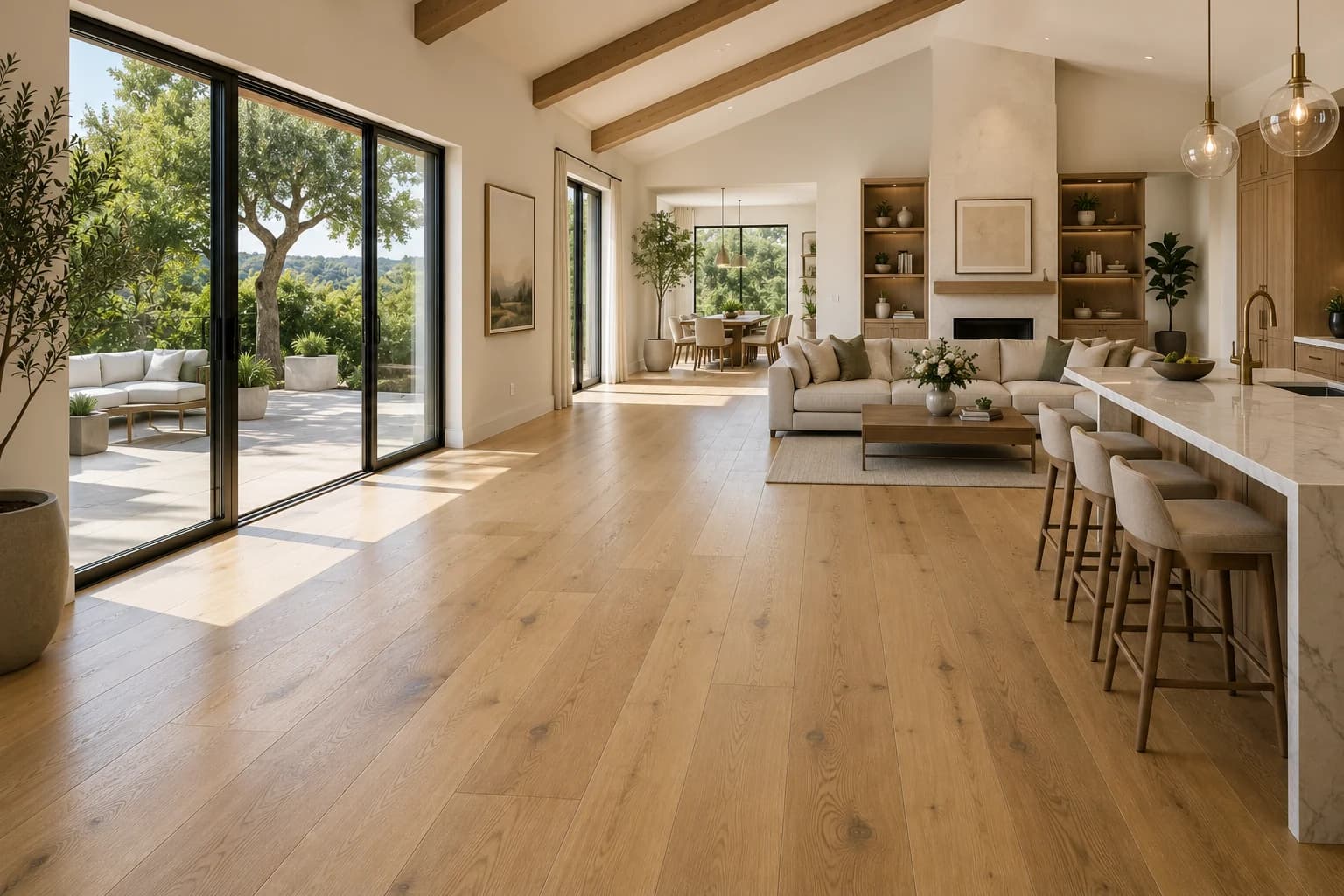
White Oak Hardwood
Great Room & Landing
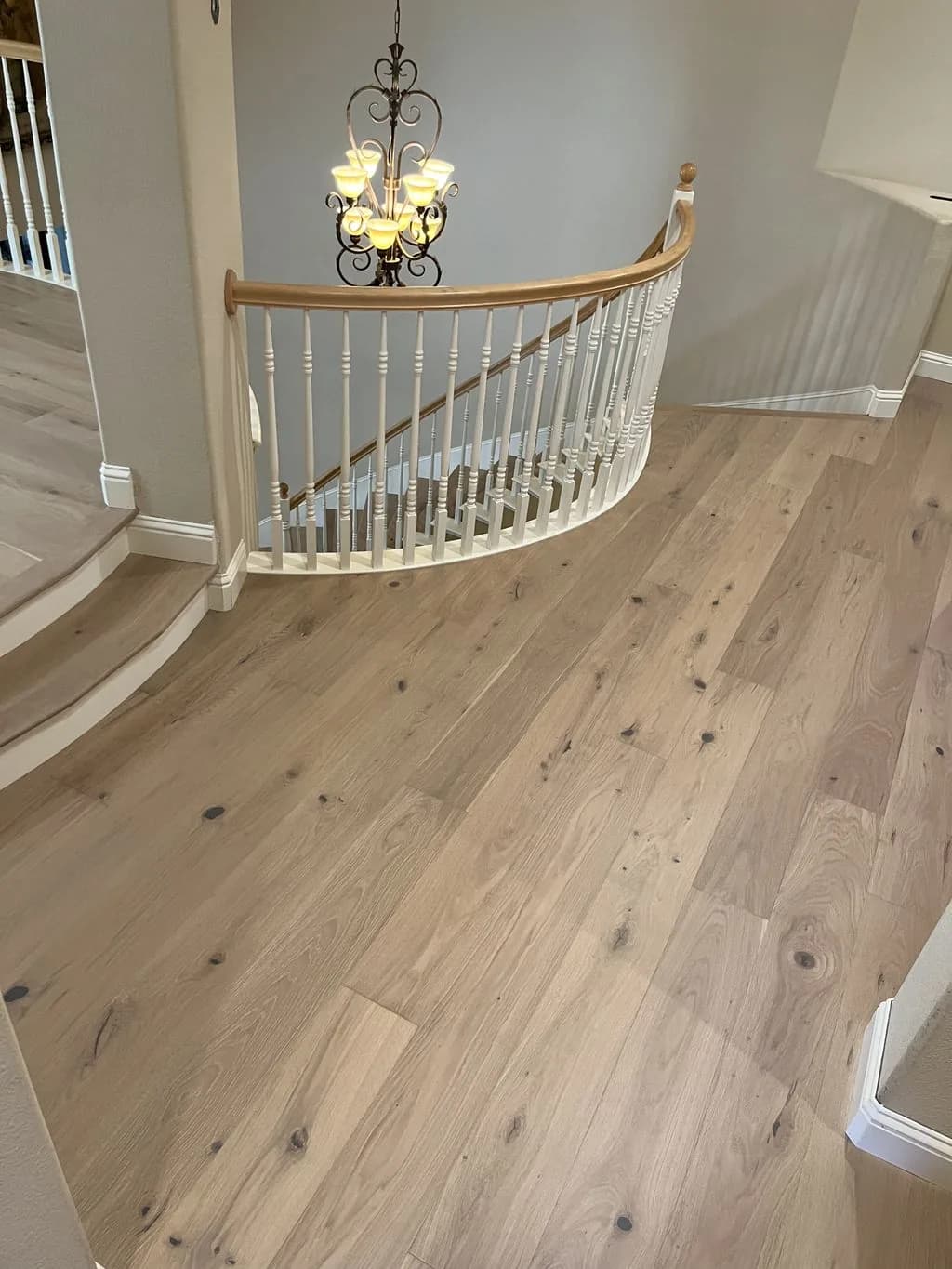
White Oak Hardwood
Staircase & Landing
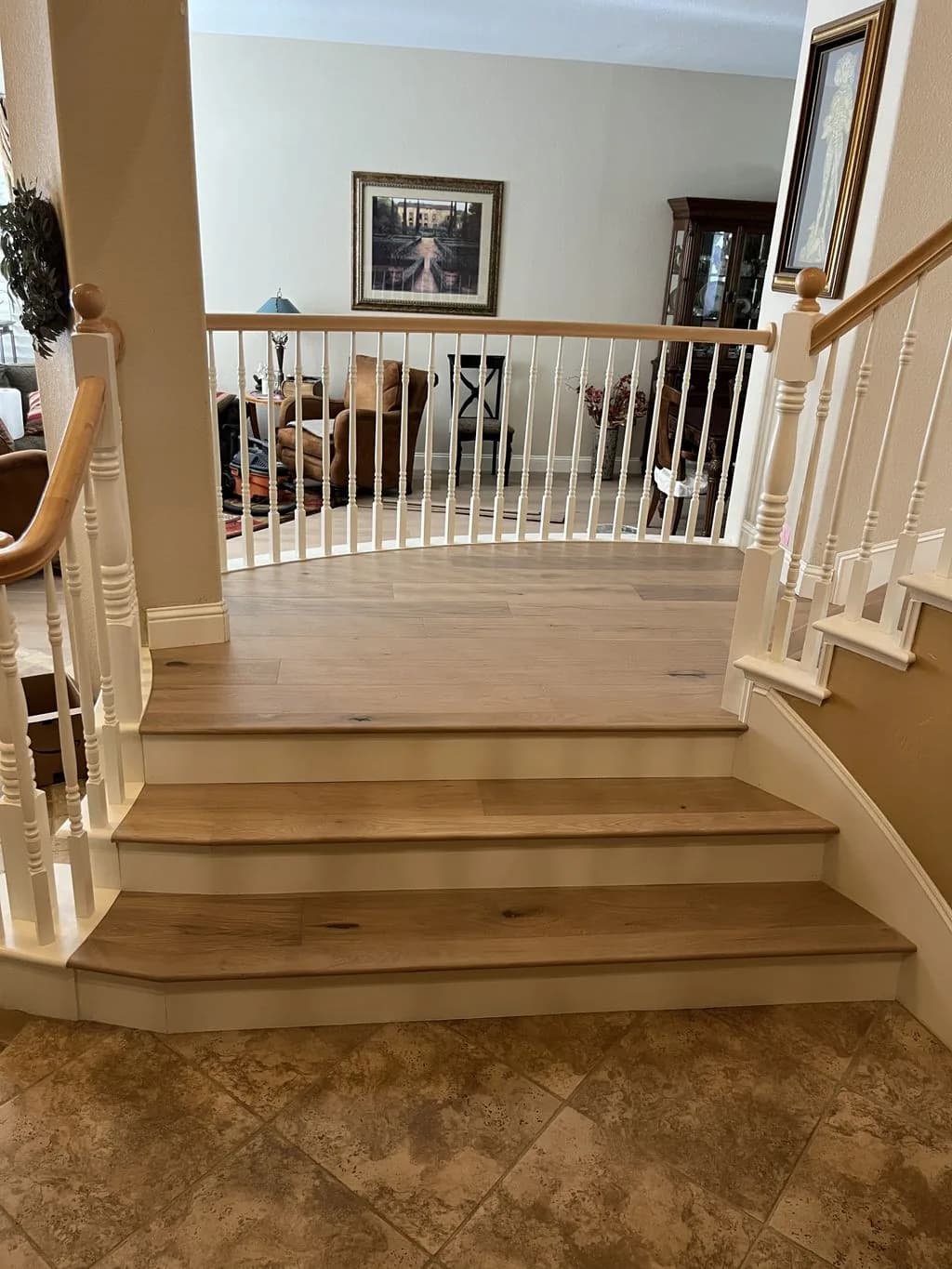
White Oak Hardwood
Curved Staircase
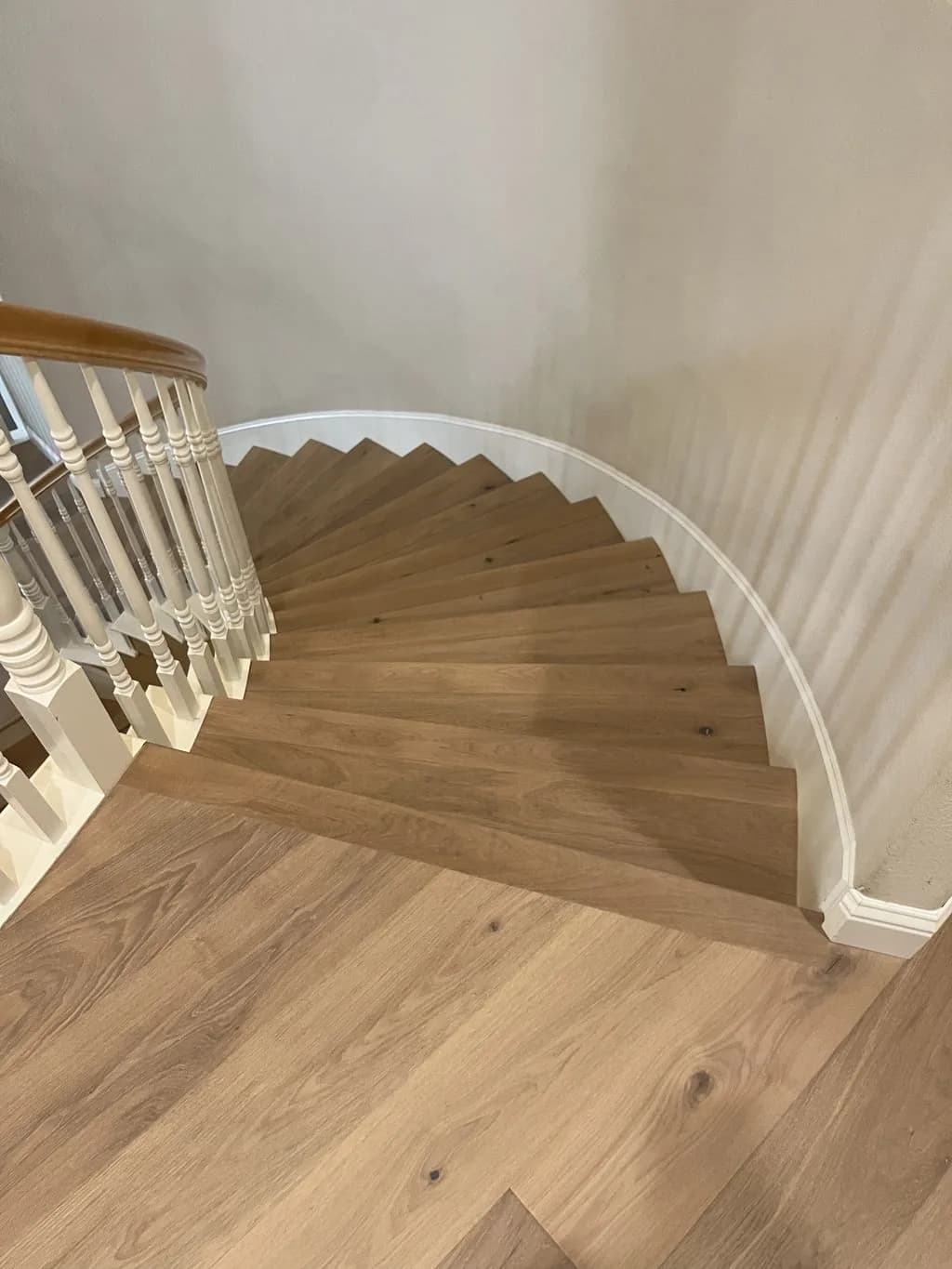
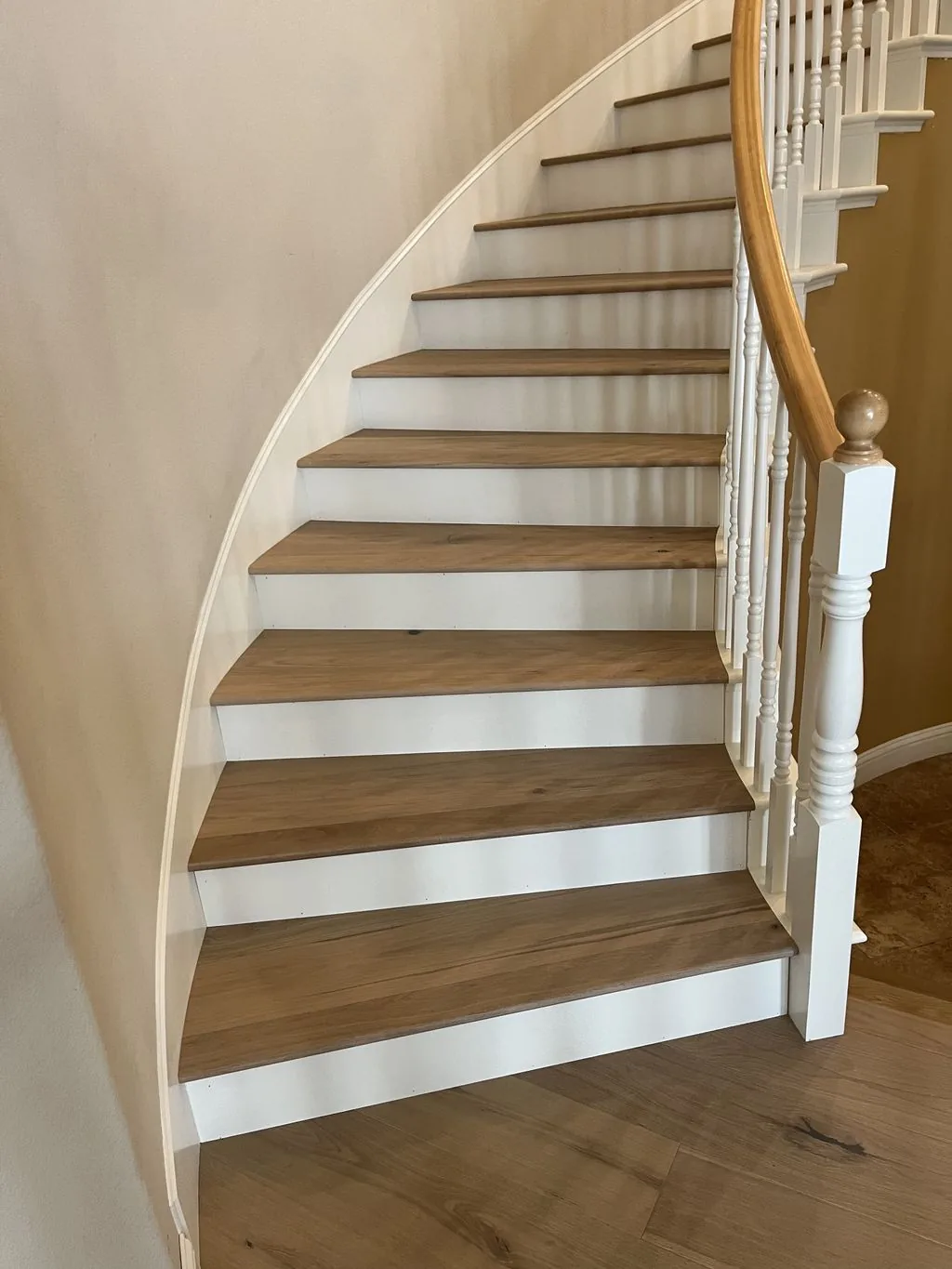
White Oak Hardwood
Stair Treads
Our Services
Flooring Services in Palo Alto
From hardwood to luxury vinyl, here's how we help Palo Alto homeowners upgrade their floors.
Hardwood Flooring
Solid oak, maple, and walkable heirloom-grade hardwood, precisely installed.
Hardwood Flooring in Palo AltoEngineered Hardwood
Real-wood wear layers built for California's climate swings.
Engineered Hardwood in Palo AltoLuxury Vinyl Plank
Waterproof, wood-look LVP for kitchens, baths, and busy households.
Luxury Vinyl Plank in Palo AltoLaminate Flooring
Durable, high-style laminate at a friendly price point.
Laminate Flooring in Palo AltoTile Flooring
Porcelain and ceramic tile set dead-level with crisp grout lines.
Tile Flooring in Palo AltoFloor Installation
Full-service installation from subfloor prep to final baseboard.
Floor Installation in Palo AltoFloor Refinishing
Sand, stain, and reseal tired hardwood back to new.
Floor Refinishing in Palo AltoFloor Repair
Board swaps, water damage, squeaks, and seamless patch-ins.
Floor Repair in Palo AltoLocal Considerations
What Palo Alto Homes Need From a Floor
Climate, home age, and foundation type all shape the right flooring choice in Palo Alto — here's what we account for.
Radiant heat in the slab, as the City describes it
The City's adopted Eichler guidelines describe radiant heating 'embedded in the concrete slab flooring' as a typical Eichler feature, note that the original system 'may be difficult to repair without highly invasive intervention,' and recommend repairing in-slab radiant heating and plumbing 'where feasible.' Flooring over a heated slab works under rules set by the products rather than the house: the floor must be one its manufacturer approves for radiant heat, installed the way that manufacturer specifies, and operated within the manufacturer's limits on surface temperature and on how gradually the system is brought up to heat. Nothing should be nailed, screwed or drilled into a slab that may carry heating — moisture-test holes included — until it is known where the heating runs. Whether a given house has its original system, a replacement, or a working one is established on site.
Voluntary guidelines, 31 tracts and a one-story overlay
The guidelines state that they 'are advisory (voluntary), unless regulatory (zoning) changes are adopted by the Palo Alto City Council to impose them as a requirement,' with no 'retroactive' application, and their page on Eichler interiors is description rather than rule. They count Eichlers two ways, 'some 2,700' and 'well over 2,000,' across 31 tracts, four of them listed as 'No Name' with only a street in parentheses — Blair Court, Amarillo Avenue, Louis Road and Middlefield Road; the 'Community Center' entry is a 1973 tract, not the whole Community Center neighborhood. What does bind some tracts is zoning. As of 2018, Single Story Overlay districts overlapped eleven Eichler tracts, and a 2015 City Council ordinance established one for 83 homes in the Los Arboles tract. The overlay regulations the guidelines quote set a 17-foot maximum height to the roof peak and 'a limit of one habitable floor.' Neither document addresses interior finishes.
The exempt list names tiling and carpeting, and the city line isn't the ZIP code
Ordinance No. 5674, passed October 20, 2025, adopts the 2025 California Building Code with local amendments, and its §105.2 lists 'Painting, papering, tiling, carpeting, cabinets, counter tops and similar finish work' among work for which permits 'shall not be required.' Flooring is not named, so whether hardwood, laminate or vinyl plank counts as 'similar finish work' is a question for Planning & Development Services rather than an assumption either way, and the same section says an exemption does not authorize work that violates the code. That is the Building Code chapter; the Residential Code's local text for one- and two-family homes was not reviewed here. Subfloor, structural, plumbing or radiant-heat work is a separate question. Jurisdiction comes first, though. Census geography classifies Stanford as an unincorporated census-designated place, and ZIP 94303 spans parts of Palo Alto, East Palo Alto, Menlo Park and Mountain View in two counties, so the address, not the ZIP code, decides which government reviews the work.
Older houses, and historic review that stops at interior work
About 13 percent of Palo Alto's housing units were built in 1939 or earlier, and the National Park Service's record for the Professorville Historic District, published in 1980, lists Colonial Revival and Bungalow/Craftsman styles and Bernard Maybeck among its architects. For floors in historic houses, the City's 2024 bulletin on historic resources is direct: 'Normal maintenance or repair, interior work, and landscaping for historic resources typically do not require historic review.' Its 'Group A,' which includes properties in the locally designated Professorville and Ramona Street districts, is where permit applications for 'exterior changes' are routed to the Historic Preservation Planner. Its 'Group B' includes properties listed in the National Register or the California Register and is 'not subject to the review procedures in the City's Historic Preservation Ordinance.' In the oldest houses, the practical questions are the old-floor questions: how much wear layer an original floor has left, what has been laid over it, and how flat the floor beneath still is.
Bay tides, San Francisquito Creek and the 1998 flood
The 2018 guidelines, describing the flood maps then in effect, say all of Palo Alto is in a flood zone 'of one kind or another' but most of it is in Zone X. They place the largest AE zone, an area predicted to flood when extraordinary bay tides overtop the levees around the Baylands, 'generally from Middlefield Road to the bay,' and the largest AH zone west of Middlefield from San Francisquito Creek to Hamilton Avenue, 'roughly the area of the disastrous flooding of February 1998.' The Santa Clara Valley Water District says that in that flood 'more than 1,100 homes were flooded in Palo Alto,' that the creek has overflowed eight times since 1910, including on December 31, 2022, and that its flood protection from the bay to Highway 101 is complete. FEMA's current map shows address points on Greer Road and East Meadow Drive in Zone AE, with a base flood elevation of 11 feet (NAVD88), and at 1 Crescent Drive and 1400 Hamilton Avenue in Zones A and AH. Check a specific property on FEMA's map; a ground-floor room in a mapped zone calls for a floor that tolerates water.
Shrink-swell clay and liquefaction zones, checked address by address
USDA soil survey data for the Santa Clara Area, Western Part, rate the named clay soils 'high' for shrink-swell at four sampled addresses — 2700 Middlefield Road, 1000 East Meadow Drive, 3400 Greer Road and 303 Parkside Drive — with representative linear extensibility of 7.5 to 10.5 percent, and 'moderate' at sampled points on Hamilton Avenue, Bryant Street, Waverley Street and La Donna Avenue. Every map unit there is 70 to 75 percent 'Urban land,' with the named soil a minority component, so these are points, not a map of the city. The California Geological Survey's liquefaction zones cover five of the ten addresses checked, on two quadrangle maps released in October 2006, because Palo Alto spans both the Palo Alto and Mountain View quadrangles. None of this is a finding about any one house; for a rigid floor on a slab, flatness is measured across the room before installation.
Dry summers that peak in September, measured in the city
NOAA's 1991–2020 normals for the Palo Alto station (USC00046646), at 25 feet about a mile from City Hall, record 15.12 inches of precipitation a year, about 85 percent of it from November through March, a July normal of 0.00 inches and no normal snowfall. February is the wettest month at 3.18 inches, December has the coldest average low at 38.6°F, and September's 79.6°F is the highest average high, just above July's 79.4°F — which is itself about 13°F above San Francisco Downtown's July average high and a little below San Jose airport's. For indoor air, the hourly humidity reference is Moffett Federal Airfield, a few miles southeast: outdoor air there from 2015 to 2025, warmed to 70°F with no moisture added, has a median of about 40 percent relative humidity through the heating season and about 61 percent in summer, the summer figure a ceiling that air conditioning brings down. Wood acclimates to the rooms it is going into, not to a regional average.
Local Resources & References
Helpful Palo Alto Resources
Authoritative local and industry references for permits, planning, and flooring standards.
- Palo Alto Eichler Neighborhood Design Guidelines, adopted April 2, 2018 (Resolution No. 9748) — Wayback Machine capture, September 9, 2026; the live City site blocks automated retrievalCity of Palo Alto
- Ordinance No. 5674 (2025) — 2025 California Building Code local amendments, §105.2 work exempt from permit; the live City site blocks automated retrievalCity of Palo Alto
- Historic Resources & Permit Review Requirements bulletin (2024) — interior work typically does not require historic review; the live City site blocks automated retrievalCity of Palo Alto
- City of Palo Alto — ACS 2020–2024 profile (place 0655282; year built, tenure, units in structure)US Census
- 1991–2020 monthly normals, Palo Alto (USC00046646)NOAA NCEI
- E5: San Francisquito Creek Flood Protection — February 1998 flood history and project statusSanta Clara Valley Water District
- Seismic Hazard Zones map, Palo Alto Quadrangle — liquefaction zones (released October 18, 2006)California Geological Survey
- Soil Data Access — Santa Clara Area, Western Part (CA641) map-unit shrink-swell dataUSDA Natural Resources Conservation Service
- National Register of Historic Places — Professorville Historic District (NRIS 80000861)National Park Service
External links are provided for reference. Always confirm current requirements with the issuing agency.
Explore Flooring Services in Palo Alto
Nearby
Nearby Cities We Serve in SF & the Peninsula
Good to Know
Frequently Asked Questions
Does Renaissance Floors serve Palo Alto?
Yes. We install and refinish flooring throughout Palo Alto and the surrounding Santa Clara County area. Call (916) 749-0272 for a free estimate.
What flooring services do you offer in Palo Alto?
We install hardwood, engineered wood, luxury vinyl plank, laminate, tile, and more in Palo Alto, plus floor refinishing, repair, and full-service installation. See the full list below.
Are you licensed to work in Palo Alto?
Yes. We hold CSLB C-15 license #1060673 (C-15 Flooring & Floor Covering) and carry insurance. We're based in Roseville, CA and serve Palo Alto and all of Greater Sacramento & Northern California.
How do I get a free flooring estimate in Palo Alto?
Call (916) 749-0272 or request an estimate online. We'll schedule a convenient in-home visit in Palo Alto, measure your space, and give you an honest, no-pressure quote.
Do I need a building permit to replace flooring in Palo Alto?
Tile and carpet are on the City's exempt list; flooring as such isn't named. Ordinance No. 5674, Palo Alto's 2025 Building Code amendments, lists 'painting, papering, tiling, carpeting, cabinets, counter tops and similar finish work' among work that needs no permit, and says an exemption doesn't authorize code violations. Hardwood, laminate and vinyl plank aren't named, and the Residential Code text for houses wasn't reviewed here, so confirm with Planning & Development Services. Subfloor, structural, plumbing or radiant-heat work is a separate question.
Do Palo Alto Eichlers have radiant heat in the slab?
Typically, according to the City. Its adopted 2018 Eichler guidelines state that 'radiant heating is embedded in the concrete slab flooring' and warn that the original system 'may be difficult to repair without highly invasive intervention.' The same document calls these typical characteristics and says 'it may be difficult to generalize,' so a particular house is checked on site. Over a heated slab, the floor must be approved by its manufacturer for radiant heat, and nothing is drilled until the heating's location is known.
How many Eichler homes are in Palo Alto?
The City's own guidelines give two figures. The Palo Alto Eichler Neighborhood Design Guidelines, adopted in 2018, say 'some 2,700 were located in Palo Alto' in one passage and 'well over 2,000' in another. They list 31 tracts built from 1949 to 1974, from University Gardens to Los Arboles Addition No. 2, four of them labeled 'No Name,' and record the last Eichler house completed on Guinda Street in 1975. Green Gables and Greenmeadow are National Register historic districts.
Do the Eichler guidelines or a Single Story Overlay restrict interior remodeling?
Not by their stated terms. The guidelines describe themselves as 'advisory (voluntary), unless regulatory (zoning) changes are adopted' by the City Council, and their interior-features page is description, not a rule. Single Story Overlay districts, which overlapped eleven Eichler tracts as of 2018, set a 17-foot maximum height and 'a limit of one habitable floor.' Neither addresses interior finishes; for an Eichler floor, the slab and any heating in it are the practical constraints.
Does historic review apply to new floors in Professorville or other historic homes?
Typically not. The City's 2024 bulletin on historic resources states that 'normal maintenance or repair, interior work, and landscaping for historic resources typically do not require historic review.' Review is routed for exterior changes to 'Group A' properties, which include those in the Professorville and Ramona Street local districts. Properties listed in the National Register, such as those in the Green Gables and Greenmeadow districts, fall in 'Group B,' which the bulletin says is not subject to the Historic Preservation Ordinance's review procedures.
Is my Palo Alto home in a flood zone?
It depends on the address. The City's 2018 Eichler guidelines say most of Palo Alto is in Zone X, with the largest AE zone 'generally from Middlefield Road to the bay' and the largest AH zone west of Middlefield from San Francisquito Creek to Hamilton Avenue, 'roughly the area of the disastrous flooding of February 1998,' when, per Valley Water, more than 1,100 Palo Alto homes flooded. FEMA's current map shows Zone AE at sampled Greer Road and East Meadow Drive addresses. Check your property on FEMA's map.
How old are Palo Alto's homes?
Mostly mid-century. The Census Bureau's 2020–2024 estimates put Palo Alto's median year built at 1963, with the 1950s the largest single decade at about a quarter of roughly 29,200 housing units. About 70 percent predate 1980 and about 13 percent predate 1940, and more than half of units are detached single-family houses. For flooring, that means slabs and subfloors with decades of history, whose condition and flatness are checked rather than assumed.
Is Stanford or East Palo Alto part of Palo Alto?
No. Census geography classifies Stanford as an unincorporated census-designated place, not part of the City of Palo Alto, and East Palo Alto is a separate incorporated city in San Mateo County. The ZIP code doesn't settle it: 94303 covers parts of Palo Alto, East Palo Alto, Menlo Park and Mountain View, and 94305 lies almost entirely outside Palo Alto. Permit questions follow the city limit, not the mailing address.

Ready for Floors You'll Love?
Free, no-pressure flooring estimates throughout Palo Alto and Santa Clara County.