San Rafael
Floor Repair in San Rafael
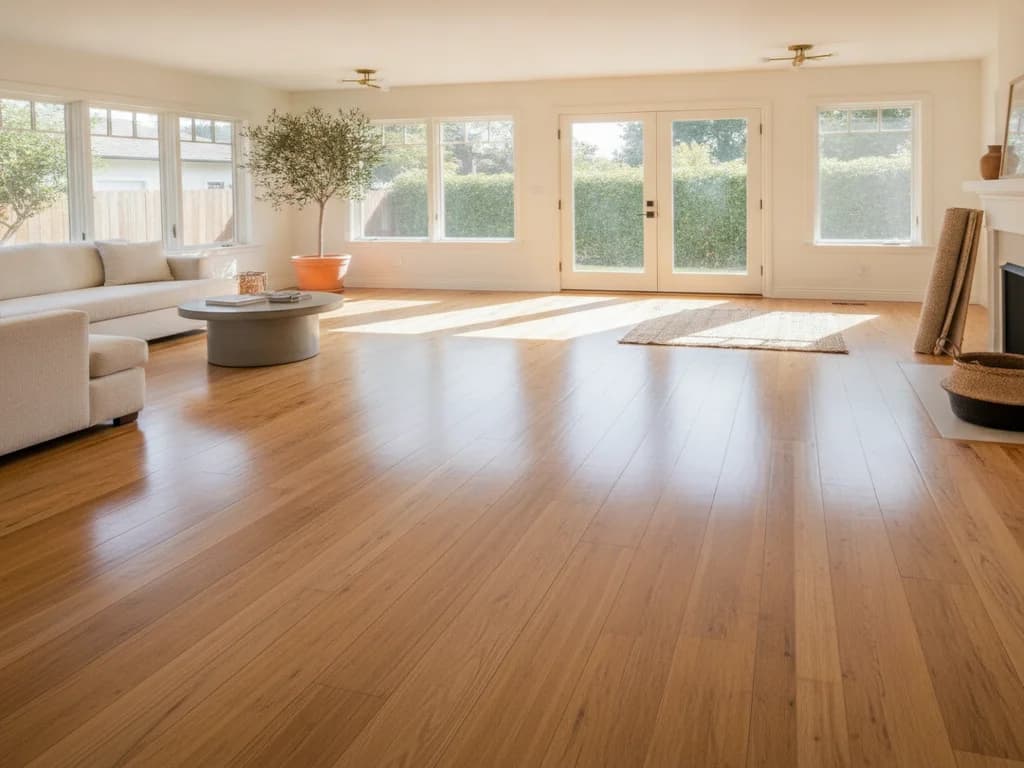
Floor repair for damaged boards, water issues, squeaks, and failed transitions — matched and blended so the fix disappears into the surrounding floor.
Local Conditions
What Floor Repair Has to Contend With in San Rafael
San Rafael Conditions That Affect Floor Repair
With San Rafael summers near 81°F, a share of the damage we're called for is seasonal rather than structural — gaps that open in dry summer conditions and close again later. Distinguishing seasonal movement from a real defect is the first thing we do, because the honest answer is sometimes that the floor does not need repairing.
NOAA 1991-2020 normals record a January average low of 42.6°F and no measurable snowfall in any month. Winter brings the opposite call: boards that have swelled tight or peaked at a joint, usually because the floor was installed without the room it needed to move.
At the San Rafael Civic Center station, August (81.3°F average high) edges out July (80.9°F), with September close behind at 80.7°F. In San Rafael, telling seasonal movement from a real defect starts with the conditions the floor actually lives in, measured in the house rather than inferred from the gap.
Movement or Damage? The San Rafael Climate Baseline
A repair diagnosis starts with what the climate alone would do to a floor. Using 78,726 hourly readings from Gnoss Field, Novato, a house in San Rafael heated without humidification sits near 40.1% relative humidity in winter, with 15% of heating hours below NWFA's 30% floor, and near 56% in summer — a swing of about 2.6 points in the moisture content of the wood. On white oak that accounts for about 0.022 inch per 2¼-inch strip board and 0.049 inch per 5-inch plank. Gaps inside those figures that follow the seasons are movement. Gaps well beyond them, gaps that stay open through summer, and cupping or crowning are the ones with a cause worth tracing, and the cause is usually moisture from below.
Finding the Actual Cause
ZIP codes 94901 and 94903 appear under San Rafael on California's Earthquake Brace + Bolt eligibility list, but eligibility is set by ZIP code rather than city limits: the same list also shows 94901 under San Anselmo, and 94903 addresses include unincorporated Lucas Valley, Marinwood and Santa Venetia. The California Residential Mitigation Program states that an EBB seismic retrofit 'is only done on wood-framed, pre-1980 homes with a raised foundation.' The City's own adopted-code findings also record that many areas of the city sit on bay alluvial soils subject to liquefaction, and that topography brings risk from hillside runoff and landslides.
Raised floors are where most structural floor repair happens: soft spots, squeaks, and bounce that trace back to the subfloor, the joists, or the crawlspace rather than to the finish floor. We go underneath and look. Fixing a soft spot from above without addressing what softened it is a temporary repair sold as a permanent one.
Source: NAHB analysis of the Census Bureau Survey of Construction, foundation type by region (2024)
San Rafael Homes We Work In
ACS 2020-2024 5-year estimates put 55.8% of San Rafael's 23,909 housing units in the 1950-1979 range (1960s 22.1%, 1970s 17.0%, 1950s 16.6%), with a further 9.8% predating 1940. In San Rafael's 1950s, 1960s, and 1970s homes, repairs frequently run into discontinued products and subfloor assemblies that predate current practice. Sourcing a match — or working out where a transition can hide a change of material — is often the harder half of the job.
Before We Quote
Planning Around San Rafael
San Rafael conditions that commonly show up in repair work:
- NWFA Wood Flooring Installation Guidelines define normal living conditions as 30-50% relative humidity at 60-80°F and direct that this range be maintained year-round.
- The USDA Forest Products Laboratory Wood Handbook directs that wood be installed at the moisture content it will experience in service to minimize post-installation dimensional change, and lists 8% average moisture content (6-10% for individual pieces) for interior flooring across most of the United States.
- About 71% of San Rafael's housing units (17,012 of 23,909) predate 1980, with a median year built of 1968, so subfloor condition and flatness in the prevailing mid-century stock are established by inspection rather than assumed.
- NOAA 1991-2020 normals for the San Rafael Civic Center station record a July average high of 80.9°F and low of 54.9°F, a 26.0°F daily swing.
Permits & Jurisdiction
Who Has Jurisdiction in San Rafael
Building permits and inspections for San Rafael properties go through City of San Rafael Building Division. San Rafael is incorporated and issues its own building permits; the Building Division sits within the Community & Economic Development department.
Requirements change. Confirm current rules with the issuing agency before work begins.
We install floor repair throughout San Rafael, including Dominican, Terra Linda, Gerstle Park, the Canal District.
Sources
Where These San Rafael Details Come From
The local conditions above are drawn from these public sources.
- City of San Rafael — Building Division
- California Residential Mitigation Program — Earthquake Brace + Bolt retrofit (pre-1980, wood-framed, raised foundation only)
- Earthquake Brace + Bolt — 2025 eligible ZIP codes, Northern California (San Rafael 94901, 94903)
- City of San Rafael — 2025 CBC adopting ordinance, local geologic findings (bay alluvial soils, liquefaction)
- NOAA NCEI — 1991-2020 Monthly Climate Normals, San Rafael Civic Ctr (USC00047880)
- U.S. Census Bureau ACS 2020-2024 5-year, table B25034 — San Rafael, CA (year structure built)
- National Wood Flooring Association — Wood Flooring Installation Guidelines
- USDA Forest Products Laboratory — Wood Handbook (GTR-282), Ch. 13
Nearby Areas
Floor Repair Near San Rafael
Good to Know
Frequently Asked Questions
Do you install floor repair in San Rafael?
Yes. Renaissance Floors installs floor repair throughout San Rafael and the surrounding Marin County area. Call (916) 749-0272 for a free estimate.
Can damaged boards be replaced without redoing the whole floor?
Often, yes. Individual boards can be cut out and replaced, and the repair blended into the surrounding floor — how invisible it ends up depends on species, finish, and how much the existing floor has aged or changed color under UV.
Why does the same damage keep coming back?
Usually because the cause is underneath. Cupping is a moisture problem arriving from below, buckling means the floor had nowhere to expand into, and hollow spots mean a bond that failed. Repairing the boards without answering where the moisture or movement came from reproduces the same result.
How do I get an estimate in San Rafael?
Call (916) 749-0272 or request a free estimate online. We'll schedule a convenient in-home visit in San Rafael, measure your space, and give you an honest written quote.
Related
Keep Reading
Related pages: Floor Repair, San Rafael, Epoxy Garage Floors, and Floor Installation.
Ready for Floors You'll Love?
Free estimates on floor repair throughout San Rafael and Marin County.