Alta Sierra
Tile Flooring in Alta Sierra
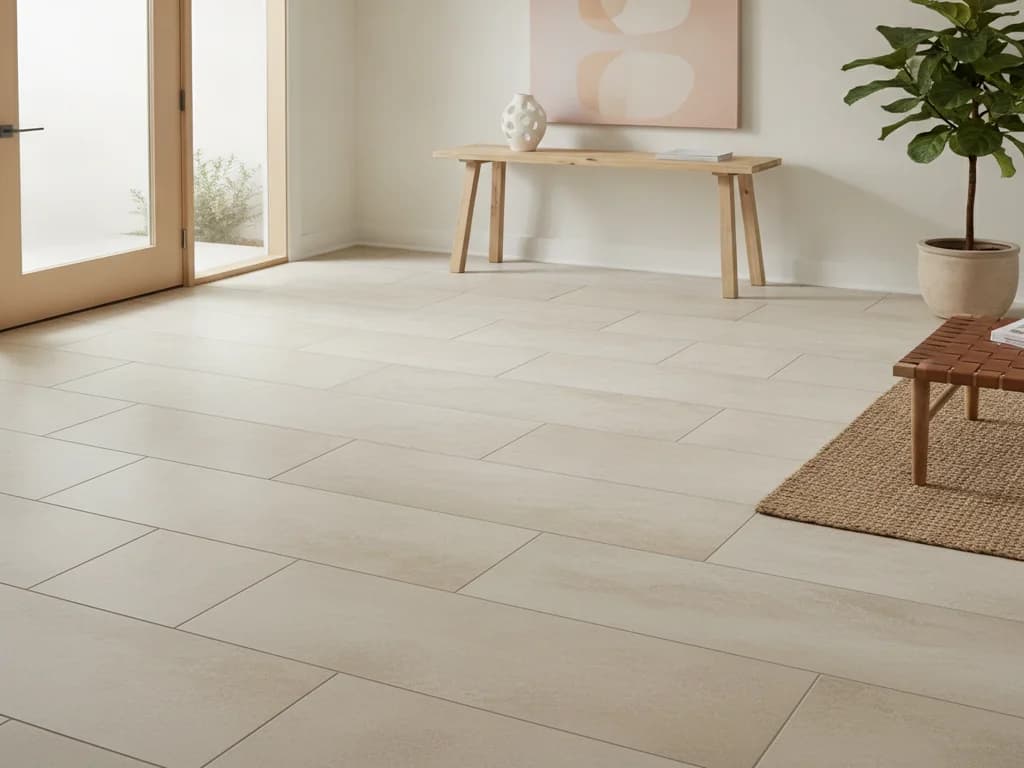
Porcelain and ceramic tile for entries, kitchens, and baths — set on a properly prepared substrate with laser-level layout and clean grout work.
Local Conditions
What Tile Flooring Has to Contend With in Alta Sierra
Alta Sierra Conditions That Affect Tile
Alta Sierra sits at about 2,035 feet in Nevada County. Alta Sierra drapes between about 1,600 and 2,340 feet in the Sierra foothills, and the closest long-term record — the Grass Valley Number 2 NOAA co-op station, roughly 5 miles north at 2,400 feet, a few hundred feet above the community's typical ground — puts the July average high near 87°F. Summers are hot and effectively rainless, so indoor humidity drops sharply for months. That is the dry half of a wide annual moisture swing, which is why solid wood is acclimated on site to the conditioned interior rather than installed off the truck. Tile itself is unbothered by Alta Sierra heat — near 87°F outside, an unheated tile floor is one of the few surfaces in the house that stays cool. What heat does affect is the installation: thinset open time shortens in hot, dry conditions, so summer work gets staged in smaller sections so every tile is set into mortar that is still live.
Winters here are genuinely wet. The Grass Valley Number 2 reference station records roughly 54 to 55 inches of annual precipitation — about three times the Sacramento Valley — concentrated almost entirely in the cool months, with real freezes and modest snow on the order of 9 inches a year at this elevation. Alta Sierra is low enough that snow is an occasional event rather than a season, but the sustained winter rain is the flooring condition that matters: crawlspace humidity, sub-slab moisture, and lot drainage all run far above valley levels. Cold slows cure times at the other end of the year, and grout and mortar both need to be held above their minimum cure temperature to reach full strength. On a winter job that means heat in the space, not just a tarp over the door.
Substrate Preparation
No dataset publishes foundation type by place, so this is inference from the era profile rather than a count. With 75.7% of the stock built in the 1970s and 1980s and almost nothing before 1970, Alta Sierra skips the historic raised-foundation layer that defines Grass Valley; what it has instead is subdivision-era foothill construction on sloping, wooded parcels, where slab-on-grade, stepped slabs, and raised or partly raised crawlspaces on the downhill side all appear on the same street. For scale on the slab side, NAHB's tabulation of the Census Survey of Construction puts new Pacific-division homes at 89.9% slab in 2024, though that describes today's construction, not 1970s–80s hillside work. Soil sampling across the community returns Boomer, Sites, Auburn, and Secca series — rocky, well-drained-but-slow-infiltrating units with rock outcrop components and shallow bedrock, and no serpentine — and what is certain is the water load — roughly three times the valley's rainfall on sloped lots — so crawlspace ventilation, vapor barriers, and slab RH testing (ASTM F2170) are decided on site, not assumed.
A slab is the friendliest substrate tile can have — provided its cracks are respected rather than tiled over. A crack that is still moving will come through the tile above it, so it gets treated with a crack-isolation membrane or honored with a movement joint. Slab flatness is what governs large-format tile in particular: the bigger the tile, the less the substrate can deviate before lippage shows at every edge.
Over a wood-framed floor, tile is a deflection question before it is a tile question. A floor system that flexes more than the assembly allows will crack grout first and tile second, regardless of how well it was set. We check joist span and subfloor thickness, add a second layer or a proper uncoupling membrane where the structure calls for it, and tell you if the answer is that the floor needs stiffening.
Source: NAHB analysis of the Census Bureau Survey of Construction, foundation type by region (2024)
Alta Sierra Homes We Work In
One of the most era-concentrated housing stocks in the service area. ACS 2020–2024 5-year estimates count 3,233 housing units, of which 42.4% were built in the 1980s and 33.3% in the 1970s — 75.7% from just those two decades — against only 3.4% built before 1970 and 11.7% built since 2000. The community was laid out by developers in the 1960s around the Alta Sierra Country Club, an 18-hole course built in 1964, so the stock is overwhelmingly custom and semi-custom foothill homes on wooded lots from a single building generation, not a mix of historic and modern. In Alta Sierra's 1970s and 1980s homes, the framing was often designed to the code of its day rather than to today's large-format tile, so the deflection check matters more, not less. It is the reason we survey the floor structure in older homes before quoting tile.
Before We Quote
Planning Around Alta Sierra
A few Alta Sierra conditions shape how we approach a tile floor:
- Three quarters of Alta Sierra's homes — 75.7% of the 3,233 units — were built in the 1970s and 1980s, so a job here usually means one consistent generation of construction: plywood-over-joist and slab-era subfloors, original oak or era-typical carpet and sheet goods, and 1970s material that is worth identifying before any tear-out rather than after.
- The Grass Valley Number 2 station 5 miles north at comparable foothill elevation records roughly 54 to 55 inches of annual rain against rainless summers, which is about three times the valley's load, so seasonal wood movement is wide and moisture control — acclimation, expansion space, vapor barriers, and slab RH testing — carries more weight here than product selection does.
- Alta Sierra was platted as a wooded golf-course subdivision on rolling foothill terrain, and heavily treed lots mean pine debris and grit tracked in year-round, so entry abrasion and walk-off matting drive wear-layer and finish choices more than they would on an open valley lot.
- This is a full-time residential community rather than a second-home market — 87.0% of occupied units are owner-occupied and only 2.3% of all units are held for seasonal, recreational, or occasional use — so flooring here is specified for continuous daily wear and whole-house continuity, not for turnover-grade or intermittent use.
Permits & Jurisdiction
Who Has Jurisdiction in Alta Sierra
Building permits and inspections for Alta Sierra properties go through Nevada County Community Development Agency, Building Department. Alta Sierra is unincorporated, so permits go through Nevada County, not the City of Grass Valley — the 95949 Grass Valley mailing address is postal, not jurisdictional. The county Building Department serves the unincorporated area and takes applications through its Citizen Access portal or the customer service counter. Alta Sierra also carries recorded 1960s Declarations of Restrictions that bind owners in the original tracts regardless of membership in the voluntary property owners association (there is no gate) — but the architectural committee's scope is exterior work, so interior flooring is a county-permit question rather than an association one.
Requirements change. Confirm current rules with the issuing agency before work begins.
We install tile flooring throughout Alta Sierra, including Alta Sierra Country Club, Brewer Road, Lodestar Drive, Aileen Way, Alta Sierra Drive.
Sources
Where These Alta Sierra Details Come From
The local conditions above are drawn from these public sources.
- Alta Sierra, California — CDP in Nevada County, GNIS point elevation 2,310 ft (near the top of the CDP's USGS-measured 1,609–2,338 ft range), 8.34 sq mi, place FIPS 06-01360, GNIS 1682830, ZIP 95949; laid out by developers in the 1960s around the Alta Sierra Country Club, a semi-private 18-hole course built in 1964; 2020 census population 7,204 (Wikipedia, citing USGS GNIS and US Census Bureau)
- Alta Sierra, CA housing profile — US Census ACS 2020–2024 5-year via Census Reporter, place FIPS 0601360: 3,233 housing units; Table B25034 Year Structure Built (1,370 built 1980–1989 = 42.4%, 1,077 built 1970–1979 = 33.3%, 110 built before 1970 = 3.4%, 378 built 2000 or later = 11.7%); Table B25003 Tenure (2,674 owner / 398 renter of 3,072 occupied = 87.0% owner-occupied); Table B25004 Vacancy Status (75 units for seasonal, recreational, or occasional use = 2.3% of all units)
- GRASS VALLEY NUMBER 2, CA US — NOAA NCEI co-op station GHCND:USC00043573, 39.2041/-121.068, elevation 731.5 m (2,400 ft), record from 1966-10-01; ~5 mi north of Alta Sierra and within ~90 ft of its elevation, the nearest elevation-matched long-term record
- Grass Valley, CA climate averages (values for the reference station above): July average high 87°F, annual precipitation ~53.7 in, annual snowfall ~9 in. NOTE: this page prints a station elevation of 3,117 ft, which conflicts with NOAA's 2,400 ft for Grass Valley Number 2 — values are used as approximate
- Which Foundation Type Is Most Common in Your Region? — NAHB tabulation of US Census Bureau Survey of Construction, Aug 2025 (Pacific division 89.9% slab in 2024 new construction)
- Nevada County Community Development Agency, Building Department — permit authority for unincorporated Nevada County including Alta Sierra; 950 Maidu Avenue, Nevada City; applications via the Citizen Access permit portal
- Alta Sierra community profile — Coldwell Banker Grass Roots Realty (local brokerage): ~2,300 ft, tree-filled subdivision established in the 1960s around the 18-hole course; named sub-areas Brewer and Lodestar (larger parcels), Aileen Way (smaller lots with views), and the Alta Sierra Drive commercial section; no mandatory HOA dues
- Alta-Sierra Property Owners Association (ASPOA) — the community's voluntary property owners association (existence verified; architectural rules not verified)
- Alta Sierra Country Club — the 18-hole course the subdivision was platted around
Good to Know
Frequently Asked Questions
Do you install tile flooring in Alta Sierra?
Yes. Renaissance Floors installs tile flooring throughout Alta Sierra and the surrounding Nevada County area. Call (916) 749-0272 for a free estimate.
Does a tiled bathroom need waterproofing behind the tile?
In a shower or on a tub deck, yes. Tile and grout are not waterproofing on their own — a real membrane system goes behind them. It is worth asking any contractor which membrane they are using and why.
Is grout maintenance-free?
No. Cementitious grout should be sealed and will need periodic resealing, especially in kitchens and bathrooms. Subfloor flatness and deflection also matter more with tile than almost anything else — an uneven or bouncy floor cracks tile, and correcting it is not optional work.
How do I get an estimate in Alta Sierra?
Call (916) 749-0272 or request a free estimate online. We'll schedule a convenient in-home visit in Alta Sierra, measure your space, and give you an honest written quote.
Related
Keep Reading
Related pages: Laminate Flooring in Cupertino, Luxury Vinyl Plank in Cupertino, Tile Flooring, and Alta Sierra.
Ready for Floors You'll Love?
Free estimates on tile flooring throughout Alta Sierra and Nevada County.