Elk Grove
Engineered Hardwood in Elk Grove
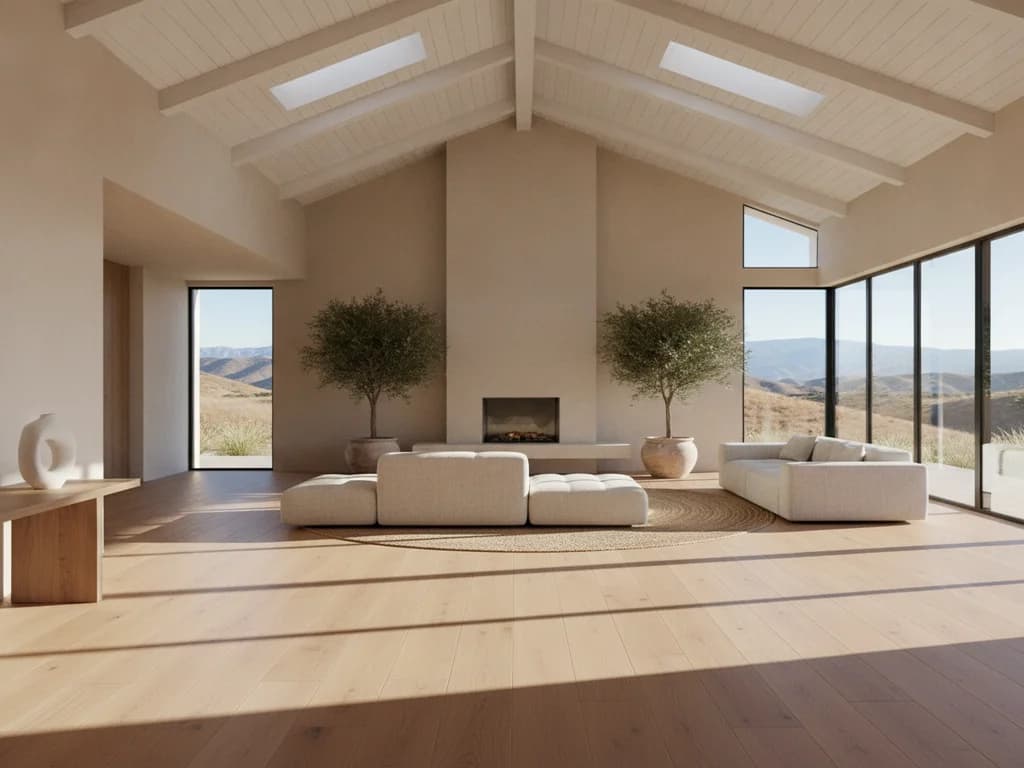
Engineered European oak and wide-plank hardwood — a genuine hardwood surface over a dimensionally stable core that handles humidity and heat.
Local Conditions
What Engineered Hardwood Has to Contend With in Elk Grove
Elk Grove Conditions That Affect Engineered Hardwood
Elk Grove sits at about 46 feet in Sacramento County. Summer afternoons in the Sacramento Valley are very dry. In the NWS Sacramento climate record for Sacramento (averages based on 1971–2000 normals), average relative humidity at 4 PM is 31% in June and 30% in July and August, while average humidity at 4 AM in the same months is 78–79%. That wide daily swing, rather than the daytime dryness alone, is the condition wood flooring has to absorb.
Winters are wet and mild rather than freezing. January normals at Sacramento Executive Airport, about 9 miles northwest of Elk Grove, are a 56°F high and a 39°F low, with 3.66 inches of rain; annual precipitation there is about 18 inches, about four-fifths of it falling November through March. NWS Sacramento reports that snow is so rare it 'may be disregarded as a climatic feature.' Through winter the same stability works in reverse: the core resists the swelling that a solid floor would show as the house takes on moisture. Stable is not inert, though — the expansion gap at the perimeter still gets set properly.
Elk Grove has no direct coastal exposure. NWS Sacramento reports that the Carquinez Strait near the Delta is the only break in the Coastal Mountains that admits significant marine air into the valley, and that the prevailing wind is southerly all year. It describes summer nights in the southern Sacramento Valley as usually pleasant because of breezes blowing up from San Francisco Bay through the Delta, and notes that heat waves produced by north or northeast winds are usually followed within two or three days by cool southwest delta breezes. For engineered hardwood in Elk Grove, the conditions that matter most are under and inside the house: a subfloor confirmed dry before a glue-down, and indoor humidity inside the range the manufacturer specifies.
What Elk Grove's Humidity Asks of Engineered Hardwood
In Elk Grove the case for engineered hardwood rests more on plank width and slab than on climate, and the measurements show why. Hourly dewpoint readings from Sacramento Executive Airport, 9 miles away, put that air at a median 37.7% relative humidity once it is heated to 70°F over winter — 23% of those hours under NWFA's 30% minimum — rising to 54.8% in summer. A solid 5-inch white oak board living through that, at roughly 7.4% to 10% equilibrium moisture content, changes width by about 0.049 inch between seasons. A cross-laminated core exists to restrain that movement; how much it restrains depends on the product's construction, so we go by the manufacturer's stated humidity range for the specific floor rather than a general rule.
Subfloor and Foundation Work
USDA-NRCS soil survey mapping, area-weighted inside Elk Grove city limits, puts about 81% of the mapped soil area in map units led by the San Joaquin series, California's official State Soil, and about 5% in Galt clay. The San Joaquin Official Series Description places a cemented hardpan (duripan) 20 to 40 inches down, beneath an abrupt increase in clay, with very slow permeability; survey data rate its silt loam surface low for shrink-swell and its thin clay layer above the hardpan high. Galt is a smectitic clay rated high to very high for shrink-swell, and its series description says its cracks are open from about mid-June to mid-October. These are area shares of survey mapping, planning-scale rather than parcel data. No City or County record reviewed states residential foundation type, so whether a home sits on a slab or a framed floor is confirmed on site.
A slab is the single biggest reason engineered hardwood gets specified at all. A dimensionally stable core can go over concrete where solid wood cannot — floated, or glued down with a moisture-control membrane. That is not a free pass: we still test the slab per ASTM F2170, still grind or fill it flat to the manufacturer's tolerance, and still match the adhesive system to the reading we get. Skipping the test is how a glue-down floor comes loose.
Over a crawlspace, engineered goes down by nail, staple, glue, or float, so the method follows the subfloor rather than the other way round. We flatten the subfloor first — engineered plank is stiff, and it bridges dips instead of following them, which is what produces hollow spots underfoot.
Source: NAHB analysis of the Census Bureau Survey of Construction, foundation type by region (2024)
Elk Grove Homes We Work In
Predominantly post-1990 single-family subdivision housing. ACS 2020–2024 5-year estimates put the median year built at 2000, with 37.4% of housing units built 2000–2009 and 27.0% built 1990–1999; about 4% of units predate 1970. In Elk Grove's 1990s and 2000s housing, engineered often wins on height as much as on moisture: a thinner assembly clears existing door jambs, appliance toe-kicks, and the transitions to rooms that aren't being redone, which matters when only part of the house is getting new floor.
Before We Quote
Planning Around Elk Grove
A few Elk Grove conditions change how we plan an engineered hardwood install:
- In the NWS Sacramento record, afternoon relative humidity near 30% in June through August, against 4 AM humidity near 78–79%, means solid wood should be acclimated on site to the conditioned interior rather than to outdoor readings taken at one time of day.
- About 5% of Elk Grove (1,266 acres in Sacramento County's 2021 hazard mitigation plan) lies in FEMA's 1% annual chance flood zone, including areas along Laguna Creek, so a ground-floor project should begin by checking the address on FEMA's flood map and, inside a mapped zone, favor flooring that tolerates water.
- Foundation type is not established from public records for this city and should be confirmed on site before selecting adhesives, underlayment or a moisture-mitigation approach.
Permits & Jurisdiction
Who Has Jurisdiction in Elk Grove
Building permits and inspections for Elk Grove properties go through City of Elk Grove Building Division. Elk Grove incorporated on July 1, 2000 and issues its own building, plumbing, mechanical and electrical permits.
Requirements change. Confirm current rules with the issuing agency before work begins.
We install engineered hardwood throughout Elk Grove, including Old Town Elk Grove, Laguna West, Laguna Ridge, East Franklin, Rural Elk Grove.
Sources
Where These Elk Grove Details Come From
The local conditions above are drawn from these public sources.
- Sacramento County Local Hazard Mitigation Plan Update (Sept. 2021), Annex B: City of Elk Grove — elevation, incorporation, 1% annual chance flood zone acreage, drainage
- City of Elk Grove — About Elk Grove (Wayback Machine snapshot, February 3, 2026) — incorporation July 1, 2000
- Elk Grove, CA housing profile — ACS 2020–2024 5-year, tables B25034 and B25035 (Census Reporter)
- Climate of Sacramento, California — NWS Sacramento (relative humidity by time of day; delta breeze; fog and snow)
- NOAA 1991–2020 U.S. Climate Normals — Sacramento Executive Airport (USW00023232), nearest station with normals, about 9 miles northwest of Elk Grove
- USDA-NRCS Official Series Description — San Joaquin series (duripan 20 to 40 inches)
- USDA-NRCS Official Series Description — Galt series (seasonal cracks, mid-June to mid-October)
- City of Elk Grove Building Safety, Inspection and Permits
More in This Area
Other Flooring Services in Elk Grove
Good to Know
Frequently Asked Questions
Do you install engineered hardwood in Elk Grove?
Yes. Renaissance Floors installs engineered hardwood throughout Elk Grove and the surrounding Sacramento County area. Call (916) 749-0272 for a free estimate.
Is engineered hardwood real wood?
Yes — the surface is a genuine wood veneer over a dimensionally stable core, usually plywood or HDF. The cross-laminated construction moves far less with humidity than solid wood, which is why it works over slabs, in basements, and in wide-plank formats where a solid board would be least stable.
Can engineered hardwood be refinished?
It depends entirely on wear-layer thickness, and it varies by product rather than by category. Some can be sanded once or twice; others are built to be replaced when worn. It is a fair question to ask before buying, and we will tell you honestly which one you are looking at.
How do I get an estimate in Elk Grove?
Call (916) 749-0272 or request a free estimate online. We'll schedule a convenient in-home visit in Elk Grove, measure your space, and give you an honest written quote.
Related
Keep Reading
Related pages: Hardwood Flooring in Mill Valley, Laminate Flooring in Mill Valley, Engineered Hardwood, and Elk Grove.

Ready for Floors You'll Love?
Free estimates on engineered hardwood throughout Elk Grove and Sacramento County.