Oakland
Tile Flooring in Oakland
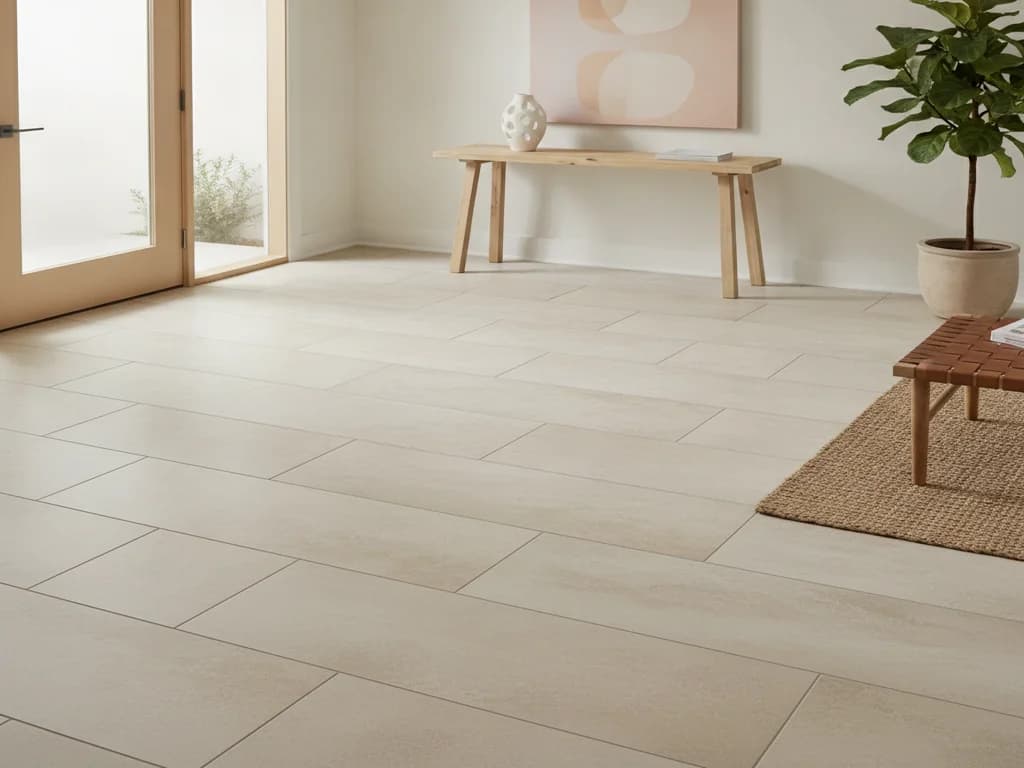
Porcelain and ceramic tile for entries, kitchens, and baths — set on a properly prepared substrate with laser-level layout and clean grout work.
Local Conditions
What Tile Flooring Has to Contend With in Oakland
Oakland Conditions That Affect Tile
Oakland International Airport, about 3.4 miles from the city's Census-defined center point, averages 65.3% relative humidity at 4 PM and 85.2% at 4 AM across the ten Julys 2015-2024 — a gap of about 20 points between those two hours. Afternoon air on the bay side stays humid; it does not dry out the way inland valley air does. Tile itself is unbothered by Oakland heat — near 72°F outside, an unheated tile floor is one of the few surfaces in the house that stays cool. What heat does affect is the installation: thinset open time shortens in hot, dry conditions, so summer work gets staged in smaller sections so every tile is set into mortar that is still live.
NOAA 1991-2020 normals at the Oakland Museum station record a January average high of 59.8°F and an average low of 45.1°F. December is the station's wettest month, with a 4.66-inch normal out of 22.61 inches a year. Cold slows cure times at the other end of the year, and grout and mortar both need to be held above their minimum cure temperature to reach full strength. On a winter job that means heat in the space, not just a tarp over the door.
Oakland's bay-side position holds summer temperatures far below Livermore's. The July normal high is 71.6°F at the Oakland Museum station, against 87.7°F at Livermore Municipal Airport roughly 25 miles inland — a 16°F difference within the same county. September, not July, is the Museum station's warmest month, with a 74.6°F normal high. Local weather in Oakland mostly shows up in tile work as cure time: cool, damp stretches run longer than a spec sheet's stated minimum.
Substrate Preparation
No per-city foundation-type dataset is published for Oakland. Three verified facts bear on it. First, 37.2% of the housing stock predates 1940 and 46.6% predates 1950 (ACS B25034). Second, California's Earthquake Brace + Bolt program says its retrofit is 'only done on wood-framed, pre-1980 homes with a raised foundation,' bracing cripple walls in the crawl space or bolting a house that sits on a stem wall. Third, thirteen ZIP codes — 94601, 94602, 94603, 94605, 94606, 94607, 94609, 94610, 94611, 94612, 94618, 94619 and 94621 — are listed under Oakland on the program's 2025 Northern California eligibility list; 94610 and 94611 are also listed under Piedmont, and the list states 'Eligibility based on ZIP Code only, city provided as reference.' The program selects ZIP codes on earthquake hazard and the percentage of pre-1940 houses, noting that 'Older houses are more likely to require earthquake bracing and bolting,' rather than on foundation type, so the listing is not a measurement of how many Oakland homes have raised foundations.
Over a wood-framed floor, tile is a deflection question before it is a tile question. A floor system that flexes more than the assembly allows will crack grout first and tile second, regardless of how well it was set. We check joist span and subfloor thickness, add a second layer or a proper uncoupling membrane where the structure calls for it, and tell you if the answer is that the floor needs stiffening.
Source: NAHB analysis of the Census Bureau Survey of Construction, foundation type by region (2024)
Oakland Homes We Work In
ACS 2020-2024 five-year estimates count 191,713 housing units, of which 37.2% (71,234 units) were built in 1939 or earlier — the largest single category by a wide margin. Another 9.5% date to 1940-1949, putting 46.6% of Oakland's housing stock at pre-1950 construction. The 1950s, 1960s and 1970s each contribute close to 10%, and the median year built is 1953. In Oakland's pre-1940, 1940s, 1950s, 1960s, and 1970s homes, the framing was often designed to the code of its day rather than to today's large-format tile, so the deflection check matters more, not less. It is the reason we survey the floor structure in older homes before quoting tile.
Before We Quote
Planning Around Oakland
A few Oakland conditions shape how we approach a tile floor:
- 37.2% of Oakland housing units were built in 1939 or earlier and a further 9.5% in the 1940s, so 46.6% of the housing stock predates 1950, and the median year built is 1953.
- Summer temperature swing is narrow compared with Livermore: NOAA 1991-2020 normals at the Oakland Museum station give a July average high of 71.6°F against an average low of 56.6°F, a 15°F daily range. Livermore, in the same county, swings 31°F over the same month.
- Summer humidity swing is likewise narrow: Oakland International Airport averages 65.3% relative humidity at 4 PM against 85.2% at 4 AM in July, a gap of about 20 points, where the same two hours at Livermore Municipal Airport differ by about 45.
- Thirteen ZIP codes listed under Oakland are eligible for California's Earthquake Brace + Bolt program, which retrofits wood-framed, pre-1980 homes with raised foundations and selects ZIP codes partly by their share of pre-1940 houses; two of them, 94610 and 94611, are also listed under Piedmont.
Permits & Jurisdiction
Who Has Jurisdiction in Oakland
Building permits and inspections for Oakland properties go through City of Oakland Planning & Building Department. The City says its Bureau of Building 'oversees the regulatory process for construction performed in the City of Oakland.' Its published list of work exempt from a building permit includes 'Painting (except if disturbing paint on pre-1978 structures), papering, tiling, carpeting, cabinets, countertops, and similar finish work' and does not use the word flooring, so whether other floor types count as similar finish work is a question for the Bureau. The same page warns that 'Planning/Zoning Permits with fees and requiring plans may still be required.'
Requirements change. Confirm current rules with the issuing agency before work begins.
We install tile flooring throughout Oakland, including Chinatown, Downtown Oakland, Fruitvale, Jack London, Lake Merritt/Uptown, Laurel, and the surrounding area.
Sources
Where These Oakland Details Come From
The local conditions above are drawn from these public sources.
- U.S. Census Bureau ACS 2020-2024 5-year, tables B25034 (Year Structure Built) and B25035 (Median Year Structure Built), Oakland city, CA
- NOAA NCEI 1991-2020 Monthly Climate Normals, station USC00046336 (Oakland Museum, CA) — temperature and precipitation
- NOAA NCEI Local Climatological Data, hourly relative humidity, station 72493023230 (Oakland International Airport) — July 2015-2024
- NOAA NCEI Local Climatological Data, hourly relative humidity, station 72492723285 (Livermore Municipal Airport) — July 2015-2024, inland comparison
- NOAA NCEI 1991-2020 Monthly Climate Normals, station USW00023285 (Livermore Municipal Airport, CA) — inland comparison
- City of Oakland Planning & Building Department — Work Exempt from a Building Permit (Wayback Machine snapshot, October 30, 2025; the live page blocks automated retrieval)
- California Residential Mitigation Program — Earthquake Brace + Bolt retrofit eligibility (raised-foundation, pre-1980 wood-framed homes)
- City of Oakland — Business Improvement Districts (commercial districts, not neighborhood boundaries; Fruitvale is not listed)
- U.S. Census Bureau Geocoder — 3301 E 12th St (Fruitvale) resolves to Oakland city, Alameda County
- California Residential Mitigation Program — 2025 Earthquake Brace + Bolt eligible ZIP codes, Northern California
More in This Area
Other Flooring Services in Oakland
Good to Know
Frequently Asked Questions
Do you install tile flooring in Oakland?
Yes. Renaissance Floors installs tile flooring throughout Oakland and the surrounding Alameda County area. Call (916) 749-0272 for a free estimate.
Does a tiled bathroom need waterproofing behind the tile?
In a shower or on a tub deck, yes. Tile and grout are not waterproofing on their own — a real membrane system goes behind them. It is worth asking any contractor which membrane they are using and why.
Is grout maintenance-free?
No. Cementitious grout should be sealed and will need periodic resealing, especially in kitchens and bathrooms. Subfloor flatness and deflection also matter more with tile than almost anything else — an uneven or bouncy floor cracks tile, and correcting it is not optional work.
How do I get an estimate in Oakland?
Call (916) 749-0272 or request a free estimate online. We'll schedule a convenient in-home visit in Oakland, measure your space, and give you an honest written quote.
Related
Keep Reading
Related pages: Engineered Hardwood in West Sacramento, Hardwood Flooring in West Sacramento, Tile Flooring, and Oakland.

Ready for Floors You'll Love?
Free estimates on tile flooring throughout Oakland and Alameda County.