Service Area
Flooring in San Jose
Renaissance Floors installs and refinishes hardwood, luxury vinyl, tile, and more for homeowners throughout San Jose and the surrounding Santa Clara County area.
CSLB #1060673
Licensed & Insured
Est. 2019
Family-Owned
15+ Years
Hands-On Experience
5.0★ Rated
22 Reviews on Thumbtack
Local, Licensed, Accountable
Flooring Contractor Serving San Jose
San Jose is part of Santa Clara County, and it's one of the communities Renaissance Floors regularly works in. We're based in Roseville, CA and serve homeowners across Greater Sacramento & Northern California— from small refinishing jobs to full home installs. Every project starts with an honest look at your subfloor and your goals, followed by a clear, no-pressure estimate. There's no dispatched sales team and no guesswork: you work directly with the crew doing the installation, backed by our CSLB C-15 license and a workmanship warranty on every job.
The South Bay blends mid-century ranch and Eichler homes with newer construction. Original oak floors often just need refinishing, while remodels are a great time to upgrade to wide-plank engineered wood or luxury vinyl.
San Jose's housing is, above all, a product of the postwar decades. The Census Bureau's 2020–2024 five-year estimates count roughly 345,000 housing units and put the median year built at 1976, which makes the typical home about half a century old. The 1970s are the largest single decade, at about 23 percent of units; about 53 percent were built between 1950 and 1979, about 60 percent before 1980, and only about 5 percent before 1940. The pace of that growth shows up in the National Register nomination for one Willow Glen subdivision, which records the city's area growing 'from 17 square miles in 1950 to 67 square miles in 1960.' The result is a city of houses more than apartments: about 51 percent of units are detached single-family homes, and owners occupy about 56 percent of occupied homes. For flooring, the questions that follow are about what those decades left under the current floor.
Some of the city's floors are documented in unusual detail: those in Joseph Eichler's houses. The City of San José counts 'seven residential tracts that were developed by Eichler Homes from the 1950s to the 1960s, which form five neighborhoods': Morepark, Fairglen, Fairglen Additions, Hudson and Fairhaven. The largest is the Fairglen Additions in Willow Glen, 218 homes built from 1959 to 1961 on streets including Booksin, Fairwood and Fairlawn Avenues. Its National Register nomination, accepted by the National Park Service in June 2019, is specific about what lies underfoot: 'Concrete slab on-grade foundations with radiant heating were covered with 12-inch asphalt tile flooring.' That record describes the Fairglen Additions; the sources behind this page don't establish the same construction in the other four neighborhoods, so it isn't assumed there. Where a slab does carry heat, the new floor has to be approved by its manufacturer for radiant heat and installed within that manufacturer's limits, and nothing is nailed, screwed or drilled into the slab until it is known where the heating runs. Whether a given house still has its original system, or a working one, is established in the house.
The City's permit guidance names floors directly. Its 'When Is a Building Permit Required?' page, updated June 12, 2025 and marked 'subject to change,' lists 'Floor finishes such as carpet, linoleum, tile, etc.' and 'Floor sheathing repairs up to 10 square feet' among cosmetic improvements that do not require a building permit. Those words carry their own limits: sheathing repair beyond 10 square feet is not on the list, and a permit is required for projects involving 'any structural change.' The page points to Municipal Code Section 24.02.110 for the full list of exempt work, and the 2025 California codes have applied to permit applications made since January 1, 2026. Historic review is written mainly for exteriors. The Municipal Code's historic-preservation design criteria 'shall not apply to the interior portions' of landmarks or district buildings — unless the director, or the City Council on appeal, finds that 'the structure cannot be preserved without preserving the interior.'
The ground has a history of its own. Valley Water says Santa Clara County was the first place in the United States where subsidence from groundwater overdraft was observed, with 'maximum subsidence of about 14 feet in downtown San José' before it was essentially halted by about 1970. The California Geological Survey maps liquefaction zones by quadrangle; its San Jose West report, for zones released February 7, 2002, says the boundary 'primarily coincides with the 30-foot ground-water depth contour' there, and records liquefaction in two areas near the city's airport during the 1989 Loma Prieta earthquake. Water is the more recent memory. On February 21, 2017, Coyote Creek overtopped into the Rock Springs neighborhood, where, according to Valley Water's flood report, firefighters evacuated 276 residents by boat; approximately 14,000 people were evacuated in all. A point in Rock Springs sits in FEMA's Zone D, 'possible but undetermined flood hazards' — a map category, not a flood history.
NOAA's 1991–2020 normals for the San Jose airport station put the year's warmest average high in August, at 81.4°F, just above July's 80.8°F, and record 13.48 inches of precipitation a year, with January the wettest month at 2.80 inches and nearly three-quarters of the total falling from December through March. Summer afternoons are dry outdoors: across the Julys of 2015 to 2024, hourly reports in the 4 PM hour at the airport averaged about 49 percent relative humidity, against about 61 percent at San Francisco International. Indoor air is a different measure. Hourly observations at San Jose Mineta International Airport from 2015 to 2025, warmed to 70°F with no moisture added, give a median of about 39 percent through the heating season and about 59 percent in summer.
Renaissance Floors is a licensed California C-15 flooring contractor (CSLB #1060673) based in Roseville. For a San Jose home, the first questions are whether heat runs through the slab, how much of the subfloor needs repair, and what the address's flood and hazard maps show — answered before a product is chosen. Free in-home estimates and a workmanship warranty.
Local Coverage
Neighborhoods We Serve in San Jose
From Willow Glen to Berryessa, Renaissance Floors installs and refinishes floors across San Jose.
Recent Work
A Sample of Our Craftsmanship
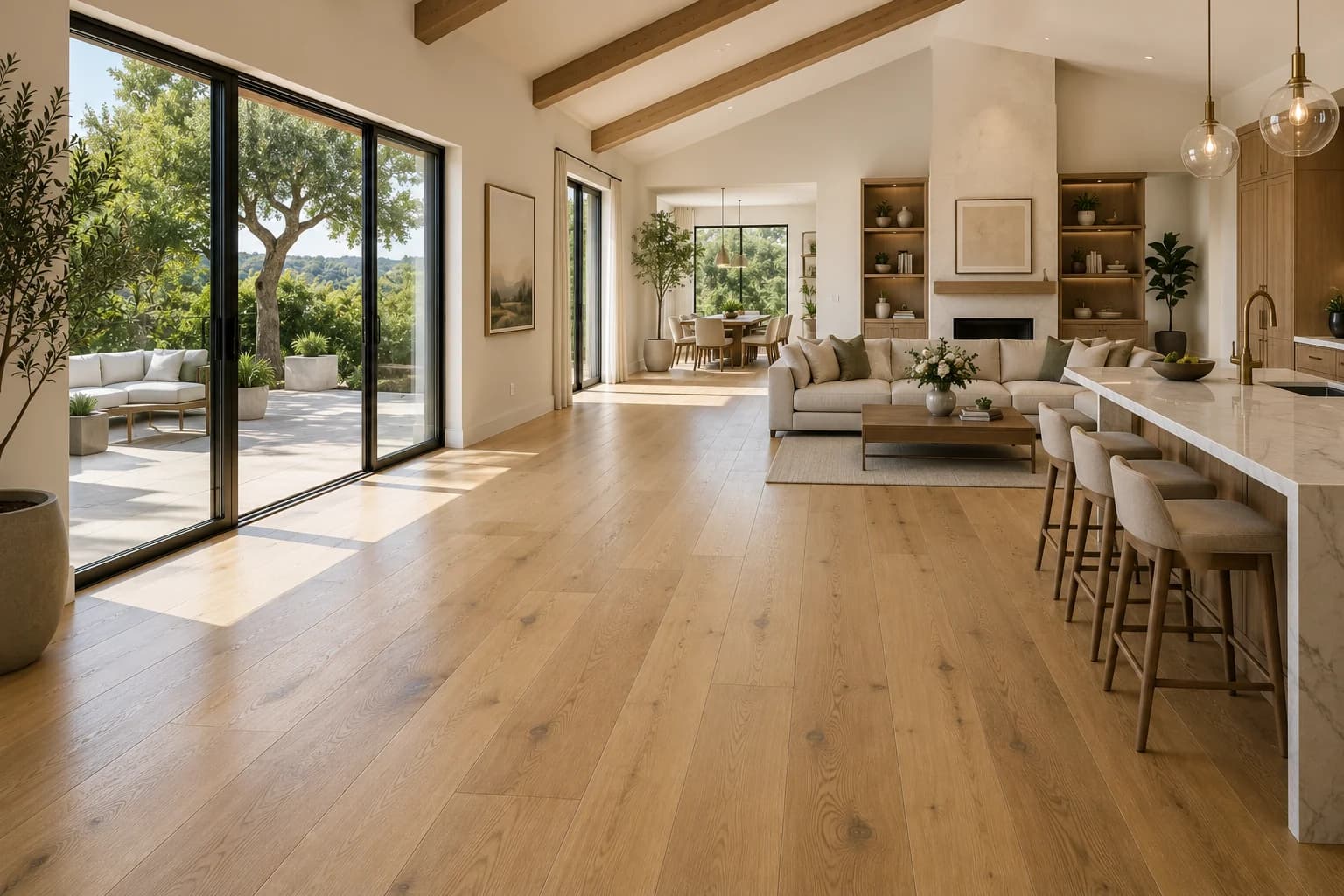
White Oak Hardwood
Great Room & Landing
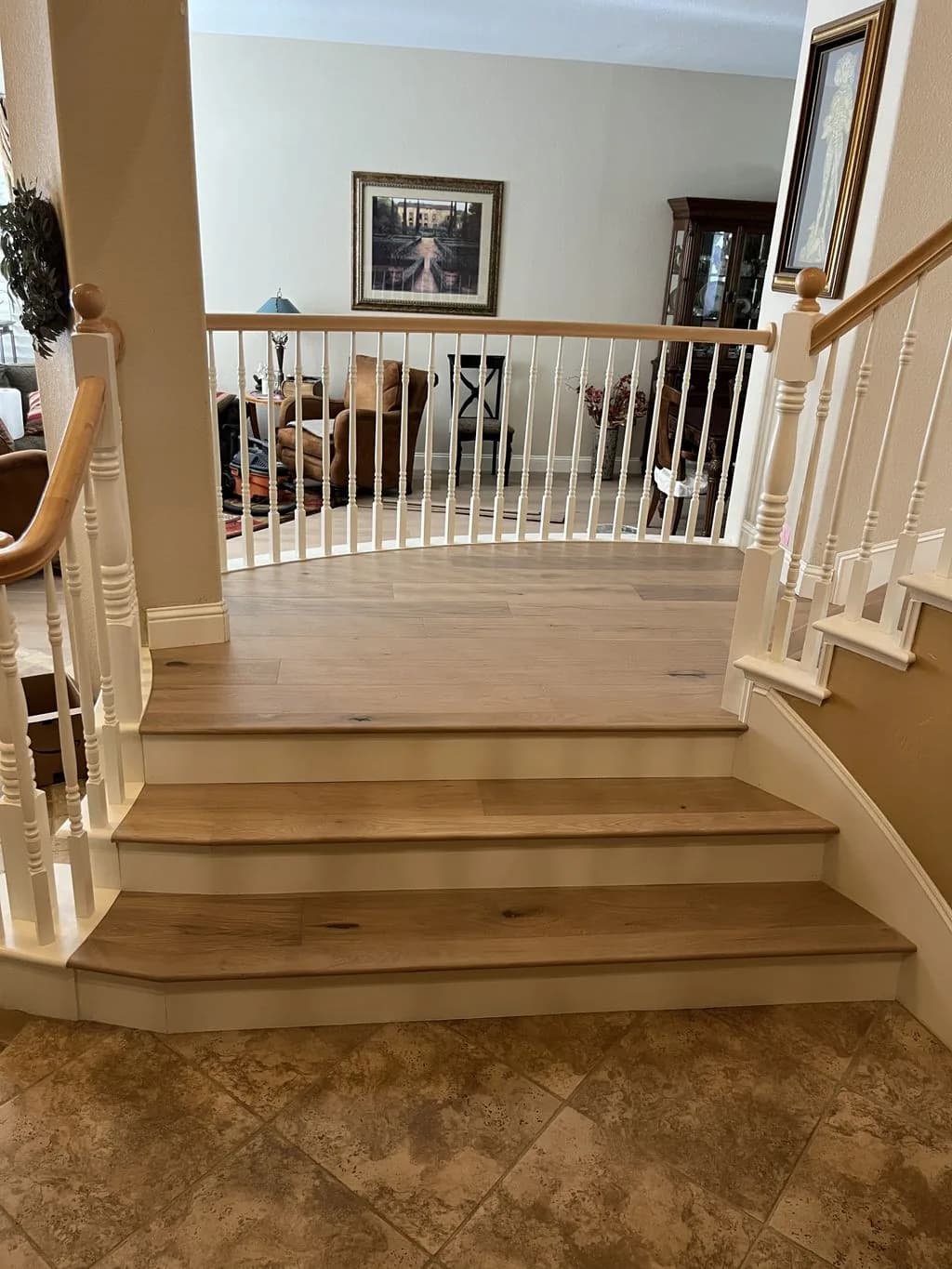
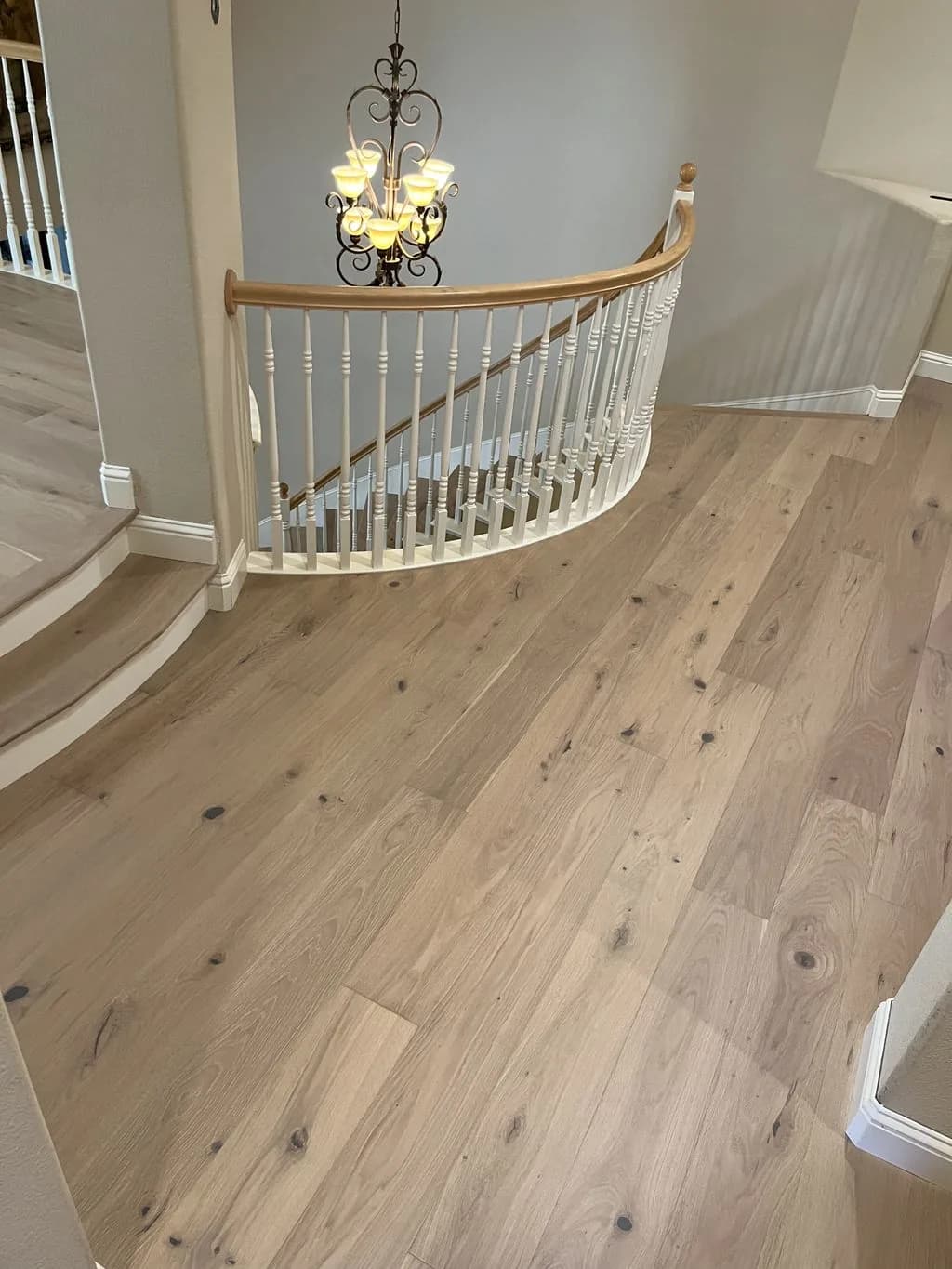
White Oak Hardwood
Staircase & Landing
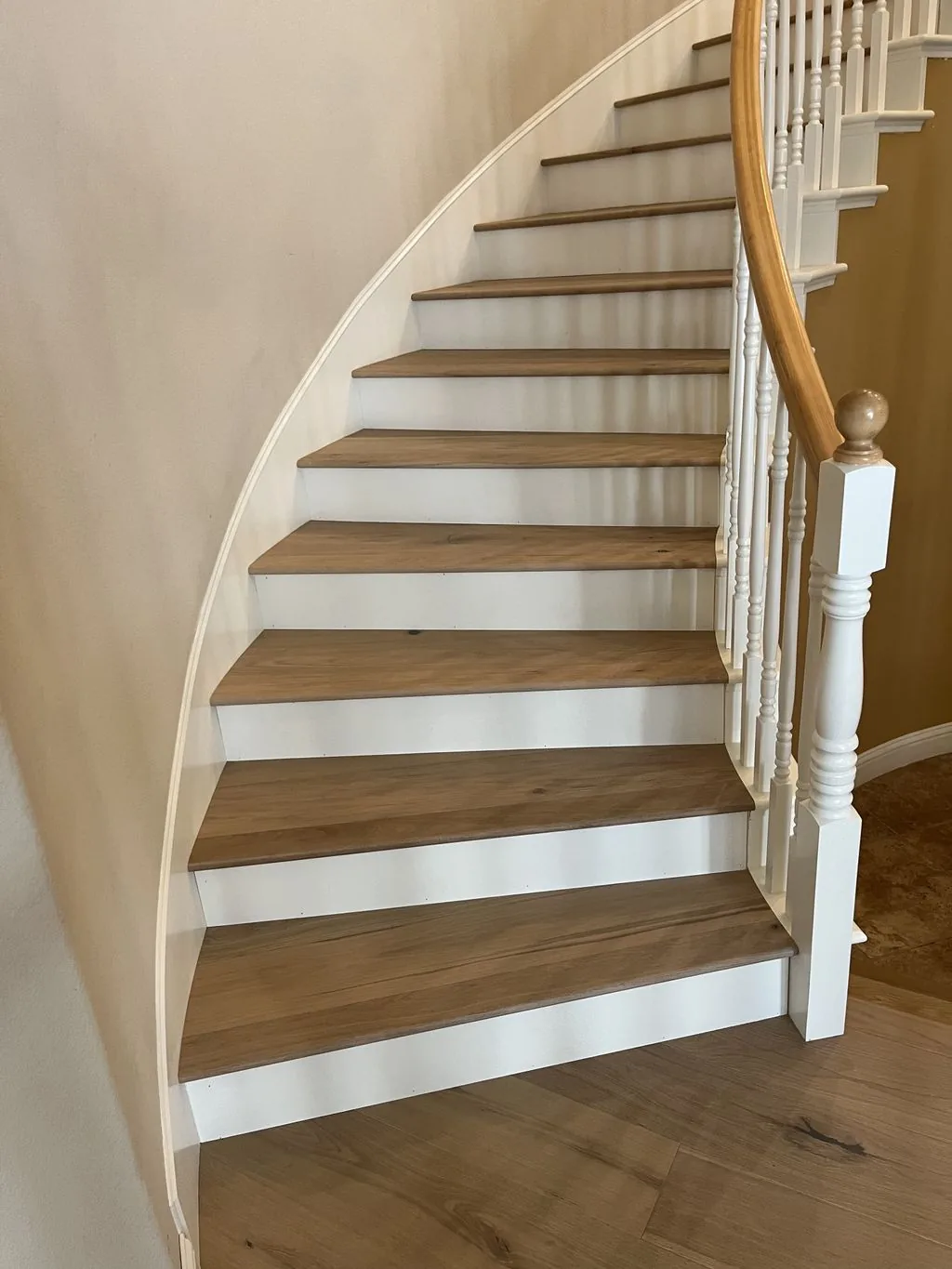
White Oak Hardwood
Curved Staircase
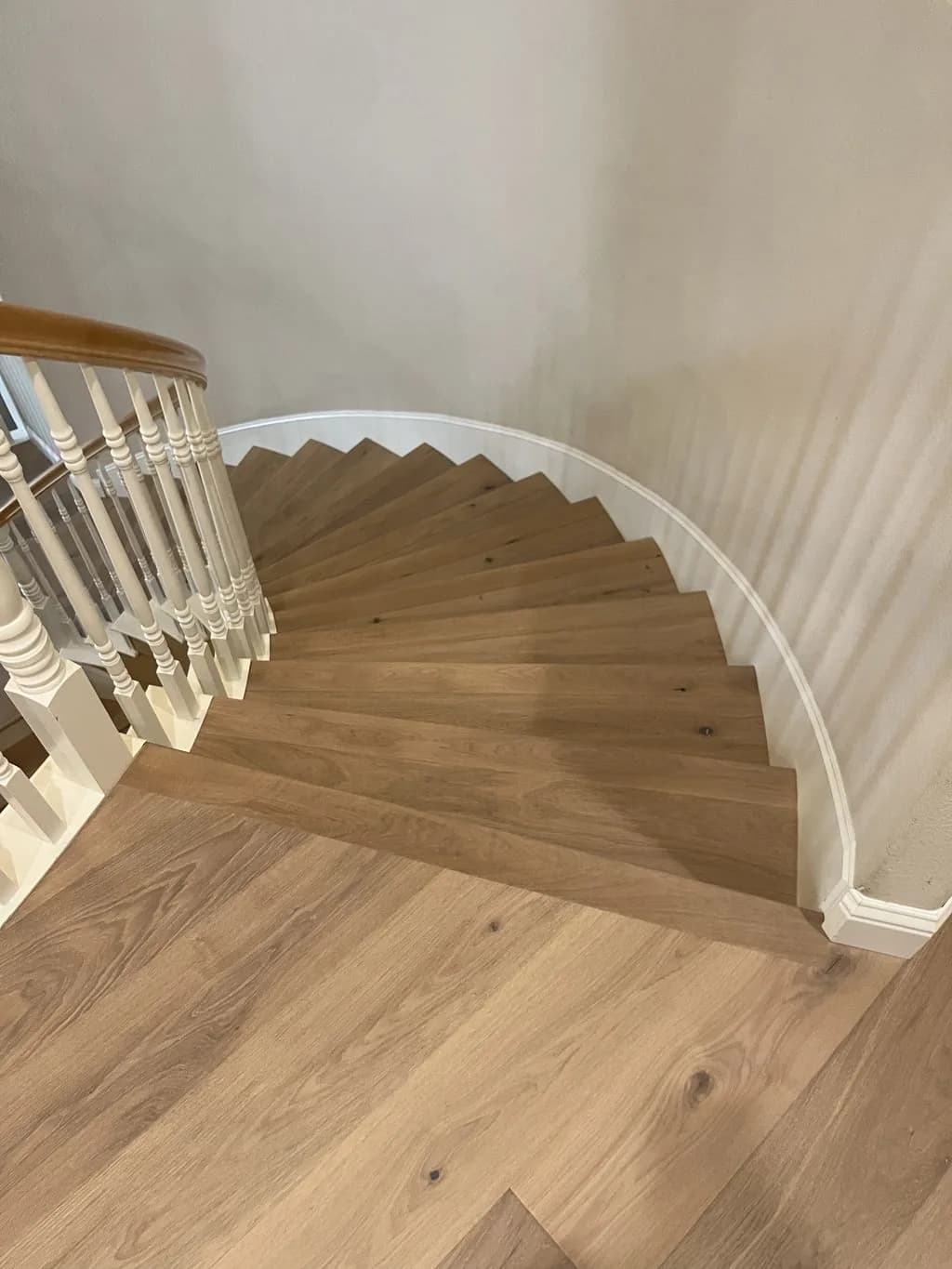
White Oak Hardwood
Stair Treads
Our Services
Flooring Services in San Jose
From hardwood to luxury vinyl, here's how we help San Jose homeowners upgrade their floors.
Hardwood Flooring
Solid oak, maple, and walkable heirloom-grade hardwood, precisely installed.
Hardwood Flooring in San JoseEngineered Hardwood
Real-wood wear layers built for California's climate swings.
Engineered Hardwood in San JoseLuxury Vinyl Plank
Waterproof, wood-look LVP for kitchens, baths, and busy households.
Luxury Vinyl Plank in San JoseLaminate Flooring
Durable, high-style laminate at a friendly price point.
Laminate Flooring in San JoseTile Flooring
Porcelain and ceramic tile set dead-level with crisp grout lines.
Tile Flooring in San JoseFloor Installation
Full-service installation from subfloor prep to final baseboard.
Floor Installation in San JoseFloor Refinishing
Sand, stain, and reseal tired hardwood back to new.
Floor Refinishing in San JoseFloor Repair
Board swaps, water damage, squeaks, and seamless patch-ins.
Floor Repair in San JoseLocal Considerations
What San Jose Homes Need From a Floor
Climate, home age, and foundation type all shape the right flooring choice in San Jose — here's what we account for.
Radiant heat under the Fairglen Additions
The National Register nomination for the Fairglen Additions — 218 Eichler homes built from 1959 to 1961 in Willow Glen, on Booksin, Fairvalley, Fairhill, Fairwood, Fairlawn, Fairorchard, Fairdell and Andalusia Avenues and nearby courts — records that 'concrete slab on-grade foundations with radiant heating were covered with 12-inch asphalt tile flooring.' A floor over a heated slab follows rules set by the products: the flooring, and any adhesive or underlayment, must be approved by its manufacturer for radiant heat, installed as that manufacturer specifies, and kept within its limits on surface temperature. Nothing is nailed, screwed or drilled into the slab, moisture-test holes included, until it is known where the heating runs. The nomination describes how the houses were built, not how they stand now: whether a house keeps its original system, has a replacement or has none, and what lies under later floor coverings, is established on site. The same construction isn't assumed in San Jose's other four Eichler neighborhoods.
Floor finishes are exempt; sheathing repair only up to 10 square feet
The City of San José's 'When Is a Building Permit Required?' page lists the cosmetic improvements that do not require a building permit, and floors appear twice: 'Floor finishes such as carpet, linoleum, tile, etc.' and 'Floor sheathing repairs up to 10 square feet.' Hardwood, laminate and vinyl plank are not named individually, so how a particular product fits 'such as … etc.' is a question for the Building Division rather than something to assume. The 10-square-foot figure is the line that shapes a project. Sheathing repair beyond it is not on the exempt list, and the page requires a permit for projects involving 'any structural change.' When damage turns out larger once the old floor is up, that scope goes to the Building Division before the repair proceeds. The page, marked 'subject to change,' refers to Municipal Code Section 24.02.110 for the complete list and notes that no project may violate City codes.
Half a century old, on slab or raised floor
The Census Bureau's 2020–2024 estimates put San Jose's median year built at 1976, with about 23 percent of roughly 345,000 housing units from the 1970s and about 53 percent from 1950 through 1979. The 1960s and the years since 2000 each account for nearly a fifth, and only about 5 percent of units predate 1940. The state's Earthquake Brace + Bolt program lists 33 ZIP codes under San Jose for a retrofit it says 'is only done on wood-framed, pre-1980 homes with a raised foundation,' but its list notes that eligibility is 'based on ZIP Code only, city provided as reference,' and eligibility is not a count of crawl spaces. No source splits San Jose's homes between slabs and raised foundations. Which one a house has, and the condition of a subfloor or slab that may be fifty years old, is checked when the old floor comes up.
Historic review is written for exteriors, with an exception
San Jose's Municipal Code Chapter 13.48 requires a historic preservation permit for work on a city landmark or in a city historic district, defining that work as changes 'to the exterior of any structure,' and Section 13.48.250 says its design criteria 'shall not apply to the interior portions' unless the director, or the City Council on appeal, finds that the structure cannot be preserved without preserving the interior. The City's historic-areas page lists seven City Landmark Districts, among them Hensley and St. James Square, and seven Conservation Areas, among them Naglee Park and Palm Haven. For Eichlers, the City has prepared Neighborhood Objective Design Standards covering 'proposed exterior changes'; as its page stood in April 2026, they applied only in the Fairglen Additions historic district. No City document reviewed for this page regulates Eichler interior flooring, and the City lists an ordinance update in progress.
Ground that sank, and zones drawn by groundwater
Valley Water says subsidence from groundwater overdraft was first measured around 1915, eventually affected more than 100 square miles of northern Santa Clara County, reached 'about 14 feet in downtown San José,' and was essentially halted by about 1970. A separate U.S. Geological Survey report puts valley subsidence at 'as much as 12.7 feet' between the early 1900s and the mid-1960s. The California Geological Survey maps liquefaction zones by quadrangle: San Jose East released January 17, 2001, San Jose West February 7, 2002, and Milpitas October 19, 2004. In the central part of San Jose West the zone boundary 'primarily coincides with the 30-foot ground-water depth contour,' placing nearly the northern third of that quadrangle in the zone. Points checked downtown, in Rock Springs and in Alviso fall inside zones; points in Willow Glen, Berryessa and Almaden Valley do not. Neither map nor history describes a particular slab today, so flatness is measured in the room.
Coyote Creek, 2017, and what a flood map doesn't show
On the morning of February 21, 2017, Coyote Creek overtopped along Rock Springs Drive and Needles Drive. Valley Water's final flood report says firefighters evacuated 276 Rock Springs residents by boat with no fatalities or injuries, that apartment buildings along South 12th Street flooded downstream of Story Road, and that approximately 14,000 people were evacuated. Valley Water calls it the worst flooding in that reach since Anderson Reservoir was built in 1950, and an interim floodwall and embankment now protects Rock Springs from an equivalent flood. Yet a point in Rock Springs is in FEMA's Zone D, where no flood hazard analysis has been conducted. A point in Alviso, annexed to San José in 1968, is in Zone AE, on Embarcadero soils whose USDA series description says subsidence 'lowered these soils several feet requiring the use of levees to keep out bay waters.' For a ground-floor room near the creek or the bay, a floor that tolerates water is worth weighing.
An August heat peak, January rain, and the air indoors
NOAA's 1991–2020 normals for the San Jose airport station make August the warmest month, at an 81.4°F average high, with July at 80.8°F and September at 80.7°F. Precipitation averages 13.48 inches a year; January is the wettest month at 2.80 inches, July's normal is zero, and December through March bring nearly three-quarters of the total. July afternoons are dry outdoors: across the Julys of 2015 to 2024, reports in the 4 PM hour at the airport averaged 49.3 percent relative humidity, against 61.3 percent at San Francisco International, and 82.1 percent in the 4 AM hour. Indoor conditions are a separate measure. Hourly observations at San Jose Mineta International Airport from 2015 to 2025, warmed to 70°F with no moisture added, give a heating-season median of about 39 percent, with about a fifth of hours below 30 percent, and a summer median of about 59 percent — higher than the same figure at San Francisco International. Wood is acclimated to the rooms it will live in.
Local Resources & References
Helpful San Jose Resources
Authoritative local and industry references for permits, planning, and flooring standards.
- When Is a Building Permit Required? (Wayback Machine snapshot, August 13, 2026) — 'Floor finishes such as carpet, linoleum, tile, etc.' and 'Floor sheathing repairs up to 10 square feet' among exempt improvements; the live page blocks automated retrievalCity of San José
- National Register of Historic Places — Fairglen Additions (Unit 1, Unit 2, and Unit 3), reference 100004036: 218 Eichler homes, 1959–1961, on radiant-heated concrete slabsNational Park Service
- San José Eichler Neighborhood Objective Design Standards (Wayback Machine snapshot, April 13, 2026) — seven Eichler tracts in five neighborhoods; standards for exterior changes in the Fairglen Additions historic districtCity of San José
- Municipal Code Chapter 13.48, Historic Preservation — exterior work requiring HP permits; Section 13.48.250 interiors clauseCity of San José
- ACS 2020–2024 5-year — housing units, year built, median year built, units in structure and tenure, San Jose city (place 0668000)US Census
- 1991–2020 monthly normals, San Jose (USW00023293) — the airport stationNOAA NCEI
- Seismic Hazard Zone Report 058, San Jose West Quadrangle — liquefaction zone boundary and the 30-foot groundwater-depth contourCalifornia Geological Survey
- Flooding Report (Final), January and February 2017 — Coyote Creek at Rock Springs, February 21, 2017Valley Water
- Subsidence — about 14 feet of maximum subsidence in downtown San José, essentially halted by about 1970Valley Water
External links are provided for reference. Always confirm current requirements with the issuing agency.
Explore Flooring Services in San Jose
Nearby Areas We Serve
Nearby
Nearby Cities We Serve in South Bay
Good to Know
Frequently Asked Questions
Does Renaissance Floors serve San Jose?
Yes. We install and refinish flooring throughout San Jose and the surrounding Santa Clara County area. Call (916) 749-0272 for a free estimate.
What flooring services do you offer in San Jose?
We install hardwood, engineered wood, luxury vinyl plank, laminate, tile, and more in San Jose, plus floor refinishing, repair, and full-service installation. See the full list below.
Are you licensed to work in San Jose?
Yes. We hold CSLB C-15 license #1060673 (C-15 Flooring & Floor Covering) and carry insurance. We're based in Roseville, CA and serve San Jose and all of Greater Sacramento & Northern California.
How do I get a free flooring estimate in San Jose?
Call (916) 749-0272 or request an estimate online. We'll schedule a convenient in-home visit in San Jose, measure your space, and give you an honest, no-pressure quote.
Do I need a building permit to replace flooring in San Jose?
Not for floor finishes, by the City's own list. San José's 'When Is a Building Permit Required?' page names 'Floor finishes such as carpet, linoleum, tile, etc.' among cosmetic improvements that do not require a building permit. The same list exempts floor sheathing repairs only 'up to 10 square feet,' and projects involving 'any structural change' need a permit. The page is marked 'subject to change' and points to Municipal Code Section 24.02.110 for the full list, so confirm a larger scope with the Building Division.
What if the subfloor under my old floor is damaged?
Up to 10 square feet of floor sheathing repair is on the City's exempt list; more than that is not. San José lists 'Floor sheathing repairs up to 10 square feet' among improvements that do not require a building permit and requires a permit for projects involving 'any structural change.' The page doesn't spell out what a larger repair needs, so when damage turns out bigger once the old floor is up, the scope goes to the Building Division before the repair proceeds.
Do San Jose Eichlers have radiant heat in the slab?
The Fairglen Additions homes were built with it. Their National Register nomination records that 'concrete slab on-grade foundations with radiant heating were covered with 12-inch asphalt tile flooring' in the 218 homes built there from 1959 to 1961. The sources behind this page don't establish the same for San Jose's other Eichler neighborhoods — Morepark, Fairglen, Hudson and Fairhaven. In any house, whether a system remains and where it runs is confirmed on site before anything is drilled or fastened into the slab.
Do San Jose's Eichler standards or historic rules cover interior floors?
Not as written, though the code keeps an exception. The City's Eichler Neighborhood Objective Design Standards cover 'proposed exterior changes' and, as the City's page stood in April 2026, applied only in the Fairglen Additions historic district. Municipal Code Section 13.48.250 says the historic-preservation design criteria 'shall not apply to the interior portions' of landmarks or district buildings, unless the director or City Council on appeal finds the structure cannot be preserved without preserving the interior.
How old are most San Jose homes?
Most were built from 1950 through 1979. The Census Bureau's 2020–2024 estimates put San Jose's median year built at 1976, with about 23 percent of roughly 345,000 housing units from the 1970s, about 53 percent from 1950 to 1979, and about 60 percent from before 1980. Only about 5 percent predate 1940. About 51 percent of units are detached single-family houses, and owners occupy about 56 percent of occupied homes.
Is my San Jose home in a liquefaction zone?
It depends on the address; the zones don't cover the whole city. The California Geological Survey maps them by quadrangle, with San Jose East released in 2001, San Jose West in 2002 and Milpitas in 2004. In San Jose West the boundary 'primarily coincides with the 30-foot ground-water depth contour.' Points checked downtown, in Rock Springs and in Alviso fall inside zones; points in Willow Glen, Berryessa and Almaden Valley do not. Check the specific address on the state's map.
Did the 2017 Coyote Creek flood reach homes, and is Rock Springs in a flood zone?
It did, though the flood map reads differently. Valley Water says hundreds of homes were inundated in February 2017; on February 21, firefighters evacuated 276 Rock Springs residents by boat, and approximately 14,000 people were evacuated in all. A point in Rock Springs is nonetheless in FEMA's Zone D, meaning 'possible but undetermined flood hazards.' An interim floodwall and embankment now protects Rock Springs from an equivalent flood. For a ground-floor room near the creek, a floor that tolerates water is worth weighing.
When is San Jose warmest and wettest, and how dry does indoor air get?
August is warmest and January wettest. NOAA's 1991–2020 normals at the San Jose airport station give August an 81.4°F average high, just above July's 80.8°F, and January 2.80 of the year's 13.48 inches. Outdoor air at San Jose Mineta International Airport, warmed to 70°F with no moisture added, has a heating-season median near 39 percent relative humidity and a summer median near 59 percent, so wood flooring is acclimated to the conditioned rooms it will live in.
Related
Keep Reading
Related pages: Floor Refinishing in Concord, Floor Repair in Concord, Hardwood Flooring in San Jose, and Engineered Hardwood in San Jose.

Ready for Floors You'll Love?
Free, no-pressure flooring estimates throughout San Jose and Santa Clara County.