San Jose
Luxury Vinyl Plank in San Jose
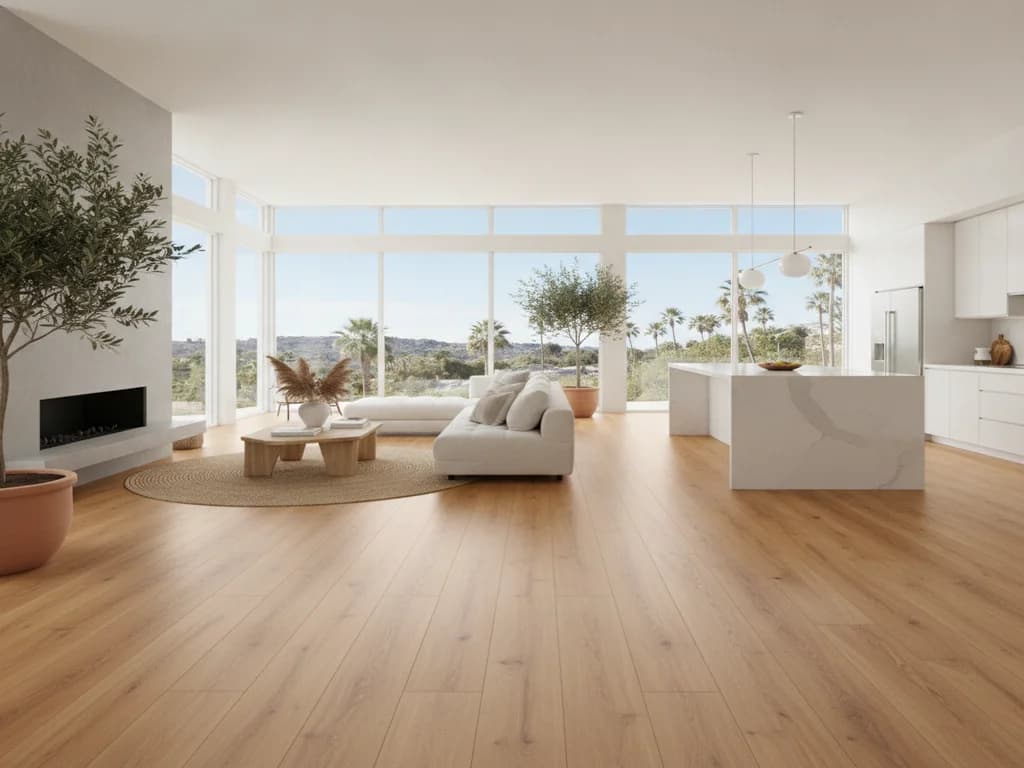
Luxury vinyl plank that looks like natural wood and shrugs off water, pets, and traffic — installed over properly leveled subfloors for a flawless result.
Local Conditions
What Luxury Vinyl Plank Has to Contend With in San Jose
San Jose Conditions That Affect Luxury Vinyl Plank
Derived statistic, not a published normal: averaging all NOAA Local Climatological Data hourly reports at San Jose International Airport in the 4 AM and 4 PM hours (Local Standard Time) across the ten Julys 2015-2024 gives 82.1% relative humidity in the 4 AM hour (n=392) and 49.3% in the 4 PM hour (n=317), a difference of about 33 points. By the same method San Francisco International averages 61.3% in the 4 PM hour, and San Jose has the lowest 4 PM-hour average of five bay-side airport stations checked — though not the lowest in the 4 AM hour, where Hayward averages 80.9%. NOAA's Comparative Climatic Data table, a different method, gives Sacramento a 29% July afternoon mean. Heat is the real design constraint for vinyl in San Jose, not humidity. With summer highs near 81°F, a floating LVP floor expands and contracts thermally, and direct sun through a large south- or west-facing window will drive a plank's surface temperature well past the room's air temperature. That is why perimeter expansion space and the manufacturer's stated run limits get respected here, and why we ask about window coverings and sun exposure before laying out a long unbroken run.
NOAA 1991-2020 normals at the San Jose airport station give a January average high of 59.8°F and an average low of 41.8°F. January is the wettest month at 2.80 inches, and the annual precipitation normal is 13.48 inches — effectively tied with Moffett Federal Airfield's 13.45 inches. Cold does the opposite — a floor that was installed tight in summer heat can pull apart at the seams once the house cools. Correct gapping at the perimeter is what makes that a non-event.
San Jose's July normal high of 80.8°F runs about 14½°F above San Francisco Downtown (66.3°F) and about 4°F above Moffett Federal Airfield to the northwest (76.9°F). August, at 81.4°F, is San Jose's warmest month. Outdoor humidity in San Jose, high or low, is a non-issue for the plank's stability; it's the subfloor underneath that we still check.
Subfloor Prep
The 2025 Northern California Earthquake Brace + Bolt ZIP list from the California Residential Mitigation Program lists 33 ZIP codes under San Jose, including 95002 and 95070, with the caveat 'Eligibility based on ZIP Code only, city provided as reference.' The program states that 'an EBB seismic retrofit is only done on wood-framed, pre-1980 homes with a raised foundation.' ZIP eligibility says nothing about how many San Jose homes have raised foundations. At tract level, the National Register nomination for the Fairglen Additions — 218 Eichler homes built 1959-1961 in Willow Glen — records that 'Concrete slab on-grade foundations with radiant heating were covered with 12-inch asphalt tile flooring.' That description is documented for Fairglen Additions only. Citywide, 60.4% of the 345,066 units predate 1980 but only 5.2% predate 1940, so most pre-1980 housing was built from 1950 through 1979. No source publishes a slab-versus-raised split for the city.
LVP is the most slab-tolerant floor we install — the plank itself is waterproof and does not care about vapor the way wood does. What it does care about, completely, is flatness. A rigid-core plank telegraphs every high spot and bridges every low one, and the click joints along a bridged dip are where separation starts. On slab that means grinding down ridges and filling with a cementitious patch until the floor meets the manufacturer's tolerance, not until it looks acceptable.
Over a crawlspace the plank is still waterproof, but "waterproof floor" is not "waterproof house" — moisture coming up through an open crawlspace ends up in the subfloor and the framing regardless of what's on top. We look underneath first. Where the subfloor has soft spots or movement, it gets fixed before anything floats over it.
Source: NAHB analysis of the Census Bureau Survey of Construction, foundation type by region (2024)
San Jose Homes We Work In
ACS 2020-2024 five-year estimates count 345,066 housing units with a median year built of 1976: 23.3% built in the 1970s, 18.5% in the 1960s and 11.8% in the 1980s, and 52.7% built from 1950 through 1979. Only 5.2% predate 1940. Construction from 2000 onward accounts for 18.6%. 51.3% of units are detached single-family houses, and 55.8% of occupied homes are owner-occupied. San Jose's 1970s, 1960s, and 1980s homes are where LVP most often replaces carpet or sheet vinyl, and the subfloor under both is frequently uneven in ways nobody has seen for decades. The prep — not the plank — is the majority of the work in those houses, and it is the part that gets skipped by whoever installed the floor you're now replacing.
Before We Quote
Planning Around San Jose
A few San Jose-specific conditions shape an LVP install:
- San Jose's housing stock is postwar rather than pre-war: the median year built is 1976, 23.3% of units were built in the 1970s and 18.5% in the 1960s, while only 5.2% predate 1940.
- The City lists 'Floor finishes such as carpet, linoleum, tile, etc.' and 'Floor sheathing repairs up to 10 square feet' among improvements that do not require a building permit; sheathing repair beyond 10 square feet is not on that list, and projects involving 'any structural change' require a permit.
- The City lists seven Eichler tracts forming five neighborhoods, and the National Register nomination for the Fairglen Additions (218 homes, 1959-1961) records concrete slab foundations with radiant heating, originally covered with 12-inch asphalt tile.
- Summer runs warmer than the peninsula: a July normal high of 80.8°F against 66.3°F at San Francisco Downtown, with August the warmest month at 81.4°F.
- July afternoons are dry outdoors: all hourly reports in the 4 PM hour at San Jose International Airport, 2015-2024, average 49.3% relative humidity against 61.3% at San Francisco International — the lowest of five bay-side airport stations checked — and 82.1% in the 4 AM hour.
- Thirty-three ZIP codes are listed under San Jose on the state's Earthquake Brace + Bolt list, a program limited to 'wood-framed, pre-1980 homes with a raised foundation'; eligibility is set by ZIP code and does not establish how many homes have raised foundations.
- The annual precipitation normal at the San Jose airport station is 13.48 inches, with January the wettest month at 2.80 inches.
- An April 2026 capture of the Building Division page reported plan review times longer than normal due to application volume and staff vacancies.
Permits & Jurisdiction
Who Has Jurisdiction in San Jose
Building permits and inspections for San Jose properties go through City of San José Building Division (Planning, Building & Code Enforcement). The City's 'When Is a Building Permit Required?' page (updated 06/12/2025, 'subject to change') lists 'Floor finishes such as carpet, linoleum, tile, etc.' and 'Floor sheathing repairs up to 10 square feet' among cosmetic improvements that do not require a building permit, and requires a permit for projects involving 'any structural change.' It cites Municipal Code Section 24.02.110 as the full list of exempt projects. The Building Division states that it 'oversee[s] the Development Services Permit Center and online permitting at www.SJPermits.org.' An April 2026 capture of the division's page advised that 'due to a high volume of applications and staff vacancies, the time frame for an initial review and subsequent reviews are currently longer than normal,' and described a Best Prepared Designer Program under which enrolled professionals 'get building permits in as little as 3-5 days.' As of January 1, 2026, the 2025 Building Codes are in effect.
Requirements change. Confirm current rules with the issuing agency before work begins.
We install luxury vinyl plank throughout San Jose, including North Willow Glen, Willow Glen South, Willow Glen West, Cambrian, Blossom Valley, West Evergreen, and the surrounding area.
Sources
Where These San Jose Details Come From
The local conditions above are drawn from these public sources.
- U.S. Census Bureau ACS 2020-2024 5-year, tables B25001, B25034, B25035, B25024, B25003, San Jose city, CA
- NOAA NCEI 1991-2020 Monthly Climate Normals, station USW00023293 (San Jose, CA)
- NOAA NCEI Local Climatological Data, hourly relative humidity, station 72494523293 (San Jose International Airport), Julys 2015-2024
- NOAA NCEI Comparative Climatic Data — Average Relative Humidity, Morning and Afternoon (data through 2023)
- California Residential Mitigation Program — Earthquake Brace + Bolt retrofit eligibility
- CRMP — 2025 EBB ZIP Codes in Northern California
- City of San José — Building Division, Planning, Building & Code Enforcement
- City of San José — When Is a Building Permit Required? (Wayback Machine snapshot, August 13, 2026; the live page blocks automated retrieval)
- City of San José — San José Eichler Neighborhood Objective Design Standards (Wayback Machine snapshot, April 13, 2026)
- National Park Service — National Register nomination, Fairglen Additions (Unit 1, Unit 2, and Unit 3), reference 100004036
- City of San José Open Data — Neighborhoods (boundaries established 2020 with Council offices)
More in This Area
Other Flooring Services in San Jose
Nearby Areas
Luxury Vinyl Plank Near San Jose
Good to Know
Frequently Asked Questions
Do you install luxury vinyl plank in San Jose?
Yes. Renaissance Floors installs luxury vinyl plank throughout San Jose and the surrounding Santa Clara County area. Call (916) 749-0272 for a free estimate.
Is luxury vinyl plank actually waterproof?
At the plank, yes — the SPC or WPC core does not swell. Grout-free seams still mean water can reach the subfloor during extreme or prolonged flooding, so it is not a substitute for plumbing that works, but for kitchens, bathrooms, mudrooms and basements it is the most forgiving option we install.
What happens when luxury vinyl wears out?
It cannot be refinished, so worn or damaged planks are replaced rather than sanded. In a rental or a busy household that is often the advantage rather than the drawback — a damaged section swaps out without refinishing an entire room.
How do I get an estimate in San Jose?
Call (916) 749-0272 or request a free estimate online. We'll schedule a convenient in-home visit in San Jose, measure your space, and give you an honest written quote.
Related
Keep Reading
Related pages: Luxury Vinyl Plank, San Jose, Hardwood Flooring, and Engineered Hardwood.
Ready for Floors You'll Love?
Free estimates on luxury vinyl plank throughout San Jose and Santa Clara County.