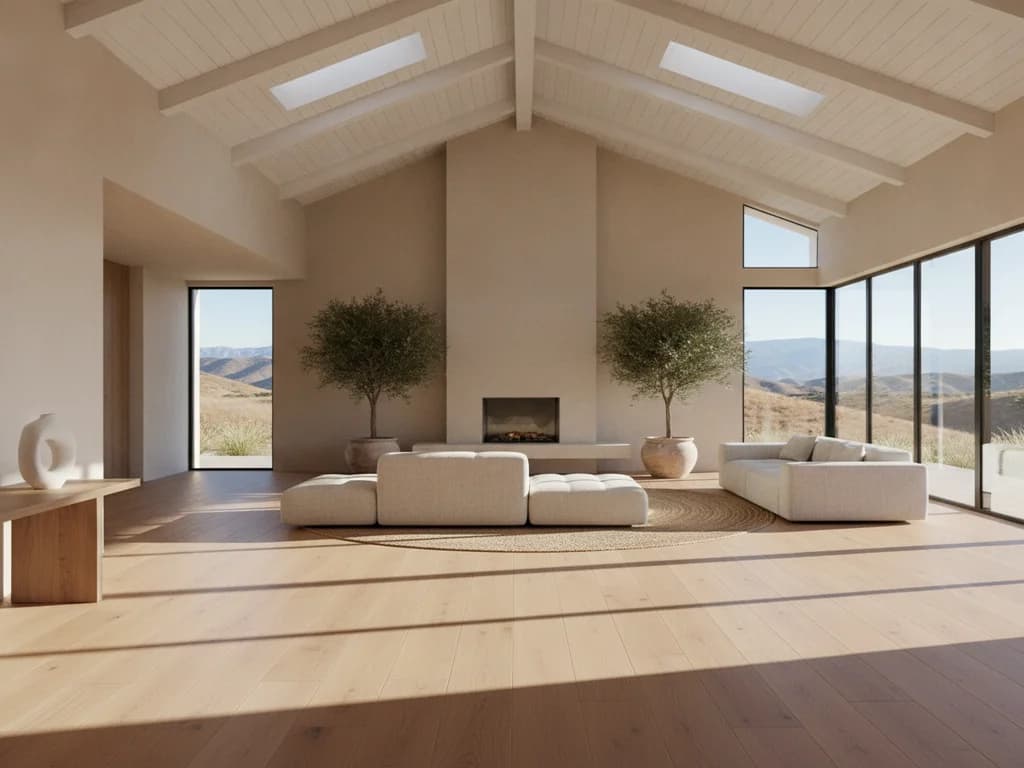
Winters
Engineered Hardwood in Winters
Engineered European oak and wide-plank hardwood — a genuine hardwood surface over a dimensionally stable core that handles humidity and heat.
Local Conditions
What Engineered Hardwood Has to Contend With in Winters
Winters Conditions That Affect Engineered Hardwood
Winters sits at about 135 feet in Yolo County. The regional Sacramento Valley record shows summer air cycling widely within each day rather than staying uniformly dry. In the National Weather Service publication "Climate of Sacramento, California" (revised August 2010), average relative humidity at Sacramento is 78 percent at 4 AM against 30 percent at 4 PM in July, a swing of roughly 48 points inside the same day. Those are Sacramento readings taken about 26 miles from Winters, not local measurements. Engineered hardwood exists precisely for climates like this. With Winters summer highs near 95°F and air conditioning drying the house out, a cross-laminated or multi-ply core moves far less across the grain than solid wood does, so seasonal gapping is much less pronounced. It is the reason we recommend engineered over wide plank widths in particular — the wider the board, the more a solid version would move.
NOAA 1991-2020 normals for the Winters station record a January mean daily maximum of 56.5°F and mean daily minimum of 37.5°F, with January and December each averaging roughly 5 inches of precipitation. Winter is the wet season; summer months average near zero. Through winter the same stability works in reverse: the core resists the swelling that a solid floor would show as the house takes on moisture. Stable is not inert, though — the expansion gap at the perimeter still gets set properly.
What Winters's Humidity Asks of Engineered Hardwood
In Winters the case for engineered hardwood rests more on plank width and slab than on climate, and the measurements show why. Hourly dewpoint readings from University Airport, Davis, 10 miles away, put that air at a median 37.4% relative humidity once it is heated to 70°F over winter — 24% of those hours under NWFA's 30% minimum — rising to 56% in summer. A solid 5-inch white oak board living through that, at roughly 7.3% to 10.3% equilibrium moisture content, changes width by about 0.056 inch between seasons. A cross-laminated core exists to restrain that movement; how much it restrains depends on the product's construction, so we go by the manufacturer's stated humidity range for the specific floor rather than a general rule.
Subfloor and Foundation Work
Foundation type is not published for Winters, but the ground under the town is mapped in detail. USDA-NRCS SSURGO maps sixteen soil units inside the city limits. Brentwood silty clay loam is the largest at 31.4% of the incorporated area and carries a linear extensibility of 7.5%; Rincon silty clay loam covers a further 20.4% at 6.4%. NRCS rates any soil above 6% linear extensibility as high shrink-swell, and on that measure 57.9% of Winters sits on high-shrink-swell ground. What Winters does not have is any very-high soil: the most expansive unit in town, Capy silty clay, reaches 8.7% across 4.5% of the area, and nothing crosses the 9% threshold. Set against Dixon ten miles southeast, where no unit in the city rates above moderate at all, Winters is meaningfully more seasonally active ground — but it is not Diablo-clay country either.
A slab is the single biggest reason engineered hardwood gets specified at all. A dimensionally stable core can go over concrete where solid wood cannot — floated, or glued down with a moisture-control membrane. That is not a free pass: we still test the slab per ASTM F2170, still grind or fill it flat to the manufacturer's tolerance, and still match the adhesive system to the reading we get. Skipping the test is how a glue-down floor comes loose.
Over a crawlspace, engineered goes down by nail, staple, glue, or float, so the method follows the subfloor rather than the other way round. We flatten the subfloor first — engineered plank is stiff, and it bridges dips instead of following them, which is what produces hollow spots underfoot.
Source: NAHB analysis of the Census Bureau Survey of Construction, foundation type by region (2024)
Winters Homes We Work In
ACS 2020-2024 five-year estimates count 2,564 housing units. The largest cohorts were built 1980-1989 (21.8%) and 1970-1979 (17.7%). Winters also retains a comparatively large pre-1940 cohort at 8.9% of units, alongside continued recent construction: 6.8% of units were built 2020 or later. In Winters's 1970s-1980s, 2000s, and pre-1940 housing, engineered often wins on height as much as on moisture: a thinner assembly clears existing door jambs, appliance toe-kicks, and the transitions to rooms that aren't being redone, which matters when only part of the house is getting new floor.
Before We Quote
Planning Around Winters
A few Winters conditions change how we plan an engineered hardwood install:
- FEMA's National Flood Hazard Layer places the Winters town center in Zone X, within an area of 0.2 percent annual chance flood hazard — outside the Special Flood Hazard Area.
- Summer and winter conditions differ sharply: NOAA 1991-2020 normals show a July mean daily maximum of 95.3°F with essentially no precipitation, against a January mean daily minimum of 37.5°F and about 5 inches of rain.
- 57.9% of the area inside Winters' city limits is mapped on soils NRCS rates high for shrink-swell — led by Brentwood silty clay loam at 7.5% linear extensibility — so seasonal subgrade movement is the normal condition here rather than the exception, and flatness should be checked against the season in which it was measured.
Permits & Jurisdiction
Who Has Jurisdiction in Winters
Building permits and inspections for Winters properties go through City of Winters Building and Code Enforcement Division. Part of the City of Winters Community Development Department. Permits that do not require plan check may be issued over the counter.
Requirements change. Confirm current rules with the issuing agency before work begins.
Sources
Where These Winters Details Come From
The local conditions above are drawn from these public sources.
- NWS Sacramento — "Climate of Sacramento, California" (revised August 2010), Average Relative Humidity by Time Periods table. The table carries no station attribution and no period line of its own, so it is cited as the Sacramento record only.
- NOAA NCEI 1991-2020 Monthly Climate Normals, station USC00049742 (Winters, CA)
- U.S. Census Bureau ACS 2020-2024 5-year, table B25034 (Year Structure Built), Winters city, CA
- City of Winters Building Division
- FEMA National Flood Hazard Layer (NFHL) map service
- Winters, California — elevation and incorporation date
- USDA-NRCS SSURGO via Soil Data Access — the sixteen map units covering the Winters city polygon; per-unit linear extensibility area-weighted from chorizon.lep_r across 0-100 cm of the dominant major component
- Linear Extensibility Percent: measurement basis and the four USDA-NRCS shrink-swell classes, documented by the UC Davis California Soil Resource Lab
- U.S. Census Bureau TIGERweb, Incorporated Places — the Winters city, CA polygon used as the soil area of interest
More in This Area
Other Flooring Services in Winters
Good to Know
Frequently Asked Questions
Do you install engineered hardwood in Winters?
Yes. Renaissance Floors installs engineered hardwood throughout Winters and the surrounding Yolo County area. Call (916) 749-0272 for a free estimate.
Is engineered hardwood real wood?
Yes — the surface is a genuine wood veneer over a dimensionally stable core, usually plywood or HDF. The cross-laminated construction moves far less with humidity than solid wood, which is why it works over slabs, in basements, and in wide-plank formats where a solid board would be least stable.
Can engineered hardwood be refinished?
It depends entirely on wear-layer thickness, and it varies by product rather than by category. Some can be sanded once or twice; others are built to be replaced when worn. It is a fair question to ask before buying, and we will tell you honestly which one you are looking at.
How do I get an estimate in Winters?
Call (916) 749-0272 or request a free estimate online. We'll schedule a convenient in-home visit in Winters, measure your space, and give you an honest written quote.
Related
Keep Reading
Related pages: Engineered Hardwood, Winters, Hardwood Flooring, and Luxury Vinyl Plank.
Ready for Floors You'll Love?
Free estimates on engineered hardwood throughout Winters and Yolo County.