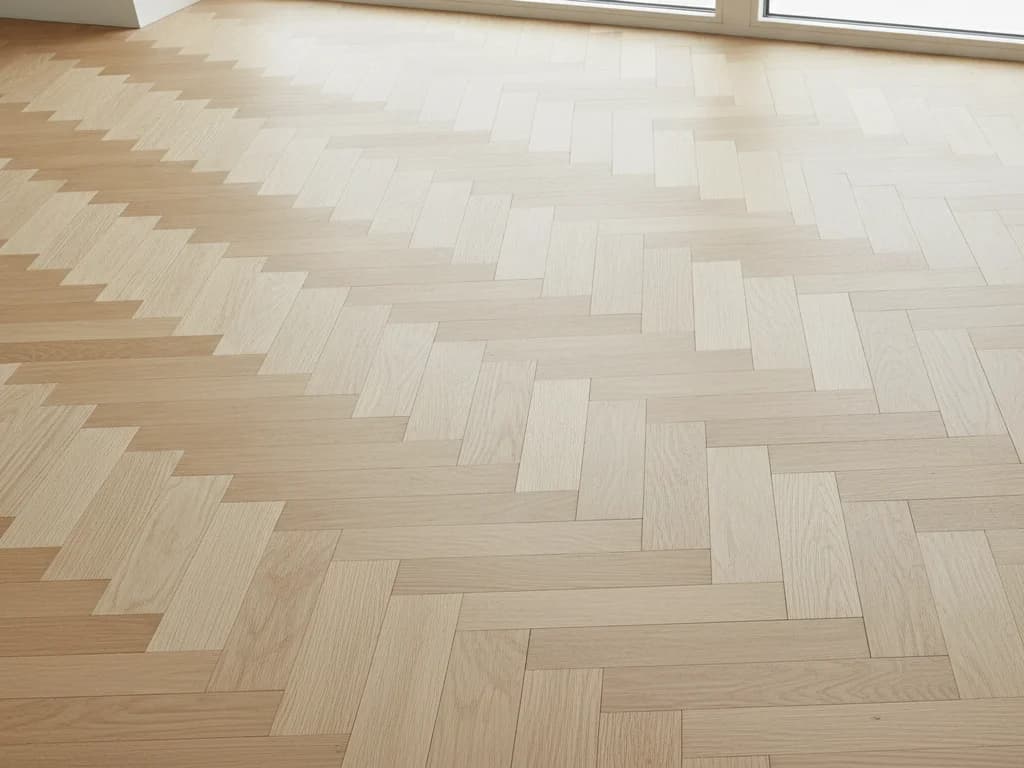
Pattern
Parquet Flooring
Geometric wood pieces arranged into repeating patterns, from classic squares to bespoke basket-weave and mosaic designs. Floors that read as craft rather than surface.
Character
Why Parquet
Look
Repeating geometry — squares, basket-weave, Versailles panels, and custom motifs — turns the floor itself into a designed feature.
Heritage
Parquet has a long luxury pedigree (think grand European estates); today it ranges from classic to strikingly modern depending on the module and wood.
Material
Most often white oak and walnut, in engineered blocks or panels finished for the design.
Parquet at a Glance
- Type
- Pattern
What It Needs
Installing Parquet
The requirements that apply specifically to this product — with the standard each one comes from.
Twice the moisture testing of a plank floor
NWFA sets a separate, higher standard for this product: for parquet or end-grain flooring, take moisture readings on a minimum of 40 panels or blocks per 1,000 square feet, plus 4 more per additional 100 square feet, and average the results — against 20 test locations for a plank floor. With pin-type meters the readings are taken on the back of the pieces. More small pieces means more independent opportunities for one of them to be wrong.
NWFA Installation Guidelines
End-grain moves in different directions than plank
Where a parquet or end-grain floor exposes the end of the grain, NWFA describes the behaviour precisely: it shrinks and swells according to the tangential value across the circumference of the growth rings, according to the radial value perpendicular to them, and with essentially no movement in thickness. That is a different movement pattern from a plank floor, and it is why a pattern floor's expansion allowance is planned around the assembly rather than around a board width.
NWFA Installation Guidelines
Geometry is the definition
NWFA's classification is simple and worth knowing when comparing quotes: parquet is any pattern that is geometric in shape rather than linear. Strip is under 3 inches wide, plank is 3 to 5 inches, and wide plank is over 5 — those are width classes for linear flooring. Parquet sits outside that scale entirely, which is why it is priced by layout complexity rather than by board width.
NWFA Installation Guidelines
These are what the standards require, not a guarantee of outcome. The flooring manufacturer's written instructions govern wherever they are stricter.
Best For
Formal rooms, foyers, and design-forward spaces wanting a floor that reads as bespoke craft.
How We Install It
Parquet is a precision, layout-driven install over a flat, prepped, moisture-tested subfloor — typically engineered blocks or panels, glue-down. Pattern planning and centering are key.
Explore related
See it in a mountain home, explore Lake Tahoe flooring, or view all wood species.
Sources
- National Wood Flooring Association (NWFA) — Industry authority on wood-flooring species characteristics, grading, and installation.
Species characteristics reflect published industry and government references; individual boards vary by grade, cut, and finish. Figures are general to the species and are not a grading or performance guarantee for a specific product.
Good to Know
Frequently Asked Questions
Is parquet flooring outdated?
Not the custom, wood-block parquet we install — that's a luxury tradition that's very much back in high-end design, especially in larger, cleaner modules and white oak or walnut. It's a world apart from the small glue-down tiles some people remember.
Can parquet be refinished?
Quality solid or thicker engineered parquet can generally be sanded and refinished, though the multi-direction grain calls for an experienced hand. We'll advise based on the specific product and build.
Related
Keep Reading
Related pages: Hardwood Flooring, Engineered Hardwood, Luxury Vinyl Plank, and Reviews.
Install Parquet in Your Home
Call (916) 749-0272 — we'll bring parquet samples and give you an honest estimate.