Species
American Walnut Flooring
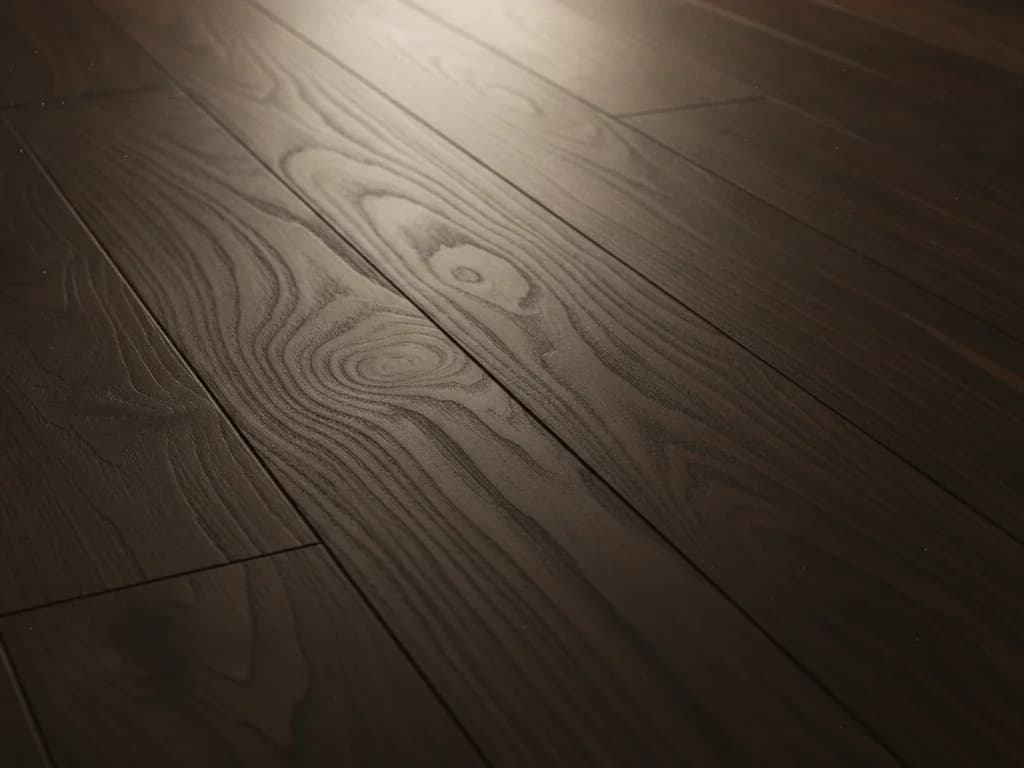
Rich, deep chocolate tones and flowing grain make walnut one of the most luxurious hardwood floors — warm, dramatic, and timeless.
Character
Why American Walnut
Look
Deep browns with purple and amber undertones and striking grain movement — a warm, high-end statement floor.
Feel
A softer hardwood than oak (walnut's Janka is lower), so it reads warm and rich; best suited to living areas over the highest-traffic zones.
Formats
Beautiful in wide-plank and available engineered for stability.
American Walnut at a Glance
- Type
- Species
- Janka Hardness
- 1,010 lbf — Moderate — everyday-durable with normal care.
- Seasonal Movement
- A 5″ board losing 2 points of moisture content narrows 0.027″ plainsawn, or 0.019″ quartersawn — the plainsawn face moves about 1.4× as much.
Janka side-hardness per USDA Forest Products Laboratory, Wood Handbook (FPL-GTR-190), Table 5-3, side hardness (lbf). Higher numbers resist denting; how visible a dent is depends on grain and color, not hardness alone.
Movement computed from the Walnut, black (Juglans nigra) coefficients (CR 0.0019, CT 0.00274) in FPL-GTR-282 Table 13–5, applied through Equation 13–3 across an 8%→6% moisture-content drop. FPL scopes those coefficients to 6–14% moisture content, so this is a lower bound on what a dry heated winter actually does, not a worst case. The same coefficients applied to a real climate.
Best For
Luxury living rooms, primary suites, and formal spaces where warmth and drama matter.
How We Install It
Engineered walnut adds stability for wide planks and mountain climates; we recommend the right build for each room.
Explore related
See it in a mountain home, explore Lake Tahoe flooring, or view all wood species.
Sources
- USDA Forest Products Laboratory — Wood Handbook (FPL-GTR-190), Ch. 5 — Mechanical properties of wood, including Janka side-hardness (Table 5-3).
- USDA Forest Products Laboratory - Wood Handbook (FPL-GTR-282), Ch. 13 — Dimensional change coefficients (Table 13-5) and Equation 13-3, behind the seasonal-movement figures.
- National Wood Flooring Association (NWFA) — Industry authority on wood-flooring species characteristics, grading, and installation.
Species characteristics reflect published industry and government references; individual boards vary by grade, cut, and finish. Figures are general to the species and are not a grading or performance guarantee for a specific product.
Good to Know
Frequently Asked Questions
Is walnut too soft for flooring?
Walnut is softer than oak, so it shows wear a bit more readily — but with a durable finish and the right placement (living and formal spaces over mudrooms/entries) it makes a gorgeous, livable luxury floor. We'll help you decide where it fits.
Is walnut stable enough for a wide-plank floor?
Yes, and it is more stable than most people expect from a softer wood. FPL gives American black walnut a tangential coefficient of 0.00274 against white oak's 0.00376, so a 5-inch plainsawn walnut board moves about 0.027 inch across a two-point moisture change where white oak moves 0.038. Walnut dents more readily than oak, but it holds its width better - which is why walnut plank handles seasonal swings better than its Janka figure alone suggests.
Does walnut lighten over time?
Yes. Walnut is one of the species that visibly changes with light exposure, generally mellowing from a deep chocolate toward a warmer, softer brown over the first few years. This is normal and not a finish defect. It is worth planning around: a large rug left in one spot through a sunny first year can leave a lighter rectangle that takes a long time to even out.
Related
Keep Reading
Related pages: Hardwood Flooring, Engineered Hardwood, Luxury Vinyl Plank, and Reviews.
Install American Walnut in Your Home
Call (916) 749-0272 — we'll bring american walnut samples and give you an honest estimate.