Antelope
Floor Refinishing in Antelope
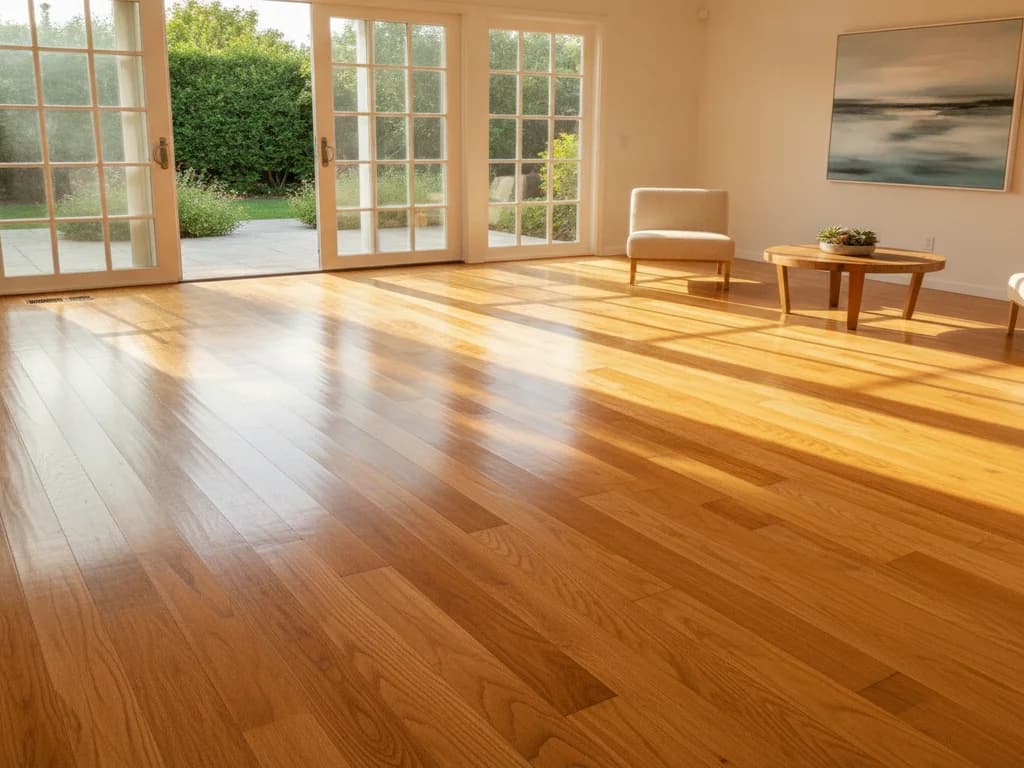
Hardwood refinishing — dustless sanding, custom stain, and durable finish coats that bring worn floors back to life without a full replacement.
Local Conditions
What Floor Refinishing Has to Contend With in Antelope
Antelope Conditions That Affect Floor Refinishing
Antelope sits at about 121 feet in Sacramento County. Summer afternoons in the Sacramento Valley are very dry. In the NWS Sacramento climate record for Sacramento, average relative humidity at 4 PM is 31% in June and 30% in July and August, while average humidity at 4 AM in the same months is 78–79%.
Winters are wet and mild, but not frost-free. Sacramento Metro Airport, 12 miles west, averages a 55°F January high and 38°F low, about 18 inches of rain a year (83% November–March) and about 23 nights a year at 32°F or below. NWS Sacramento reports snow is so rare it 'may be disregarded as a climatic feature.' Cold, damp conditions do the reverse and stretch cure times, which mostly costs patience — a floor that is walkable is not yet a floor that is ready for furniture or rugs.
Antelope has no direct coastal exposure. NWS Sacramento reports that the Carquinez Strait is the only break in the Coast Ranges admitting significant marine air, and that summer heat waves are usually followed within two or three days by cool delta breezes, especially at night. Cool, damp days in Antelope lengthen finish cure times compared with a hot, dry one — a scheduling factor rather than a quality one.
Seasonal Gaps in Antelope Floors, by the Numbers
Seasonal gaps between boards are a common reason people ask about refinishing, and Antelope's measured climate shows how much of that gapping is simply the wood moving with the seasons. Measured at McClellan Airfield, Sacramento, then brought to 70°F, the air averages 37.4% relative humidity over the heating season and 52.5% over summer, which settles wood at roughly 7.3% and 9.6% moisture content. For a traditional 2¼-inch oak strip floor that is about 0.019 inch of seasonal shrinkage per board (about 1/51 inch); for 5-inch plank, about 0.043 inch. Gaps in that range that open in winter and close by summer should not be filled — filler packed into a winter gap gets crushed out, or pushes the boards toward cupping, once the wood takes its moisture back.
What's Under the Finish
ACS 2020–2024 5-year estimates put 87.7% of Antelope's housing units in construction years 1980 or later, with a median year built of 1993 and 4.6% predating 1960. NAHB's analysis of the Census Bureau's Survey of Construction found 89.9% of new single-family homes in the Pacific division were built on slab in 2024, against 73% nationally. That is a regional figure for recent new construction, not a measurement of Antelope's existing stock. USDA maps most of Antelope as Fiddyment soils, with a cemented hardpan 20 to 40 inches down. No public record found states foundation type here, so it is confirmed on site.
A slab affects what can be refinished at all. Wood over concrete is usually engineered or glued-down, and an engineered floor can only be sanded if its wear layer is thick enough to survive it — some can take a full sanding, many can take one light pass, and some cannot be sanded at all. We measure the wear layer before quoting rather than after starting.
Raised floors are where the best refinishing candidates live: solid wood over a crawlspace, often with decades of wear and plenty of thickness left. It is also where cupping comes from. Sanding a cupped floor flat before the crawlspace moisture is fixed produces a floor that goes concave the other way once it dries — so the moisture reading comes first and the sanding comes second.
Source: NAHB analysis of the Census Bureau Survey of Construction, foundation type by region (2024)
Antelope Homes We Work In
Mainly single-family homes: ACS 2020–2024 5-year estimates put 79.2% of units in one-unit detached structures and the median year built at 1993, with 38.6% built 1990–1999 and 27.7% built 1980–1989; only 4.6% predate 1960 and 4.4% were built in 2010 or later. Antelope's 1980s and 1990s stock is where refinishing pays off most: homes of that period often have original wood under carpet, and when the wear layer is intact, refinishing keeps a floor that cannot be bought new. We check thickness at a vent or a doorway before recommending it.
Before We Quote
Planning Around Antelope
Antelope conditions that affect a refinishing job:
- Sacramento County's exempt-work handout (GI-21) lists 'painting, papering, tiling, carpeting, cabinets, counter tops and similar finish work'; confirm subfloor repairs with the County.
- USDA soil survey maps most of Antelope as Fiddyment soils, with a cemented hardpan 20 to 40 inches down on which water can perch after heavy December–April rain.
- NWS Sacramento's record puts 4 PM humidity near 30% in June–August and 4 AM humidity near 78%; acclimate solid wood to the home's conditioned air, not to an outdoor reading.
- Foundation type is not established from public records for this community and should be confirmed on site before selecting adhesives, underlayment or a moisture-mitigation approach.
Permits & Jurisdiction
Who Has Jurisdiction in Antelope
Building permits and inspections for Antelope properties go through Sacramento County Building Permits and Inspection Division. Antelope is an unincorporated census-designated place with no city government, so building permits and inspections for private development are issued by Sacramento County rather than by a city. The county accepts electronic plan submittal only.
Requirements change. Confirm current rules with the issuing agency before work begins.
Sources
Where These Antelope Details Come From
The local conditions above are drawn from these public sources.
- Which Foundation Type Is Most Common in Your Region? — NAHB analysis of US Census Bureau Survey of Construction, 2024 (Pacific division 89.9% slab, 73% nationally)
- Sacramento County, About Antelope (2012 archive) — boundaries
- US Census Bureau 2020 place codes for California — confirms Antelope CDP (06-02210) as an unincorporated census-designated place in Sacramento County
- Antelope, CA housing profile — ACS 2020–2024 5-year, tables B25034 and B25035 (Census Reporter)
- Climate of Sacramento, California — NWS Sacramento (relative humidity by time of day; delta breeze; snow)
- NOAA 1991–2020 U.S. Climate Normals — Sacramento Metro Airport (USW00093225), 12 miles west
- Sacramento County GI-21, Residential Work Exempt from Permit
More in This Area
Other Flooring Services in Antelope
Good to Know
Frequently Asked Questions
Do you install floor refinishing in Antelope?
Yes. Renaissance Floors installs floor refinishing throughout Antelope and the surrounding Sacramento County area. Call (916) 749-0272 for a free estimate.
Can my floor be refinished, or does it need replacing?
If the wear is still in the finish rather than in the wood, a screen-and-recoat abrades the existing finish and adds a fresh coat without sanding to bare wood — faster, cheaper, and far less disruptive. Once traffic lanes have worn through to bare wood or stains have reached the wood itself, that window has closed and it needs a full sand-and-finish.
How disruptive is refinishing?
Site-finished work means sanding, staining, and multiple coats with dry time between them, so the rooms are out of use for longer than a prefinished installation. We give a realistic day count up front and tell you how long the finish needs to cure before rugs and heavy traffic go back.
How do I get an estimate in Antelope?
Call (916) 749-0272 or request a free estimate online. We'll schedule a convenient in-home visit in Antelope, measure your space, and give you an honest written quote.
Related
Keep Reading
Related pages: Floor Repair in Cupertino, Floor Installation in Danville, Floor Refinishing, and Antelope.

Ready for Floors You'll Love?
Free estimates on floor refinishing throughout Antelope and Sacramento County.