San Francisco
Laminate Flooring in San Francisco
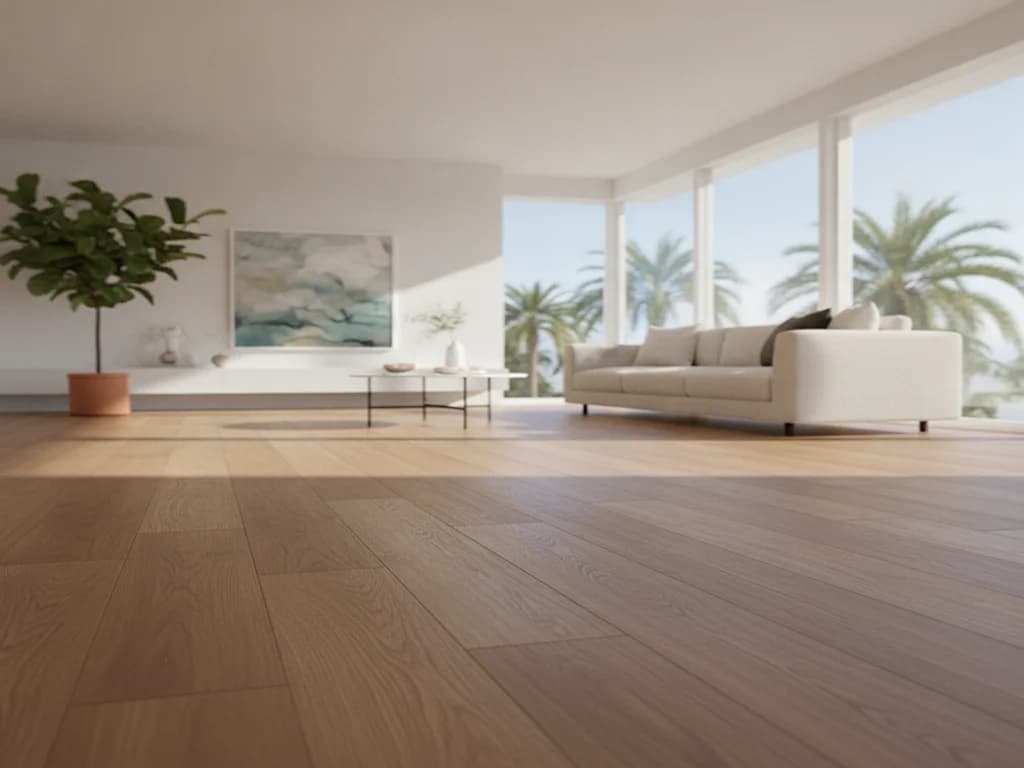
Modern laminate with realistic wood and stone visuals and a tough wear layer — a smart, budget-conscious upgrade installed to exacting standards.
Local Conditions
What Laminate Flooring Has to Contend With in San Francisco
San Francisco Conditions That Affect Laminate Flooring
NOAA's Comparative Climatic Data humidity table lists San Francisco (station 23272, period of record 1945-2018) at a mean July relative humidity of 91% in the morning and 71% in the afternoon, with annual means of 87% and 69%. The same table gives Sacramento a July afternoon mean of 29% and Stockton 27%. San Francisco's morning-to-afternoon spread of about 20 points is among the narrowest in the table; Sacramento's is roughly 42. With San Francisco summer highs near 67°F, laminate is installed as a floating floor that must be free to move. Expansion space at every wall, every cabinet toe-kick, and every door jamb — and no fastening the floor through to the subfloor at any point — is what prevents the peaking that shows up when a tight floor grows into itself.
NOAA 1991-2020 normals at San Francisco Downtown give a January average high of 57.8°F and an average low of 46.6°F. Winter lows sit well above freezing. Annual precipitation normal is 22.9 inches; December is the wettest month at 4.76 inches, with January close behind at 4.40. In winter the floor contracts, and gaps at the joints are the visible sign that it was installed without enough room to move in the first place.
The marine layer holds summer temperatures far below the inland valleys. The July normal high at San Francisco Downtown is 66.3°F and August is 67.9°F — about 15°F cooler than Redwood City, some 23 miles down the peninsula, which normals at 81.0°F in July. The city's warmest month is September, at 70.2°F. Whatever San Francisco's outdoor pattern, a laminate floor is decided more by the subfloor moisture path than by the room air, so that is what we check first.
Subfloor Prep
California's Earthquake Brace + Bolt program, administered by the California Residential Mitigation Program, states that 'an EBB seismic retrofit is only done on wood-framed, pre-1980 homes with a raised foundation,' targeting cripple walls in crawl spaces beneath the structure. Twenty-eight San Francisco ZIP codes appear on the 2025 EBB Northern California eligibility list, from 94102 through 94158. Eligibility is set by ZIP code, so the list shows where the state offers that retrofit, not how many homes have raised foundations, and no source publishes a measured raised-versus-slab split for San Francisco. Alongside this, 76.5% of the city's 414,602 housing units predate 1980 and 45.2% predate 1940 per ACS. Separately, San Francisco's mandatory soft-story retrofit program applies to 'wood-frame structures, containing five or more residential units, having two or more stories over a soft or weak story, and permitted for construction prior to January 1, 1978' — evidence about multi-unit buildings, not about single-family foundation type, and not used here as a proxy for one.
Over a crawlspace, laminate needs the same two things: a flat, sound subfloor and a moisture path that has been dealt with underneath rather than covered over. A damp crawlspace under a fiberboard-core floor is a slow failure, and it shows up first as swollen, peaked joints.
Source: NAHB analysis of the Census Bureau Survey of Construction, foundation type by region (2024)
San Francisco Homes We Work In
ACS 2020-2024 five-year estimates count 414,602 housing units, of which 45.2% (187,447 units) were built in 1939 or earlier — by count, more pre-war housing than any other city in this service area (Berkeley's share, 46.3%, is statistically the same). A further 8.4% date to 1940-1949, and 76.5% of all units predate 1980; construction from 2000 onward accounts for 14.4% of the stock. 69.4% of units are in buildings with two or more units. In San Francisco's pre-1940 and 1940s homes, laminate is usually going over a subfloor that has carried carpet for a long time. We pull it and look at what's actually there — the underlayment and the flatness correction are what separate a laminate floor that feels solid from one that clicks and gives underfoot.
Before We Quote
Planning Around San Francisco
Some San Francisco conditions change how a laminate floor gets planned:
- 45.2% of San Francisco housing units — about 187,000 — were built in 1939 or earlier, and 76.5% before 1980, so a large part of the city's flooring sits on pre-war and mid-century construction.
- DBI exempts floor-covering replacement from permits only 'in areas other than bathrooms' and where the work does not require 'the removal of existing required flooring' — the bathroom and anything beyond the covering are where the permit question starts.
- 69.4% of San Francisco's housing units are in buildings with two or more units and 61.8% are renter-occupied, so most floors are shared with a neighbor below; in a condominium, California Civil Code §4760 makes an owner's alterations 'subject to the governing documents'.
- NOAA's Comparative Climatic Data table lists San Francisco (station 23272) with the highest relative humidity of its 13 California stations: mean July humidity 91% in the morning and 71% in the afternoon, against a 29% July afternoon mean at Sacramento.
- Twenty-eight San Francisco ZIP codes appear on the state's 2025 Earthquake Brace + Bolt eligibility list, a retrofit limited to 'wood-framed, pre-1980 homes with a raised foundation'; eligibility is set by ZIP code, so the list does not say how many homes are built that way.
- Summer is cool and the warm month is late: the downtown normal high is 66.3°F in July, 67.9°F in August and 70.2°F in September. December is the wettest month at 4.76 inches of a 22.9-inch annual normal, against 0.01 inches in July.
Permits & Jurisdiction
Who Has Jurisdiction in San Francisco
Building permits and inspections for San Francisco properties go through City and County of San Francisco Department of Building Inspection (Permit Services). DBI's list of work that does not need a permit includes 'installations or replacement of floor coverings in areas other than bathrooms not requiring the removal of existing required flooring' — so bathroom floors, and work that removes required flooring, are not on that list. Over-the-counter review is available 'for projects that need less than 1 hour of plan review,' and as of January 1, 2026, all new permit filings must use the 2025 California Codes and 2025 San Francisco Code Amendments, with no grace period.
Requirements change. Confirm current rules with the issuing agency before work begins.
We install laminate flooring throughout San Francisco, including Bayview Hunters Point, Bernal Heights, Castro/Upper Market, Chinatown, Excelsior, Financial District/South Beach, and the surrounding area.
Sources
Where These San Francisco Details Come From
The local conditions above are drawn from these public sources.
- U.S. Census Bureau ACS 2020-2024 5-year, tables B25034 (Year Structure Built), B25024 (Units in Structure) and B25003 (Tenure), San Francisco city, CA — pinned 5-year release via Census Reporter
- San Francisco Department of Building Inspection — Check if your construction project needs a permit (floor coverings outside bathrooms on the no-permit list)
- California Civil Code §4760 — a common interest development member's alterations are 'subject to the governing documents'
- NOAA NCEI 1991-2020 Monthly Climate Normals, station USW00023272 (San Francisco Downtown, CA)
- NOAA NCEI Comparative Climatic Data — Average Relative Humidity, Morning and Afternoon (data through 2023), station 23272 San Francisco, CA
- California Residential Mitigation Program — Earthquake Brace + Bolt retrofit eligibility (wood-framed, pre-1980 homes with a raised foundation)
- CRMP — 2025 EBB ZIP Codes in Northern California
- San Francisco Department of Building Inspection — Permit Services
- DataSF — Analysis Neighborhoods (41 groupings of 2010 census tracts; DataSF notes they are not an official boundary map)
- San Francisco Planning — Neighborhood Group Organizations (statement that SF neighborhoods have no official boundaries)
Nearby Areas
Laminate Flooring Near San Francisco
Good to Know
Frequently Asked Questions
Do you install laminate flooring in San Francisco?
Yes. Renaissance Floors installs laminate flooring throughout San Francisco and the surrounding San Francisco County area. Call (916) 749-0272 for a free estimate.
Is laminate the same as luxury vinyl?
No. Laminate is a printed image layer under a clear wear layer over a fiberboard core — durable underfoot, but not wood and not waterproof the way an SPC or WPC vinyl core is. Even water-resistant laminate swells at the seams under standing water.
Where does laminate work best?
Bedrooms, living rooms, home offices — moderate-traffic dry areas, where it performs well and looks convincing. For kitchens, bathrooms, or basements where water exposure is routine we would usually steer you to luxury vinyl instead and say why.
How do I get an estimate in San Francisco?
Call (916) 749-0272 or request a free estimate online. We'll schedule a convenient in-home visit in San Francisco, measure your space, and give you an honest written quote.
Related
Keep Reading
Related pages: Laminate Flooring, San Francisco, Hardwood Flooring, and Engineered Hardwood.
Ready for Floors You'll Love?
Free estimates on laminate flooring throughout San Francisco and San Francisco County.