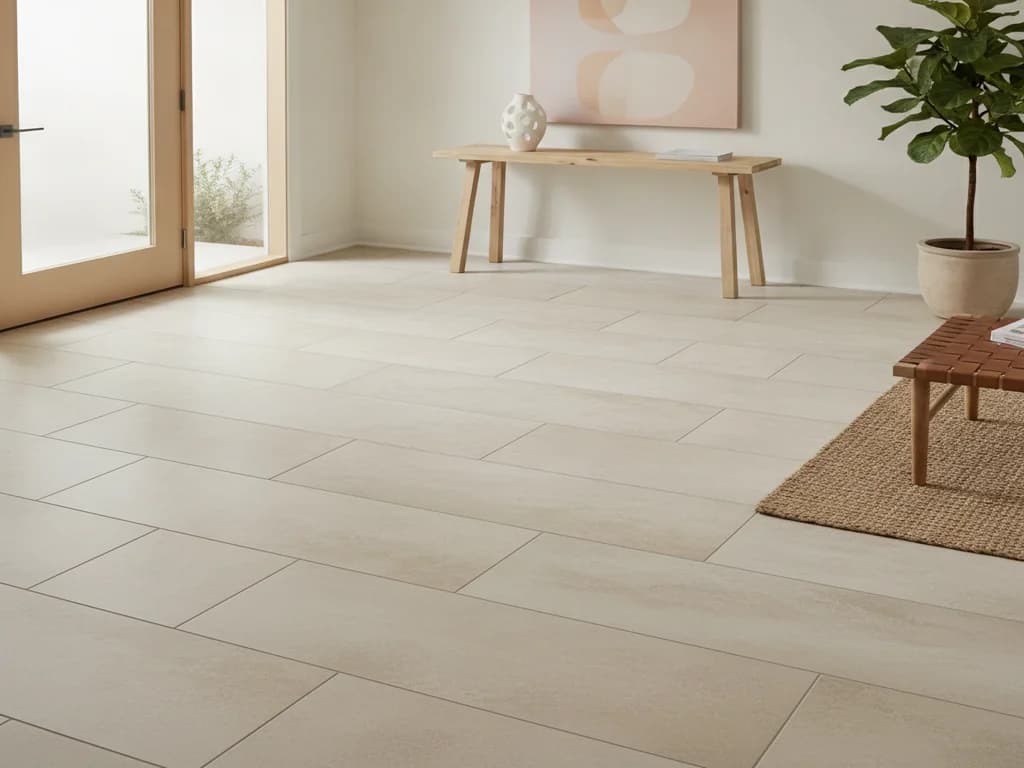
Should I use hardwood or tile?
Tile where there is water, hardwood where there is not — and then the interesting part, which is the kitchen and the entry, where both are defensible and the decision turns on what the floor connects to.
Tile is a fired ceramic body: it does not absorb moisture the way wood does, it does not care about indoor humidity, it goes below grade and over slabs without qualification, and it conducts heat well enough to make radiant systems noticeably more effective. Its weaknesses are all in the assembly rather than the material. Tile is rigid, so it depends on a substrate that does not deflect; a floor system that flexes under load will crack tile or its grout regardless of how well the tile itself was made. Grout joints are a maintenance surface. And tile is hard and cold underfoot in a way that matters over a whole day.
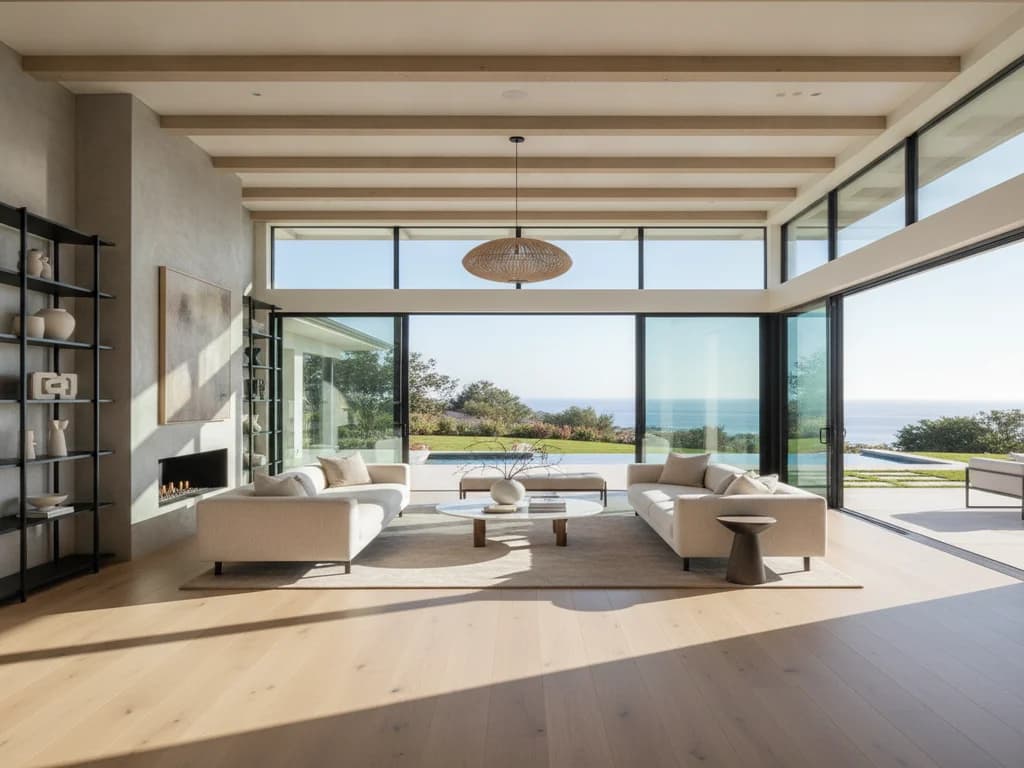
Hardwood is warmer, quieter, more forgiving to stand on and to drop things onto, and it can be sanded back to new. It is also the material that fails when a dishwasher lets go. In an open plan the practical question is often continuity: a single hardwood floor running from living room through kitchen reads as one space, while a change of material at the kitchen threshold divides it. That visual consequence is frequently what actually decides the room.
Decision Framework
When Each One Wins
Conditions, not preferences. If one of these describes your project, it should carry more weight than anything else on this page.
Choose Hardwood when…
- Living rooms, dining rooms, bedrooms, hallways, and stairs.
- Open plans where you want one continuous surface across several rooms.
- Rooms where standing comfort and acoustic warmth matter — kitchens where someone actually cooks, for instance.
- Any floor you want to restore rather than demolish when it wears.
- Second floors, where tile's weight and substrate stiffness requirements are a real constraint.
Choose Tile when…
- Bathrooms, showers, and laundry rooms.
- Entries and mudrooms that take wet boots all winter.
- Below-grade rooms and slab floors.
- Any floor over radiant heat where you want the system's full output.
- Sunrooms and rooms with strong solar gain, where wood's movement and fading are worse.
Side by Side
The Properties That Actually Differ
Where a figure is set by an individual product's instructions rather than by the material itself, the property is described as a relationship. An invented number would be worse than no number.
| Property | Hardwood | Tile |
|---|---|---|
| Water tolerance | Poor — absorbs, swells, cups, and stains. | Excellent. The body is fired and does not absorb the way wood does. |
| Below grade / over slab | Engineered only, with moisture control; solid is unsuitable. | Standard, with the right setting materials. |
| Radiant heat | Works with engineered constructions, but wood insulates the system somewhat. | The best pairing — tile conducts heat well. |
| Substrate requirement | Flat and sound; wood tolerates modest deflection without cracking. | Stiff and flat. Deflection cracks tile or grout, and the required stiffness is set by the tile industry's installation handbook — natural stone demands more than ceramic. |
| Underfoot | Warmer, softer, quieter, easier to stand on for long stretches. | Hard, cold without radiant heat, acoustically live. |
| Dropped items | The floor dents; the item often survives. | The item usually does not survive; the tile may chip. |
| Maintenance surface | The finish — recoated when it dulls. | The grout — sealed, cleaned, and eventually re-grouted. |
| Renewal | Sand and refinish, repeatedly. | Not renewable. Individual tiles are replaced; a tired floor is demolished. |
| Weight | Light enough to be a non-issue in any normal framing. | Heavy, especially stone — a real consideration on upper floors. |
It Depends
The Variables That Decide It
No comparison answers this for every house. These are the specific things about your project that move the answer, and they are worth establishing before you shop.
How stiff the floor system is
This is the tile question nobody asks until the grout cracks. Tile is only as sound as the structure under it, and older homes with longer joist spans or springy floors need that addressed before tile goes down. It is a structural evaluation, not a preference, and it can change the cost of the tile option substantially.
Whether there is radiant heat
Radiant plus tile is a genuinely superior combination, because the tile transmits the heat rather than insulating against it. If the system is going in anyway, tile's cold-underfoot disadvantage inverts into its strongest argument.
Ceramic, porcelain, or natural stone
"Tile" hides three quite different materials. Porcelain is denser and less absorptive than ordinary ceramic. Natural stone is porous, needs sealing, and demands a stiffer floor than ceramic does. Comparing hardwood against "tile" generically compares it against nothing in particular.
How the rooms connect
In an open plan, a material change is a visual line across the space. Sometimes that line is wanted — it defines a kitchen. Often it is not, and running one floor throughout is worth more than the marginal performance difference in the one room where the materials disagree.
On this site: Tile Flooring, Natural Stone Flooring, Hardwood Flooring, and Radiant Heat Flooring.
Next decision: LVP vs. Hardwood, Carpet vs. Hard Surface (Bedrooms), and Engineered vs. Solid Hardwood.
See all 17 flooring comparisons, or look up a term in the glossary.
Common Questions
Frequently Asked Questions
Can I put hardwood in a kitchen?
Yes, and it is common. Kitchens see spills rather than standing water, and spills wiped up promptly are not what damages wood. The genuine risk is a slow appliance or supply leak under a dishwasher or refrigerator, which can be running for a long time before anyone notices. That specific failure mode, not everyday cooking, is the argument against wood in a kitchen.
Is wood-look tile a reasonable compromise?
For performance, yes — it is tile, so it behaves like tile in water and over slabs while presenting a plank appearance. What it does not give you is wood's warmth or acoustic softness underfoot, and the plank format means a lot of grout joints. It is a strong answer for bathrooms and mudrooms that want visual continuity with adjacent wood floors.
Which is better over a concrete slab?
Tile, as a default. It is the simpler assembly — no moisture-driven movement to manage, no build-up in height. Engineered hardwood over a slab is entirely viable and often the better choice for living space, but it requires the slab's moisture to be tested and managed, which tile largely sidesteps.
Does tile crack easily?
Well-installed tile over a stiff, flat substrate is extremely durable. Cracked tile almost always indicates a substrate problem — deflection, movement, or an unaddressed crack in the slab telegraphing upward — rather than a defect in the tile. That is why the substrate assessment is the important part of a tile job.
Which is more expensive?
The material ranges overlap so heavily in both categories that the comparison is not meaningful without a specific product, and installation cost is driven by substrate preparation, which varies per house. Our cost calculator has the real installed ranges for this market — that is the honest place to look rather than a general rule.
Related
Keep Reading
Related pages: The Best Flooring for Dogs and Busy Households, The Best Flooring for High-Traffic Homes and Rentals, Contact, and Flooring Comparisons.
Get a Straight Answer for Your House
Free estimates across Greater Sacramento & Northern California. We'll look at your subfloor and your rooms and tell you which of these actually fits — call (916) 749-0272.