Flooring Problem
Hardwood Floor Crowning
Why is the center of my floorboards higher than the edges?
The Short Answer
What Causes Crowning?
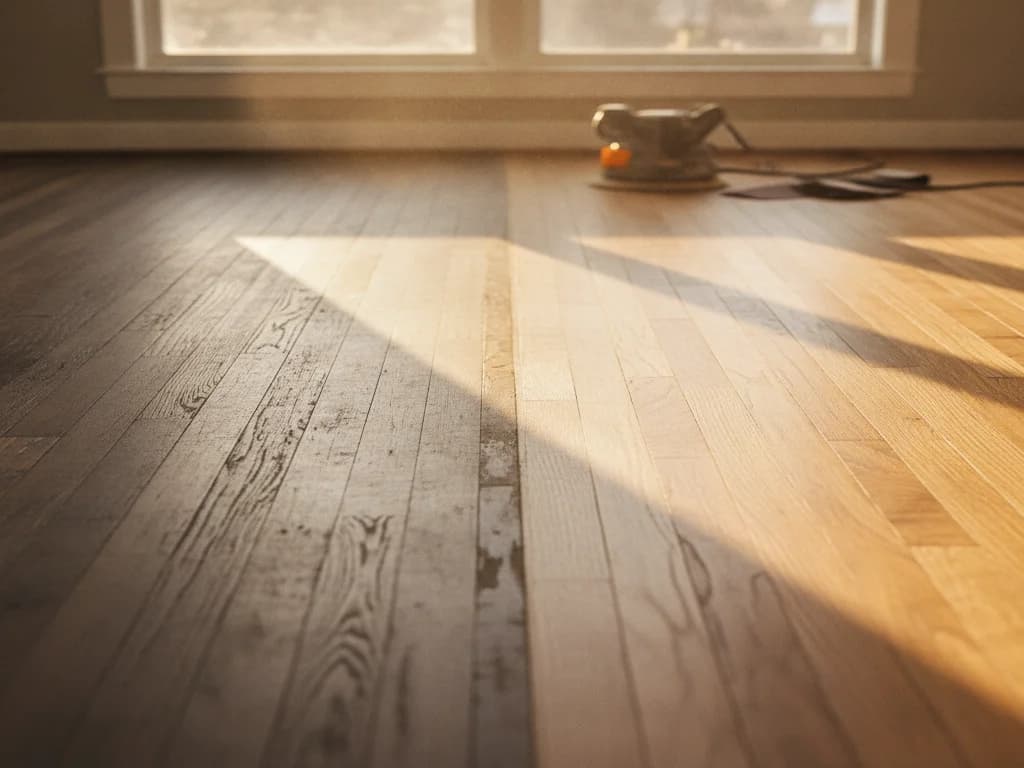
Crowning is the inverse of cupping: the center of each board rides above its two edges. It has two paths. The less common one is top-side moisture — the top face swells relative to a drier underside. The far more common one in the field is a cupped floor that was sanded flat before it dried. When the swollen edges are sanded off and the boards later dry and those edges shrink back down, the un-sanded center is left standing proud.
That makes crowning largely a preventable, timing-driven problem: the durable fix is to control moisture and, critically, to never sand a cupped floor until it has returned to its equilibrium moisture content. Sanding wet wood buys a flat floor for a few months and a crowned one within the year.
How to Recognize Crowning
A convex profile across each board — the center is high and the long edges dip away, the mirror image of cupping. It often appears months after a floor that had cupped was refinished.
Root Causes
Why Crowning Happens
Premature sanding of a cupped floor
The classic cause: a cupped floor was sanded flat while the edges were still swollen with moisture. As the boards dried, the edges shrank back down and the center — which kept its full thickness — was left proud.
Top-side moisture
Less commonly, water reaching the top face (a spill left to sit, a wet-mopping habit) swells the surface relative to a drier underside, doming the board upward.
An unresolved moisture gradient
Any situation that leaves the top and bottom of the board at different moisture contents can crown it; the direction just depends on which face is wetter.
What You Can Check
- Take moisture-meter readings to check for a residual gradient between the top and underside of the boards and the subfloor.
- History is the tell: a crown that shows up months after refinishing a previously cupped floor is a premature-sanding crown.
- A crown with no sanding history points instead to a current top-side wetting event, which you locate the same way you would a leak.
Can It Be Saved? Repair vs. Replace
If the moisture has fully equilibrated and stabilized, a crowned floor can usually be re-sanded flat once — provided the boards still have enough wear-layer thickness left, which is a real limit on engineered floors and on solid floors that have already been sanded several times.
If the crown came from premature sanding, you must wait for full equilibration before the corrective sand, or the crown simply comes back.
Where the wear layer is too thin to sand again, board replacement or a new floor is the honest answer rather than a sand that cannot be done safely.
Prevention
How to Prevent Crowning
- The single most important rule: let a cupped floor dry to its equilibrium moisture content, verified with a meter, before sanding it flat.
- Control top-side moisture — no wet-mopping, wipe spills immediately, and fix leaks promptly.
- Hold the home at 30–50% relative humidity year-round so boards stay near a stable, uniform moisture content.
Good to Know
Frequently Asked Questions
Is crowning caused by sanding too soon?
Most of the time, yes. Sanding a floor that is still cupped removes the swollen board edges; when those edges later dry and drop, the center is left high. Industry guidance is explicit that sanding a cupped floor before it dries most likely produces a crowned floor within six months to a year.
Can a crowned floor be fixed?
Usually — by re-sanding it flat, but only after the wood has fully returned to its equilibrium moisture content and stayed stable. The constraint is wear layer: engineered floors and solids that have already been sanded a few times may not have enough thickness left for another pass, in which case replacement is the safer call.
How is crowning different from cupping?
They are opposites of the same moisture behavior. Cupping is edges-high (underside wetter than top); crowning is center-high (top wetter than bottom, or the aftermath of sanding a cupped floor). Both are moisture-driven dimensional movement, not board defects.
Related
Keep Reading
Related pages: Flooring Guides, Acclimating Hardwood in a Dry Mountain Climate, Flooring Problems, and When It Goes Wrong.
Think You Have Crowning?
We'll inspect your floor, find the moisture or structural source, and tell you honestly whether it's a repair or a replacement. Call (916) 749-0272 for an assessment.