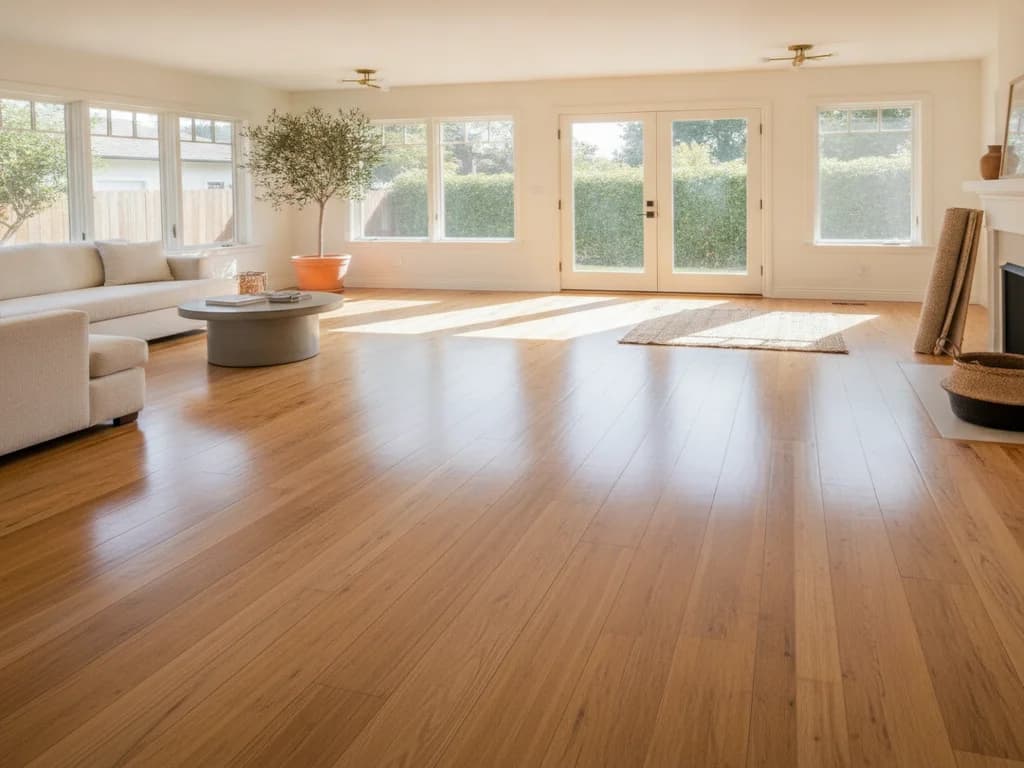
Comparison
Refinishing vs. Replacement
Should I refinish my hardwood floors or replace them?
Should I refinish my hardwood floors or replace them?
If the boards are sound and there is enough wood left above the tongue to sand, refinish. Refinishing is dramatically less disruptive and less expensive than replacement, and a tired floor with good bones comes back looking new. Replace when the wood itself is compromised — not when it merely looks bad.
The threshold is physical, not aesthetic. Surface problems are refinishing problems: scratches, dullness, worn traffic lanes, an outdated stain color, minor cupping that has flattened out. Sanding removes the top layer of wood, which removes all of them at once, and you can change the color while you are there. Structural problems are replacement problems: widespread water damage, boards that have delaminated or split, subfloor failure, pet urine that has penetrated deep into the wood, or an engineered floor whose veneer has already been sanded to its limit.
There is also a threshold you cannot see. Every solid floor has a finite amount of wood above the tongue, and once it is used up the floor cannot be sanded again — the fasteners are exposed and the boards lose integrity. An old floor that has been refinished several times may be at that limit, and a professional can determine it from a board edge, a vent cutout, or a threshold. That measurement, more than anything on the surface, is what determines whether refinishing is still available to you.
Decision Framework
When Each One Wins
Conditions, not preferences. If one of these describes your project, it should carry more weight than anything else on this page.
Choose Refinishing when…
- Scratches, dullness, and worn traffic paths on structurally sound boards.
- You want a different stain color on a floor you otherwise like.
- Solid hardwood with adequate thickness above the tongue.
- Isolated damage that can be repaired with board replacement, then sanded as one floor.
- You want the least disruptive, least expensive path back to a floor you are happy with.
- The floor is original to a period house and worth preserving.
Choose Replacement when…
- Widespread water damage, or cupping that has not resolved after the moisture source was fixed.
- Pet urine that has penetrated the wood — staining and odor sanding will not reach.
- A solid floor already sanded to its limit, with no thickness left above the tongue.
- An engineered floor whose veneer is spent.
- Subfloor failure, movement, or squeaking that must be corrected from above.
- You want a different species, width, direction, or pattern — none of which sanding can deliver.
- The floor is a patchwork of mismatched repairs that will not blend.
Side by Side
The Properties That Actually Differ
Where a figure is set by an individual product's instructions rather than by the material itself, the property is described as a relationship. An invented number would be worse than no number.
| Property | Refinishing | Replacement |
|---|---|---|
| What it fixes | Everything at the surface — scratches, wear, dullness, color. | Everything, including the boards and access to the subfloor. |
| What it cannot fix | Deep water damage, urine penetration, structural failure, species or format. | Nothing — but you pay for the reach. |
| Changes color | Yes, to any color the species accepts. | Yes. |
| Changes width, species, or direction | No. | Yes. |
| Consumes floor life | Yes — each sanding uses thickness that cannot be replaced. | Resets it; the new floor starts with a full wear layer. |
| Subfloor access | None. Squeaks and unevenness underneath remain. | Full — the subfloor can be inspected, leveled, and repaired. |
| Disruption | Rooms unusable during sanding and coats; dust and odor. | Demolition, disposal, and a longer schedule. |
| Relative cost | The less expensive option, substantially. | The more expensive option — new material, demolition, and disposal. |
| Preserves original material | Yes — the historic floor stays. | No. |
It Depends
The Variables That Decide It
No comparison answers this for every house. These are the specific things about your project that move the answer, and they are worth establishing before you shop.
How much wood is left above the tongue
The single measurement that governs the decision, and it is not visible from standing height. It is assessed at a board edge, a floor vent, or a threshold. A floor that has already been refinished two or three times may have nothing left to give, and no amount of wanting to refinish changes that.
Whether the moisture source was fixed
Refinishing a floor that cupped from a leak, without fixing the leak, guarantees you will do it again. Cupped boards often flatten out once the moisture equalizes, so the correct sequence is: fix the source, let the floor stabilize, then reassess. Sanding a still-wet floor flat produces crowning when it dries.
Whether it is solid or engineered
This changes the answer completely. A solid floor almost always has refinishing available. A thin-veneer engineered floor may have only a screen-and-recoat available, and may already be past even that. Confirm which you have before planning either path.
Whether pets have had accidents
Urine penetrates into the wood and often through to the subfloor, and it takes odor with it. Sanding removes a surface layer, not saturation. Black staining that persists after sanding is the diagnostic, and it usually means those boards are replaced regardless of the rest of the floor.
What you actually want
If you want a different width, a different species, a different direction, or a pattern, refinishing cannot deliver it and the comparison is over. Sanding renews a floor; it does not change what the floor is.
On this site: Floor Refinishing, Floor Repair, Cost Calculator, and Journal: refinishing guide.
Next decision: Screen-and-Recoat vs. Full Refinish, Engineered vs. Solid Hardwood, and Water-Based vs. Oil-Based Poly.
See all 17 flooring comparisons, or look up a term in the glossary.
Common Questions
Frequently Asked Questions
How many times can hardwood be refinished?
It depends on the thickness above the tongue and how aggressively each previous sanding was done — a light sanding removes far less than a heavy one. What matters is not a count but what is left, and that has to be measured on your floor rather than assumed from its age.
Can water-damaged floors be refinished?
Sometimes. Superficial staining can sand out, and boards that cupped often flatten once the moisture source is fixed and the wood equalizes. What cannot be refinished is wood that has swollen, split, or delaminated, or a floor sitting on a compromised subfloor. Fix the source and let it stabilize before deciding.
Is refinishing cheaper than replacing?
Substantially, in essentially every case where it is available — there is no new material, no demolition, and no disposal. That gap is the reason to establish whether refinishing is possible before pricing replacement. Our cost calculator has the real installed ranges for new floors in this market.
Can I refinish only one room?
Physically yes. Visually it is a problem where that room's floor is continuous with another one, because a freshly finished floor will not match an older one even under the identical stain — the old floor has aged and, if it was oil-finished, ambered. Where floors meet at a doorway with a transition, a single room works fine.
How do I know if my engineered floor can be refinished?
Look at the wear layer, which is visible at a board edge, a vent cutout, or a stair nose, and check the product specification if you have it. Thick-veneer engineered floors sand like solid, though fewer times. Thin-veneer ones may only take a screen-and-recoat, and sanding one aggressively cuts through into the core and ruins the board.
Related
Keep Reading
Related pages: Flooring for South Lake Tahoe & Meyers Homes, Choosing Flooring for a Tahoe Vacation Rental, Contact, and Flooring Comparisons.
Get a Straight Answer for Your House
Free estimates across Greater Sacramento & Northern California. We'll look at your subfloor and your rooms and tell you which of these actually fits — call (916) 749-0272.