Napa
Tile Flooring in Napa
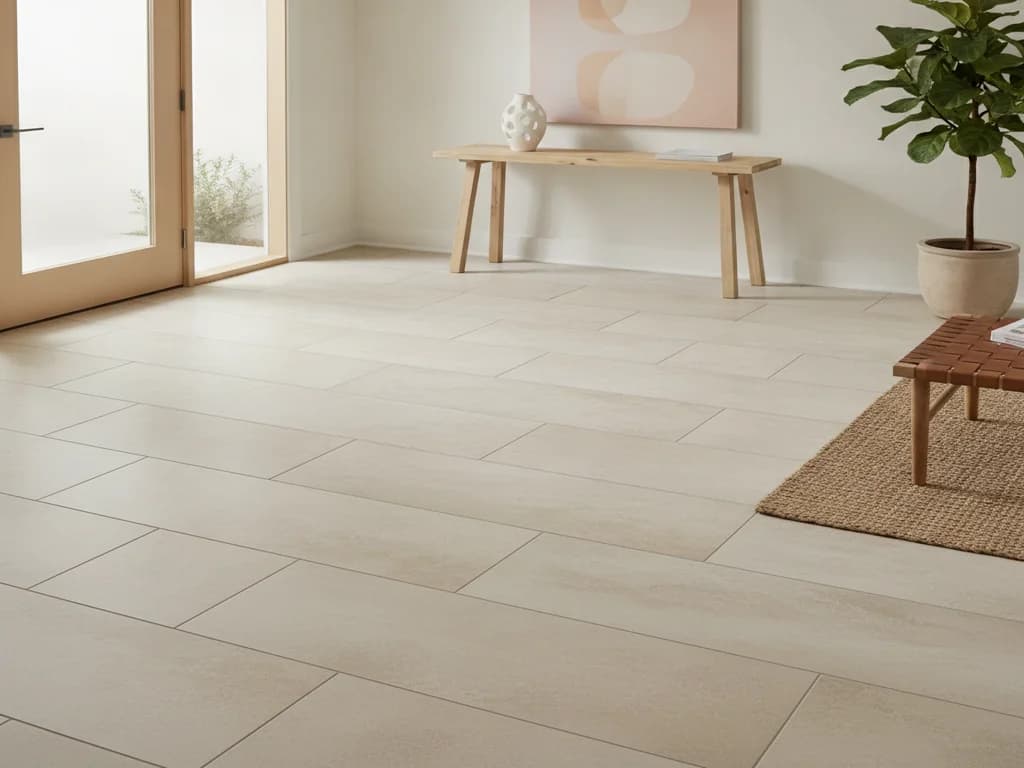
Porcelain and ceramic tile for entries, kitchens, and baths — set on a properly prepared substrate with laser-level layout and clean grout work.
Local Conditions
What Tile Flooring Has to Contend With in Napa
Napa Conditions That Affect Tile
Napa sits at about 20 feet in Napa County. Napa is Wine Country at the north end of San Pablo Bay, not a Sacramento Valley town, and its summers are markedly cooler: the in-city co-op station records a July average high near 83°F, roughly ten degrees below the valley. Marine air keeps summer mornings foggy and afternoons breezy, so indoor humidity here does not swing as hard or as dry as inland — but acclimating wood to the home's actual conditioned interior is still how that swing is handled. Tile itself is unbothered by Napa heat — near 83°F outside, an unheated tile floor is one of the few surfaces in the house that stays cool. What heat does affect is the installation: thinset open time shortens in hot, dry conditions, so summer work gets staged in smaller sections so every tile is set into mortar that is still live.
Winters are mild, wet, and Mediterranean with a marine influence — about 27 inches of annual precipitation, more than the valley, falling November through March, frequent fog, and no snow. The wetter, more maritime winter keeps ambient humidity higher for longer, a real factor for wood-floor acclimation and moisture control. Cold slows cure times at the other end of the year, and grout and mortar both need to be held above their minimum cure temperature to reach full strength. On a winter job that means heat in the space, not just a tarp over the door.
Napa has a genuine maritime influence: cool marine air is drawn through the Golden Gate and across San Pablo Bay, then funneled north through the Carneros wind gap into the south end of the valley, producing morning fog that can persist to late morning and afternoon cooling winds. It is why the south valley runs cool and humid while up-valley towns bake — a real climate difference from the inland packs. Local weather in Napa mostly shows up in tile work as cure time: cool, damp stretches run longer than a spec sheet's stated minimum.
Substrate Preparation
Napa carries a dual foundation story the inland towns do not. First, soil: the residential valley floor sits mostly on Cole silt loam, whose clay content climbs from about 25% near the surface past 40% at depth with linear extensibility reaching 7.2 — high shrink-swell that moves seasonally and stresses slabs and floor flatness, grading to poorly drained Egbert silty clay loam along the river. Second, seismicity: the 2014 M6.0 South Napa earthquake, the largest Bay Area quake since Loma Prieta, did the worst damage exactly where soft basin sediments amplified the shaking, and months of fault afterslip kept moving foundations. Combine expansive clay with soft-soil seismic settlement and subfloor flatness becomes a leading concern here — over the pre-1940 and mid-century stock's mix of raised perimeter and slab foundations (the NAHB new-build figure of 89.9% slab describes new homes only). Slab moisture testing, subfloor flatness checks, and movement-tolerant installs are the local best practice, and foundation and leveling conditions are confirmed on site.
Over a wood-framed floor, tile is a deflection question before it is a tile question. A floor system that flexes more than the assembly allows will crack grout first and tile second, regardless of how well it was set. We check joist span and subfloor thickness, add a second layer or a proper uncoupling membrane where the structure calls for it, and tell you if the answer is that the floor needs stiffening.
Source: NAHB analysis of the Census Bureau Survey of Construction, foundation type by region (2024)
Napa Homes We Work In
A pre-war historic core layered with heavy mid-century-to-1970s growth. ACS 2020–2024 5-year estimates place 8.8% of Napa's 32,141 housing units in pre-1940 construction — the Victorian and Craftsman fabric of the Napa Abajo–Fuller Park National Register district, 604 buildings across some thirty blocks — with a mid-century band of about 26% (1950s–60s), a 1970s peak near 20%, and the median year built in the 1970s. Over 60% of the stock predates 1980. In Napa's 1950s and 1970s homes, the framing was often designed to the code of its day rather than to today's large-format tile, so the deflection check matters more, not less. It is the reason we survey the floor structure in older homes before quoting tile.
Before We Quote
Planning Around Napa
A few Napa conditions shape how we approach a tile floor:
- Napa's maritime climate keeps ambient humidity higher and steadier than the inland valley, so wood acclimation targets a different equilibrium here — closer to a coastal home's than a hot-dry valley one's.
- The Cole silt loam under most Napa neighborhoods carries high shrink-swell that moves slabs seasonally — the soil survey rates it very limited for dwellings — so slab moisture testing and movement-tolerant assemblies matter more here than over stable ground.
- Seismic settlement is a real local factor — the 2014 M6.0 South Napa quake damaged foundations most where soft soils amplified shaking — so checking subfloor and slab flatness before a rigid floor is prudent in Napa in a way it is not inland.
- The Napa Abajo–Fuller Park historic district and the broader 8.8% pre-1940 core make refinishing and matching original wood floors a genuine part of the local market, over raised foundations that reward a crawlspace-moisture check.
Permits & Jurisdiction
Who Has Jurisdiction in Napa
Building permits and inspections for Napa properties go through City of Napa Community Development Department, Building Division. Napa is the incorporated Napa County seat and its own permit authority; the up-valley towns (Yountville, St. Helena, Calistoga) and neighboring American Canyon permit separately.
Requirements change. Confirm current rules with the issuing agency before work begins.
We install tile flooring throughout Napa, including Downtown Napa, Old Town, Napa Abajo–Fuller Park, Alta Heights, Browns Valley, Bel Aire.
Sources
Where These Napa Details Come From
The local conditions above are drawn from these public sources.
- Napa State Hospital NOAA co-op station USC00046074 (NCEI 1991–2020 normals): July average high 83.3°F — about 11°F below Sacramento — annual precipitation 26.66 in, and September the warmest month at 84.4°F, the marine fingerprint of the San Pablo Bay influence
- Napa, CA housing profile — US Census ACS 2020–2024 5-year, Table B25034 Year Structure Built, place FIPS 0650258 (32,141 units; 8.8% pre-1940, median 1970s, 60%+ pre-1980) via Census Reporter
- Which Foundation Type Is Most Common in Your Region? — NAHB tabulation of US Census Bureau Survey of Construction, Aug 2025 (Pacific division 89.9% slab in 2024)
- M6.0 South Napa Earthquake, August 24, 2014 — USGS: damage concentrated in pre-1950 masonry and older wood-frame houses, with cracked chimneys and failure of cripple walls — 'short walls in the crawl space between the foundation and the floor' — a few homes shifted off their foundations, 100+ red-tagged; soft basin sediments amplified the shaking and afterslip continued for days
- USDA-NRCS SSURGO (survey CA055), 17-point sampling across the city — Cole silt loam under most residential neighborhoods (clay 25→42%, LEP to 7.2, somewhat poorly drained, 'very limited' for dwellings); Egbert silty clay loam along the river; well-drained Coombs gravelly loam on the north and west fans; Millsholm and Hambright–Rock outcrop in the hills
- City of Napa — Community Development Department, Building Division
- Napa, California — elevation 20 ft, Napa County seat, Wine Country (Wikipedia, citing USGS GNIS)
More in This Area
Other Flooring Services in Napa
Good to Know
Frequently Asked Questions
Do you install tile flooring in Napa?
Yes. Renaissance Floors installs tile flooring throughout Napa and the surrounding Napa County area. Call (916) 749-0272 for a free estimate.
Does a tiled bathroom need waterproofing behind the tile?
In a shower or on a tub deck, yes. Tile and grout are not waterproofing on their own — a real membrane system goes behind them. It is worth asking any contractor which membrane they are using and why.
Is grout maintenance-free?
No. Cementitious grout should be sealed and will need periodic resealing, especially in kitchens and bathrooms. Subfloor flatness and deflection also matter more with tile than almost anything else — an uneven or bouncy floor cracks tile, and correcting it is not optional work.
How do I get an estimate in Napa?
Call (916) 749-0272 or request a free estimate online. We'll schedule a convenient in-home visit in Napa, measure your space, and give you an honest written quote.
Related
Keep Reading
Related pages: Engineered Hardwood in South Lake Tahoe, Hardwood Flooring in South Lake Tahoe, Tile Flooring, and Napa.

Ready for Floors You'll Love?
Free estimates on tile flooring throughout Napa and Napa County.