Service Area
Flooring in Petaluma
Renaissance Floors installs and refinishes hardwood, luxury vinyl, tile, and more for homeowners throughout Petaluma and the surrounding Sonoma County area.
CSLB #1060673
Licensed & Insured
Est. 2019
Family-Owned
15+ Years
Hands-On Experience
5.0★ Rated
22 Reviews on Thumbtack
Local, Licensed, Accountable
Flooring Contractor Serving Petaluma
Petaluma is part of Sonoma County, and it's one of the communities Renaissance Floors regularly works in. We're based in Roseville, CA and serve homeowners across Greater Sacramento & Northern California— from small refinishing jobs to full home installs. Every project starts with an honest look at your subfloor and your goals, followed by a clear, no-pressure estimate. There's no dispatched sales team and no guesswork: you work directly with the crew doing the installation, backed by our CSLB C-15 license and a workmanship warranty on every job.
Wine Country homes lean into indoor-outdoor living, where warm wide-plank oak and durable luxury vinyl both shine. We help you choose flooring that looks at home in everything from a Sonoma ranch to a Napa estate.
Downtown Petaluma runs up to the Petaluma River, and its commercial core is on the National Register of Historic Places. The Petaluma Historic Commercial District, along Petaluma Boulevard between B and Prospect streets and listed March 31, 1995, is 'especially notable for its collection of Italianate iron-front commercial buildings,' in its nomination's words, and the California Secretary of State's roster lists Petaluma as a chartered city. The housing did not come from a single boom. Census Bureau estimates for 2020–2024 count about 25,000 housing units with a median year built of 1979, give or take a year, and the 1960s, 1970s, 1980s and 1990s each hold between about 14 and 17 percent of them; the 1970s' slight lead sits inside the margins of error. About half of all units predate 1980 and about 18 percent were built in 2000 or later, while roughly 2,700, about 11 percent, date from 1939 or earlier. About 70 percent of units are detached houses, and about 65 percent of occupied homes are owner-occupied. None of those counts says whether a given home sits on a slab or over a crawl space.
Petaluma's historic protections are local as well as national. The City has adopted guidelines for three overlay districts: the Historic Commercial District downtown, whose guidelines the City Council adopted on August 16, 1999; the 'A' Street Historic District, zoned H-1, with guidelines from 1986; and the Oakhill-Brewster Historic District, zoned H-2, with guidelines from 1990 that describe homes 'representing most major residential styles from the 1850's through the 1980's.' The review they describe is aimed at the outside of buildings: the two residential districts' guidelines review construction unless it is 'of a type which does not affect the exterior appearance' or is excepted by the designating ordinance, and the City's building FAQ says district homes face special requirements 'especially for exterior changes (including paint and windows).' The zoning ordinance, however, requires review of work 'for which a City permit is required' in a designated district, and no City text we found exempts interior work outright. Interior projects in a district are worth confirming with the Planning Division.
Permits come from the City of Petaluma Building Division, which says it issues all building permits and investigates complaints about unpermitted construction. The City's list of projects that do not require a permit, in a copy archived in March 2025, is short: very minor sheetrock repair, detached storage buildings under 120 square feet with no utilities, plumbing fixtures where plumbing is not changed, plug cord connected spas and hot tubs, and replacement receptacles, lights and switches. Flooring does not appear on it, and the page does not address floors either way, so nothing here treats a floor covering as exempt. The same page warns that other departments 'may require approval and/or permits for work not mandated to have a permit by the Building Division.' One City answer bears directly on old floors: 'Yes, dry rot repair does require a permit.' Which edition of the California codes Petaluma has adopted, and whether it amended them, could not be verified, because the City's code host blocked retrieval.
Water and soil maps shape the ground floor. At points sampled along the Petaluma River inside the city, FEMA's flood map shows Zone AE, most of them in the floodway, and sampled points along Lynch, Capri and Adobe creeks are mostly Zone AE, though a point a block away can be minimal-hazard Zone X. The City's flooding brochure says 'Petaluma has experienced five major floods since 1982' and tells owners to 'Call the permit office 707-778-4301 before you fill or build.' USDA soil data map Clear Lake clay at seven of ten test points inside the city, a poorly drained soil its series description places 'in flood basins, flood plains and in swales of drainageways,' while the downtown point is well-drained Yolo clay loam. On the seismic side, no Alquist-Priolo Earthquake Fault Zone lies within city limits, and the California Geological Survey has not evaluated any of the four quadrangles covering Petaluma for liquefaction, so the absence of a mapped zone is not a finding of low hazard.
The warmest afternoons come late in the summer. NOAA's Petaluma Airport normals station, inside city limits, averages 81.6°F in September for 1991–2020, a little above August's 81.2°F and July's 80.8°F, and July's average high is the lowest of the four Sonoma County normals stations this site uses. February is the wettest month, with 5.23 of the year's 25.56 inches, December has the lowest average low, 38.4°F, and no month records snowfall. Hourly observations at Petaluma Municipal Airport from 2015 through 2025, recalculated for outdoor air warmed to 70°F with no moisture added, give a November-to-April median near 40 percent relative humidity and a June-to-September median near 56 percent. The National Wood Flooring Association says indoor relative humidity should be maintained between 30 and 50 percent year-round.
Renaissance Floors is a licensed California C-15 flooring contractor (CSLB #1060673) based in Roseville. For a Petaluma home, the records come before the material: whether the address is in a historic district, where the lot falls on FEMA's map, and whether lifting the old floor exposes dry rot that needs its own permit. Free in-home estimates and a workmanship warranty.
Local Coverage
Neighborhoods We Serve in Petaluma
From East Petaluma to Oakhill-Brewster, Renaissance Floors installs and refinishes floors across Petaluma.
Recent Work
A Sample of Our Craftsmanship
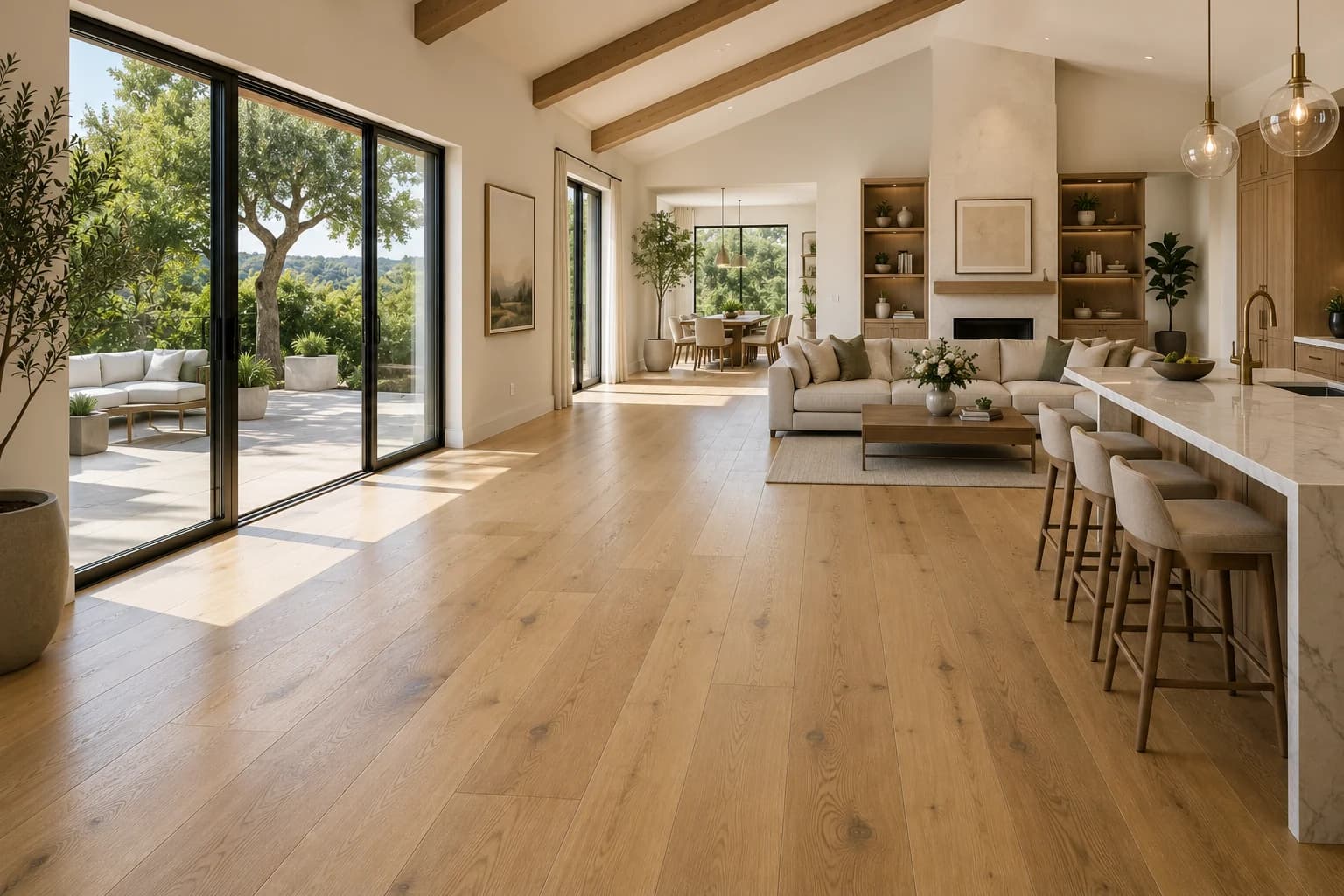
White Oak Hardwood
Great Room & Landing
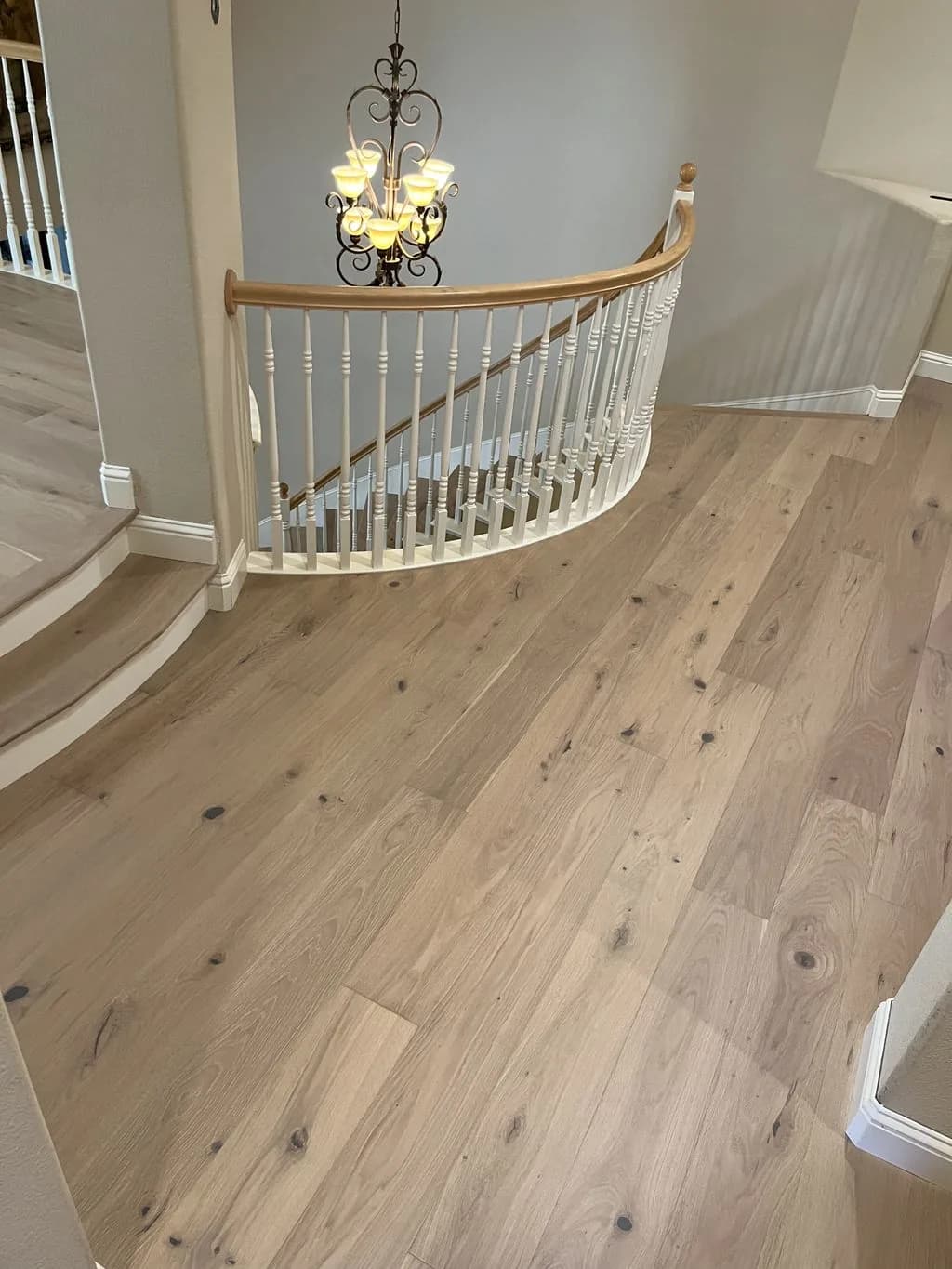
White Oak Hardwood
Staircase & Landing
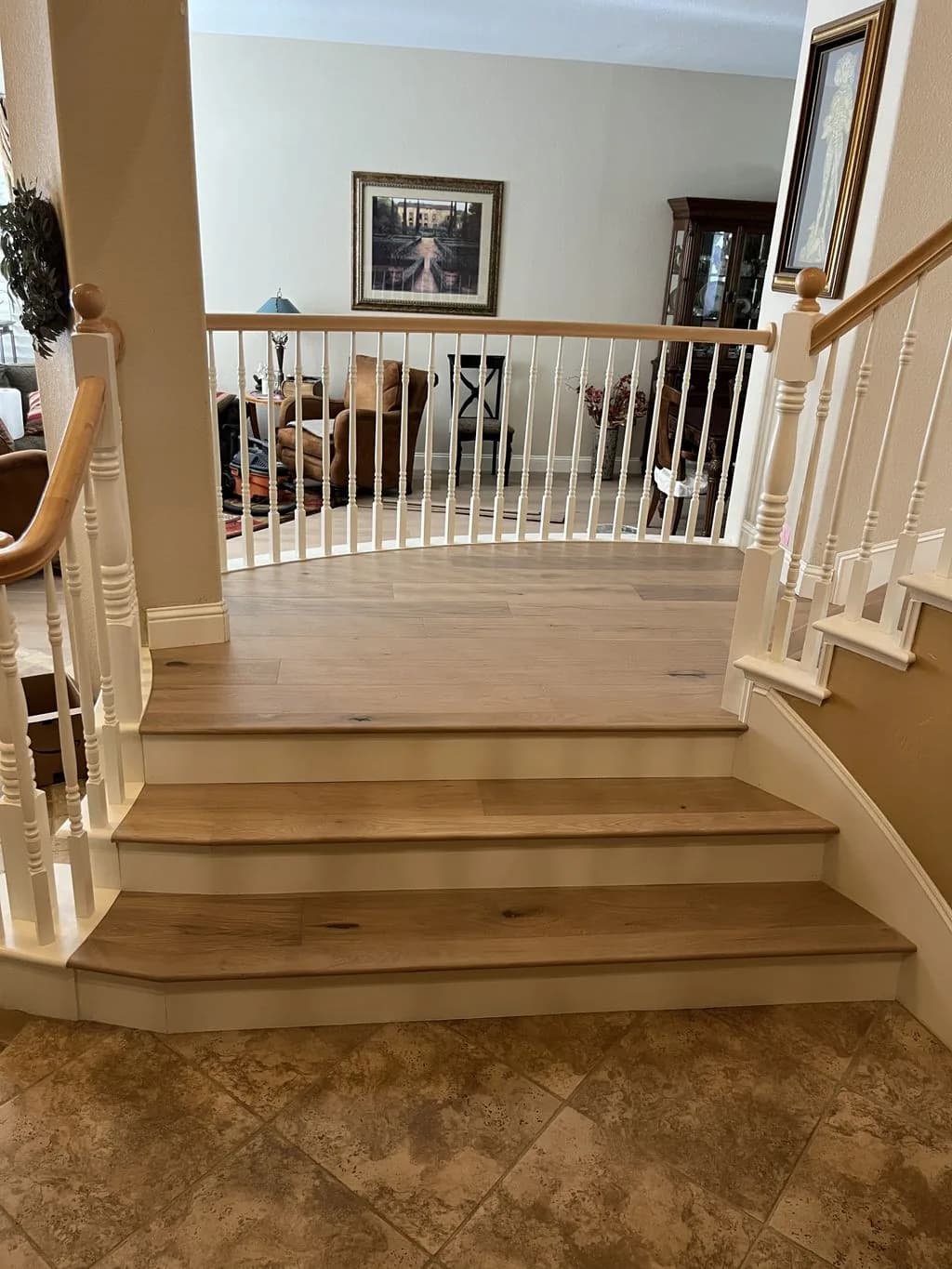
White Oak Hardwood
Curved Staircase
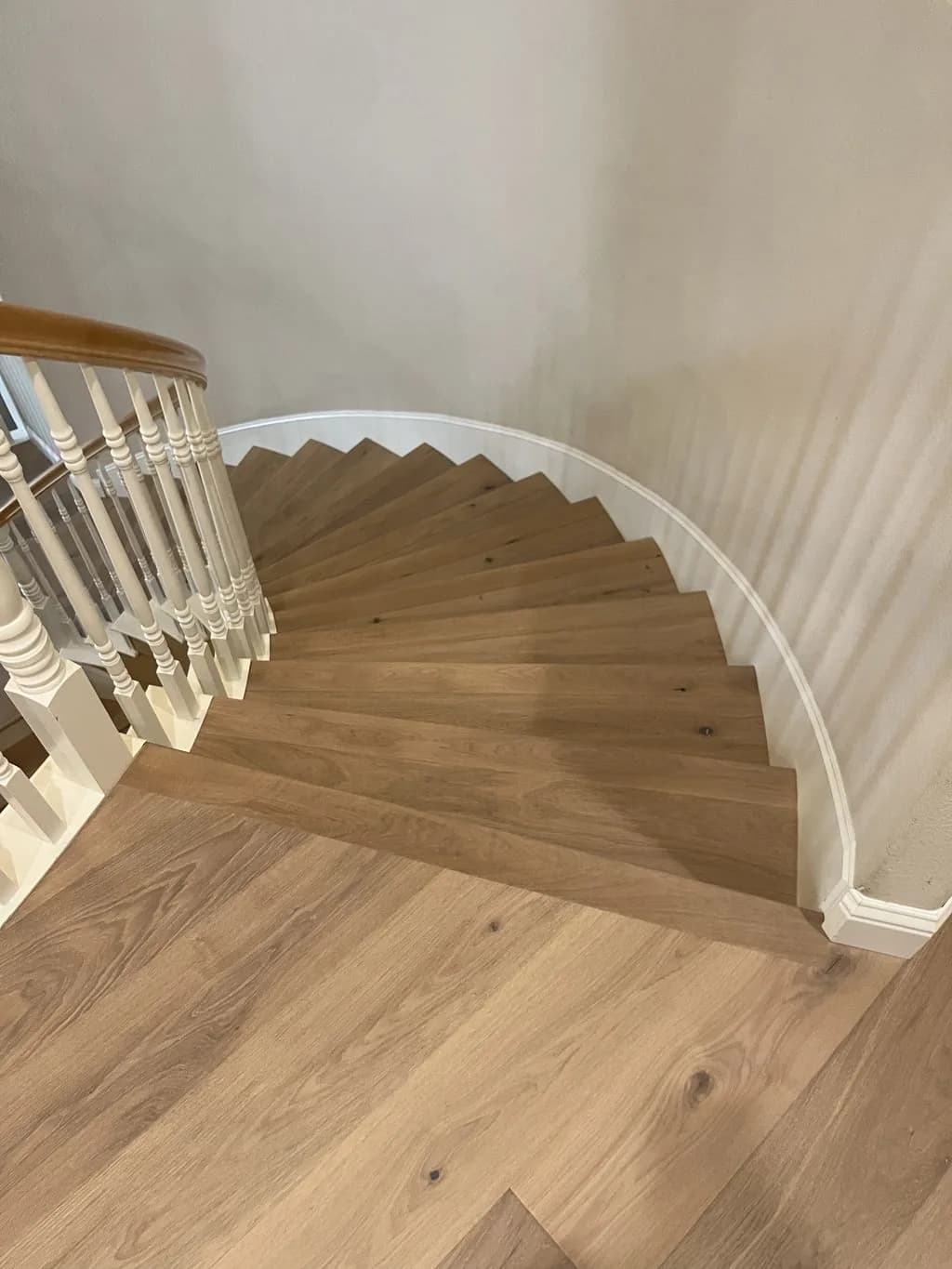
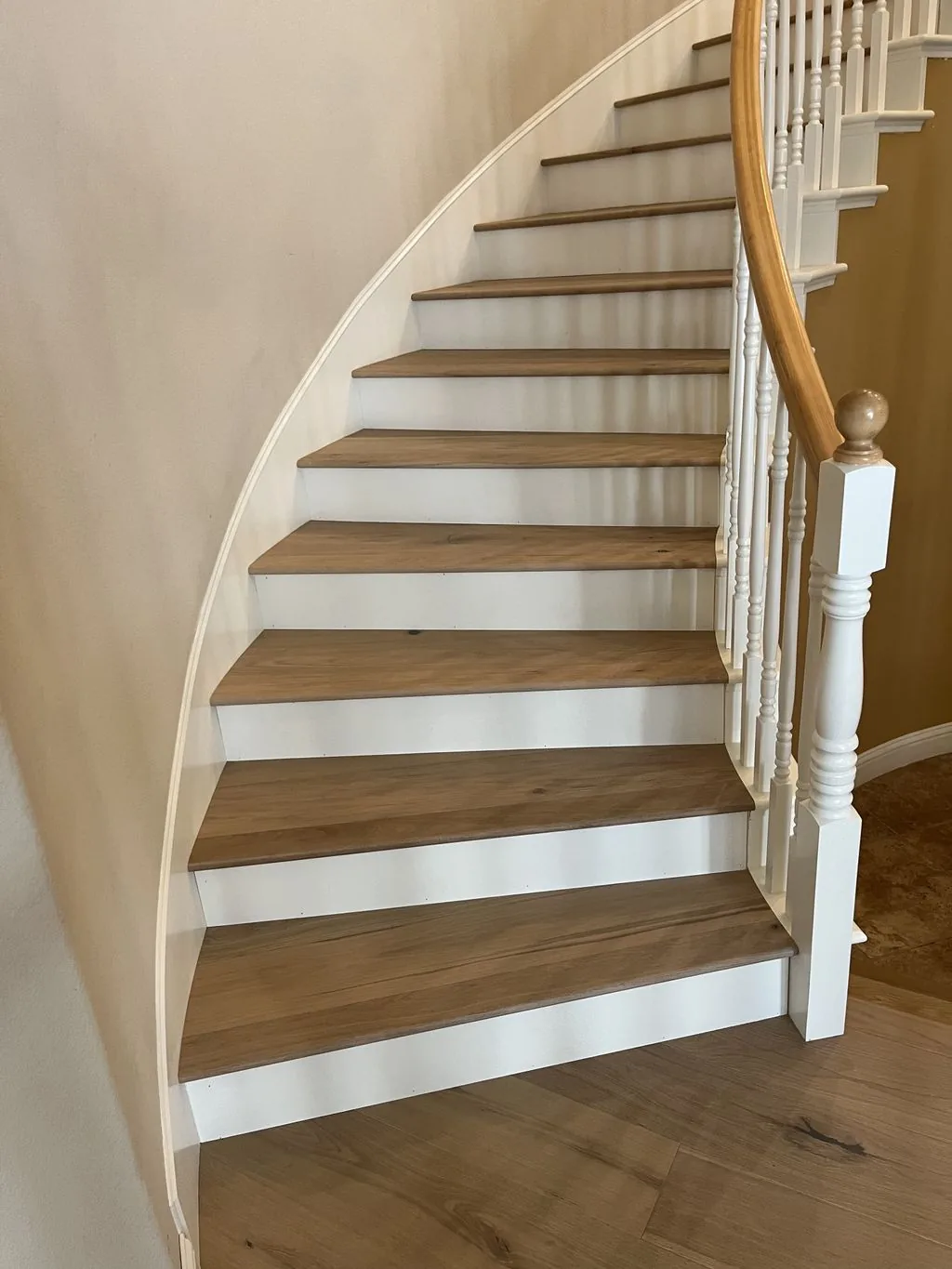
White Oak Hardwood
Stair Treads
Our Services
Flooring Services in Petaluma
From hardwood to luxury vinyl, here's how we help Petaluma homeowners upgrade their floors.
Hardwood Flooring
Solid oak, maple, and walkable heirloom-grade hardwood, precisely installed.
Hardwood Flooring in PetalumaEngineered Hardwood
Real-wood wear layers built for California's climate swings.
Engineered Hardwood in PetalumaLuxury Vinyl Plank
Waterproof, wood-look LVP for kitchens, baths, and busy households.
Luxury Vinyl Plank in PetalumaLaminate Flooring
Durable, high-style laminate at a friendly price point.
Laminate Flooring in PetalumaTile Flooring
Porcelain and ceramic tile set dead-level with crisp grout lines.
Tile Flooring in PetalumaFloor Installation
Full-service installation from subfloor prep to final baseboard.
Floor Installation in PetalumaFloor Refinishing
Sand, stain, and reseal tired hardwood back to new.
Floor Refinishing in PetalumaFloor Repair
Board swaps, water damage, squeaks, and seamless patch-ins.
Floor Repair in PetalumaLocal Considerations
What Petaluma Homes Need From a Floor
Climate, home age, and foundation type all shape the right flooring choice in Petaluma — here's what we account for.
The City's no-permit list doesn't mention floors, and dry rot repair needs a permit
The City of Petaluma's Building Permit Requirements page, in a copy archived March 22, 2025, starts with a rule that applies either way: 'All work, regardless of whether or not a permit is required, shall comply with the State and Uniform Codes, City Municipal Codes and City Ordinances.' Its list of projects that do not require a permit names very minor sheetrock repair such as small hole repair; detached storage buildings under 120 square feet with no electrical, mechanical or plumbing work and no finish on interior walls; plumbing fixtures where plumbing is not changed; plug cord connected spas and hot tubs; and replacement receptacles, lights and switches. Carpet, tile, wood and vinyl are not mentioned, so this page cannot call any floor covering exempt, and a longer project type list the page links could not be retrieved. The City's residential permit page, archived in August 2025, counts dry rot repair among the common reasons for a permit and says that typically the contractor or specialist doing the work submits the application and payment. The City's building FAQ is direct: 'Yes, dry rot repair does require a permit.' It adds that kitchen and bathroom remodels 'trigger a wide variety of permits, depending on the work that is done.' The state set January 1, 2026 as the effective date of its 2025 building standards code, but which edition Petaluma has adopted, and whether it changed the state's exemptions, could not be read, because the municipal code's hosts blocked retrieval and no archived copy was found. Scope questions, especially rotted subfloor or joists found under an old floor, go to the Building Division before work starts.
Historic review is framed around exteriors, with no written interior exemption
Section 15.040 of Petaluma's Implementing Zoning Ordinance, in a copy archived in September 2024 and current through Ordinance 2890 N.C.S., passed June 17, 2024, says: 'Construction, alteration, demolition, repair, maintenance, or removal work for which a City permit is required is prohibited on a designated landmark site or in a designated historic district unless reviewed by the Historic and Cultural Preservation Commission and/or approved by the Planning Commission.' The same section provides 'review of proposed changes in major interior architectural features' only 'For a publicly owned landmark,' and only if the designating ordinance imposes it. The district guidelines look outward. The Oakhill-Brewster and 'A' Street guidelines both say no one shall do 'construction of any type within a historic district' without review unless it is excepted by the designating ordinance or is 'of a type which does not affect the exterior appearance' of the district or its structures, and the Oakhill-Brewster text adds, 'Emphasis of historic review is on portion visible to the public.' The City's building FAQ says historic-district buildings have special requirements 'especially for exterior changes (including paint and windows).' Read together, these texts center on what can be seen from outside, yet none says interior floors need no review, and section 15.040 attaches review to permit-requiring work without separating interior from exterior. Downtown, the commercial guidelines include 'replacing or removing threshold features such as marble, tile, and stairs' among the changes they cover. For interior work in a district, confirm with the Planning Division first.
An iron-front downtown, three City districts and a house from before 1856
The National Register's Petaluma Historic Commercial District, listed March 31, 1995 with state-level significance, runs along Petaluma Boulevard between B and Prospect streets on 17.4 acres. Its nomination, posted by the City, says the district 'gives a strong sense of the city's downtown at the end of World War II' and is 'especially notable for its collection of Italianate iron-front commercial buildings'; of its 99 elements, 64 contribute to its historic character and 35 do not, and there are 14 empty parcels. The area under the City's downtown guidelines is a different outline. Those guidelines, adopted by the City Council on August 16, 1999, cover approximately 31 acres, generally bounded by Prospect Street to the north, 'D' Street to the south, the Petaluma River to the east and Kentucky and Fourth streets to the west. Two residential overlays have their own guidelines: the 'A' Street Historic District, zoned H-1, with guidelines from 1986, and the Oakhill-Brewster Historic District, zoned H-2, with guidelines from 1990. The Oakhill-Brewster guidelines say that 'By far most of the dwellings are single-family homes' and that the earliest documented structure is the Goshen house at 619 Prospect Street, 'built prior to 1856.' Individually listed National Register properties at addresses inside the city include the Petaluma Silk Mill at 420 Jefferson Street, the Free Public Library of Petaluma at 20 Fourth Street, the Philip Sweed House at 301 Keokuk Street, the Ellis-Martin House at 1197 East Washington Street and the Petaluma Woman's Club at 518 B Street, listed June 11, 2024. The Petaluma Adobe, a National Historic Landmark, is a separate matter: the National Park Service places it 4 miles east of Petaluma on Casa Grande Road.
A 1979 median, four even decades and an older layer beneath
Petaluma's median year built is 1979, plus or minus one year, across about 25,000 housing units in the Census Bureau's 2020–2024 five-year estimates. Four decades hold most of them in close to equal measure: about 17 percent from the 1970s, about 15 percent each from the 1990s and 1980s, and about 14 percent from the 1960s. The 1970s estimate is the largest, but the gap to the 1990s is smaller than the margins of error, so no decade clearly leads. Earlier, the 1950s account for about 7 percent, and roughly 2,700 units, about 11 percent, were built in 1939 or earlier. About 18 percent date from 2000 or later. About 70 percent of units are detached single-family houses, about 8 percent are in buildings of 50 or more units, and roughly 800 are mobile homes. Of occupied homes, about 65 percent are owner-occupied and about 35 percent rented. The estimates carry no foundation data, so a home's age says nothing certain about whether its floor sits on a slab or on framing, and that is confirmed at the house.
The river's floodway, and creek zones that change by the block
FEMA's National Flood Hazard Layer maps the Petaluma River through the city as Zone AE. Of four points sampled along the river inside city limits, three fall in the floodway and the fourth in Zone AE outside it; the panel in effect at one river point is FIRM 06097C0982G, effective October 2, 2015. The creeks are less uniform. On Lynch Creek one sampled point is Zone AE with the floodway contained in the channel, a second is AE and a third is minimal-hazard Zone X; Capri Creek gave two AE points and one X; both in-city points on Adobe Creek are AE. Points at the Census Bureau's reference point for the city, the downtown SMART station, Washington Street at Petaluma Boulevard, 400 North McDowell Boulevard and the municipal airport are all Zone X. Washington Creek was not tested. The City's Flooding Information brochure says 'The Petaluma River and our creeks flowing to the River can flood during large storm events,' that 'Petaluma has experienced five major floods since 1982,' and that 'Most of our Floodplain has experienced some level of flooding during significant storms'; it names no years. The City's flood management page lists the Payran Reach project, which included widening the river and constructing flood walls, Denman Reach, 'Designed to decrease flooding along Industrial Avenue,' and Capri Creek, aimed at out-of-bank flooding east of North McDowell Boulevard to Maria Drive, and says the City is updating its floodplain maps. Because zones shift within a block, the FIRM for the address, not the street name, settles whether a ground floor sits in a mapped flood zone, and a slab near a creek gets a moisture test before a moisture-sensitive floor is chosen.
Clear Lake clay at most test points, and seismic zones never drawn
USDA soil survey data queried at ten points inside the city map Clear Lake clay at seven, including the Census Bureau's reference point, the municipal airport, 400 North McDowell Boulevard, the Ely Boulevard area and points on the Petaluma River and Adobe Creek. The series description calls Clear Lake 'very deep, poorly drained soils' found 'in flood basins, flood plains and in swales of drainageways,' with 'slow to very slow permeability'; at these points its linear extensibility, the survey's measure of shrink and swell, reaches 10.4 percent in a layer roughly two to three feet down. Downtown at Washington Street and Petaluma Boulevard and at a southeast point near the Lakeville corridor, the test points are well-drained Yolo clay loam, at 3.9 percent, and a west-side point near Oakhill Park is well-drained Arbuckle gravelly loam at 4.5. These are single points, not a map of any neighborhood. The state's seismic hazard maps have gaps here. Intersected with the Census Bureau's city boundary, the California Geological Survey's Alquist-Priolo, liquefaction and landslide zone layers return nothing, and its layer of unevaluated areas covers all four quadrangles that span Petaluma: Petaluma, Cotati, Glen Ellen and Petaluma River. No fault zone lies within city limits, but the lack of liquefaction or landslide zones reflects areas the survey has not yet assessed, not a rating of low hazard. CAL FIRE's current fire hazard map, checked on a grid of test points, shows no High or Very High zone inside the city and a small Moderate area on the south side, and those rules govern exterior construction. On poorly drained clay, slab moisture and flatness are measured before tile, stone or wood is laid.
A September peak, winter rain and heated air near 40 percent
NOAA's Petaluma Airport normals station, which the Census geocoder places inside city limits about 1.6 miles from the city's reference point, gives average highs of 80.8°F in July, 81.2°F in August and 81.6°F in September for 1991–2020, over a July average low of 52.4°F. Among the four Sonoma County normals stations this site uses, its July average high is the lowest, below Santa Rosa at 81.6°F, Sonoma at 86.0°F and Healdsburg at 88.7°F; that comparison covers those stations only. December has the lowest average low, 38.4°F, just under January's 39.0°F. February is the wettest month at 5.23 inches, with December close at 5.19, and about 83 percent of the 25.56-inch annual total falls from November through March, against less than half an inch from June through September. No snowfall is recorded in any month. Indoors, the useful figures come from air that has been heated or cooled. Hourly observations at Petaluma Municipal Airport for 2015 through 2025, recalculated for air warmed to 70°F with its moisture unchanged, put the November-to-April median near 40 percent relative humidity, with about one heating-season hour in six below 30 percent, and the June-to-September median near 56 percent, a ceiling for an air-conditioned house. The National Wood Flooring Association says indoor relative humidity 'should be maintained between 30-50% and a temperature between 60-80°F year-round.' Site-applied finishes fall under the Bay Area Air Quality Management District, which the County of Sonoma says extends through southern Sonoma County, including Petaluma.
Local Resources & References
Helpful Petaluma Resources
Authoritative local and industry references for permits, planning, and flooring standards.
- California Roster 2026, Incorporated Cities and Town Officials — City of Petaluma, County of Sonoma, a chartered cityCalifornia Secretary of State
- Building Permit Requirements (Wayback Machine capture, March 22, 2025) — 'Projects that DO NOT require a permit'; flooring is not listed; the live City site refuses automated requestsCity of Petaluma
- Building FAQs (Wayback Machine capture, August 3, 2024) — 'dry rot repair does require a permit'; historic districts 'especially for exterior changes'City of Petaluma
- Implementing Zoning Ordinance 15.040, historic landmarks and districts (Wayback Machine capture, September 7, 2024) — review of permit-requiring work; interior review only for publicly owned landmarksCity of Petaluma
- National Register of Historic Places nomination, Petaluma Historic Commercial District — Italianate iron-front commercial buildings, 99 elementsCity of Petaluma
- Oakhill-Brewster Historic District Preservation Guidelines (scanned) — review of work affecting 'the exterior appearance'City of Petaluma
- Flooding Information brochure — 'five major floods since 1982'; call the permit office before you fill or buildCity of Petaluma
- 1991–2020 monthly normals, Petaluma AP (USC00046826) — September warmest, February wettestNOAA NCEI
- ACS 2020–2024 5-year, Petaluma city (place 0656784) — table B25034, year structure builtUS Census
External links are provided for reference. Always confirm current requirements with the issuing agency.
Explore Flooring Services in Petaluma
Nearby
Nearby Cities We Serve in Wine Country
Good to Know
Frequently Asked Questions
Does Renaissance Floors serve Petaluma?
Yes. We install and refinish flooring throughout Petaluma and the surrounding Sonoma County area. Call (916) 749-0272 for a free estimate.
What flooring services do you offer in Petaluma?
We install hardwood, engineered wood, luxury vinyl plank, laminate, tile, and more in Petaluma, plus floor refinishing, repair, and full-service installation. See the full list below.
Are you licensed to work in Petaluma?
Yes. We hold CSLB C-15 license #1060673 (C-15 Flooring & Floor Covering) and carry insurance. We're based in Roseville, CA and serve Petaluma and all of Greater Sacramento & Northern California.
How do I get a free flooring estimate in Petaluma?
Call (916) 749-0272 or request an estimate online. We'll schedule a convenient in-home visit in Petaluma, measure your space, and give you an honest, no-pressure quote.
Do I need a City permit to replace floors in Petaluma?
The City's published list doesn't say. Petaluma's list of projects that do not require a permit covers very minor sheetrock repair, small detached storage buildings, plumbing fixtures where plumbing isn't changed, plug-in spas and hot tubs, and replacement receptacles, lights and switches; flooring isn't mentioned either way. The City's FAQ adds that 'dry rot repair does require a permit,' which matters if rot turns up under an old floor. Confirm your scope with the Building Division before work starts.
Does historic-district review cover interior floors in Oakhill-Brewster or the 'A' Street district?
No written exemption was found, so ask the Planning Division. The district guidelines focus review on work that affects exterior appearance, and the City's FAQ says special requirements apply 'especially for exterior changes.' But Petaluma's zoning ordinance requires review of work 'for which a City permit is required' in a designated district, without separating interior from exterior. Review of major interior architectural features is written specifically only for publicly owned landmarks.
How old are Petaluma homes?
Mostly from the 1960s through the 1990s, with an older layer. Census Bureau estimates for 2020–2024 put the median year built at 1979, give or take a year. Those four decades each hold about 14 to 17 percent of roughly 25,000 housing units, about half of all units predate 1980, and about 11 percent were built in 1939 or earlier. About 18 percent date from 2000 or later.
What historic districts does Petaluma have?
One on the National Register and three City overlay districts with adopted guidelines. The Petaluma Historic Commercial District, listed March 31, 1995, runs along Petaluma Boulevard between B and Prospect streets. The City's downtown guidelines cover about 31 acres, a larger area. The City also has the 'A' Street Historic District, zoned H-1, and the Oakhill-Brewster Historic District, zoned H-2, whose guidelines cover residential styles from the 1850s through the 1980s.
Is my Petaluma home in a flood zone?
Check the FEMA map for your address, because zones change within a block. Sampled points along the Petaluma River are Zone AE, mostly floodway, and many points on Lynch, Capri and Adobe creeks are AE, while other points nearby are minimal-hazard Zone X. The City says 'Petaluma has experienced five major floods since 1982' and asks owners to call the permit office at 707-778-4301 before they fill or build.
What kind of soil is under Petaluma homes?
It varies, and soil data here comes from single points. USDA survey data map Clear Lake clay, a poorly drained soil of flood basins and flood plains with a linear extensibility up to 10.4 percent, at seven of ten points tested inside the city. The downtown and Lakeville corridor points are well-drained Yolo clay loam, and a west-side point is Arbuckle gravelly loam. A slab's own moisture and flatness readings matter more than any map.
Is Petaluma in a liquefaction zone or an earthquake fault zone?
No state fault zone lies within city limits, and liquefaction hasn't been mapped. No Alquist-Priolo Earthquake Fault Zone intersects the city. The California Geological Survey lists the Petaluma, Cotati, Glen Ellen and Petaluma River quadrangles, the four covering the city, as unevaluated for liquefaction and landslide zones. That means the state hasn't drawn those zones for Petaluma; it does not mean the hazard is low.
When is Petaluma warmest, and how dry does heated air get?
September has the warmest average high, 81.6°F, at NOAA's in-city Petaluma Airport station for 1991–2020, just ahead of August and July. Rain comes mostly from November through March. At Petaluma Municipal Airport, outdoor air warmed to 70°F has a November-to-April median near 40 percent relative humidity, inside the 30 to 50 percent range the National Wood Flooring Association recommends, though about one hour in six falls below 30 percent.
Related
Keep Reading
Related pages: Laminate Flooring in Colfax, Tile Flooring in Colfax, Hardwood Flooring in Petaluma, and Engineered Hardwood in Petaluma.

Ready for Floors You'll Love?
Free, no-pressure flooring estimates throughout Petaluma and Sonoma County.