Sonoma
Tile Flooring in Sonoma
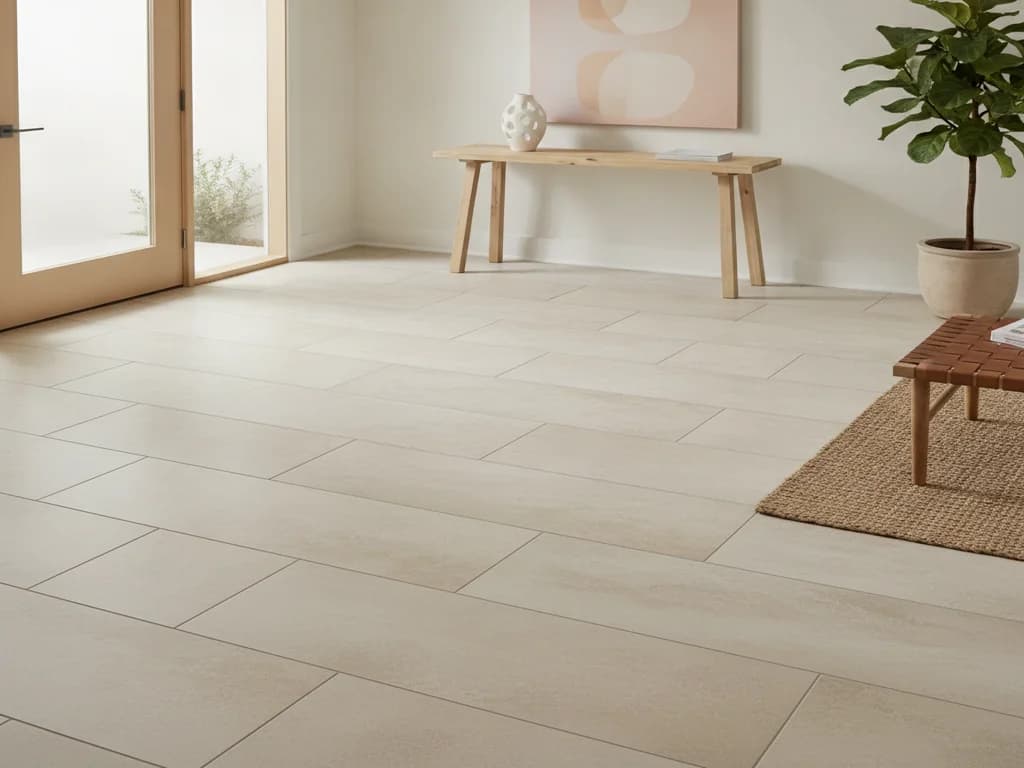
Porcelain and ceramic tile for entries, kitchens, and baths — set on a properly prepared substrate with laser-level layout and clean grout work.
Local Conditions
What Tile Flooring Has to Contend With in Sonoma
Sonoma Conditions That Affect Tile
Sonoma sits at about 78 feet in Sonoma County. Sonoma sits in the Sonoma Valley, which runs warmer and more inland than coastal Santa Rosa — its July and August highs are about 5°F above the coast. Summer mornings still draw some marine air and fog off the Petaluma Gap and stay cool and humid, but the afternoons are warm and dry, so Sonoma sits toward the drier, inland end of the region's humidity range: NCEI 1991–2020 hourly normals run about 60% afternoon at San Francisco to 28% at Sacramento, with the marine dew point near the low 50s°F. A wood floor here is acclimated to a warmer, drier-afternoon summer than coastal Santa Rosa, with humid mornings still feeding a real daily swing. Tile itself is unbothered by Sonoma heat — near 86°F outside, an unheated tile floor is one of the few surfaces in the house that stays cool. What heat does affect is the installation: thinset open time shortens in hot, dry conditions, so summer work gets staged in smaller sections so every tile is set into mortar that is still live.
NOAA 1991-2020 normals record a January average low of 38.4°F and no measurable snowfall in any month. Cold slows cure times at the other end of the year, and grout and mortar both need to be held above their minimum cure temperature to reach full strength. On a winter job that means heat in the space, not just a tarp over the door.
July and August average highs are nearly identical (86.0°F and 86.1°F), and both run about 5°F above Santa Rosa and Petaluma — an inland valley pattern rather than a marine-moderated one. Local weather in Sonoma mostly shows up in tile work as cure time: cool, damp stretches run longer than a spec sheet's stated minimum.
Substrate Preparation
The City's own residential plan notes require concrete foundations for stud-bearing walls supporting one floor to have a minimum 12-inch-wide footing, 6-inch minimum thickness, and 12-inch minimum depth below undisturbed soil, and address cripple walls under 14 inches in height and cleanouts for under-floor piping extended outside the building crawl space — so both crawl-space and slab-on-ground construction are contemplated in city practice. Separately, Sonoma ZIP code 95476 is eligible for California's Earthquake Brace + Bolt program, which the California Residential Mitigation Program states is 'only done on wood-framed, pre-1980 homes with a raised foundation' over a crawl space.
A slab is the friendliest substrate tile can have — provided its cracks are respected rather than tiled over. A crack that is still moving will come through the tile above it, so it gets treated with a crack-isolation membrane or honored with a movement joint. Slab flatness is what governs large-format tile in particular: the bigger the tile, the less the substrate can deviate before lippage shows at every edge.
Over a wood-framed floor, tile is a deflection question before it is a tile question. A floor system that flexes more than the assembly allows will crack grout first and tile second, regardless of how well it was set. We check joist span and subfloor thickness, add a second layer or a proper uncoupling membrane where the structure calls for it, and tell you if the answer is that the floor needs stiffening.
Source: NAHB analysis of the Census Bureau Survey of Construction, foundation type by region (2024)
Sonoma Homes We Work In
ACS 2020-2024 5-year estimates put 23.9% of Sonoma's 5,992 housing units in the 1970s — the single largest decade — followed by the 2000s at 14.4% and the 1980s at 14.3%. Only 6.0% was built 1939 or earlier. In Sonoma's 1970s, 1980s, and 2000s homes, the framing was often designed to the code of its day rather than to today's large-format tile, so the deflection check matters more, not less. It is the reason we survey the floor structure in older homes before quoting tile.
Before We Quote
Planning Around Sonoma
A few Sonoma conditions shape how we approach a tile floor:
- NWFA Wood Flooring Installation Guidelines define normal living conditions as 30-50% relative humidity at 60-80°F and direct that this range be maintained year-round.
- The USDA Forest Products Laboratory Wood Handbook directs that wood be installed at the moisture content it will experience in service to minimize post-installation dimensional change, and lists 8% average moisture content (6-10% for individual pieces) for interior flooring across most of the United States.
- NOAA 1991-2020 normals for the Sonoma station record a July average high of 86.0°F against a July average low of 53.5°F — a diurnal swing of roughly 33°F, materially wider than the Marin markets, so interior conditions swing more across a summer day in an unconditioned or intermittently conditioned home.
Permits & Jurisdiction
Who Has Jurisdiction in Sonoma
Building permits and inspections for Sonoma properties go through City of Sonoma Building Division. Sonoma is incorporated and issues its own building permits through the Building Division of the Community Development Department at No. 1 The Plaza. El Verano, Boyes Hot Springs, and Temelec lie outside city limits in unincorporated Sonoma County, where county permitting applies instead.
Requirements change. Confirm current rules with the issuing agency before work begins.
We install tile flooring throughout Sonoma, including Downtown Sonoma Plaza.
Sources
Where These Sonoma Details Come From
The local conditions above are drawn from these public sources.
- Wine Country summer humidity — fog mechanism from the Petaluma Gap AVA (marine air through the wind gap and Russian River corridor); afternoon RH bracketed by NCEI 1991–2020 hourly normals for San Francisco (~60%) and Sacramento (~28%). No relative-humidity normal is published for the local station.
- City of Sonoma — Building Division
- City of Sonoma — One & Two-Family Residential Basic Plan Notes, 2022 Codes (footing dimensions, cripple walls, crawl space)
- California Residential Mitigation Program — Earthquake Brace + Bolt retrofit (pre-1980, wood-framed, raised foundation only)
- Earthquake Brace + Bolt — 2025 eligible ZIP codes, Northern California (Sonoma 95476)
- NOAA NCEI — 1991-2020 Monthly Climate Normals, Sonoma (USC00048351)
- U.S. Census Bureau ACS 2020-2024 5-year, table B25034 — Sonoma, CA (year structure built)
- USGS 3DEP Elevation Point Query Service
- National Wood Flooring Association — Wood Flooring Installation Guidelines
- USDA Forest Products Laboratory — Wood Handbook (GTR-282), Ch. 13
More in This Area
Other Flooring Services in Sonoma
Good to Know
Frequently Asked Questions
Do you install tile flooring in Sonoma?
Yes. Renaissance Floors installs tile flooring throughout Sonoma and the surrounding Sonoma County area. Call (916) 749-0272 for a free estimate.
Does a tiled bathroom need waterproofing behind the tile?
In a shower or on a tub deck, yes. Tile and grout are not waterproofing on their own — a real membrane system goes behind them. It is worth asking any contractor which membrane they are using and why.
Is grout maintenance-free?
No. Cementitious grout should be sealed and will need periodic resealing, especially in kitchens and bathrooms. Subfloor flatness and deflection also matter more with tile than almost anything else — an uneven or bouncy floor cracks tile, and correcting it is not optional work.
How do I get an estimate in Sonoma?
Call (916) 749-0272 or request a free estimate online. We'll schedule a convenient in-home visit in Sonoma, measure your space, and give you an honest written quote.
Related
Keep Reading
Related pages: Tile Flooring, Sonoma, Hardwood Flooring, and Engineered Hardwood.
Ready for Floors You'll Love?
Free estimates on tile flooring throughout Sonoma and Sonoma County.