Santa Rosa
Tile Flooring in Santa Rosa
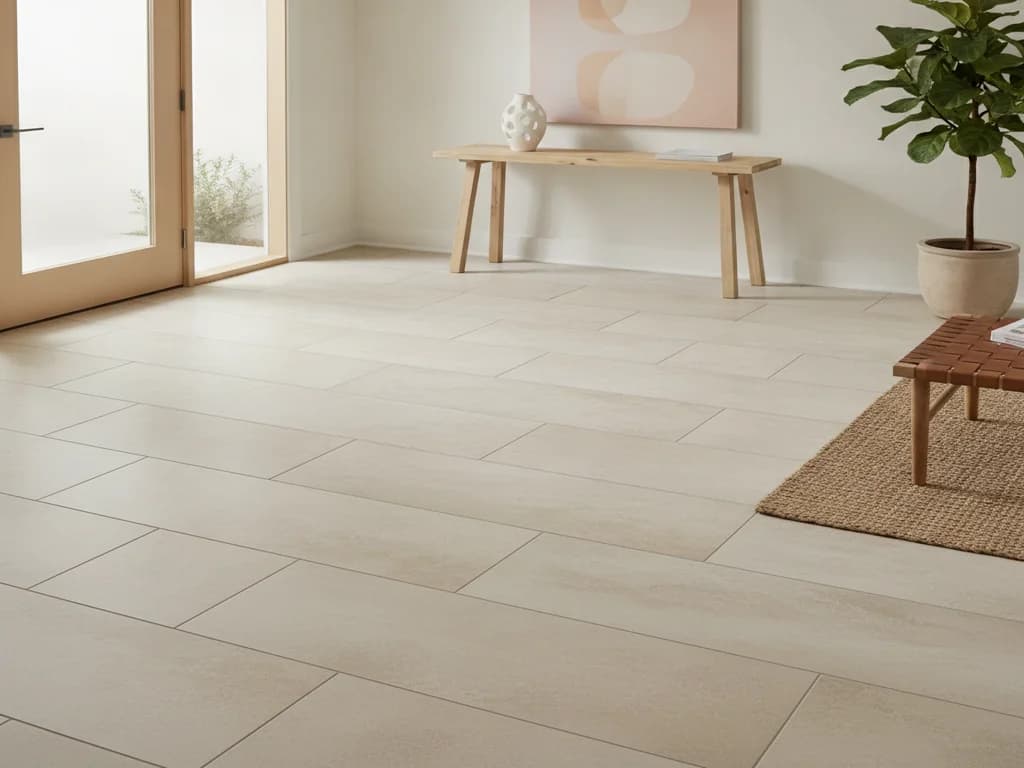
Porcelain and ceramic tile for entries, kitchens, and baths — set on a properly prepared substrate with laser-level layout and clean grout work.
Local Conditions
What Tile Flooring Has to Contend With in Santa Rosa
Santa Rosa Conditions That Affect Tile
Santa Rosa sits at about 180 feet in Sonoma County. No relative-humidity normal is published for Santa Rosa. The nearest measured record is Charles M. Schulz–Sonoma County Airport, about 7 miles from the city and 77 feet lower: across hourly observations from 2015 through 2025, outdoor air warmed to 70°F with no moisture added has a median relative humidity of 39.2% from November through April and 54.8% from June through September. The summer figure is a ceiling for an air-conditioned house, and neither figure is claimed as a downtown reading. Tile itself is unbothered by Santa Rosa heat — near 82°F outside, an unheated tile floor is one of the few surfaces in the house that stays cool. What heat does affect is the installation: thinset open time shortens in hot, dry conditions, so summer work gets staged in smaller sections so every tile is set into mortar that is still live.
NOAA 1991-2020 normals record a January average low of 38.4°F and no measurable snowfall in any month. Cold slows cure times at the other end of the year, and grout and mortar both need to be held above their minimum cure temperature to reach full strength. On a winter job that means heat in the space, not just a tarp over the door.
At NOAA's Santa Rosa normals station (USC00047965), the warmest month is September (83.9°F average high), ahead of August (83.0°F) and July (81.6°F). Local weather in Santa Rosa mostly shows up in tile work as cure time: cool, damp stretches run longer than a spec sheet's stated minimum.
Substrate Preparation
The City's Policy 2.5.6 on geotechnical investigation requirements (dated August 2005, revised August 2011) states that residential remodels with no increase in square footage and no foundation repair or upgrade need no geotechnical investigation. For foundation replacement or repair, an investigation is not required unless the foundation is designed with an assumed low expansive soil condition or an assumed soil bearing capacity exceeding 1,500 pounds per square foot, and a City building inspector may require one on inspection of the footing excavation. Separately, California's 2025 Earthquake Brace + Bolt ZIP list includes Santa Rosa ZIP codes 95401, 95403, 95404, 95405, 95407, and 95409, and the California Residential Mitigation Program states the retrofit is 'only done on wood-framed, pre-1980 homes with a raised foundation'; eligibility is set by ZIP code, which does not follow city limits and is not a count of raised foundations. USDA soil data at single test points map Yolo clay loam, 0-5% slopes, at a Coffey Park point and Zamora silty clay loam at the city's Census reference point; these describe points, not neighborhoods. The City's fire-rebuild permitting estimated hillside development and design review at about six weeks for the rebuild program generally. The City does not publish a foundation-type breakdown of the post-fire rebuild.
A slab is the friendliest substrate tile can have — provided its cracks are respected rather than tiled over. A crack that is still moving will come through the tile above it, so it gets treated with a crack-isolation membrane or honored with a movement joint. Slab flatness is what governs large-format tile in particular: the bigger the tile, the less the substrate can deviate before lippage shows at every edge.
Over a wood-framed floor, tile is a deflection question before it is a tile question. A floor system that flexes more than the assembly allows will crack grout first and tile second, regardless of how well it was set. We check joist span and subfloor thickness, add a second layer or a proper uncoupling membrane where the structure calls for it, and tell you if the answer is that the floor needs stiffening.
Source: NAHB analysis of the Census Bureau Survey of Construction, foundation type by region (2024)
Santa Rosa Homes We Work In
ACS 2020-2024 5-year estimates put 38% of Santa Rosa's 71,382 housing units in the 1970s (20.8%) and 1980s (17.2%), with 5.1% built 1939 or earlier and a median year built of 1980. Separately, 1.9% of the stock is recorded as built 2020 or later. In Santa Rosa's 1970s, 1980s, and Post-2018 rebuild stock in two neighborhoods homes, the framing was often designed to the code of its day rather than to today's large-format tile, so the deflection check matters more, not less. It is the reason we survey the floor structure in older homes before quoting tile.
Before We Quote
Planning Around Santa Rosa
A few Santa Rosa conditions shape how we approach a tile floor:
- The October 2017 Tubbs Fire destroyed 5,636 structures and caused 22 civilian fatalities across Napa and Sonoma counties, per CAL FIRE; an ICMA case study of the city's recovery records 3,098 buildings destroyed within Santa Rosa, including 2,668 single-family homes, and nine fatalities in the city.
- City of Santa Rosa recovery data published December 31, 2025 (reflecting permit data current to about July 7, 2025) record 2,508 residential units citywide at 'structure complete,' including 1,312 in Coffey Park and 1,194 in Fountaingrove, with a further 504 units in construction and 298 permitted but not yet started; 593 of those 802 remaining units are multifamily units in Fountaingrove.
- Rebuild completions were already under way by May 2019, per an earlier City recovery snapshot, and units were still in construction in the City's 2025 data, so the rebuild stock spans years of construction dates rather than being uniformly new.
- The rebuild has overlapped several California Building Standards Code editions, which took effect January 1, 2017 (2016 edition), January 1, 2020 (2019 edition), January 1, 2023 (2022 edition), and January 1, 2026 (2025 edition); the City's rebuild FAQ now states that all buildings must meet the 2025 California Residential Building Standards Code as amended and adopted by the City. There is no single code vintage for the rebuild.
- The City requires new construction within a Wildland Urban Interface Fire Area to meet Chapter 7A of the California Building Code. The City's WUI map layer places a Fountaingrove test point inside that area and a Coffey Park test point outside it, but the layer predates the updated 2026 WUI boundary the City now uses, so status must be checked by parcel; Chapter 7A governs exterior construction, not interior floor coverings.
- NWFA Wood Flooring Installation Guidelines define normal living conditions as 30-50% relative humidity at 60-80°F and direct that this range be maintained year-round.
- NOAA 1991-2020 normals for the Santa Rosa station record a July average high of 81.6°F against a July average low of 52.1°F — a diurnal swing of roughly 30°F.
- The USDA Forest Products Laboratory Wood Handbook directs that wood be installed at the moisture content it will experience in service to minimize post-installation dimensional change, and lists 8% average moisture content (6-10% for individual pieces) for interior flooring across most of the United States.
Permits & Jurisdiction
Who Has Jurisdiction in Santa Rosa
Building permits and inspections for Santa Rosa properties go through City of Santa Rosa Building Division. Santa Rosa is incorporated and issues its own building permits through the Building Division of the Planning and Economic Development Department. The City also operates a Resilient City Permit Center for fire-rebuild projects, offering expedited review and certain fee waivers. A City notice of December 2025 stated that the Resilient City standards for properties affected by the Tubbs and Nuns fires remained in effect until December 31, 2025, and that properties affected by the Glass Fire, including Piedmont Heights, Oakmont, and Skyhawk, follow them until October 28, 2026.
Requirements change. Confirm current rules with the issuing agency before work begins.
We install tile flooring throughout Santa Rosa, including Railroad Square, McDonald Preservation District, Coffey Park, Fountaingrove, Roseland.
Sources
Where These Santa Rosa Details Come From
The local conditions above are drawn from these public sources.
- Iowa Environmental Mesonet ASOS archive — hourly observations 2015-2025 at Charles M. Schulz–Sonoma County Airport (STS), about 7 miles from Santa Rosa
- CAL FIRE — Tubbs Fire incident record (36,807 acres; 5,636 structures destroyed; 22 fatalities)
- ICMA case study of Santa Rosa's fire recovery (3,098 buildings destroyed in the city; 2,668 single-family homes; nine fatalities in the city)
- City of Santa Rosa open data — Resilient City Fire Recovery Progress, residential units by status
- City of Santa Rosa — Resilient City Permit Center
- City of Santa Rosa — Resilient City Standards in effect through Dec. 31, 2025 (Glass Fire areas until Oct. 28, 2026)
- City of Santa Rosa — Fire rebuild Frequently Asked Questions (2025 California Residential Code)
- City of Santa Rosa — Wildland-Urban Interface (Chapter 7A requirements)
- City of Santa Rosa — Building Division
- City of Santa Rosa Policy 2.5.6 — Geotechnical Investigation Requirements (remodels; low expansive soil and 1,500 psf triggers)
- California Residential Mitigation Program — Earthquake Brace + Bolt retrofit (pre-1980, wood-framed, raised foundation only)
- Earthquake Brace + Bolt — 2025 eligible ZIP codes, Northern California (Santa Rosa 95401, 95403, 95404, 95405, 95407, 95409)
- California Building Standards Commission — Title 24 code edition effective dates
- NOAA NCEI — 1991-2020 Monthly Climate Normals, Santa Rosa (USC00047965)
- U.S. Census Bureau ACS 2020-2024 5-year, table B25034 — Santa Rosa city, CA (year structure built)
- USGS 3DEP Elevation Point Query Service
- National Wood Flooring Association — Wood Flooring Installation Guidelines
- USDA Forest Products Laboratory — Wood Handbook (GTR-282), Ch. 13
More in This Area
Other Flooring Services in Santa Rosa
Nearby Areas
Tile Flooring Near Santa Rosa
Good to Know
Frequently Asked Questions
Do you install tile flooring in Santa Rosa?
Yes. Renaissance Floors installs tile flooring throughout Santa Rosa and the surrounding Sonoma County area. Call (916) 749-0272 for a free estimate.
Does a tiled bathroom need waterproofing behind the tile?
In a shower or on a tub deck, yes. Tile and grout are not waterproofing on their own — a real membrane system goes behind them. It is worth asking any contractor which membrane they are using and why.
Is grout maintenance-free?
No. Cementitious grout should be sealed and will need periodic resealing, especially in kitchens and bathrooms. Subfloor flatness and deflection also matter more with tile than almost anything else — an uneven or bouncy floor cracks tile, and correcting it is not optional work.
How do I get an estimate in Santa Rosa?
Call (916) 749-0272 or request a free estimate online. We'll schedule a convenient in-home visit in Santa Rosa, measure your space, and give you an honest written quote.
Related
Keep Reading
Related pages: Tile Flooring, Santa Rosa, Hardwood Flooring, and Engineered Hardwood.
Ready for Floors You'll Love?
Free estimates on tile flooring throughout Santa Rosa and Sonoma County.