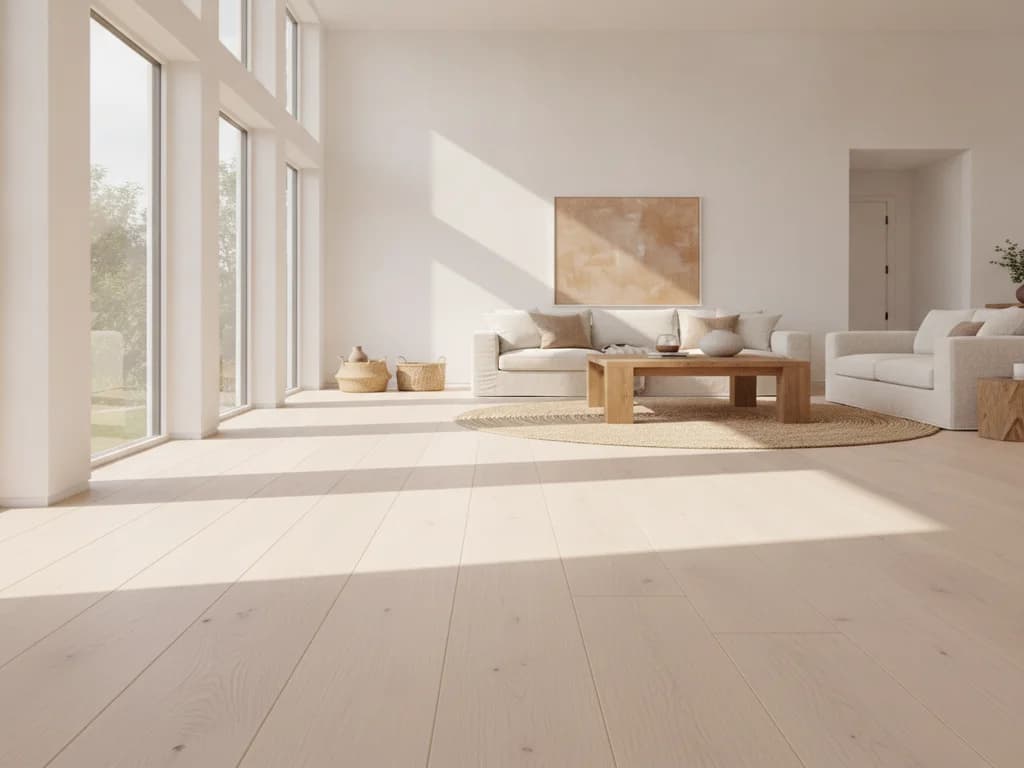
Palo Alto
Hardwood Flooring in Palo Alto
Solid hardwood installation in white oak, red oak, maple, hickory, and walnut — measured, racked, and fastened for a floor that lasts for decades.
Local Conditions
What Hardwood Flooring Has to Contend With in Palo Alto
Palo Alto Conditions That Affect Solid Hardwood
Derived statistic, not a published normal: averaging NOAA Local Climatological Data hourly observations at Palo Alto Airport across the ten Julys 2015-2024 (Local Standard Time) gives 86.6% relative humidity at 05:00 (n=250) and 62.7% at 16:00 (n=235). The station reports only between about 05:00 and 19:00, so no overnight figure exists for it. For contrast, NOAA's Comparative Climatic Data table gives Sacramento a July afternoon mean of 29%. Palo Alto summers running near 79°F pull indoor humidity down hard whenever the air conditioning is working. Solid hardwood answers that by shrinking, which is what opens seasonal gaps between boards. The fix is not a tighter install — it is acclimating the wood to the house's real conditions before it goes down, and setting expansion space at the walls to match the swing this climate actually produces.
NOAA 1991-2020 normals at the Palo Alto station give January an average high of 57.8°F and an average low of 39.0°F; December's 38.6°F is the coldest average low. Annual precipitation normal is 15.12 inches, with February the wettest month at 3.18 inches. Winter runs the same cycle in reverse. Solid hardwood is a hygroscopic material: it moves with the seasons for its whole service life, and an install that ignores that is an install that telegraphs every season change through the floor.
Palo Alto's July normal high of 79.4°F runs about 13°F above San Francisco Downtown (66.3°F) and just below San Jose's airport station (80.8°F). Whatever the outdoor pattern in Palo Alto, solid hardwood responds to the air inside the house, so the wood acclimates to the rooms it is going into rather than to a delivery truck or a garage.
Measured Humidity and Solid Wood Movement in Palo Alto
Moffett Federal Airfield, 5 miles from Palo Alto and 117 feet lower, supplied the 66,906 hourly dewpoint readings, 2015 to 2025, behind these figures. Warm that winter air to 70°F without adding moisture and it settles at a median 40.1% relative humidity, with 16% of heating-season hours below the 30% floor NWFA sets for wood floors; the same air reaches 61.2% in summer. Solid hardwood follows those numbers: its equilibrium moisture content runs from about 7.7% in the heating season to 11.2% in summer, and on the Forest Products Laboratory's coefficients for American white oak that swing changes the width of a 5-inch plainsawn board by about 0.066 inch (about 1/15 inch) — against 0.034 inch for the same board quartersawn. That is a mild climate for solid wood, and it is why wider plank is a realistic choice in Palo Alto rather than a gamble.
Subfloor and Foundation Work
The city's adopted Eichler Neighborhood Design Guidelines (April 2, 2018) state that of the more than 11,000 homes Joseph Eichler built, 'some 2,700 were located in Palo Alto' — elsewhere the same document says 'well over 2,000' — across 31 tracts built between 1949 and 1974. As typical characteristics, the guidelines describe a 'post and beam construction method, built on a concrete slab foundation,' with 'Radiant heating is embedded in the concrete slab flooring,' and warn that the original radiant heating system 'may be difficult to repair without highly invasive intervention.' 70.0% of Palo Alto housing predates 1980. CRMP's 2025 Earthquake Brace + Bolt list, with eligibility 'based on ZIP Code only,' includes 94301, 94303, 94304 and 94306, ZIPs that contain Palo Alto addresses, for a program limited to 'wood-framed, pre-1980 homes with a raised foundation.'
Over a crawlspace, solid hardwood is in its element — plank or plywood subfloors take fasteners well — but only when the crawlspace itself is dry. We check the ground cover, look for standing water and rot at the joist ends, and read the moisture content of the subfloor from below. Cupping in a solid floor is almost always a crawlspace problem that surfaced upstairs.
Source: NAHB analysis of the Census Bureau Survey of Construction, foundation type by region (2024)
Palo Alto Homes We Work In
ACS 2020-2024 five-year estimates count 29,241 housing units, with a median year built of 1963. The 1950s alone account for 25.1% (7,341 units), the largest single decade. 13.3% were built in 1939 or earlier and 12.1% in the 1960s. 58.9% of the stock predates 1970. Palo Alto's 1950s, pre-1940, and 1960s stock is directly relevant here, because homes of that period frequently have a board or plywood subfloor that will hold a nail-down installation, and sometimes original wood still under the carpet. We check for both before quoting a full replacement — refinishing what's already there is often the better answer.
Before We Quote
Planning Around Palo Alto
Some conditions are specific to Palo Alto and change how we plan a solid hardwood job:
- The city's adopted Eichler guidelines record some 2,700 Eichler homes across 31 tracts and describe post-and-beam construction on a concrete slab, with radiant heating embedded in the slab, as typical.
- Where the original radiant heating sits in the slab, the guidelines note that the system 'may be difficult to repair without highly invasive intervention.'
- The guidelines are explicitly voluntary — 'advisory (voluntary), unless regulatory (zoning) changes are adopted by the Palo Alto City Council to impose them as a requirement' — and their 'Interior Plans & Features' section describes the original open-plan layouts rather than setting rules.
- The 1950s are the single largest construction decade at 25.1% of housing units, and 58.9% of the stock predates 1970.
- July normals are a 79.4°F high and a 55.7°F low; September's average high of 79.6°F is the year's highest.
- Hourly observations at Palo Alto Airport average 62.7% relative humidity at 4 PM across the Julys of 2015-2024, against a 29% July afternoon mean for Sacramento in NOAA's published table.
Permits & Jurisdiction
Who Has Jurisdiction in Palo Alto
Building permits and inspections for Palo Alto properties go through City of Palo Alto Planning & Development Services. Palo Alto operates an Accela-based online permitting portal, self-described on the portal as 'City of Palo Alto Online Permitting Services.' Separately, the city's adopted Eichler Neighborhood Design Guidelines state that they 'are advisory (voluntary), unless regulatory (zoning) changes are adopted by the Palo Alto City Council to impose them as a requirement.' As of the 2018 guidelines, Single Story Overlay Combining Districts, which do carry binding site development regulations (17 ft maximum height, a limit of one habitable floor), overlapped eleven Eichler tracts; the rezoning process is described at PAMC 18.80.035.
Requirements change. Confirm current rules with the issuing agency before work begins.
We install hardwood flooring throughout Palo Alto, including Green Gables, Greenmeadow, Fairmeadow, Charleston Meadows, Charleston Gardens, Los Arboles, and the surrounding area.
Sources
Where These Palo Alto Details Come From
The local conditions above are drawn from these public sources.
- U.S. Census Bureau ACS 2020-2024 5-year, table B25034 (Year Structure Built), Palo Alto city, CA
- NOAA NCEI 1991-2020 Monthly Climate Normals, station USC00046646 (Palo Alto, CA)
- City of Palo Alto — Palo Alto Eichler Neighborhood Design Guidelines, adopted April 2, 2018
- City of Palo Alto Online Permitting Services (Accela Citizen Access)
- NOAA NCEI Local Climatological Data, hourly relative humidity, station 72493723289 (Palo Alto Airport), 2015-2024
- NOAA NCEI Comparative Climatic Data — Average Relative Humidity, Morning and Afternoon (data through 2023)
- California Residential Mitigation Program — Earthquake Brace + Bolt retrofit eligibility
- CRMP — 2025 EBB ZIP Codes in Northern California
More in This Area
Other Flooring Services in Palo Alto
Nearby Areas
Hardwood Flooring Near Palo Alto
Good to Know
Frequently Asked Questions
Do you install hardwood flooring in Palo Alto?
Yes. Renaissance Floors installs hardwood flooring throughout Palo Alto and the surrounding Santa Clara County area. Call (916) 749-0272 for a free estimate.
Can solid hardwood go anywhere in the house?
Not quite. Solid hardwood is milled from one piece of wood and moves with moisture for its whole service life, so it is not recommended below grade, over a concrete slab without the right conditions, or in a full bathroom. Above grade on a wood subfloor it is in its element.
How many times can a hardwood floor be refinished?
A solid hardwood floor has a full-thickness wear layer, so it can typically be sanded and refinished several times across decades — a tired floor gets restored rather than torn out. That single property is most of the argument for what it costs up front.
How do I get an estimate in Palo Alto?
Call (916) 749-0272 or request a free estimate online. We'll schedule a convenient in-home visit in Palo Alto, measure your space, and give you an honest written quote.
Related
Keep Reading
Related pages: Tile Flooring in Winters, Engineered Hardwood in Woodland, Hardwood Flooring, and Palo Alto.
Ready for Floors You'll Love?
Free estimates on hardwood flooring throughout Palo Alto and Santa Clara County.