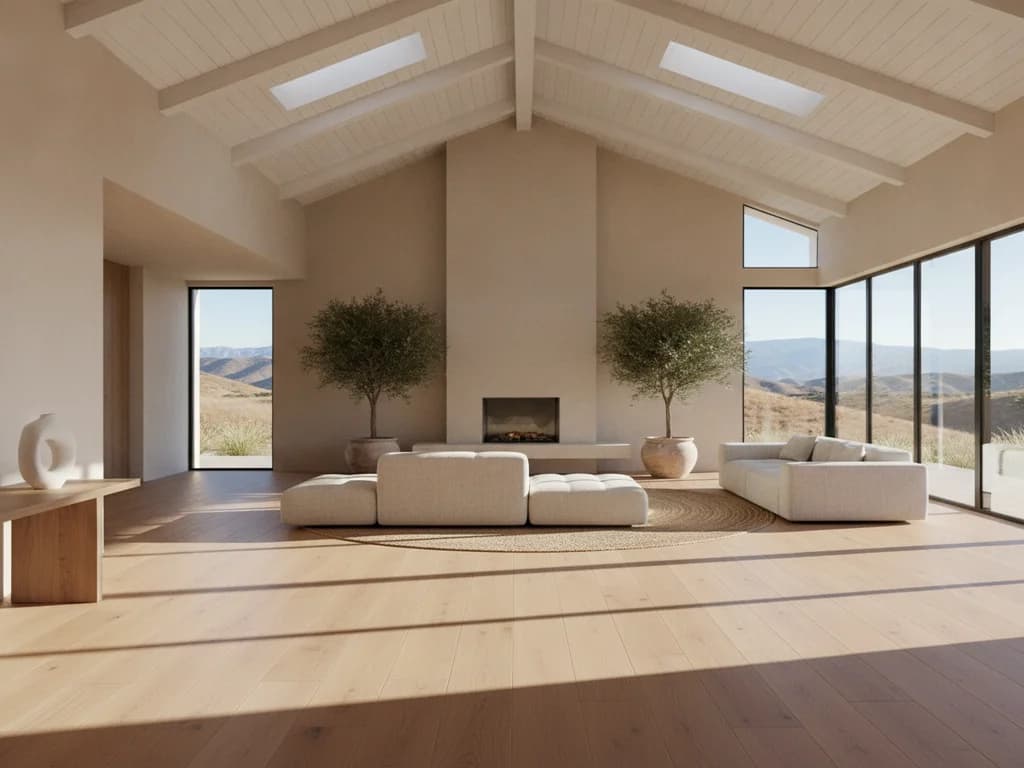
Truckee
Engineered Hardwood in Truckee
Engineered European oak and wide-plank hardwood — a genuine hardwood surface over a dimensionally stable core that handles humidity and heat.
Local Conditions
What Engineered Hardwood Has to Contend With in Truckee
Truckee Conditions That Affect Engineered Hardwood
Truckee sits at about 5,980 feet in Nevada County. Summer is the dry season here. Hourly outdoor readings at Truckee Airport averaged 52.8% relative humidity in July across 2022-2024, against 85.3% in December — a seasonal outdoor swing of more than 30 percentage points. NOAA 1991-2020 normals for the Truckee Ranger Station also record a July average high of 83.8°F against a July average low of 41.4°F, a diurnal swing of roughly 42°F. Engineered hardwood exists precisely for climates like this. With Truckee summer highs near 84°F and air conditioning drying the house out, a cross-laminated or multi-ply core moves far less across the grain than solid wood does, so seasonal gapping is much less pronounced. It is the reason we recommend engineered over wide plank widths in particular — the wider the board, the more a solid version would move.
NOAA 1991-2020 normals record a January average low of 16.1°F and average annual snowfall of 206.6 inches, with January (43.6 in.), February (47.9 in.), and December (44.2 in.) the heaviest months. Outdoor relative humidity is at its highest in winter, not its lowest — Truckee Airport hourly readings averaged 82.9% in January across 2022-2024. Through winter the same stability works in reverse: the core resists the swelling that a solid floor would show as the house takes on moisture. Stable is not inert, though — the expansion gap at the perimeter still gets set properly. Around 5,980 feet, heated winter air gets dry enough to matter even for engineered products. The wear layer is real wood and will still respond to sustained low humidity, so the 30–50% interior range NWFA recommends is worth holding to — engineered widens the margin for error rather than removing it.
Subfloor and Foundation Work
Truckee Municipal Code §15.03.150 amends the state footing provisions to require foundations extend a minimum of 18 inches below grade below 7,000 ft elevation and 24 inches at 7,000 ft and above, with interior footings a minimum of 12 inches.
Truckee's 1970s, 1980s, and 1990s stock straddles the shift toward slab-on-grade: new Pacific-division construction ran 89.9% slab in 2024, but that shift is recent. Both foundation types are genuinely in play here, so we confirm on site before specifying anything.
A slab is the single biggest reason engineered hardwood gets specified at all. A dimensionally stable core can go over concrete where solid wood cannot — floated, or glued down with a moisture-control membrane. That is not a free pass: we still test the slab per ASTM F2170, still grind or fill it flat to the manufacturer's tolerance, and still match the adhesive system to the reading we get. Skipping the test is how a glue-down floor comes loose.
Over a crawlspace, engineered goes down by nail, staple, glue, or float, so the method follows the subfloor rather than the other way round. We flatten the subfloor first — engineered plank is stiff, and it bridges dips instead of following them, which is what produces hollow spots underfoot.
Source: NAHB analysis of the Census Bureau Survey of Construction, foundation type by region (2024)
Truckee Homes We Work In
ACS 2020-2024 5-year estimates put 65% of Truckee's 13,984 housing units in the 1970-1999 range (1990s 23.1%, 1980s 22.7%, 1970s 19.2%). Only 1.1% predates 1940. In Truckee's 1970s, 1980s, and 1990s housing, engineered often wins on height as much as on moisture: a thinner assembly clears existing door jambs, appliance toe-kicks, and the transitions to rooms that aren't being redone, which matters when only part of the house is getting new floor.
Before We Quote
Planning Around Truckee
A few Truckee conditions change how we plan an engineered hardwood install:
- NWFA Wood Flooring Installation Guidelines define normal living conditions as 30-50% relative humidity at 60-80°F and direct that this range be maintained year-round.
- The condition that moves a wood floor in winter is interior, not outdoor. Outdoor humidity at Truckee Airport is at its highest in the cold months, but NWFA states that during the interior heating season, heating raises the air temperature and thereby increases its capacity to hold moisture, so interior relative humidity decreases and vapor drive runs outward from the wood. Heating-season indoor conditions therefore run drier than the outdoor reading suggests, and a long heating season at this elevation extends that period.
- The USDA Forest Products Laboratory Wood Handbook directs that wood be installed at the moisture content it will experience in service to minimize post-installation dimensional change, and lists 8% average moisture content (6-10% for individual pieces) for interior flooring across most of the United States.
- Where wood flooring is installed over a radiant system, NWFA specifies that subfloor surface temperature not exceed 80°F at the time of installation, that finished floor surface temperature vary no more than 3°F across the installed floor, and that supplemental humidification be operational before delivery, during, and after installation.
Permits & Jurisdiction
Who Has Jurisdiction in Truckee
Building permits and inspections for Truckee properties go through Town of Truckee Building and Safety Division. Truckee is incorporated and issues its own building permits. It lies OUTSIDE the Lake Tahoe Basin, so Tahoe Regional Planning Agency review does not apply. The Town's residential permit submittals include a Wildland-Urban Interface (WUI) form.
Requirements change. Confirm current rules with the issuing agency before work begins.
We install engineered hardwood throughout Truckee, including Tahoe Donner, Glenshire, Gateway, Historic Downtown Truckee.
Sources
Where These Truckee Details Come From
The local conditions above are drawn from these public sources.
- Town of Truckee — Town Council Handbook (downtown elevation 5,980 ft)
- Town of Truckee Municipal Code Title 15 (§15.03.150)
- Town of Truckee — Building Permits
- NOAA NCEI — 1991-2020 Monthly Climate Normals, Truckee RS (USC00049043)
- NOAA NCEI Local Climatological Data — Truckee Airport, CA (72584693201), hourly relative humidity
- U.S. Census Bureau ACS 2020-2024 5-year, table B25034 — Truckee, CA (year structure built)
- National Wood Flooring Association — Wood Flooring Installation Guidelines
- USDA Forest Products Laboratory — Wood Handbook (GTR-282), Ch. 13
More in This Area
Other Flooring Services in Truckee
Good to Know
Frequently Asked Questions
Do you install engineered hardwood in Truckee?
Yes. Renaissance Floors installs engineered hardwood throughout Truckee and the surrounding Nevada County area. Call (916) 749-0272 for a free estimate.
Is engineered hardwood real wood?
Yes — the surface is a genuine wood veneer over a dimensionally stable core, usually plywood or HDF. The cross-laminated construction moves far less with humidity than solid wood, which is why it works over slabs, in basements, and in wide-plank formats where a solid board would be least stable.
Can engineered hardwood be refinished?
It depends entirely on wear-layer thickness, and it varies by product rather than by category. Some can be sanded once or twice; others are built to be replaced when worn. It is a fair question to ask before buying, and we will tell you honestly which one you are looking at.
How do I get an estimate in Truckee?
Call (916) 749-0272 or request a free estimate online. We'll schedule a convenient in-home visit in Truckee, measure your space, and give you an honest written quote.
Related
Keep Reading
Related pages: Engineered Hardwood, Truckee, Hardwood Flooring, and Luxury Vinyl Plank.
Ready for Floors You'll Love?
Free estimates on engineered hardwood throughout Truckee and Nevada County.