Service Area
Flooring in Fairfield
Renaissance Floors installs and refinishes hardwood, luxury vinyl, tile, and more for homeowners throughout Fairfield and the surrounding Solano County area.
CSLB #1060673
Licensed & Insured
Est. 2019
Family-Owned
15+ Years
Hands-On Experience
5.0★ Rated
22 Reviews on Thumbtack
Local, Licensed, Accountable
Flooring Contractor Serving Fairfield
Fairfield is part of Solano County, and it's one of the communities Renaissance Floors regularly works in. We're based in Roseville, CA and serve homeowners across Greater Sacramento & Northern California— from small refinishing jobs to full home installs. Every project starts with an honest look at your subfloor and your goals, followed by a clear, no-pressure estimate. There's no dispatched sales team and no guesswork: you work directly with the crew doing the installation, backed by our CSLB C-15 license and a workmanship warranty on every job.
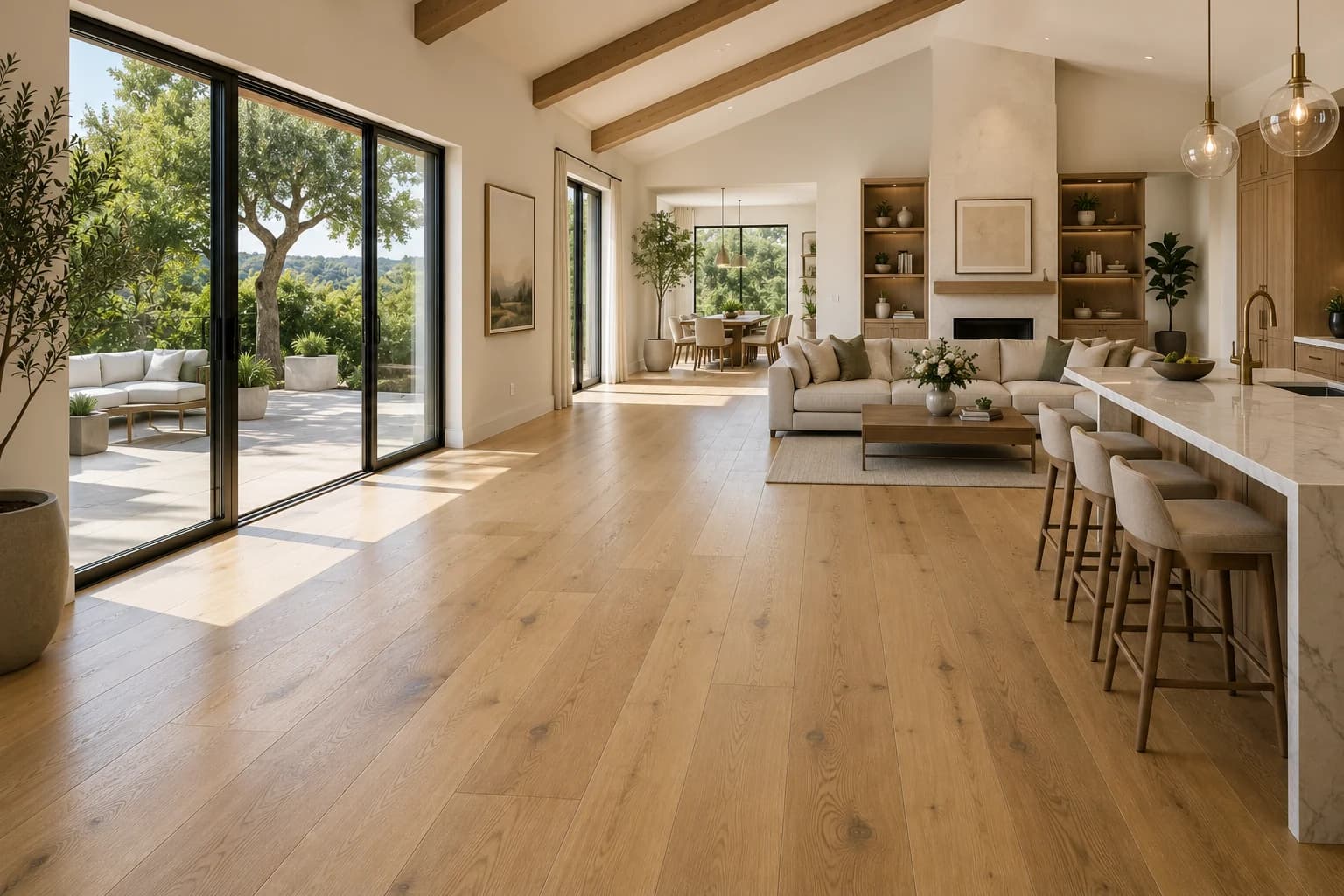
Wine Country homes lean into indoor-outdoor living, where warm wide-plank oak and durable luxury vinyl both shine. We help you choose flooring that looks at home in everything from a Sonoma ranch to a Napa estate.
The City of Fairfield dates its founding to 1856, when Captain Robert H. Waterman laid out the townsite and named it after his hometown in Connecticut. In 1858 Waterman offered to have the Solano County seat moved from Benicia to Fairfield; voters ratified the proposal that November, and he donated sixteen acres at the corner of Texas and Union Streets for county buildings. A brick courthouse and jail followed in 1860, built for $15,400, and Fairfield was formally incorporated as a city in 1903. The City's history also names the Cordelia area of Fairfield for Waterman's wife, Cordelia. Today the Census Bureau's five-year estimates count about 121,000 residents, and the city's Census boundary takes in about 41.6 square miles of land.
Travis Air Force Base is part of the city, not a neighbor of it. During World War II an Army air base was built on land east of Fairfield, and the City's history says the Fairfield-Suisun Army Air Base later became Travis Air Force Base and that 'the base was annexed to Fairfield on March 30, 1966.' U.S. Census geography agrees, placing base addresses and the Travis Field AFB weather station inside Fairfield city limits. The war reached downtown, too: in 1943 the Waterman Park Federal Housing, forty buildings with 160 family apartments and five dormitories, went up for airmen and their families where the Civic Center Complex, completed in 1971, stands today. On the west side the city line cuts the other way. Rockville is unincorporated at every point sampled for this page, as are the USGS place point for the old Cordelia village and the Green Valley census-designated place, while sampled addresses at 2300 Cordelia Road, 5050 Business Center Drive and 3600 Green Valley Road fall inside the city.
Most of Fairfield's homes are far younger than the town. The Census Bureau's 2020–2024 estimates count roughly 40,000 housing units with a median year built of 1986. The 1980s are the largest single decade, at about 20 percent of units, followed by the 1970s at about 17 percent and the 2000s and 1990s at about 16 percent each; together, 1970 through 2009 account for about 68 percent, and only about 2 percent of units predate 1950. About 69 percent are detached single-family houses, and owners occupy about 61 percent of occupied homes. Wherever original floors remain in houses now roughly 17 to 56 years old, the next floor is a replacement, and the slab or subfloor underneath shows its condition only once the old floor comes up.
The permit question has a careful answer. Chapter 5 of the Fairfield Municipal Code, adopted by Ordinance No. 2025-10, applies the 2025 California Building Standards Code within city limits. It replaces two of the state's permit exemptions and adds two more, leaving in place the state item for 'painting, papering, tiling, carpeting, cabinets, counter tops and similar finish work.' The City's own homeowner permit table lists painting as finish work that needs no permit and has no row for flooring, so hardwood, laminate and vinyl plank are questions for Building Safety, as is any job that touches subfloor, plumbing or walls. The ground needs the same care. USDA soil survey data maps high shrink-swell clays at sampled points on Travis Boulevard and Green Valley Road, with linear extensibility of 10.8 to 12.6 percent in their upper layers, while a point on Oliver Road maps as silty clay loam at 4.1 to 4.7.
State and federal maps draw other lines through the city. Alquist-Priolo earthquake fault zones for the Green Valley and Cordelia faults, released in 1993 on the Cordelia quadrangle, cover about 950 acres on Fairfield's west side, near Cordelia and Green Valley Road. The California Geological Survey has not released liquefaction or landslide zone maps covering Fairfield, which is an absence of maps, not a finding of low risk. FEMA maps about 5.5 percent of the city as Special Flood Hazard Area, including Zone AE at a sampled Cordelia Road address, and the final perimeter of the 2020 Hennessey fire overlaps about 196 acres along the city's northern edge. The climate record is kept inside the city: NOAA's Fairfield station averages an 89.6°F July high, against 97.3°F at Vacaville's station about 10 miles northeast, and 24.53 inches of precipitation a year, with December the wettest month.
Renaissance Floors is a licensed California C-15 flooring contractor (CSLB #1060673) based in Roseville. For a Fairfield home, the first questions are whether the address is inside city limits, what Building Safety says about the scope, whether the room sits in a mapped flood zone, and how flat and dry the slab or subfloor is, all answered before a product is chosen. Free in-home estimates and a workmanship warranty.
Recent Work
A Sample of Our Craftsmanship
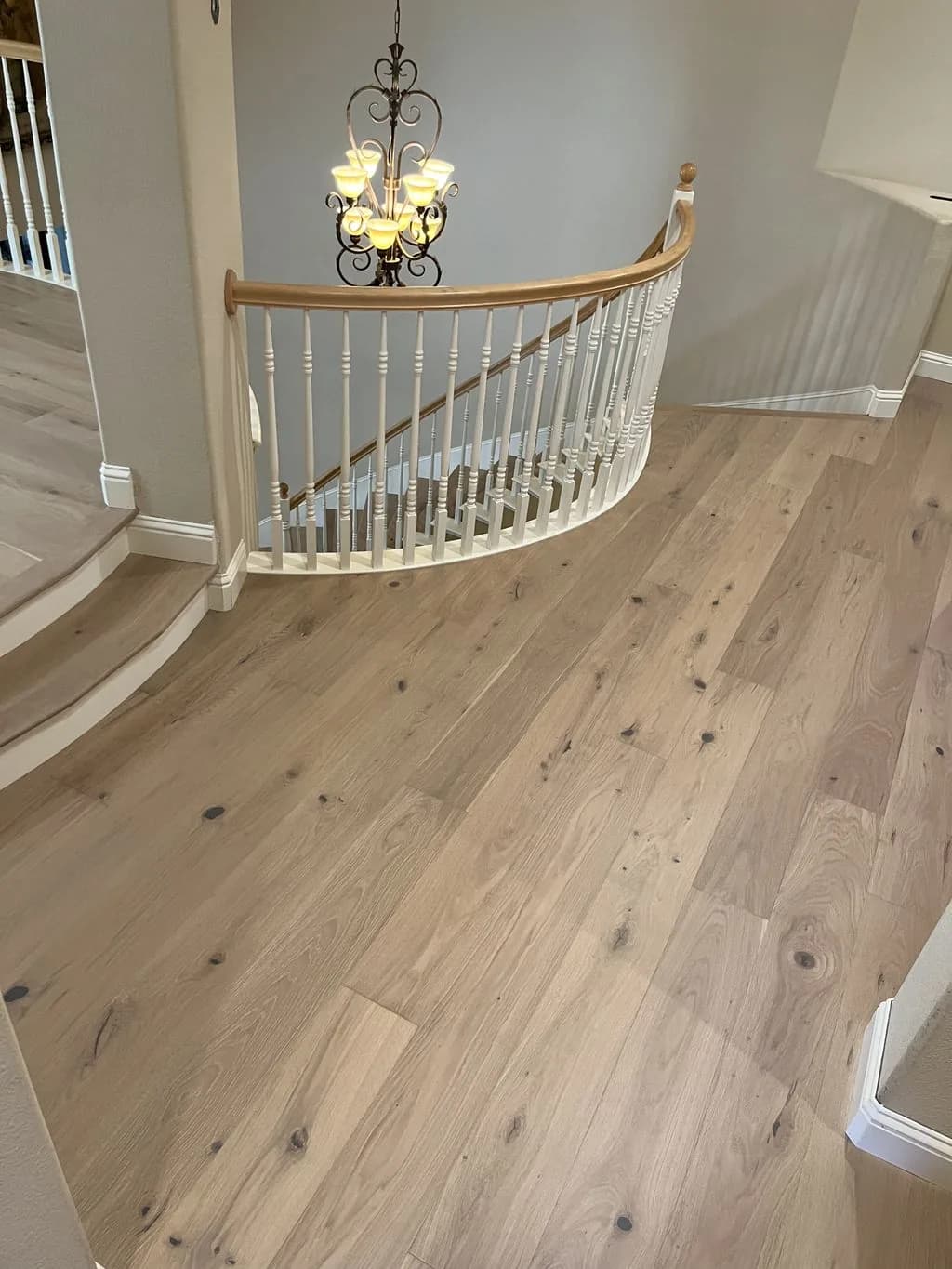
White Oak Hardwood
Great Room & Landing
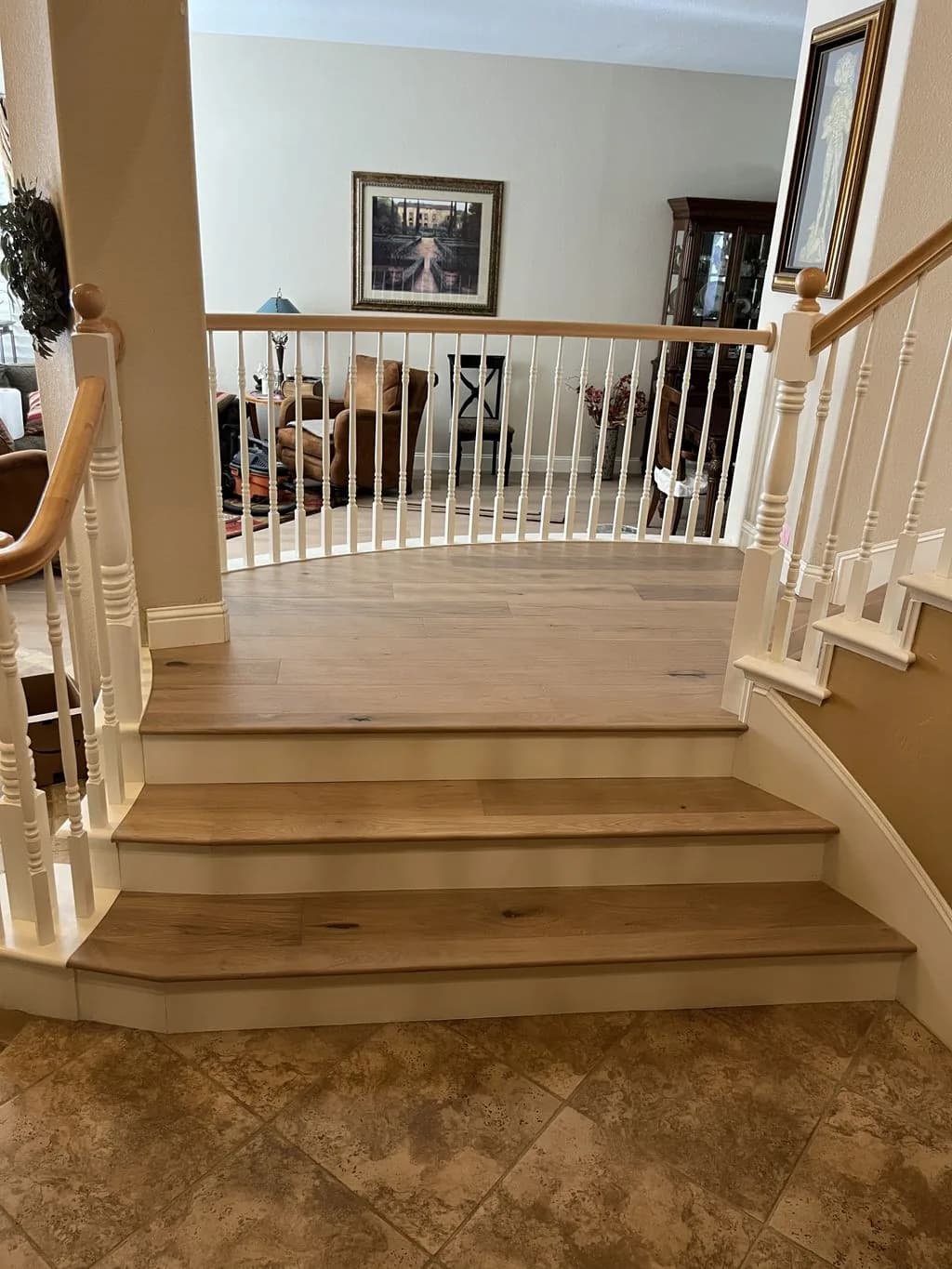
White Oak Hardwood
Staircase & Landing
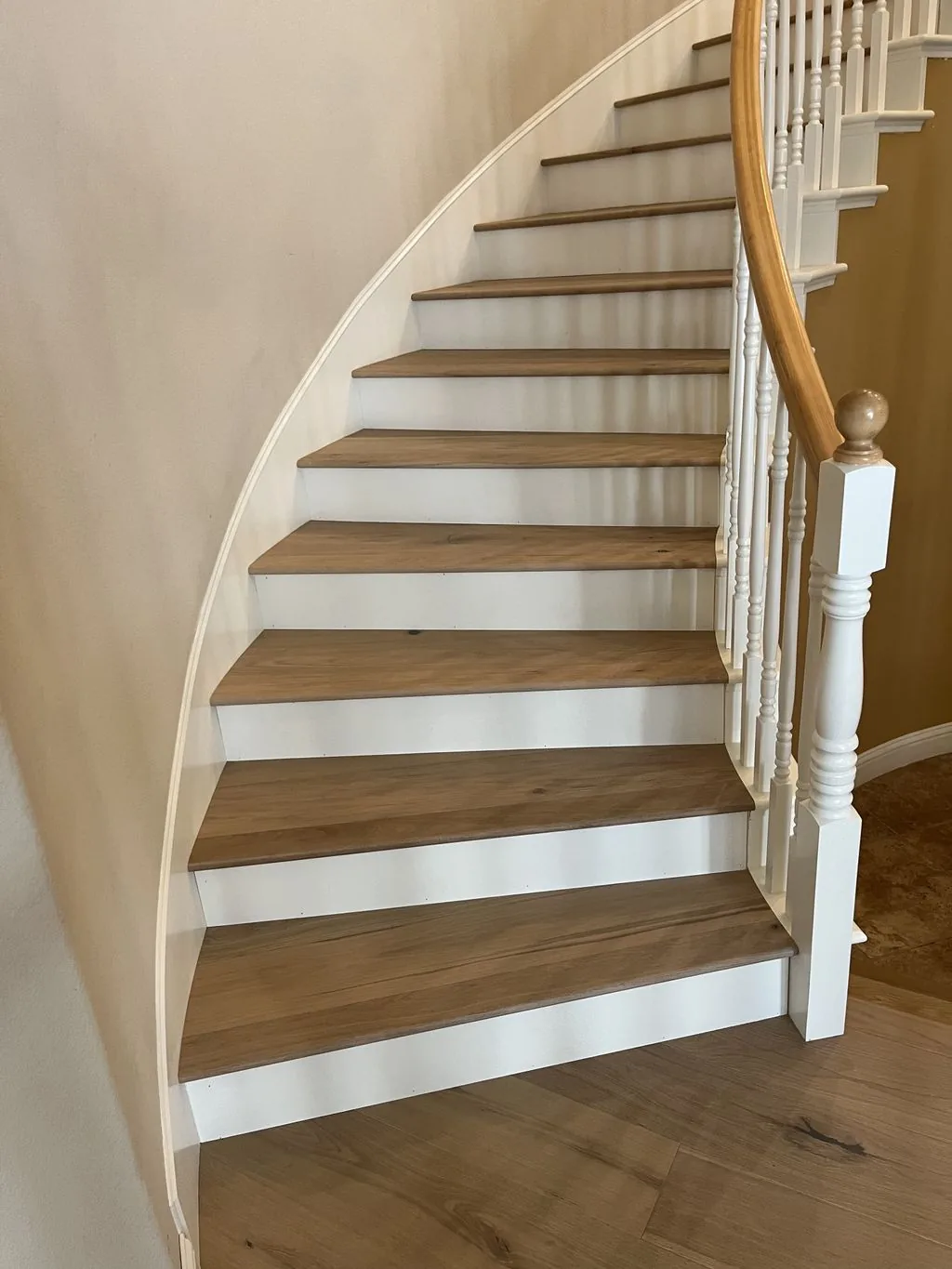
White Oak Hardwood
Curved Staircase
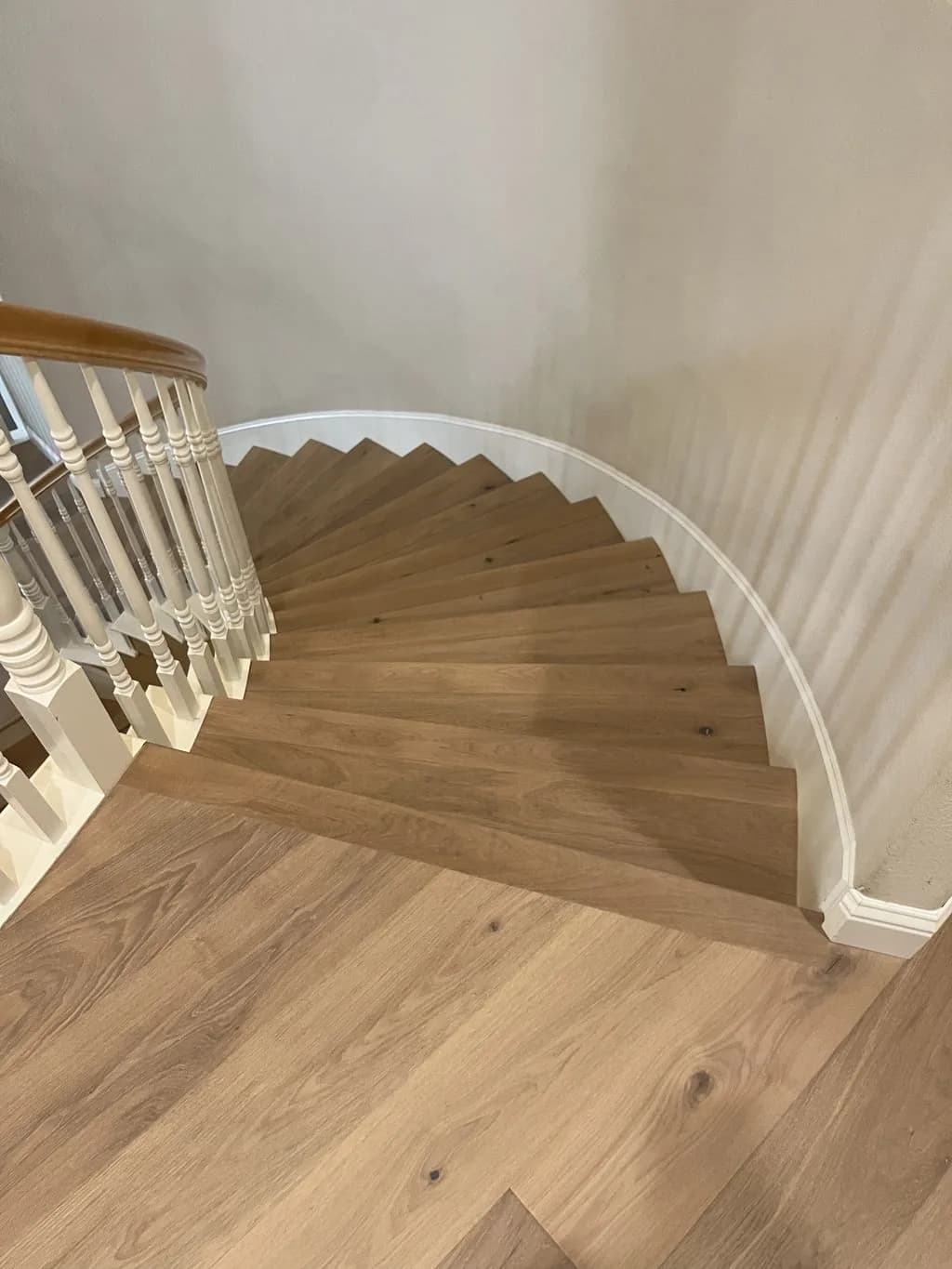
White Oak Hardwood
Stair Treads
Our Services
Flooring Services in Fairfield
From hardwood to luxury vinyl, here's how we help Fairfield homeowners upgrade their floors.
Hardwood Flooring
Solid oak, maple, and walkable heirloom-grade hardwood, precisely installed.
Hardwood Flooring in FairfieldEngineered Hardwood
Real-wood wear layers built for California's climate swings.
Engineered Hardwood in FairfieldLuxury Vinyl Plank
Waterproof, wood-look LVP for kitchens, baths, and busy households.
Luxury Vinyl Plank in FairfieldLaminate Flooring
Durable, high-style laminate at a friendly price point.
Laminate Flooring in FairfieldTile Flooring
Porcelain and ceramic tile set dead-level with crisp grout lines.
Tile Flooring in FairfieldFloor Installation
Full-service installation from subfloor prep to final baseboard.
Floor Installation in FairfieldFloor Refinishing
Sand, stain, and reseal tired hardwood back to new.
Floor Refinishing in FairfieldFloor Repair
Board swaps, water damage, squeaks, and seamless patch-ins.
Floor Repair in FairfieldLocal Considerations
What Fairfield Homes Need From a Floor
Climate, home age, and foundation type all shape the right flooring choice in Fairfield — here's what we account for.
Tile and carpet are named finish work; flooring isn't in the City's table
Chapter 5 of the Fairfield Municipal Code, adopted by Ordinance No. 2025-10, is 'applicable within the city limits of the City of Fairfield' and adopts the 2025 California Building Standards Code, including the California Residential Code's permit-exemption sections. The City's amendments replace the state's exempt-work items for small sheds and above-ground pools and add two more: roof-covering repairs of up to 100 square feet in any 12-month period, and use of the Residential Code's exemptions for projects subject to that code. The state item 'Painting, papering, tiling, carpeting, cabinets, counter tops and similar finish work' stands as written; hardwood, laminate and vinyl plank are not named. The City's homeowner permit table, archived in March 2022 before the current code, lists 'Painting (finish work)' as needing no permit, requires a permit for wall removal and for replacing plumbing fixtures only if rough plumbing is altered, and has no flooring row. Building Safety, at 707-428-7451, is where to confirm a scope; applications go through the City's BUILD online system.
Travis AFB is inside the city; Rockville is not
A Fairfield address doesn't settle who issues the permit. The City's history says Travis Air Force Base was annexed to Fairfield on March 30, 1966, and the Census geocoder places base addresses such as 101 Bodin Circle in Fairfield city; no separate Travis AFB census-designated place appears in Census geography for 2010, 2020 or today. To the west the picture reverses. Rockville is unincorporated at every point sampled, including addresses on Rockville Road and Suisun Valley Road. Cordelia and Green Valley straddle the line: the USGS place point for the old Cordelia village and an address at 2155 Cordelia Road are unincorporated, while 2300 Cordelia Road and 5050 Business Center Drive are in the city, and Green Valley is an unincorporated census-designated place even though 3600 Green Valley Road is inside city limits. Chapter 5 of the Municipal Code applies only within city limits, so for an unincorporated parcel the permitting question goes to Solano County, whose rules this page does not cover.
About two-thirds of homes date from 1970 to 2009
The Census Bureau's 2020–2024 five-year estimates put Fairfield's median year built at 1986. Of roughly 40,000 units, the 1980s hold about 20 percent, the 1970s about 17 percent, the 2000s and 1990s about 16 percent each, the 1960s about 11 percent and the 1950s about 8 percent; under 1 percent predate 1940. About 69 percent are detached single-family houses, about 22 percent are in buildings of two or more units, and renters occupy about 39 percent of occupied homes, so some projects also run through a landlord. No City, County or Census source reviewed for this page reports foundation type, so it is not assumed. Removing the old floor shows whether it sits on a slab or a framed subfloor; a slab is tested for in-slab relative humidity (ASTM F2170) and checked for flatness, and a framed floor is checked for fastening and deflection, before a new product is chosen.
High shrink-swell clay at sampled points, not citywide
USDA soil survey data, queried at individual addresses inside the city, maps Capay clay at 600 Travis Boulevard in central Fairfield, with a representative linear extensibility of 10.8 to 10.9 percent in its top 53 centimeters, and Clear Lake clay at 3600 Green Valley Road at 12.1 to 12.6 percent. Both are high shrink-swell clays in the Vertisol order, and the survey rates the Clear Lake component poorly drained. The official Capay series description records cracks 'that open and close at least once each year and remain open for 150 days or less in the summer,' though its type location is elsewhere in Solano County, not in Fairfield. Other points differ: Alviso silty clay loam at 2300 Cordelia Road maps at 4.5 near the surface and 7.5 below, and Sycamore silty clay loam at 1350 Oliver Road at 4.1 to 4.7. Survey data is not a parcel test; where the ground is clay, a flatness check across the room comes before rigid tile or stone is laid.
Fault zones on the west side, and liquefaction left unmapped
The California Geological Survey's Alquist-Priolo Earthquake Fault Zones for the Green Valley and Cordelia faults, on the Cordelia quadrangle, were released July 1, 1993, replacing zones first issued in 1974 and 1983. Inside Fairfield they cover about 950 acres, about 3.5 percent of the city, along its western edge near Cordelia and Green Valley Road. Distance to a mapped trace varies sharply: a city address at 3600 Green Valley Road sits about a quarter mile from the nearest Cordelia fault trace but outside the zone, while 675 West Texas Street downtown is about 5 miles from it. What is missing matters as much. CGS has not released liquefaction or earthquake-induced landslide zone maps covering Fairfield, and no such zone intersects the city in its statewide layers; that is an unmapped area, not a finding of low risk. A mapped fault zone is not a prediction for any one house, so when an old floor comes up on the west side, the slab or subfloor is checked for cracks and flatness like anywhere else.
Flood zones on about 5.5 percent of the city, and a fire perimeter at its edge
FEMA's National Flood Hazard Layer maps about 5.5 percent of Fairfield as Special Flood Hazard Area, mostly Zones AE, AO and A, with mapped creeks including Laurel Creek, Ledgewood Creek and Union Avenue Creek running through those areas. Sampled points show how local it is: 2300 Cordelia Road is Zone AE on a panel effective August 3, 2016; 1350 Oliver Road is in the 0.2 percent annual chance zone; 675 West Texas Street downtown is minimal-hazard Zone X; and 101 Bodin Circle on Travis AFB is Zone D, where flood hazard is undetermined — a zone that covers about 18 percent of the city. On the northern edge, CAL FIRE's final perimeter for the 2020 Hennessey fire, part of the LNU Lightning Complex, overlaps about 196 acres of the city; no damage figures for Fairfield were reviewed for this page. For a ground-floor room in a mapped flood zone, a floor that tolerates water and a slab moisture test are the practical starting points.
Cooler than Vacaville, and dry by afternoon
NOAA's Fairfield station (USC00042934) sits inside city limits at about 40 feet. Its 1991–2020 normals average an 89.6°F July high and a 57.9°F July low, a January low of 40.4°F and a December low of 40.1°F, and 24.53 inches of precipitation a year, with December the wettest month at 5.40 inches and July at 0.00. Vacaville's station, about 10 miles northeast, averages a 97.3°F July high, and Winters', about 18 miles north, 95.3°F. The cooler afternoons are not humid ones. Hourly observations at the Travis Field AFB station, also inside the city, average about 82 percent relative humidity at 4 AM and 34 percent at 4 PM across the Julys of 2015 to 2024, a swing of about 48 points, essentially the same as Sacramento Airport's. Travis Air Force Base readings from 2015 to 2025, heated to 70°F with no moisture added, give a heating-season median of about 38 percent relative humidity, with about a quarter of hours below 30 percent, and a summer median of about 54 percent. Wood is acclimated to the conditioned rooms it will live in, not to the air outside.
Local Resources & References
Helpful Fairfield Resources
Authoritative local and industry references for permits, planning, and flooring standards.
- History (Wayback Machine snapshot, September 11, 2026) — Waterman's 1856 townsite, the 1858 county seat, 1903 incorporation and the annexation of Travis AFB on March 30, 1966; the live page blocks automated retrievalCity of Fairfield
- Building Safety Division (Wayback Machine snapshot, October 18, 2025) — review of new construction and improvements, BUILD online applications, 707-428-7451City of Fairfield
- Fairfield Municipal Code Chapter 5 (Ord. No. 2025-10) — adoption of the 2025 California Building Standards Code within city limits and local amendments to the permit exemptionsCity of Fairfield
- Fairfield city — ACS 2020–2024 profile (place 0623182; year built, units in structure, tenure)US Census
- 1991–2020 monthly normals, Fairfield (USC00042934) — the station inside city limitsNOAA NCEI
- Local Climatological Data, Travis Field AFB (74516023202), 2024 hourly file — one of the ten July records behind the 4 AM and 4 PM humidity averagesNOAA NCEI
- Official Series Description, Capay series — cracks that open and close at least once each yearUSDA Natural Resources Conservation Service
- Alquist-Priolo Earthquake Fault Zones map service — Green Valley and Cordelia fault zones, Cordelia quadrangle, released 1993California Geological Survey
- National Flood Hazard Layer map service — flood zones and FIRM panelsFEMA
External links are provided for reference. Always confirm current requirements with the issuing agency.
Explore Flooring Services in Fairfield
Nearby
Nearby Cities We Serve in Wine Country
Good to Know
Frequently Asked Questions
Does Renaissance Floors serve Fairfield?
Yes. We install and refinish flooring throughout Fairfield and the surrounding Solano County area. Call (916) 749-0272 for a free estimate.
What flooring services do you offer in Fairfield?
We install hardwood, engineered wood, luxury vinyl plank, laminate, tile, and more in Fairfield, plus floor refinishing, repair, and full-service installation. See the full list below.
Are you licensed to work in Fairfield?
Yes. We hold CSLB C-15 license #1060673 (C-15 Flooring & Floor Covering) and carry insurance. We're based in Roseville, CA and serve Fairfield and all of Greater Sacramento & Northern California.
How do I get a free flooring estimate in Fairfield?
Call (916) 749-0272 or request an estimate online. We'll schedule a convenient in-home visit in Fairfield, measure your space, and give you an honest, no-pressure quote.
Do I need a permit to replace flooring in Fairfield?
The City has not published a flooring-specific answer. Fairfield adopted the 2025 California Building Standards Code (Ordinance No. 2025-10) without changing the exemption for 'painting, papering, tiling, carpeting, cabinets, counter tops and similar finish work,' and the City's homeowner permit table lists painting as permit-free but has no row for flooring. Hardwood, laminate and vinyl plank are not named, so confirm with Building Safety at 707-428-7451, especially if subfloor, plumbing or wall work is involved.
Is Travis Air Force Base part of the City of Fairfield?
Yes. The City of Fairfield's history says the base 'was annexed to Fairfield on March 30, 1966,' and U.S. Census geography places base addresses, including 101 Bodin Circle, inside Fairfield city limits. No separate Travis AFB census-designated place appears in Census geography for 2010, 2020 or today. The Travis Field AFB weather station is inside the city as well, so its readings are in-city observations.
Are Cordelia, Green Valley and Rockville inside Fairfield city limits?
Partly, or not at all. Rockville is unincorporated at every point sampled for this page. Cordelia and Green Valley straddle the line: the USGS place point for the old Cordelia village and the Green Valley census-designated place are unincorporated, while addresses such as 2300 Cordelia Road, 5050 Business Center Drive and 3600 Green Valley Road are in the city. Fairfield's building code applies within city limits, so check with Solano County for an unincorporated parcel.
How old are most Fairfield homes?
Mostly built between 1970 and 2009. The Census Bureau's 2020–2024 estimates put Fairfield's median year built at 1986, with about 68 percent of roughly 40,000 housing units from those four decades and the 1980s the largest single decade, at about 20 percent. Only about 2 percent predate 1950. About 69 percent of units are detached single-family houses, and owners occupy about 61 percent of occupied homes.
Does Fairfield have expansive soil?
In places, not everywhere. USDA soil survey data maps Capay clay at a sampled central-Fairfield point on Travis Boulevard and Clear Lake clay on Green Valley Road, both high shrink-swell clays with linear extensibility of 10.8 to 12.6 percent in their upper layers. A sampled point on Oliver Road maps as silty clay loam at 4.1 to 4.7. Survey data is not a parcel test, so a slab still gets moisture and flatness checks before a rigid floor.
Is my Fairfield home in a flood zone?
Most of the city is outside FEMA's Special Flood Hazard Areas, but check the address. FEMA's flood map puts about 5.5 percent of Fairfield in those areas, along mapped creeks and at sampled points such as 2300 Cordelia Road, which is Zone AE. A downtown point on West Texas Street is minimal-hazard Zone X, and Travis AFB is Zone D, where flood hazard is undetermined. FEMA's map shows how a specific parcel is mapped.
Are there earthquake fault zones or liquefaction zones in Fairfield?
Fault zones, yes, on the west side. State Alquist-Priolo zones for the Green Valley and Cordelia faults, released in 1993 on the Cordelia quadrangle, cover about 950 acres of the city near Cordelia and Green Valley Road. Liquefaction zones are a different story: the California Geological Survey has not released liquefaction or landslide zone maps covering Fairfield, so those hazards are unmapped here, not ruled out. A mapped zone is not a prediction for any one house.
How hot and dry does Fairfield get, and does it matter for wood floors?
Warm in summer, and dry by afternoon. NOAA's Fairfield station averages an 89.6°F July high, against 97.3°F at Vacaville's station about 10 miles northeast, and July afternoons at the Travis Field AFB station average about 34 percent relative humidity. Travis air heated to 70°F has a heating-season median near 38 percent and a summer median near 54 percent, so wood is acclimated to the conditioned rooms it will live in.
Related
Keep Reading
Related pages: Wine Country, Floor Repair in Citrus Heights, Hardwood Flooring in Fairfield, and Engineered Hardwood in Fairfield.

Ready for Floors You'll Love?
Free, no-pressure flooring estimates throughout Fairfield and Solano County.